Customer service software is the system your team uses to receive, answer and track every customer question, whether it arrives by email, chat, phone or a help center search. Picking one looks easy until you open ten pricing pages and find ten different ways to count a seat, a channel and an AI answer.
Every price below comes from the vendor's own pricing page, checked on November 25, 2026.
Where Pluno fits: Pluno is the AI layer of your customer service software. It runs inside Zendesk, Intercom, Salesforce Service Cloud, HubSpot, Jira Service Management and Freshdesk and replaces their built-in AI agents, resolving, drafting and escalating the tickets those tools hold. So it's scored separately from the help desks, in its own section.
Every platform is scored on the same five yardsticks, 1 to 5 points each:
- Channels: how many of email, live chat, messaging, phone and social come built in, without a partner tool.
- AI: whether there's a built-in AI agent that resolves tickets, and how clearly it's priced.
- Self-service: how good the help center is, and on which plan it starts.
- Price: the monthly cost for a 10-agent team on the plan most teams pick (lower scores more).
- Setup effort: how fast a team can run it without consultants or required onboarding fees.
Disclosure: I work at Pluno. We make an AI agent for complex support tickets that works inside your help desk. None of the ten vendors below paid to be included.
TL;DR
- Best customer service software overall: Zendesk (20/25). The widest built-in channel mix, including native voice from Suite Team at $55 per agent a month, billed annually.
- Best AI agent for any help desk on this list: Pluno. €0.90 per resolved ticket, escalations never billed, and it runs inside six of the ten.
- Best for small, email-first teams: Help Scout (20/25). Plus at $45 per user a month, and AI resolutions at $0.75.
- Best on a budget: Zoho Desk (19/25). Professional costs $23 per user a month, billed annually.
- Best for chat-first SaaS: Intercom (19/25). Fin AI Agent at $0.99 per outcome, with live chat and in-app messaging on every plan.
- Best for Shopify stores: Gorgias (19/25). Priced by ticket volume, never per agent.
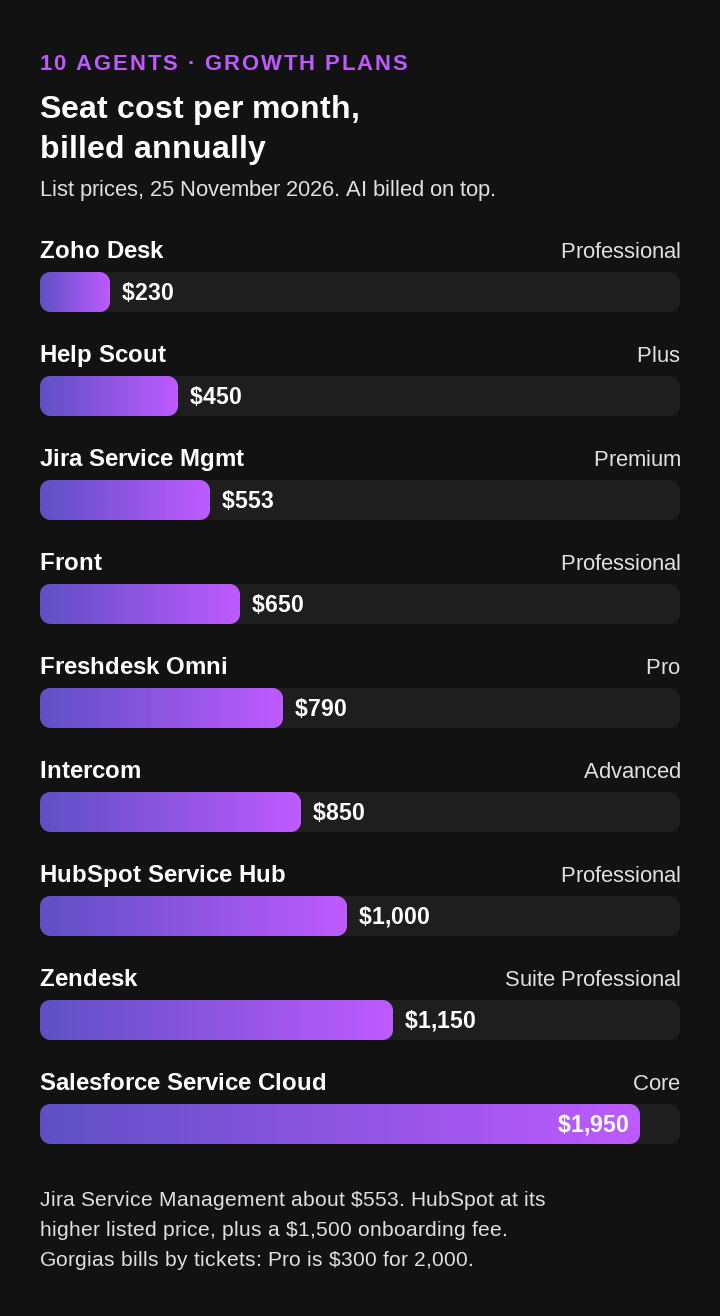
- Key data point: for 10 agents on growth plans, seats alone run from about $230 a month (Zoho Desk) to $1,950 (Salesforce Service Cloud Core). The AI agent is priced on top on nine of the ten, so model your volume in the calculator.
- Bottom-line advice: choose the help desk for channels and workflow, then choose the AI layer on its own merits. Run Pluno on your last 50 tickets before you pay for a help desk's own AI.
What is customer service software?
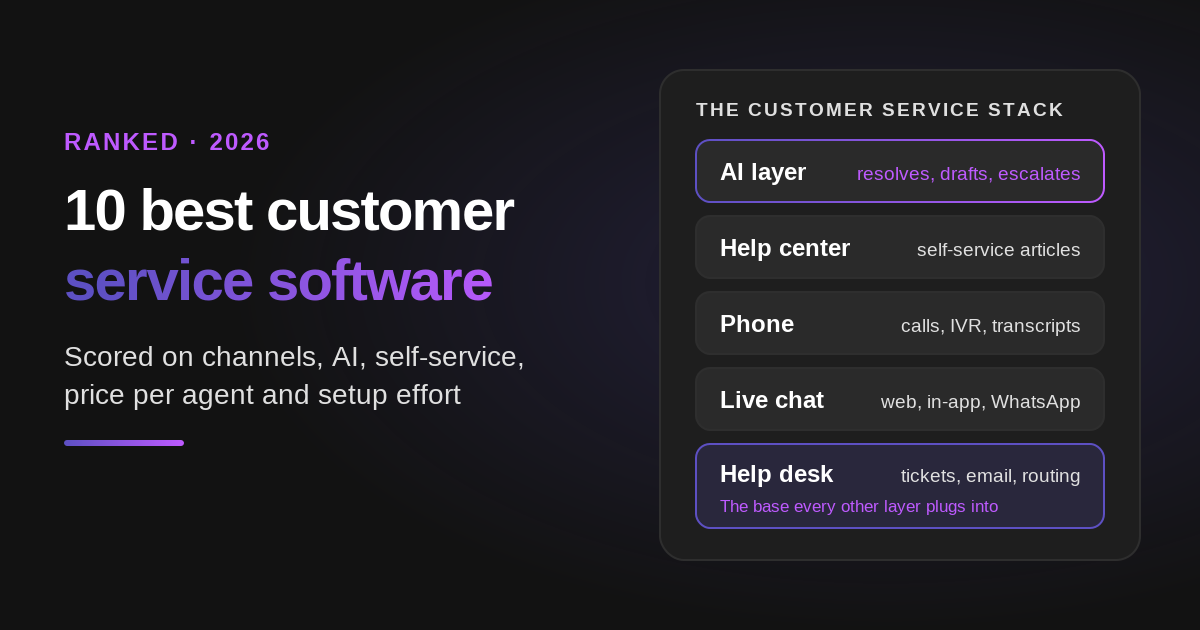
Customer service software turns customer questions from every channel into tracked conversations that a team can assign, answer and measure. At its core sits a help desk (tickets, email, routing and reporting). Around it sit live chat and messaging, phone, a help center for self-service and, now, an AI layer.
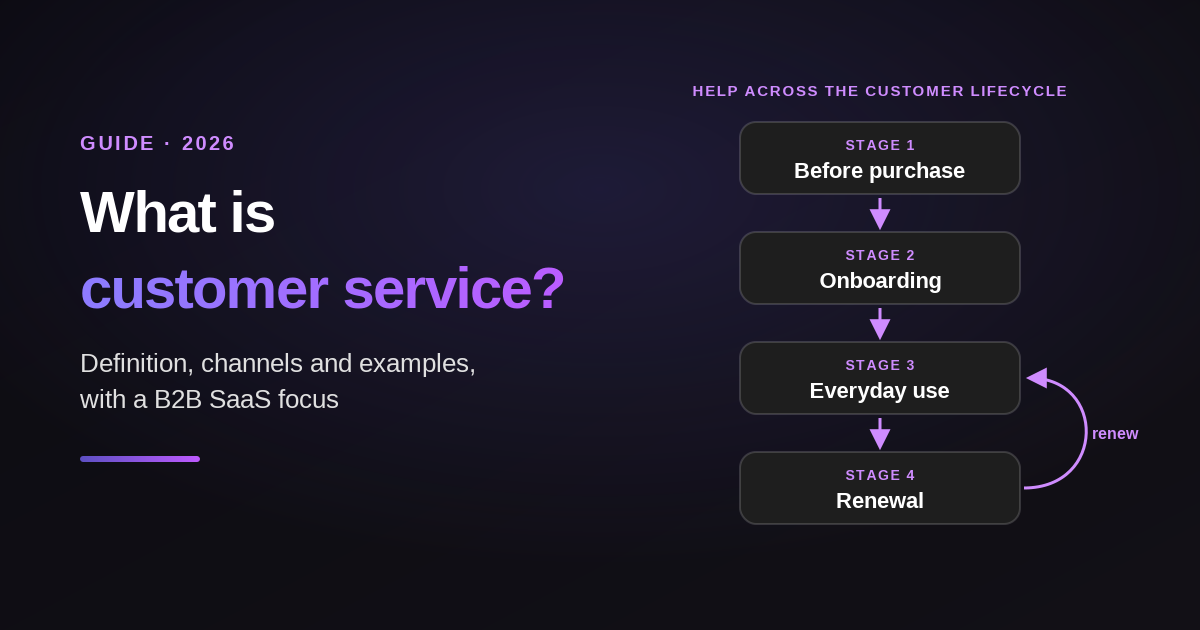
Most buyers don't need all five layers from one vendor. A ten-person B2B SaaS team may live in email and chat, while a consumer brand needs phone and WhatsApp on day one. If you're still defining what the team covers, my guide to what customer service is breaks down the channels and service types first.
Customer service software and customer support software mean the same thing in practice. Vendors use both terms for the same products, so I use them as one category here.
What to look for in customer service software
Look for five things before you compare prices. Each one maps to a yardstick in this review.
- Ticketing and routing: shared queues, assignment rules, SLAs and macros, so nothing gets lost when volume spikes.
- Channels your customers use: check which plan includes chat, WhatsApp or phone, not just whether the product offers them.
- A help center: articles customers can search, ideally in their language, on the plan you can afford.
- Reporting and integrations: first response time, resolution time and CSAT, plus connections to your CRM and the tools engineering uses.
- AI that bills only for resolutions: an AI agent that learns from your resolved tickets and doesn't charge for escalations. That's the bar Pluno is built to.
The best customer support software in 2026, compared
Zendesk and Help Scout lead on total score, but three platforms sit one point behind them. The gap is mostly price and channel coverage, so the table matters more than the rank.
| Rank | Platform | Channels | AI | Self-service | Price | Setup | Total | Growth plan, per agent/month (annual) |
|---|---|---|---|---|---|---|---|---|
| 1 | Zendesk | 5 | 4 | 5 | 2 | 4 | 20 | Suite Professional $115 |
| 2 | Help Scout | 3 | 4 | 4 | 4 | 5 | 20 | Plus $45 |
| 3 | Zoho Desk | 4 | 3 | 4 | 5 | 3 | 19 | Professional $23 |
| 4 | Intercom (Fin) | 4 | 4 | 4 | 3 | 4 | 19 | Advanced $85 |
| 5 | Gorgias | 3 | 4 | 3 | 4 | 5 | 19 | Pro $300 for 2,000 tickets |
| 6 | Freshdesk Omni | 4 | 3 | 4 | 3 | 4 | 18 | Pro $79 |
| 7 | Front | 3 | 4 | 3 | 3 | 4 | 17 | Professional $65 |
| 8 | HubSpot Service Hub | 4 | 4 | 3 | 2 | 3 | 16 | Professional $90 to $100 |
| 9 | Jira Service Management | 2 | 3 | 4 | 4 | 3 | 16 | Premium $55.28 |
| 10 | Salesforce Service Cloud | 3 | 4 | 3 | 1 | 1 | 12 | Core $195 |
Price points follow the 10-agent monthly bill on the growth plan: under $300 scores 5, $300 to $599 scores 4, $600 to $999 scores 3, $1,000 to $1,499 scores 2 and $1,500 or more scores 1. Ties are broken by channel coverage, then by price. Salesforce ranks last for the teams this list is written for (5 to 100 agents). For a large enterprise already running Salesforce CRM, its score on price and setup matters less. ServiceNow Customer Service Management is another option at that enterprise end.
The 10 best customer service software platforms, reviewed
Each review follows the same order: what it is, the five yardsticks, who it fits and what to watch.
1. Zendesk: best customer service software overall
Zendesk is the most complete all-channel help desk on this list. Email, messaging, voice, social messaging and a help center all come in one Suite plan.
- Channels (5/5): email on every plan. Messaging, native voice and social messaging start on Suite Team. Numbers, minutes and SMS cost extra.
- AI (4/5): AI agents are included on every plan with 5 automated resolutions per agent a month (10 on Suite Professional). Extra resolutions cost $1.50 committed or $2.00 pay-as-you-go. Copilot is $50 per agent a month, billed annually.
- Self-service (5/5): one help center on Suite Team, five on Suite Professional, plus community forums.
- Price (2/5): Support Team $19, Suite Team $55, Suite Professional $115 per agent a month, billed annually (Zendesk pricing).
- Setup (4/5): 14-day trial with Suite Professional features. IVR and skills-based routing need Suite Professional.
Best for: teams of 10 to 500 agents that need several channels and a deep app marketplace. Watch out for: add-ons. The AI resolutions, Copilot and voice usage are all billed on top of the seat. My Zendesk AI pricing breakdown works through that bill.
2. Help Scout: best for small, email-first teams
Help Scout keeps support feeling like email. Customers see a normal reply, not a ticket number, and agents learn it in an afternoon.
- Channels (3/5): email on every plan. Standard adds live chat, WhatsApp, Instagram and Messenger. SMS runs through an integration and phone through Aircall.
- AI (4/5): the Envoy AI agent costs $0.75 per resolution, billed monthly, with a spending cap available. New accounts get three months of free, unlimited Envoy resolutions.
- Self-service (4/5): multiple knowledge bases. An extra Docs site costs $20 a month, billed annually.
- Price (4/5): Standard $25, Plus $45 and Pro $75 per user a month, billed annually. Pro needs at least 10 users (Help Scout pricing).
- Setup (5/5): 15-day trial on Standard and Plus, no credit card. A free plan covers up to 5 users.
Best for: teams under 25 agents whose customers write emails. Watch out for: limits on lower plans, such as 2 inboxes and 1 basic SLA policy on Standard. My list of Help Scout alternatives covers when teams outgrow it, and my roundup of help desks built for SaaS teams adds options for technical support.
3. Zoho Desk: best on a tight budget
Zoho Desk is the cheapest full-featured option here, and it slots neatly into the rest of Zoho's apps.
- Channels (4/5): Express covers email, social and web forms. Standard adds live chat and messaging, including WhatsApp, Instagram, Messenger and Telegram. Telephony arrives on Professional through phone provider integrations.
- AI (3/5): AI agents run on your own model key or on Zoho's model, with up to 30 million free tokens a month from Standard up. Zia AI is built into Professional. No per-resolution price is listed.
- Self-service (4/5): a knowledge base from Standard, and a multilingual help center in over 40 languages on Professional.
- Price (5/5): Express $7, Standard $14, Professional $23 and Enterprise $40 per user a month, billed annually. A free plan covers three users (Zoho Desk pricing).
- Setup (3/5): 15-day trial with no credit card, but a dense admin with many settings to configure.
Best for: price-sensitive teams and companies already on Zoho CRM. Watch out for: the Standard plan's 5-user cap.
4. Intercom: best for chat-first SaaS teams
Intercom started as in-app chat and is now built around Fin, its AI agent. It fits software companies whose customers ask questions inside the product. The company renamed itself Fin in May 2026, and Salesforce completed its acquisition on September 10, 2026, so ask how pricing and the roadmap will change before you sign a multi-year term.
- Channels (4/5): every plan includes unlimited live chat, in-app chat, support email and a public help center. WhatsApp, SMS and phone are pay-as-you-go.
- AI (4/5): Fin AI Agent costs $0.99 per outcome ($1.99 for a Fin Voice outcome), charged at most once per conversation. Outcomes include Procedure handoffs, so some escalated conversations are billed too. Copilot is $29 per agent a month, billed annually.
- Self-service (4/5): a public help center on every plan. Multilingual and private help centers need Advanced.
- Price (3/5): Essential $29 (new customers $19), Advanced $85 and Expert $132 per seat a month, billed annually (Intercom pricing).
- Setup (4/5): 14-day free trial with no credit card. Monthly or annual self-serve on Essential and Advanced.
Best for: B2B SaaS and app teams with high chat volume. Watch out for: pricing model changes. One customer's quote in the reviews section below shows how a switch to seat pricing hit their bill. More in my Intercom pricing guide.
5. Gorgias: best for Shopify stores
Gorgias is built for e-commerce. It pulls orders from Shopify, WooCommerce and BigCommerce into each ticket, and says it powers customer conversations for 40% of Shopify brands.
- Channels (3/5): email, chat, social and a help center on every plan. Voice and SMS are paid add-ons with no published price. WhatsApp isn't listed.
- AI (4/5): the AI Agent costs $0.90 per automated interaction on an annual contract or $1.00 monthly, and $1.50 above the plan's allowance. Each automated interaction also counts as a help desk ticket.
- Self-service (3/5): a help center on every plan.
- Price (4/5): priced by ticket volume, never per agent. Basic is $50 a month for 300 tickets and Pro $300 for 2,000 tickets, billed annually (Gorgias pricing).
- Setup (5/5): a 7-day trial and a Shopify connection in minutes.
Best for: Shopify brands with order-status and returns volume. Watch out for: busy seasons, because every extra ticket costs money. My Gorgias alternatives post covers other e-commerce help desks.
6. Freshdesk Omni: best value across channels
Freshdesk comes in two products. Plain Freshdesk is email-based support with a portal and knowledge base. Freshdesk Omni adds the web widget and messaging, so it's the one to compare here.
- Channels (4/5): Omni includes email, the web chat widget, WhatsApp, Facebook Messenger, Instagram and LINE. Phone is a paid Voice add-on from $15 per agent a month, billed annually.
- AI (3/5): Freddy AI Agent includes 500 sessions once per account, then costs $49 per 100 sessions. A session is a 72-hour window, so you pay for conversations, not resolutions. Freddy AI Copilot is $29 per agent a month on Pro and Enterprise.
- Self-service (4/5): a portal and knowledge base on every plan.
- Price (3/5): Omni Growth $29, Pro $79 and Enterprise $119 per agent a month, billed annually. Plain Freshdesk starts at $19 (Freshdesk pricing).
- Setup (4/5): 14-day trial and a clean admin. Skill-based routing and a sandbox need Enterprise.
Best for: small and mid-size teams that want chat and messaging for less than Zendesk. Watch out for: session billing, which charges for escalated conversations too. The Freshdesk pricing guide runs the numbers.
7. Front: best for shared inboxes and account teams
Front looks like a shared email inbox and works like a help desk. Account managers and support agents can work the same conversations.
- Channels (3/5): Starter is limited to one channel type (email, live chat, SMS or Slack). Professional adds Facebook, Instagram and X. WhatsApp is an add-on and phone runs through integrations such as Aircall or Dialpad.
- AI (4/5): Autopilot costs $0.89 per resolution or $0.39 per handoff. Copilot is $20 per seat a month, included on Enterprise.
- Self-service (3/5): a basic knowledge base on Starter, customizable on Professional.
- Price (3/5): Starter $25, Professional $65 and Enterprise $105 per seat a month, billed annually (Front pricing).
- Setup (4/5): 14-day trial with no credit card. Contracts over $25,000 need an onboarding package.
Best for: B2B teams where support and account management share customers. Watch out for: the single-channel Starter plan. See how it stacks up in Front vs Zendesk.
8. HubSpot Service Hub: best if your CRM is HubSpot
HubSpot Service Hub puts tickets on the same contact record as marketing and sales. That's its main reason to exist.
- Channels (4/5): live chat, email and Facebook Messenger on every plan. Calling minutes are included (500 on Starter, 3,000 on Professional). WhatsApp needs Professional.
- AI (4/5): Customer Agent costs $0.50 per resolution, paid in HubSpot Credits, and needs Professional or Enterprise. Professional includes 3,000 credits a month.
- Self-service (3/5): the knowledge base starts on Professional.
- Price (2/5): Starter from $7 to $20 and Professional from $90 to $100 per seat a month, depending on billing and new-customer discounts. Professional adds a required $1,500 onboarding fee (HubSpot pricing).
- Setup (3/5): the onboarding fee signals a guided setup, and the CRM data model takes planning.
Best for: teams whose sales and marketing already run on HubSpot. Watch out for: the jump from Starter to Professional for the knowledge base and AI. My review of HubSpot AI agents covers the AI side.
9. Jira Service Management: best when support and IT share Atlassian
Jira Service Management is Atlassian's service desk. It suits B2B and technical teams whose escalations end up in Jira anyway.
- Channels (2/5): a customer portal, email, chat, Microsoft Teams, Slack and an embedded widget. No native phone, social or WhatsApp.
- AI (3/5): the virtual service agent needs Premium. It includes 1,000 assisted conversations a month, then starts at $0.30 each, counted whether it resolves or escalates.
- Self-service (4/5): an embedded knowledge base on every plan, and a custom-branded help center from Standard.
- Price (4/5): free for 3 agents. Standard from about $21.50 and Premium from about $55.28 per agent a month (Jira Service Management pricing). Atlassian starts usage-based billing on December 3, 2026, so check the page before you budget.
- Setup (3/5): powerful workflows, but they take an admin who knows Jira.
Best for: internal service desks and technical B2B support. Watch out for: consumer-facing teams, which will miss phone and social channels.
10. Salesforce Service Cloud: best for enterprises on Salesforce CRM
Salesforce Service Cloud is the deepest option for large contact centers with complex case processes and Salesforce data.
- Channels (3/5): web chat is included on Advanced. Enhanced messaging (+$75 per user a month), phone (Service Cloud Contact Center) and the help center are add-ons on most editions.
- AI (4/5): Agentforce costs $2 per conversation, or Flex Credits at $500 per 100,000 credits (20 credits per action, about $0.10). An Agentforce Service add-on costs $150 per user a month (Agentforce pricing).
- Self-service (3/5): help center articles (Salesforce Knowledge) and customer communities are add-ons.
- Price (1/5): Starter Suite $25, Pro Suite $100, Core $195, Advanced $395 and Max $550 per user a month, starting prices (Salesforce Service Cloud pricing).
- Setup (1/5): most teams need a Salesforce admin or partner to configure it.
Best for: enterprises with hundreds of agents already on Salesforce. Watch out for: the add-on stack. My Agentforce pricing guide breaks down the AI bill.
What customer service software costs for a 10-agent team
For a 10-agent team on growth plans, seats alone cost from about $230 to $1,950 a month. The bigger swing comes from the AI agent, because nine of the ten platforms charge for it per resolution, conversation or session on top of the seat.
| Platform | Growth plan | 10 seats a month (annual) | AI agent unit price |
|---|---|---|---|
| Zoho Desk | Professional | $230 | Your own model key, or 30M free Zoho tokens |
| Help Scout | Plus | $450 | $0.75 per resolution |
| Jira Service Management | Premium | about $553 | $0.30 per assisted conversation after 1,000 |
| Front | Professional | $650 | $0.89 per resolution |
| Freshdesk Omni | Pro | $790 | $49 per 100 sessions |
| Intercom (Fin) | Advanced | $850 | $0.99 per outcome |
| HubSpot Service Hub | Professional | $900 to $1,000, plus $1,500 onboarding | $0.50 per resolution in credits |
| Zendesk | Suite Professional | $1,150 | $1.50 per resolution after included ones |
| Salesforce Service Cloud | Core | $1,950 | $2 per conversation |
| Gorgias | Pro | $300 for 2,000 tickets (no seat price) | $0.90 per automated interaction |
Pluno as the AI layer: on Zendesk, Intercom, Salesforce Service Cloud, HubSpot, Jira Service Management or Freshdesk, Pluno replaces the AI agent column above. It costs a platform fee from €210 a month, billed annually, plus €0.90 per resolved ticket, and escalations are never billed.
Move the sliders to price your own team. The calculator uses the same list prices as the table.
Customer service software cost for your team
US list prices per agent a month, billed annually, from each vendor's pricing page on 25 November 2026. AI uses each vendor's published unit price: Zendesk $1.50 per automated resolution after the included ones, Intercom Fin $0.99, Help Scout Envoy $0.75, Freshdesk $49 per 100 Freddy sessions (one session per AI conversation assumed, and the one-time 500 free sessions left out because they don't recur), Front Autopilot $0.89, HubSpot Customer Agent 50 credits at $0.01 after 3,000 included (Professional only), Jira Service Management $0.30 per assisted conversation after 1,000 included (Premium only) and Salesforce $2 per conversation. Zoho Desk AI runs on your own model key or Zoho's token allowance, so your model cost is not included and Zoho is left out of the lowest and highest bill. Plans without an AI agent are left out too. Pluno, the AI layer for six of these help desks, is priced in euros separately: a platform fee from 210€ a month, billed annually, plus 0.90€ per resolved ticket. HubSpot shows the higher of its two listed seat prices. Excludes onboarding fees, phone minutes, add-ons, Gorgias (priced by ticket volume) and taxes.
Zoho Desk (Professional)
$230
$230 seats + AI on your own model key (model cost not included)
Jira Service Management (Premium)
$553
$553 seats + $0 AI
Help Scout (Plus)
$825
$450 seats + $375 AI
Freshdesk Omni (Pro)
$1,035
$790 seats + $245 AI
Front (Professional)
$1,095
$650 seats + $445 AI
HubSpot Service Hub (Professional)
$1,220
$1,000 seats + $220 AI
Intercom (Advanced)
$1,345
$850 seats + $495 AI
Zendesk (Suite Professional)
$1,750
$1,150 seats + $600 AI
Salesforce Service Cloud (Core)
$2,950
$1,950 seats + $1,000 AI
Among plans with a priced AI agent, Jira Service Management is the lowest monthly bill for 10 agents at $553 and Salesforce Service Cloud the highest at $2,950. Price is one yardstick of five: check which channels each plan really includes before you shortlist.
Two things change the result more than the seat price. First, check what counts as a billable AI event: a resolution, an outcome, a session or any assisted conversation. Second, check whether escalated conversations are billed. Your cost per ticket is the number to watch after launch, not the list price.
Customer support tools by layer: what each platform covers
Customer support tools fall into five layers, and no vendor on this list is best at all of them. The table shows what each platform includes natively on its main plans, according to its pricing page.
| Platform | Live chat and messaging | Phone | Help center | Built-in AI agent | |
|---|---|---|---|---|---|
| Zendesk | Yes | Suite Team and up | Native, Suite Team and up (usage billed) | Yes | Yes |
| Intercom (Fin) | Yes | Yes (WhatsApp pay-as-you-go) | Native, pay-as-you-go | Yes | Fin |
| Help Scout | Yes | Standard and up | Via Aircall | Yes | Envoy |
| Freshdesk Omni | Yes | Yes | Paid add-on | Yes | Freddy |
| Zoho Desk | Yes | Standard and up | Via providers, Professional | Standard and up | Yes, own key or Zoho tokens |
| Gorgias | Yes | Yes (no WhatsApp) | Paid add-on | Yes | Yes |
| Front | Yes | Professional for several channels | Via integrations | Yes | Autopilot |
| HubSpot Service Hub | Yes | Yes (WhatsApp on Professional) | Included minutes | Professional and up | Customer Agent, Professional |
| Jira Service Management | Yes | Chat, Slack and Teams | No | Yes | Premium |
| Salesforce Service Cloud | Yes | Add-on on most editions | Add-on | Add-on | Agentforce |
Email and a help center are table stakes. Phone is where the platforms split: Zendesk, Intercom and HubSpot run calls natively (HubSpot includes minutes, while Zendesk and Intercom bill usage), and the rest rely on a partner tool or a paid add-on.
The AI column needs a closer look than the others. Most built-in agents answer from your help center articles. Fewer learn from your resolved tickets or look up live account data before they reply, and that's where complex tickets get stuck. For a deeper comparison of the AI side, see my guide to AI customer service software.
How to choose customer service software in 5 steps
Choose customer service software by working from your channels and systems to the price, not the other way round. These five steps take about a week for a team of 10 to 50 agents.
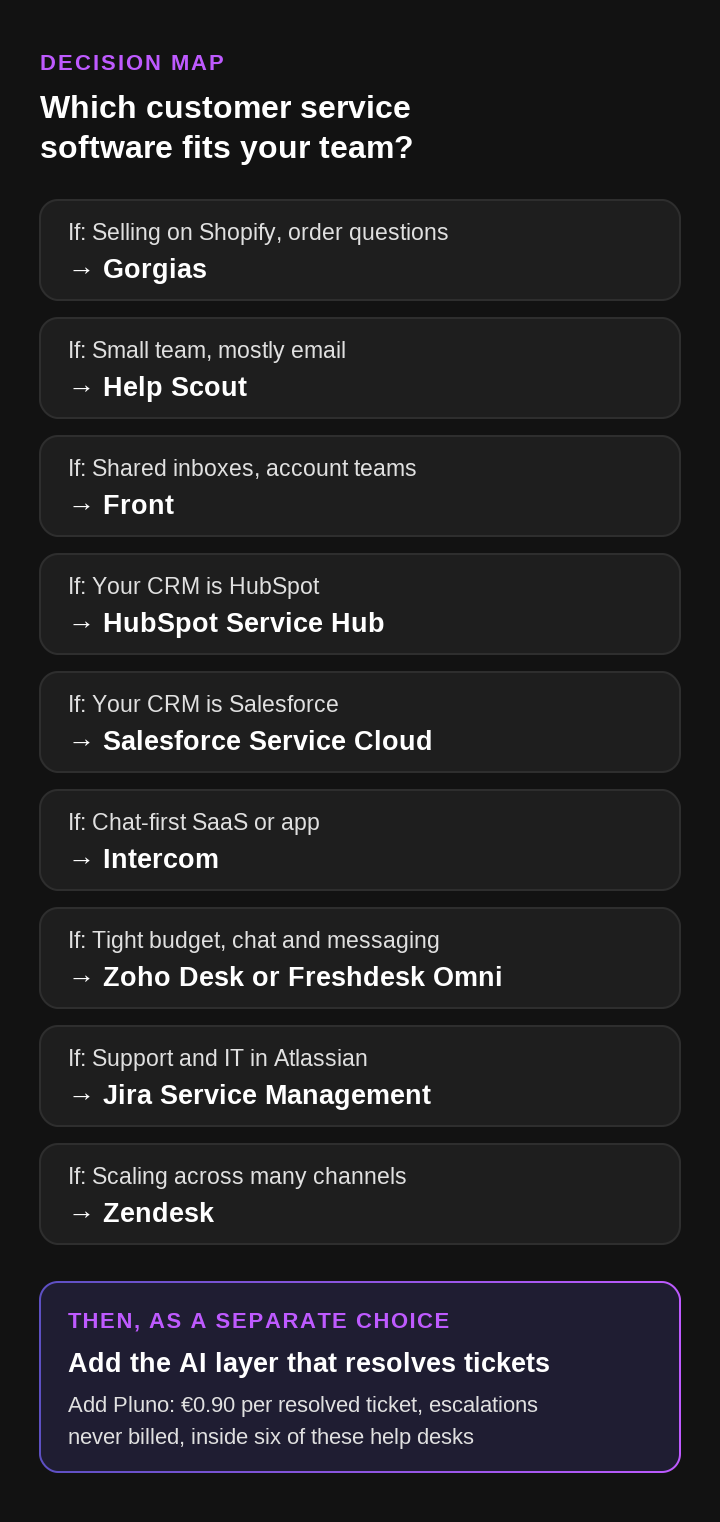
- List your channels by volume. Pull last quarter's tickets by channel. If phone is over 20% of volume, shortlist only platforms with native voice or a voice add-on you're happy to pay for.
- Name the system of record. If sales lives in HubSpot or Salesforce, start with their service products. If engineering lives in Jira, look at Jira Service Management.
- Price three plans at your real seat count. Use the calculator above with growth plans, because entry plans usually lack SLAs, routing or the help center you need.
- Price the AI separately. Ask each vendor what triggers a charge and whether escalations are billed. Then compare that with an AI layer that runs inside the help desk you pick.
- Test on real tickets. Every vendor here offers a trial or a free plan. Import a week of tickets and time how long an agent takes to answer ten of them.
Switching later is expensive, as one founder says below, so step 5 is the one to protect. Migrating help center articles and chat settings is the hidden cost, not the license.
What support teams say about their help desks
These comments come from Hacker News threads where founders and support leads discuss their help desks. They're individual views, not a survey, but they show the trade-offs that pricing pages leave out.
“Per agent/user pricing (zendesk/freshdesk/helpscout etc) really adds up for a startup/smaller teams and I would encourage you to consider flat rate pricing with limits of different types.”
“Zendesk is pretty powerful between its well documented API and native ‘triggers’, and also its new reporting and dashboard tool, but it is pricey for enabling extras. ... I need to pay for Talk just to access the pop-up API.”
“Switching cost is more than you think. For example, I don't like Zendesk it's expensive and over-engineered. But I stick to it because I know how hard it is to port my docs over and re-setup the live chat.”
“Our company has been using Intercom for customer support for the last 7 years. ... we would be forcibly migrated to seat-based pricing ... With our current usage of their product, this will result in us paying 3 to 4 times our current expenditure.”
The common thread is cost that grows with seats, extras and pricing changes, and the work of moving help center articles and chat settings when you switch. Both are reasons to keep the AI decision separate from the help desk decision.
The best AI layer for your customer service software: Pluno
Pluno is an AI agent for complex support that runs inside Zendesk, Intercom, Salesforce Service Cloud, HubSpot, Jira Service Management and Freshdesk. You keep the help desk your team knows, and Pluno replaces its built-in AI agent to handle the tickets that a help center article alone can't answer. More than 200 companies use it, and it has processed over 5 million tickets.
| Pluno | Typical built-in AI agent | |
|---|---|---|
| Where answers come from | Your resolved tickets, help center and connected systems | Often help center articles first |
| What you pay for | Resolved tickets only, €0.90 each | Outcomes, sessions or conversations, some including escalations |
| Help desk lock-in | One AI layer across six help desks | Tied to one help desk |
Here's what that means against this post's yardsticks:
- Channels: Pluno works the channels your help desk already runs: email, web forms, chat and messaging (including WhatsApp and the web widget), plus phone calls through transcripts and call summaries.
- AI: Deflection AI learns from your past tickets, help center and connected systems, then replies only when its sources agree. When it can't resolve a ticket, it escalates with a research summary. AI Copilot drafts replies for agents to approve, and Escalation Copilot sends engineering issues to the tool your engineering team already uses, such as Slack, Jira, Linear, Microsoft Teams or incident.io.
- Self-service: your help center stays where it is, and Pluno uses it as one of its sources, together with resolved tickets that never became articles.
- Price: a platform fee from €249 a month (€210 a month, billed annually) for up to 500 tickets, plus €0.90 per resolved ticket. Escalations are never billed and a reopened ticket isn't billed again (Pluno pricing).
- Setup: a 14-day free trial with full access to every module and no credit card. Pluno is SOC 2 Type 2 certified, which shortens security review.
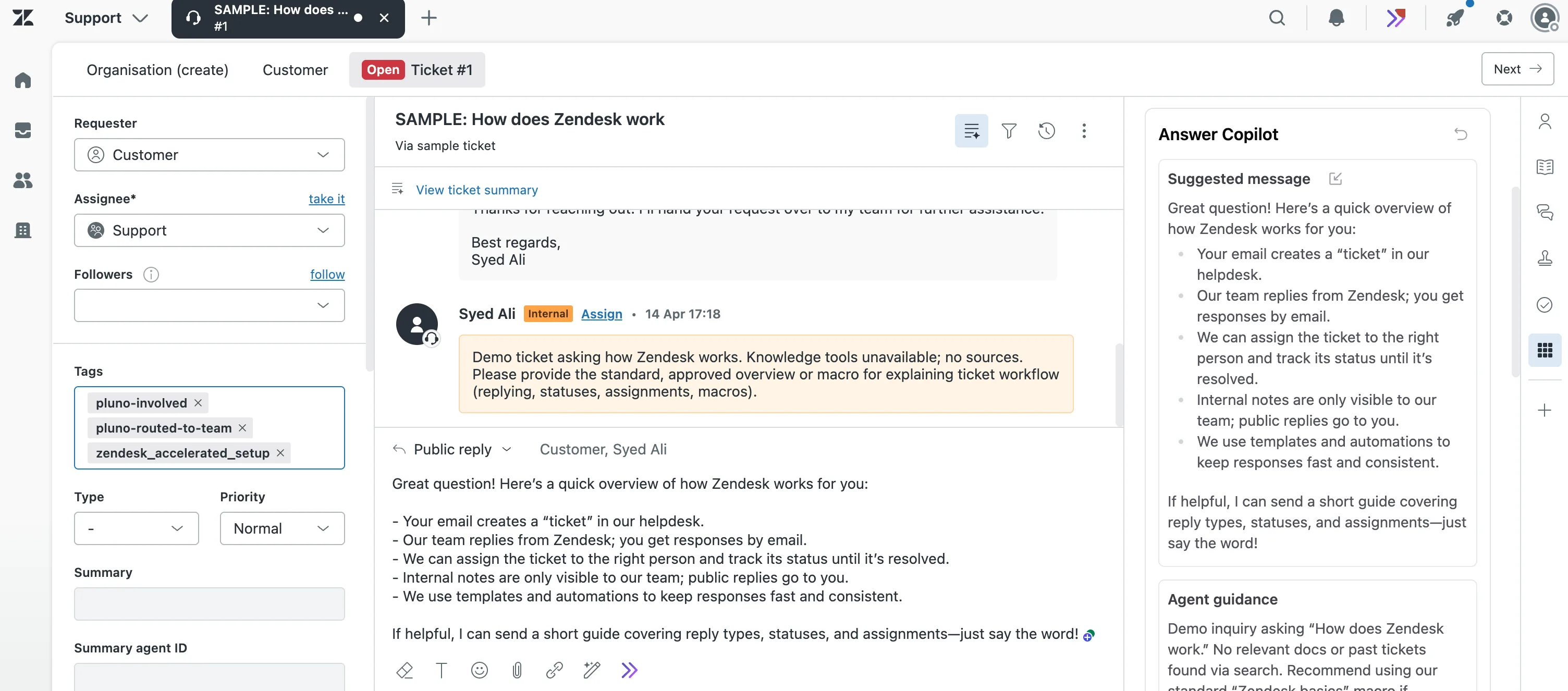
The billing difference adds up. Zendesk bills $1.50 to $2.00 per automated resolution beyond the included ones, Freshdesk and Jira Service Management bill escalated conversations too, and Salesforce bills $2 per conversation. Pluno bills €0.90 only for tickets it resolves, and never for escalations.
The results are why teams add it. Across Deflection AI customers, the average resolution rate is 65% and the average agent time saved is 48% (customer averages, November 2026). Innovorder reports 67% of chat tickets resolved by AI, and at Velotric the AI agent handles 58% of the tickets routed to it. As Innovorder put it: "Setup took under one hour. We connected Zendesk, added guidelines, and auto-replies started immediately."
With Pluno, the AI decision no longer locks you into a help desk, and the help desk decision no longer limits your AI. For more AI-first options, see my review of AI help desk software.
The bottom line
The best customer service software for most growing support teams is Zendesk, for its channel depth and help center. Help Scout wins for small email-first teams, Zoho Desk on price, Intercom for chat-first SaaS and Gorgias for Shopify stores.
Whichever you pick, treat the AI agent as a separate decision and add Pluno as the AI layer. The help desk decides where tickets live. Pluno decides how many of them your team still has to answer, and bills only for the ones it resolves.
FAQ
What is the best customer service software?
Zendesk is the best customer service software for most growing teams in 2026, scoring 20 of 25 on channels, AI, self-service, price and setup, tied with Help Scout. Zoho Desk, Intercom and Gorgias follow with 19 each. For the AI agent on top, Pluno runs inside six of these help desks and bills only for resolved tickets. The right pick depends on your channels: Gorgias fits Shopify stores, and HubSpot Service Hub fits teams already on HubSpot CRM.
What is the best customer support software for small businesses?
Help Scout and Zoho Desk are the best customer support software for small businesses. Help Scout has a free plan for up to 5 users and Standard at $25 per user a month, billed annually. Zoho Desk has a free plan for three users and Standard at $14.
What software is used for customer service?
Most teams use a help desk such as Zendesk, Freshdesk, Intercom or Help Scout as the core of their stack. Many add live chat, a phone system, a help center and an AI agent, either from the same vendor or as separate customer support tools.
What are the best customer support tools besides a help desk?
The best customer support tools beyond the help desk are a phone system (such as Aircall or Dialpad), a help center, a quality assurance tool and an AI layer like Pluno that resolves, drafts and escalates tickets inside the help desk. Pick them after the help desk, so they integrate with it.
How much does customer service software cost?
Customer service software costs from about $7 to $550 per agent a month, billed annually, across the ten platforms here. A 10-agent team on growth plans pays about $230 to $1,950 a month for seats, plus AI usage that most vendors bill per resolution or conversation.
Is there free customer service software?
Yes. Zoho Desk (three users), Help Scout (five users), HubSpot Service Hub (two users) and Jira Service Management (three agents) all have free plans. Free plans limit channels, inboxes or automation, so most teams upgrade once they pass a handful of agents.
Which customer service software uses AI?
All ten platforms here offer an AI agent, but they price it differently: per resolution (Zendesk, Help Scout, Front, HubSpot), per outcome (Intercom), per automated interaction (Gorgias), per session (Freshdesk), per assisted conversation (Jira Service Management), per conversation (Salesforce) or through your own model key (Zoho Desk). Pluno runs inside six of them, Zendesk, Intercom, Salesforce Service Cloud, HubSpot, Jira Service Management and Freshdesk, and bills only for resolved tickets.
Is customer service software the same as CRM?
No. Customer service software manages tickets and conversations, while a CRM manages customer and deal records. HubSpot Service Hub and Salesforce Service Cloud combine both, which helps if your sales team already uses that CRM.