You have outgrown the shared inbox, or the help desk you bought two years ago is now fighting you, and somebody wants a shortlist by Friday. This is that shortlist, with the pricing worked out.
A SaaS help desk is customer support software built for the way software companies support their customers: conversations threaded by account instead of by requester, technical tickets that need engineering escalation, and channels that include Slack and in-app messaging alongside email.
Most shortlists miss that you are making two purchases. The first is the help desk, which decides where tickets live and what an agent works in. The second is the AI layer that resolves tickets without a human, which seven of the nine price separately from the seat and which is where the bill lands. A $19 seat with a $2 resolution rate behind it is not a $19 seat.
The wrong choice is expensive to reverse, because migrating ticket history, macros and integrations costs more than the licence ever did, and the team absorbs the disruption while the queue keeps filling.
Pluno publishes this article. It is an AI support agent for complex technical tickets, not a help desk, so it is not one of the nine below and has its own section after them.
TL;DR
-
Already on Zendesk and staying: Zendesk has the deepest ecosystem and the best reporting here. Watch the AI line, billed on resolutions at an unpublished rate.
-
Product-led SaaS, support happens in the app. Fin, formerly Intercom. The in-app messenger is still the best here.
-
Under ten seats, email-heavy: Help Scout. Fastest to adopt, free for five users.
-
Slack-first B2B support: Pylon. Built for it, with accounts as the unit of work. Entry cost is the highest here.
-
Engineering-adjacent support teams. Plain. Developer-shaped, and Ari is in the plan price.
-
Budget-constrained: Zoho Desk. Three free agents, then $7 a seat with Zia bundled.
-
Already running HubSpot: Service Hub, so the CRM record and the ticket sit together.
-
Want Zendesk's shape for less per seat. Freshdesk. The first 500 Freddy sessions are free on every plan, though it bills per session.
-
Several people work the same customer thread. Front. Shared inbox with account threading, and Autopilot is the lowest published AI rate here at $0.05 a conversation.
Nine tools, six different billing units for the AI, and two that fold it into the plan. The seat price is the smaller number for most teams. If your bottleneck is the AI layer, that is a second purchase, covered after the nine.
What is a SaaS help desk?
A SaaS help desk is customer support software designed around how software companies receive support requests, which differs from how a retailer or a bank receives them.
The difference that matters is the shape of the customer. In consumer support, one person files one ticket about one order. In B2B SaaS, your customer is a company. Five people from one account might contact you in a week about billing, a failed integration and onboarding: three tickets, one relationship. A tool that cannot show you the account behind the ticket will let you resolve all three and still miss that the account is in trouble, a point DragApp made well in July 2026.
Two more things separate SaaS support from the general case. The tickets are technical, so an agent often needs logs, account state or an API response to answer at all. And many are bugs, so the tool has to hand off to engineering and bring an answer back.
"SaaS help desk" also gets used to mean any cloud-hosted help desk, which described something real fifteen years ago and describes every tool here today. This piece uses the fit meaning, because that is the one that changes your shortlist.
What matters when a SaaS team picks a help desk
Six things decide it, and only two show up on a feature comparison page.
1. Account threading. Can an agent opening a ticket see the rest of that customer company's history without going looking for it? Test it: have three people from one test account file three tickets and see whether the tool shows you an account or three strangers.
2. Your busiest support channel. Slack, in-app messaging, email, a community forum. A tool that treats Slack as an integration behaves differently from one built around it, and the difference shows up in whether your team lives in the help desk or in Slack. Test it: run your busiest channel through the trial, never the easiest.
3. Engineering escalation. What happens when the ticket is a bug. Does the handoff to Jira or Linear carry the context an engineer needs, and does the answer come back to the customer without someone chasing it. Test it: escalate a real bug and time the round trip.
4. Technical ticket depth. Whether an agent can hold logs, screenshots, account configuration and API errors in one place. Help desk ticketing software built for order status handles this badly. Test it: paste a stack trace into a ticket and see what happens.
5. What the AI costs and what triggers the charge. Seven of the nine bill the AI separately, and a resolution, an outcome, a session and a conversation are four different billable events. Test it: get the vendor's definition of a billable event in writing.
6. Total cost at your real seat count, including minimums. Plain's mid-tier is priced for three seats. Front's Starter caps at ten. HubSpot Enterprise is reported to carry a ten-seat minimum, putting a $1,500 monthly floor under a $150 headline. Test it: multiply by your actual headcount and add the AI before comparing anything.
SaaS help desk software comparison
Figures for Zendesk, Fin, Help Scout, Freshdesk, Front, Plain and HubSpot were read from each vendor's own pricing page on 26 August 2026. Pylon publishes no pricing and Zoho's page serves local currency; both are labelled below.
| Tool | Starting seat price | What the AI costs on top | Free tier | Best for |
|---|---|---|---|---|
| Zendesk | Support Team $19; Suite Team $55; Suite Professional $115 per agent/mo, annual | Automated resolutions, rate not published. Copilot $50/agent/mo | Trial only | Deepest ecosystem and best reporting |
| Fin (formerly Intercom) | $29 / $85 / $132 per seat/mo, annual | From $0.99 per outcome. A reported $49.50 standalone minimum is not on Intercom's pricing page. Copilot $29/seat/mo | Trial only | Product-led SaaS, support inside the app |
| Help Scout | $25 / $45 / $75 per user/mo, monthly billing (annual ~16% less) | AI Answers $0.75 per resolution, free for 3 months on new accounts | Free, 5 users | Small teams who want to be live this week |
| Freshdesk | $19 / $55 / $89 per agent/mo, annual | First 500 Freddy sessions free, then $49 per 100 ($0.49 a session). Copilot $29/agent/mo | Free Program, 2 agents, 6 months | Zendesk's shape at a lower seat price |
| Front | $25 (max 10 seats) / $65 (max 50) / $105 per seat/mo, annual | Autopilot from $0.05 per conversation. Copilot $20, Smart QA $20, Smart CSAT $10 per seat/mo | Trial only | Several people working one thread |
| Pylon | Reported $59 / $89 / $139 per seat/mo, annual. Not published by Pylon | Reported: AI Assistants $50 per seat/mo, AI Agents from $100/mo | Trial only | Slack-first B2B, accounts built in |
| Plain | Foundation $35 per seat/mo; Horizon $299/mo for 3 seats then $99 each, monthly ($269 yearly) | Ari included in the plan, capped by a credit allowance (2,000 or 15,000/mo) | 7-day trial, no card | Engineering-adjacent teams, AI in the price |
| Zoho Desk | 7 / 14 / 23 / 40 per agent/mo, annual. Page serves local currency | Zia AI included from Professional, no separate charge | Free, 3 agents | Teams optimising hard on cost |
| HubSpot Service Hub | Starter $7; Professional $90 per seat/mo, annual; Enterprise quoted, reported at about $150 | 50 credits per resolved conversation, $0.50 ($0.45 annual prepay) | Free, 2 users | Teams already on HubSpot CRM |
Prices vary by region, billing term and packaging, so treat every figure as the start of a quote.
These AI rates are not directly comparable. Seven of the nine bill separately, across six models: per resolution, per outcome, per session, per conversation, in credits against a monthly allowance, and per seat with a monthly floor. Zoho and Plain include theirs in the plan. Compare the definitions before you compare the numbers.
The 9 best SaaS help desk tools in 2026
Each entry covers what the tool is, what it does well for a SaaS team, where it falls short and what it costs including the AI.
1. Zendesk
Best for teams who need the deepest ecosystem and the best reporting.
What it is. The category default, and the tool most readers are already on or evaluating. Ticketing, help centre, messaging, voice and analytics as one suite.
What it does well for a SaaS team. The app marketplace is the largest here, which matters when your stack is unusual. Explore is among the deepest reporting of the nine once your fields and groups are set up. Multi-brand handles companies with more than one product cleanly, and hiring a Zendesk admin is easier than for anything else here.
Where it falls short. Many pricing analyses point to cost predictability once the AI is on, because Zendesk bills automated resolutions and does not publish the rate. And the configuration surface is large enough that a five-person team will spend weeks on setup they did not budget for.
What it costs. The ladder mixes two products. Support Team is $19 per agent per month paid yearly and covers ticketing without the knowledge base or messaging. Suite Team is $55 and Suite Professional is $115; Suite Enterprise is quote-only. AI agents are included on both families and billed on automated resolutions, with no published rate. Copilot is $50 per agent per month. See what Zendesk's automated resolutions cost and Zendesk against Intercom.
2. Fin (formerly Intercom)
Best for product-led SaaS where support happens inside the app.
What it is. Intercom rebuilt itself around its AI agent and now trades as Fin. Salesforce agreed to acquire it in June 2026 for roughly $3.6 billion, a deal not yet closed and worth knowing before signing a multi-year contract.
What it does well for a SaaS team. The in-app messenger is still the best in the category, which suits products where the support conversation and the product session are the same one. Fin also runs standalone on a help desk you already have, so you can test the AI without migrating.
Where it falls short. Outcome billing is harder to forecast than a seat price, because your bill moves with your volume, and the seat prices are the highest of the mainstream three. Procedures, the natural-language SOPs that let Fin handle anything past a documented answer, and Custom Actions, the API calls it makes mid-conversation, are both written and maintained by hand. On a B2B edge-case list that changes every sprint, that maintenance lands on the team already behind on the help centre.
What it costs. Seats at $29, $85 and $132 per seat per month. Fin from $0.99 per outcome. A 50-outcome monthly minimum of $49.50 for standalone use is widely reported but does not appear on Intercom's pricing page, so confirm it in your quote. Copilot is $29 per seat per month on intercom.com/pricing, with 10 complimentary conversations per agent; fin.ai/pricing lists it at $35, so confirm which applies. More in how Fin's per-outcome pricing works.
3. Help Scout
Best for small teams who want to be live this week.
What it is. A shared-inbox help desk that stayed deliberately simple while the rest of the category added surface area.
What it does well for a SaaS team. Setup takes an afternoon and agents need almost no training, which is the whole proposition. The free tier covers five users properly, so a small team can run on it indefinitely. Docs, its knowledge base product, is usable without a designer.
Where it falls short. Account-level structure is thinner than Pylon's or Front's, so a five-person customer with three open tickets shows up as three tickets and no account. Routing and workflow options run out past twenty or so agents, which is where teams move to Zendesk. And AI Answers has no free allowance after three months, so $0.75 applies from month four on every deflected ticket.
What it costs. Free for 5 users. Standard $25, Plus $45, Pro $75 per user per month on monthly billing, with annual billing about 16% cheaper. AI Answers is $0.75 per resolution, free for the first three months on new accounts.
4. Freshdesk
Best for teams who want Zendesk's shape at a lower seat price.
What it is. Freshworks' help desk, structurally similar to Zendesk and consistently cheaper per seat.
What it does well for a SaaS team. The price gap against Zendesk holds across every tier. Automation and SLA management are solid at the mid-tier, where most competitors gate them to enterprise. And the first 500 Freddy AI Agent sessions are included on every plan, the most generous AI allowance here.
Where it falls short. The AI bills per session, so on a hard technical queue you pay for attempts that did not land. Ask Freshworks in writing what closes a session before you model it. Reporting is a step behind Zendesk's.
What it costs. Growth $19, Pro $55, Enterprise $89 per agent per month billed annually. Freddy AI Agent includes the first 500 sessions on every plan, then $49 per 100, or $0.49 a session. Freddy AI Copilot is $29 per agent per month on Pro and Enterprise. See also Freshdesk and Zendesk compared.
5. Front
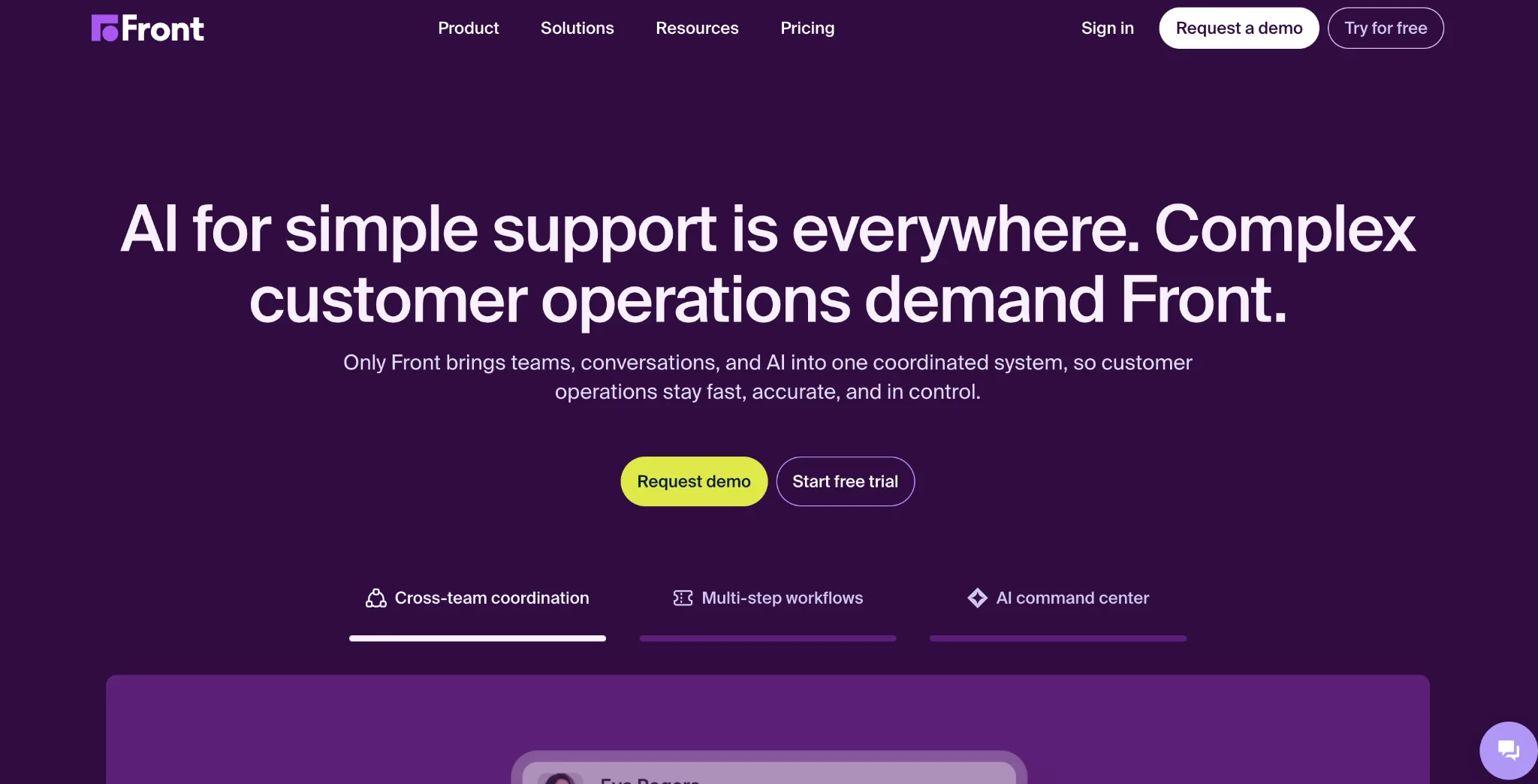
Best for collaborative inboxes where several people work one thread.
What it is. A shared inbox that behaves like email, threading conversations by contact and account with comments and assignments on top.
What it does well for a SaaS team. Internal collaboration is the strongest part of the product. Commenting on a draft before it goes out, or looping in a solutions engineer mid-thread, feels native. Threading by account is closer to the SaaS shape than a pure ticket queue, and Autopilot's per-conversation rate is the lowest published AI price here.
Where it falls short. Below Enterprise, Copilot, Smart QA and Smart CSAT are each priced separately, so a Professional seat with all three is $65 plus $45 with the QA and CSAT bundle, or $65 plus $50 without. And a shared inbox is a different mental model from a ticket queue, which some teams find harder to report on.
What it costs. Starter $25 per seat per month up to 10 seats, Professional $65 up to 50, Enterprise $105, all billed annually. Autopilot starts at $0.05 per conversation. Copilot is $20, Smart QA $20 and Smart CSAT $10 per seat per month, with a QA plus CSAT bundle at $25, all included on Enterprise. See also Front and Zendesk compared.
6. Pylon
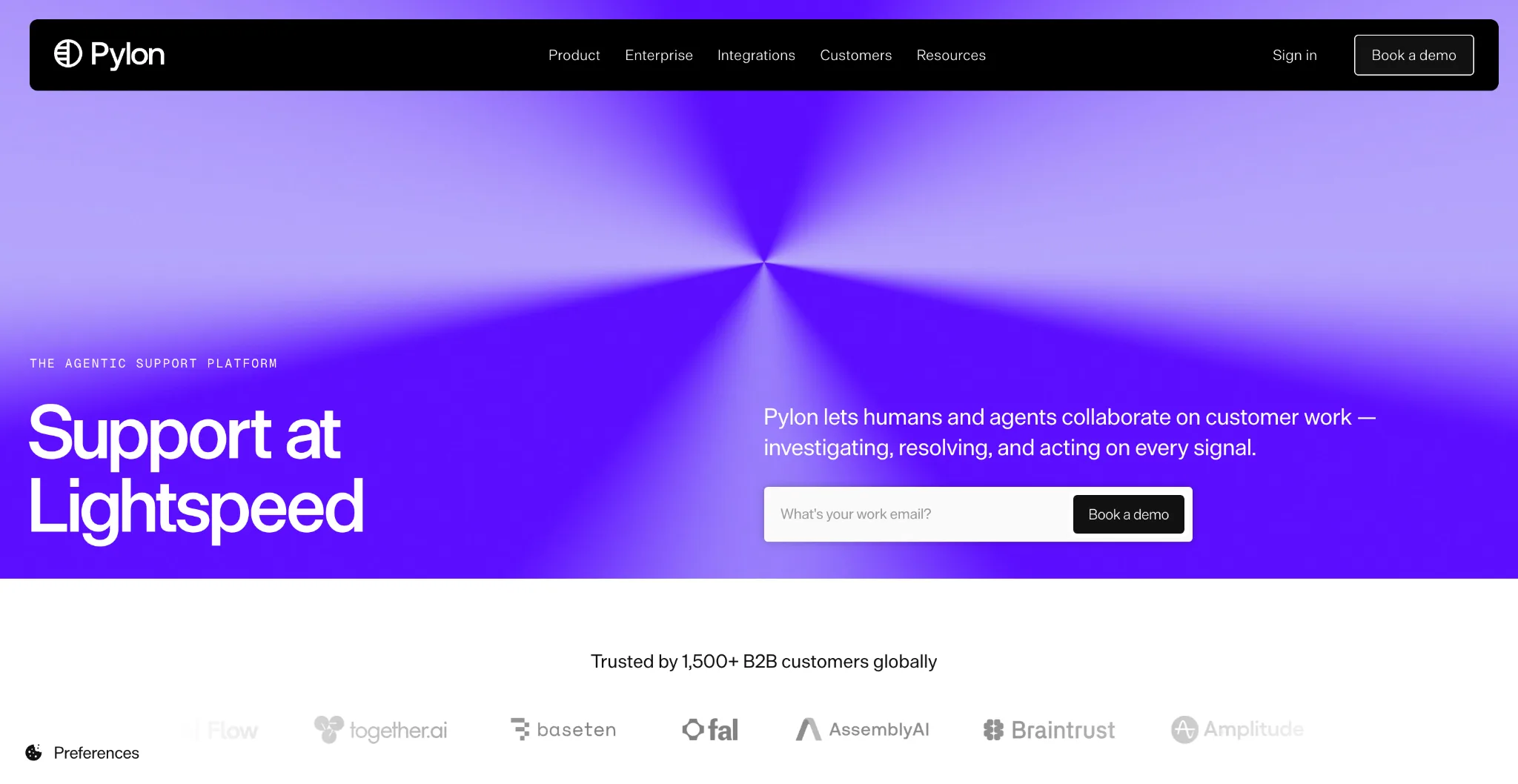
Best for Slack-first B2B support with account structure built in.
What it is. A support platform built for B2B software companies, where customers get a shared Slack channel and the help desk sits behind it.
What it does well for a SaaS team. Slack is a first-class channel, which matters if your customers already expect one. Accounts are the primary object, so the customer company is the unit of work, and Account Intelligence surfaces health signals at the account level.
Where it falls short. Pylon publishes no pricing, so every figure here is a third-party report and you cannot budget from a public page. Entry cost is reported as the highest of the nine, and the AI is a stack of add-ons: an $89 Professional seat plus $50 for AI Assistants is $139 all in, before AI Agents adds a monthly charge.
7. Plain
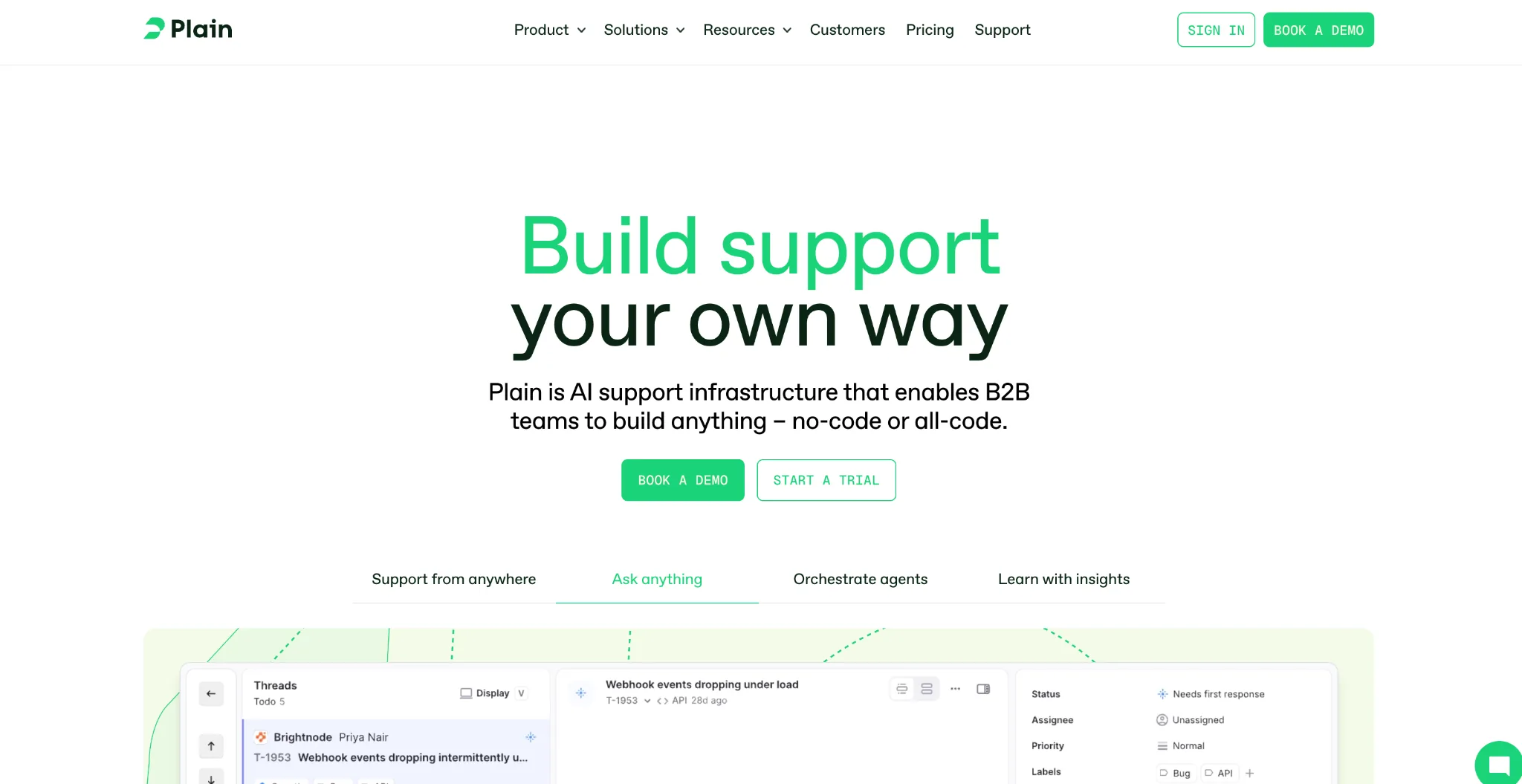
Best for engineering-adjacent teams who want the AI in the price.
What it is. A support tool for technical products, API-first, with an AI agent, Ari, included on every plan.
What it does well for a SaaS team. The AI is included in the plan, which removes the forecasting problem affecting most of this list. The product is shaped for teams where engineers do support, and the API and customer-context model are the most developer-oriented of the nine.
Where it falls short. The ecosystem is the youngest here, so integrations you take for granted elsewhere may need building. And credits are still a meter, so "included" means an allowance, and forecasting a credit burn is harder than forecasting a per-resolution rate.
What it costs. Foundation $35 per seat per month, one-seat minimum. Horizon $299 a month for three seats then $99 each, both on monthly billing ($269 billed yearly). Frontier is custom. Ari is included on every plan, metered in credits at 2,000 a month on Foundation and 15,000 on Horizon. Seven-day free trial, no card.
8. Zoho Desk
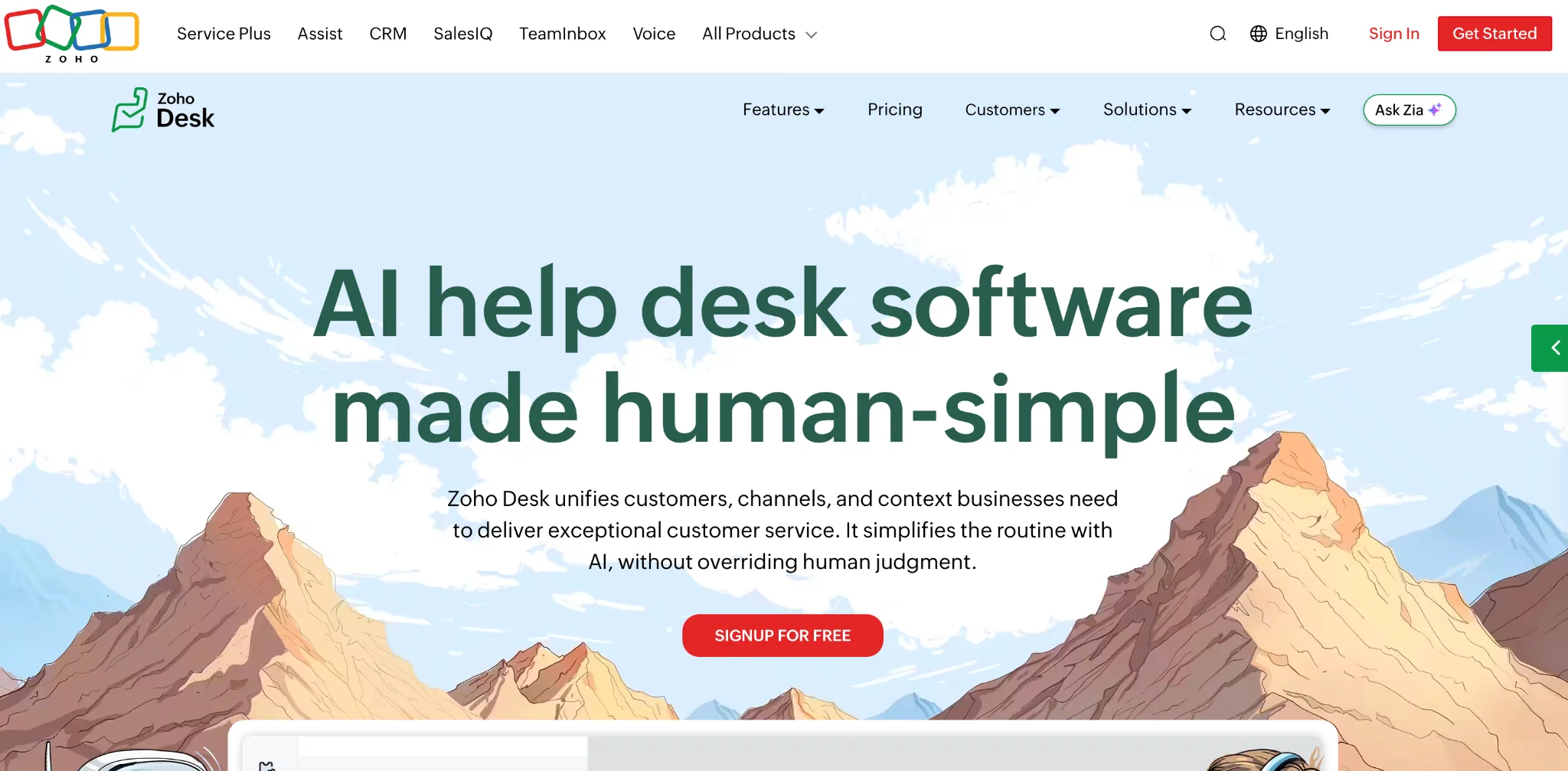
Best for teams optimising hard on cost.
What it is. Zoho's help desk, part of a very large suite and priced well below the rest of this list.
What it does well for a SaaS team. At 7 a seat, Zoho Desk is the cheapest credible standalone option of the nine; HubSpot Starter matches the price but only makes sense if you are already on the CRM. The free edition covers three agents permanently, and Zia is bundled into Professional, which makes the bill predictable in a way most of this list is not.
Where it falls short. The interface is denser and less polished than Help Scout's or Front's, and onboarding takes longer as a result. The suite also pulls you toward other Zoho products, which is friction if you do not want them.
What it costs. Free Edition for three user licences. Express, Standard, Professional and Enterprise list at 7, 14, 23 and 40 per user per month billed annually. Zoho's pricing page serves local currency, so confirm the figure in your region before comparing it against the dollar prices above. Zia is included from Professional upward with no separate charge, and Express already includes AI agents and generative AI with your own key.
9. HubSpot Service Hub
Best for teams already running HubSpot CRM.
What it is. HubSpot's support product, sitting on the same customer record as its marketing and sales tools.
What it does well for a SaaS team. If you already run HubSpot, the support ticket and the CRM record are one object, which removes an integration and a class of data-sync problem. Reporting spans the customer lifecycle, so you can trace a support pattern back to the deal that created it.
Where it falls short. The onboarding fees are the sharpest edge here, at $1,500 one-time on Professional and $3,500 on Enterprise, and they are easy to miss when comparing seat prices. Credits are also an abstraction, so working out your AI cost takes arithmetic the pricing page does not do for you.
What it costs. Free for 2 users. Starter $7 per seat per month annual, Professional $90 annual plus a one-time $1,500 onboarding fee. Enterprise is quoted; pricing analyses report about $150 per seat with a ten-seat minimum, so budget a $1,500 monthly floor and confirm it. The Customer Agent spends 50 credits per resolved conversation, which HubSpot prices at $0.50, or $0.45 buying credits annually at $9 per 1,000. Included credits are per account and do not roll over: 500 a month on Starter, 3,000 on Professional, 5,000 on Enterprise.
What these tools cost, including the AI
Seat prices run from about $7 to $115 on published tiers. The AI on top runs from $0.05 a conversation to $0.99 an outcome, two vendors include it in the plan and one publishes no rate.
Help Scout charges $0.75 per resolution and Fin from $0.99 per outcome. Freshdesk bills $0.49 a session whether or not it ends in an answer, and Front's Autopilot starts at $0.05 per conversation. HubSpot meters credits, working out at $0.50 a resolution. Pylon is reported at $50 a seat plus a $100 monthly floor, and Zendesk bills resolutions without publishing a rate. Plain and Zoho include the AI in the plan, Plain against a credit allowance and Zoho with no separate charge.
Freshdesk needs arithmetic the vendor does not do for you. $49 per 100 sessions is $0.49 a session, and the free first 500 on every plan is an allowance worth $245 that no comparison page mentions.
What three seats costs across the nine
Most SaaS support teams start at two to four people, where minimums make the headline price meaningless. At three seats, before any AI:
-
Zoho Desk Standard: 3 × $14 = $42 a month in your local currency
-
Help Scout Standard: 3 × $25 = $75
-
Front Starter: 3 × $25 = $75
-
Freshdesk Growth: 3 × $19 = $57
-
Zendesk Suite Team: 3 × $55 = $165
-
Pylon Starter: 3 × $59 = $177 at the reported rate
-
Plain Horizon: $299, priced for three
The spread is seven-fold on the same seat count, before a single AI resolution. Help Scout and Plain are shown on monthly billing because that is how they list; the rest are annual.
"Free" means three different things
Three of the nine have a permanent free tier and none means the same thing by it. Zoho Desk gives three agents, Help Scout five users, HubSpot two, and Freshdesk runs a six-month Free Program for two. Every roundup treats free as a yes-or-no column, and two seats versus five is the difference between a starting point and a demo.
Your help desk and your AI layer are two different purchases
Every AI layer here grounds its answers in sources you point it at, and how deeply each reaches into the tickets your team has already solved varies a lot. Article-grounded AI suits documented, repetitive questions, which in a consumer queue is most of the volume.
B2B SaaS support is shaped differently. The tickets that eat your team's week are integration errors, failed imports and authentication problems nobody wrote up, because the product changed again last sprint and whoever solved it last time solved it in a ticket. Ask each vendor what it does with tickets you have already resolved, then test it on your twenty hardest.
That grounding question is separate from which help desk you buy. To compare on AI capability instead of SaaS fit, AI help desk software compared is the companion piece, and how vendors define a resolution covers the billing definitions.
Where Pluno fits
Pluno ingests resolved support tickets, which is what lets it handle issues the help centre never documented. It is an AI support agent for complex technical tickets, and it works inside Zendesk and Intercom. The AI layer is a decision worth making on its own terms.
The module for autonomous resolution is Deflection AI (module name pending Syed's sign-off before it becomes a link), which draws on your help centre, uploaded files and custom API integrations alongside those tickets. It responds on Zendesk email and form tickets and on messaging channels through Sunshine Conversations. When confidence is low, when system access is needed or when a business decision is required, it escalates with a research summary, ticket references and suggested next steps.
Pricing is €0.90 per resolution, roughly $1 for US readers. The monthly base fee scales with ticket volume and is published in full on the pricing page. The unit matters more than the rate. Pluno's unit is a ticket closed without a human getting involved, so an escalation costs nothing and there is no credit balance to convert. A ticket is marked resolved 72 hours after Pluno's last reply if the customer does not respond.
Where the ticket is a real bug, the Troubleshooting Agent investigates across code, logs, Sentry and Linear, and the Escalation Copilot two-way syncs it to Jira, Slack or Linear so the answer comes back without anyone chasing it.
Two limits worth stating. Pluno needs a back catalogue of resolved tickets, so a team in its first months has little for it to learn from, and Deflection AI on Intercom is scoped per company. AI agents for Zendesk compared is the deeper read.
How to choose the best helpdesk software for your use case
It comes down to seat count, channel mix and how technical your tickets are.
-
Under five seats, mostly email. Help Scout. Live in an afternoon, free for five users.
-
Under five seats, cost is the constraint. Zoho Desk. Three agents free, then $7 a seat with Zia bundled.
-
Ten to thirty seats with a shipping product. Zendesk or Freshdesk. Both have the automation depth you will need by month six; Freshdesk costs less per seat, Zendesk reports better.
-
Slack-first B2B with shared customer channels. Pylon. The only tool here built around that assumption, and the entry cost is what you pay to avoid working around your busiest channel.
-
Engineers do your support. Plain. API-first, and the AI is in the price.
-
Already on HubSpot CRM. Service Hub, and budget the onboarding fee.
-
Product-led, support happens in-app. Fin.