The best Help Scout alternatives in 2026 are Front, Hiver, Missive, Zoho Desk, Freshdesk, Zendesk, Intercom, Gorgias and FreeScout, and the right one depends on whether you are replacing a shared inbox or upgrading to a ticketing system.
People search this for one of two reasons. Help Scout switched from per-seat pricing to charging by the number of customers you helped each month, long-time customers published what it did to their bills, and the pricing page today prices per user again. Or they have outgrown it, which Help Scout is unusually candid about, since it publishes its own list of teams it does not serve well.
Below are nine alternatives grouped by what you are replacing, since a shared-inbox shortlist and a ticketing shortlist are different lists. Each profile carries the price, what it fixes and where it falls short, followed by switching costs, the AI-layer decision and five rules for picking. Pluno is not in the list, because Pluno is not a helpdesk. Every price was read on the vendor's own pricing page on 16 August 2026, and pricing here moves quickly.
Key takeaways
-
Choose Front if your conversations cross departments. $25 per seat per month up to 10 seats, $65 up to 50, $105 unlimited, built around shared threads instead of a support queue.
-
Choose Hiver if your team lives in Gmail. From $25 per user per month, with AI agents included on every plan and no separate AI fee, which is unusual in this lineup.
-
Choose Missive if you were running Help Scout plus Slack. $14 per user per month up to 5 users, and the only option here with team chat built into the inbox.
-
Choose Zoho Desk if your objection was the price. Free forever for 3 agents with no contact cap, then $7 per user per month, against Help Scout's $25.
-
Choose Freshdesk if you need ticketing on a budget. $19 per agent per month on annual billing, with routing and SLAs Help Scout does not model.
-
Choose Zendesk if you have outgrown simplicity. $55 per agent per month paid yearly, with the widest ecosystem and the strongest multi-team routing here.
-
Choose Intercom if you want the strongest AI. $29 per seat per month on annual billing, with Fin at a published $0.99 per outcome against Help Scout's $0.75 per resolution.
-
Choose Gorgias if you sell on Shopify, or if your headcount is high relative to your ticket count. From $10 a month by ticket volume, with no per-agent charge at all.
-
Choose FreeScout if you want Help Scout without the vendor. It is a free, open-source clone of Help Scout, and where documented customers went after the pricing change.
What happened to Help Scout's pricing
Help Scout moved to billing by customer contacts, customers published what it cost them, and the pricing page today prices per user.
The switch was announced around November 2024 with six months' notice. It billed on the number of contacts you helped each month, smoothed by a rolling three-month average.
On 30 April 2025 Daniel Jalkut, a long-time customer, published his own numbers. His $22 a month became roughly $50, or $28.60 with a two-year loyalty discount, and he worked out that a three-person team handling 500 unique customers would go from $66 to $266. The increase mattered less than what the model asked him to weigh: whether to help a customer today "at the cost of sending myself into a higher pricing tier." Customers started moving to FreeScout, an open-source Help Scout clone, which is why it appears at number nine below.
Where it stands now. The pricing page prices per user, though we found no Help Scout statement announcing the return, and one analysis reports that some existing accounts kept contact-based plans. If you are on one, check your invoice before you compare anything below.
One piece of the old model is still visible. Help Scout's free plan is capped at 100 contacts a month while every paid tier is listed as unlimited. The metric that caused the trouble survives on the tier nobody pays for.
A company tried a pricing model, customers objected in public with their own numbers, and it is no longer what new customers are sold. Worth knowing before you renew.
What Help Scout costs now
Help Scout lists $25, $45 and $75 per user per month across Standard, Plus and Pro, and offers 16% off for annual billing.
| Plan | Per user/mo | Users | Inboxes | Docs sites | Light Users | Contacts |
|---|---|---|---|---|---|---|
| Free | $0 | 5 | 1 | 1 | None | 100/mo |
| Standard | $25 | 25 | 2 | 1 | None | Unlimited |
| Plus | $45 | 50 | 5 | 3 | 5 included (max 25) | Unlimited |
| Pro | $75 | Unlimited, minimum 10 | 10 | 5 | 15 included (max 50) | Unlimited |
Pro has a floor. The plan is listed as unlimited users with a minimum of ten, so the cheapest possible Pro deployment is 10 × $75, or $750 a month. Pro is also the only tier with SSO, SAML and HIPAA compliance, which means a six-person team with a security requirement cannot buy what it needs at any price. No other article covering this topic mentions it.
The seat price is not the bill. Additional inboxes beyond your plan cost $10 a month on annual billing, or $12 monthly. Additional Docs sites cost $20 annually or $24 monthly. A team running four inboxes on Standard is paying $25 per user plus $20 a month before anything else.
Light Users are the counterweight. Plus includes five, up to a maximum of 25. Pro includes 15, up to 50. Free and Standard include none. If you have colleagues who need to see conversations and rarely reply, that allowance changes your effective per-seat cost more than the headline price does.
AI Answers costs $0.75 per resolution, pay-as-you-go on paid plans, with a three-month free trial. It charges at most once per conversation regardless of how many messages it takes. AI Assist, AI Drafts and AI Summarize are included on Plus and Pro.
Who Help Scout says it is not for
Help Scout publishes a list of teams it is a poor fit for, and it is the most useful thing written about its limits.
Most vendors leave that job to their competitors. Help Scout does it on its own blog, which makes it better evidence than anything on this SERP. The company names seven situations: solo operators, broad internal team communication, setups where support@ forwards from a personal account, enterprises needing hundreds or thousands of third-party integrations, internal-only knowledge bases, businesses needing scheduling or invoicing, and engineering support workflows where developers reply to submitters directly.
Those limits map onto three reasons people replace Help Scout, and the groups below follow them.
Some teams want a different shared inbox, usually because conversations cross departments and Help Scout is built around a support queue. Front makes exactly this argument, saying Help Scout struggles when support is no longer the sole owner of a conversation. That is a competitor's claim, but Help Scout's own exclusion of cross-functional work supports it, and two independent sources agreeing is worth more than either alone.
Some teams need a full ticketing system, usually because they have hit the integration ceiling or need routing and SLAs Help Scout does not model.
And some teams need channels or automation Help Scout does not cover, which is where voice, social and heavy AI automation come in.
Credit where it is due. A vendor that publishes who it cannot help is doing something rare, and it saves its readers a wasted trial.
How this list was put together
Five tools appear across every substantial list covering this topic: Zendesk, Front, Freshdesk, Zoho Desk and Hiver. Leaving any of them out would make this list incomplete, so all five are here.
The gap is open source. No ranking page includes a single open-source option, which is a strange omission for this keyword, because FreeScout is an open-source clone of Help Scout and is where documented customers went after the pricing change.
We read every price on the vendor's own pricing page on 16 August 2026. Where a vendor does not publish a figure, this article says so instead of borrowing an estimate.
One observation about the search results themselves. Help Scout ranks for its own alternatives keyword, with a page listing Gmail, Slack, Front, Slab, Zendesk, Linear and Jobber. Five of those seven do a different job from a helpdesk: email hosting, team chat, an internal wiki, issue tracking and field service software. Only Front and Zendesk are competitors. It is a legitimate strategy, and the page is worth reading for its candor, but if you read it and felt the list did not answer your question, that is why.
The nine tools are grouped by what you are replacing, because a shared-inbox shortlist and a ticketing shortlist are different lists.
The 9 best Help Scout alternatives at a glance
| Tool | Best for | Starting price | Free tier | AI pricing model |
|---|---|---|---|---|
| Front | Conversations that cross teams | $25/seat/mo | No | Add-on below Enterprise |
| Hiver | Teams that live in Gmail | From $25/user/mo | No | Included, no separate fee |
| Missive | Cheapest shared inbox, chat built in | $14/user/mo | Yes | Credit-based |
| Zoho Desk | The cheapest full ticketing system | $7/user/mo annual | 3 agents, forever | Included per tier |
| Freshdesk | Mainstream ticketing on a budget | $19/agent/mo annual | 2 agents, 6 months | $49 per 100 sessions |
| Zendesk | Enterprise depth and ecosystem | $55/agent/mo paid yearly | No | Per resolution, rate not published |
| Intercom | Messaging-first with the heaviest AI | $29/seat/mo annual | No | $0.99 per outcome |
| Gorgias | Ecommerce, and large teams on low volume | $10/mo for 50 tickets | No | $0.90–$1.00 per interaction |
| FreeScout | A Help Scout clone you own | Free, open source | Free | None built in |
The AI column is not directly comparable. Each vendor defines a resolution, an outcome, an interaction and a session differently, so compare the definitions before the numbers.
The 9 best Help Scout alternatives, reviewed
If you want to keep the shared inbox
1. Front
Best for teams whose conversations cross departments.
Pricing. Starter $25 per seat per month for up to 10 seats, Professional $65 for up to 50, Enterprise $105 with no seat limit. Annual billing carries a stated 24% discount.
Why it works as a Help Scout alternative. Front models conversations as shared threads with internal discussion attached, which suits teams where support, success and sales all touch the same customer. Front argues that Help Scout is built to manage a queue and meet SLAs, and struggles when support isn't the sole owner of a conversation. Help Scout's own page supports that reading by excluding cross-functional work, and two independent sources agree that this is a limit rather than a claim.
Where it falls short. The seat ceilings on Starter and Professional are hard limits, so a team of 12 cannot stay on Starter regardless of budget. AI features sit behind add-ons below the Enterprise tier.
Best for. Account-managed support, agencies, and teams where support and customer success share the same customers.
2. Hiver
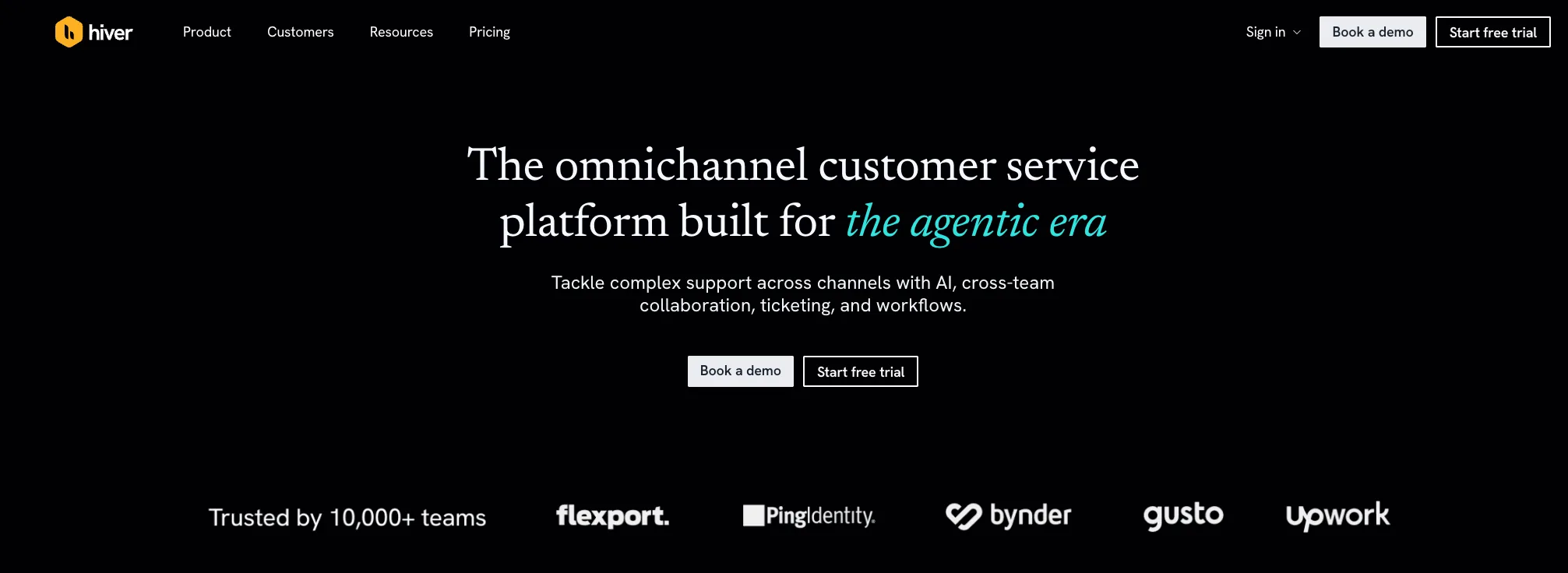
Best for teams that never wanted to leave Gmail.
Pricing. Growth from $25 per user per month, Pro from $55, Elite from $85. Growth caps at 10 users and 2 shared inboxes; Pro includes 5 inboxes and Elite unlimited, both with unlimited users. All plans start at a two-seat minimum. Voice is a $30 per-voice-seat add-on that includes 1,000 minutes, then $0.03 per minute.
Why it works as a Help Scout alternative. It runs inside Gmail, so migration is a browser extension instead of a platform move, and adoption is nearly free because nobody learns a new interface. AI agents are included on all plans with no separate AI fee, which is unusual in a lineup where five vendors meter AI separately, and worth a look if the AI bill is what pushed you out.
Where it falls short. There is no permanent free plan, only a seven-day Elite trial with no credit card. The two-seat minimum and Growth's 10-user ceiling are hard constraints. Its pricing page also returned an ambiguous billing-term ordering, so confirm the term at checkout.
Best for. Small teams already standardised on Google Workspace.
3. Missive
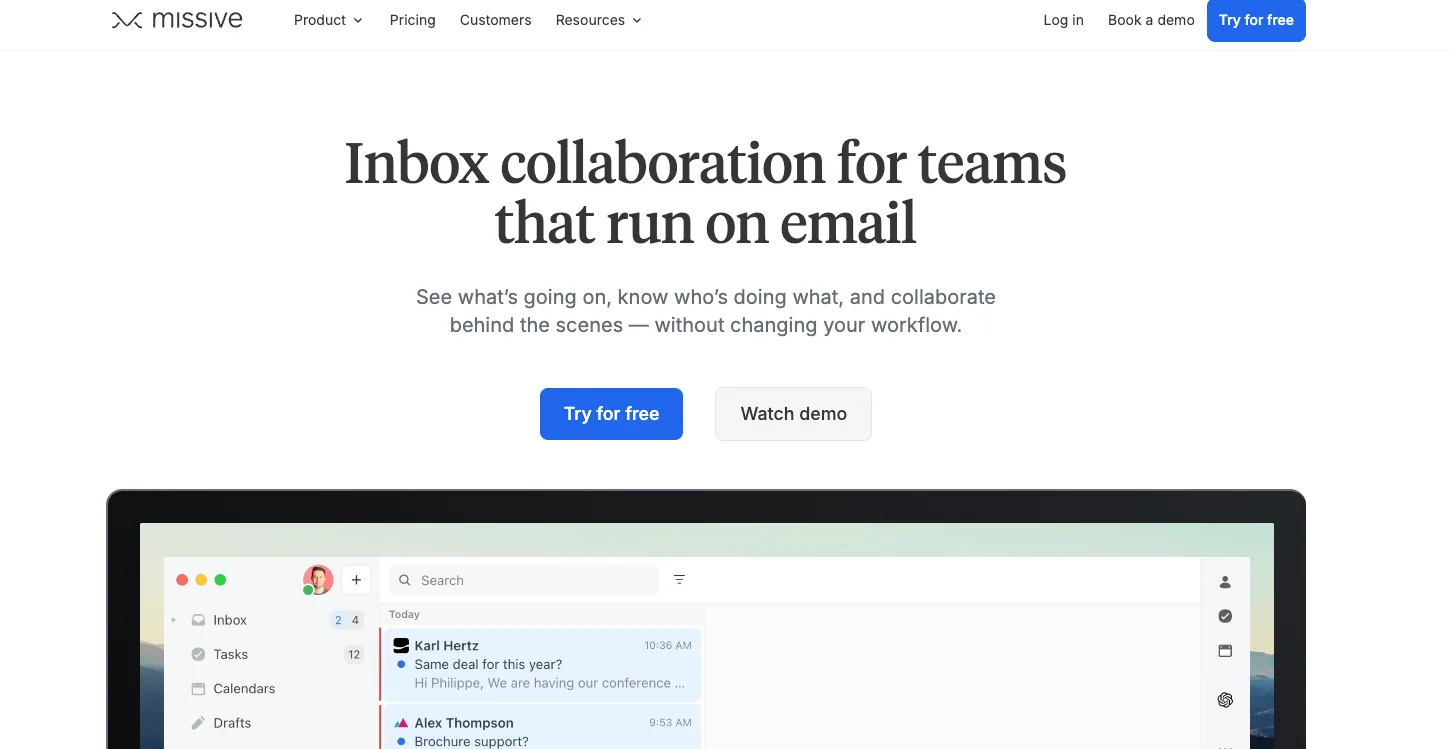
Best for teams that were running Help Scout plus Slack.
Pricing. Starter $14 per user per month for up to 5 users, Productive $24 for up to 50, Business $36 with unlimited users. 20% off when billed yearly. A free plan exists.
Why it works as a Help Scout alternative. It is the cheapest entry in this list and the only one with team chat built into the inbox, so the internal conversation about a customer sits beside the conversation with them. Teams paying for a helpdesk and a chat tool can often collapse both.
Where it falls short. The free plan's specific limits were not published on the page we read, so confirm them before relying on it. Knowledge base and self-service are lighter than Help Scout's Docs.
Best for. Small teams under 50 people who want one tool for internal and external conversation.
If you need a full ticketing system
4. Zoho Desk
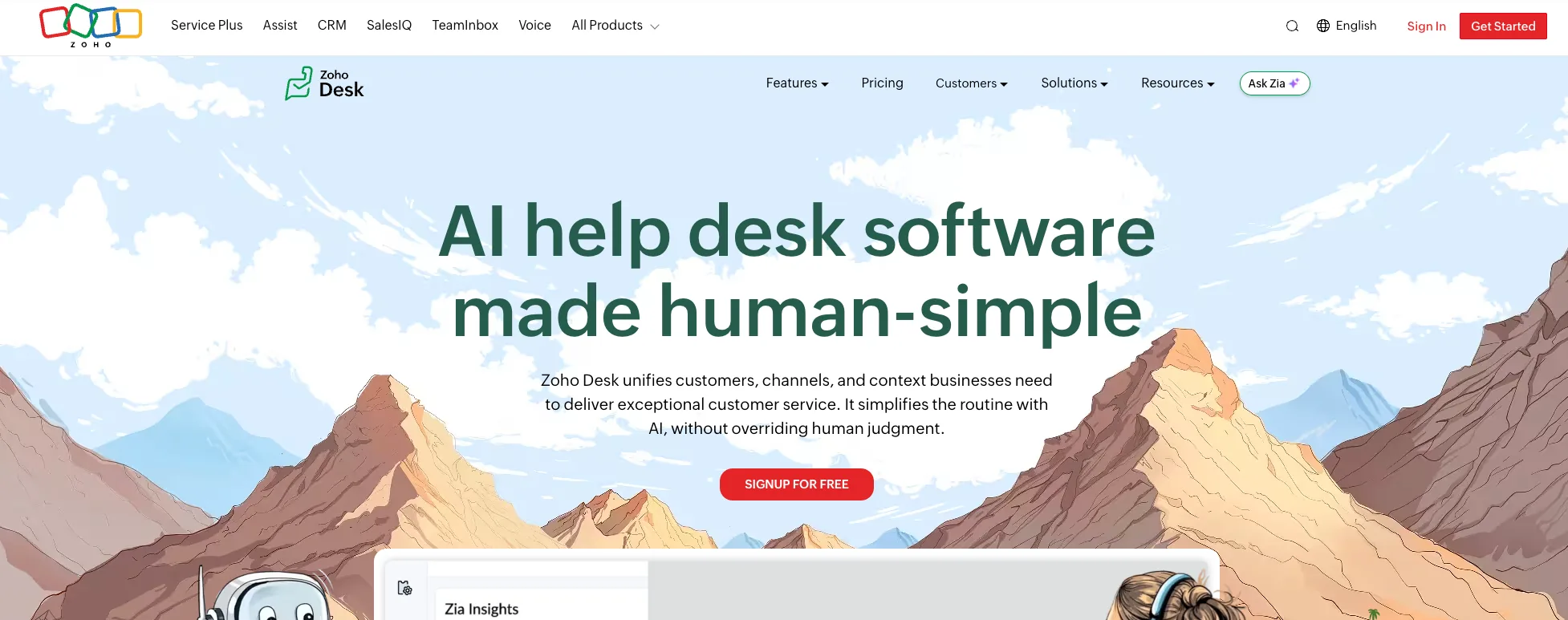
Best for teams whose objection to Help Scout was the price.
Pricing. Free forever for 3 agents. Express $7, Standard $14, Professional $23 and Enterprise $40 per user per month on annual billing.
Why it works as a Help Scout alternative. It is the cheapest full ticketing system here, at roughly a quarter of Help Scout's Standard tier, and its free plan carries three agents with no contact cap and no clock. For a team that liked Help Scout and left over cost, this is the most direct answer.
Where it falls short. Express carries a hard five-seat ceiling, so a growing team hits an upgrade sooner than the entry price suggests. Monthly billing is reported at 30 to 50% above annual, which is a wide range and is not published. The pricing page renders in Indian rupees by default, so switch the currency before quoting yourself a number.
Best for. Cost-driven moves, and small teams that want room to grow into automation.
5. Freshdesk
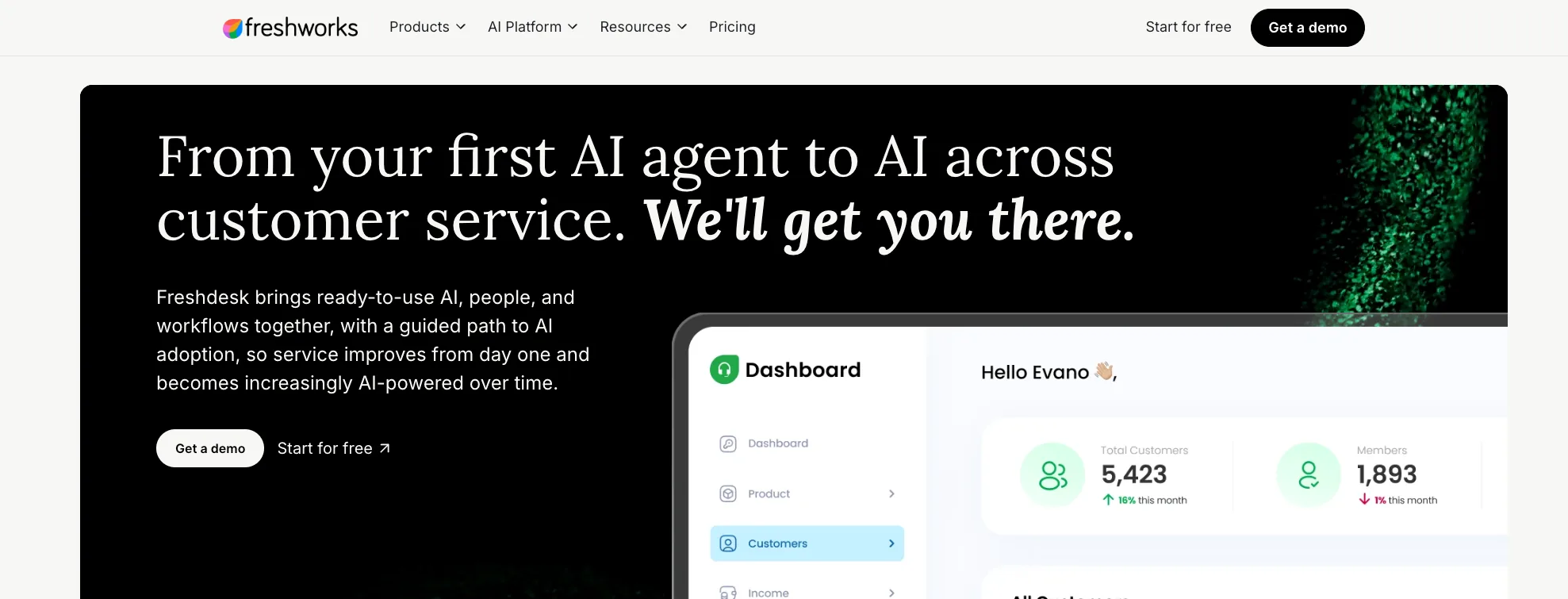
Best for teams that want mainstream ticketing without Zendesk's price.
Pricing. Growth $19, Pro $55 and Enterprise $89 per agent per month on annual billing. Freshdesk Omni is a separate product line at $29, $79 and $119. Freddy AI Copilot costs $29 per agent per month, and Freddy AI Agent costs $49 per 100 sessions.
Why it works as a Help Scout alternative. It is the most complete ticketing platform at the low end, with routing, SLAs and automation that Help Scout does not model, at an entry price below Help Scout's Standard tier.
Where it falls short. Its free plan is a six-month program for two agents, cut from ten agents effective 15 November 2024, so it is not a landing place if a free tier is what you are looking for. AI is metered twice, per agent for Copilot and per session for the AI Agent, and the 500 sessions commonly quoted are a one-time signup allowance.
Best for. Teams that need ticketing mechanics and are watching the seat price.
6. Zendesk
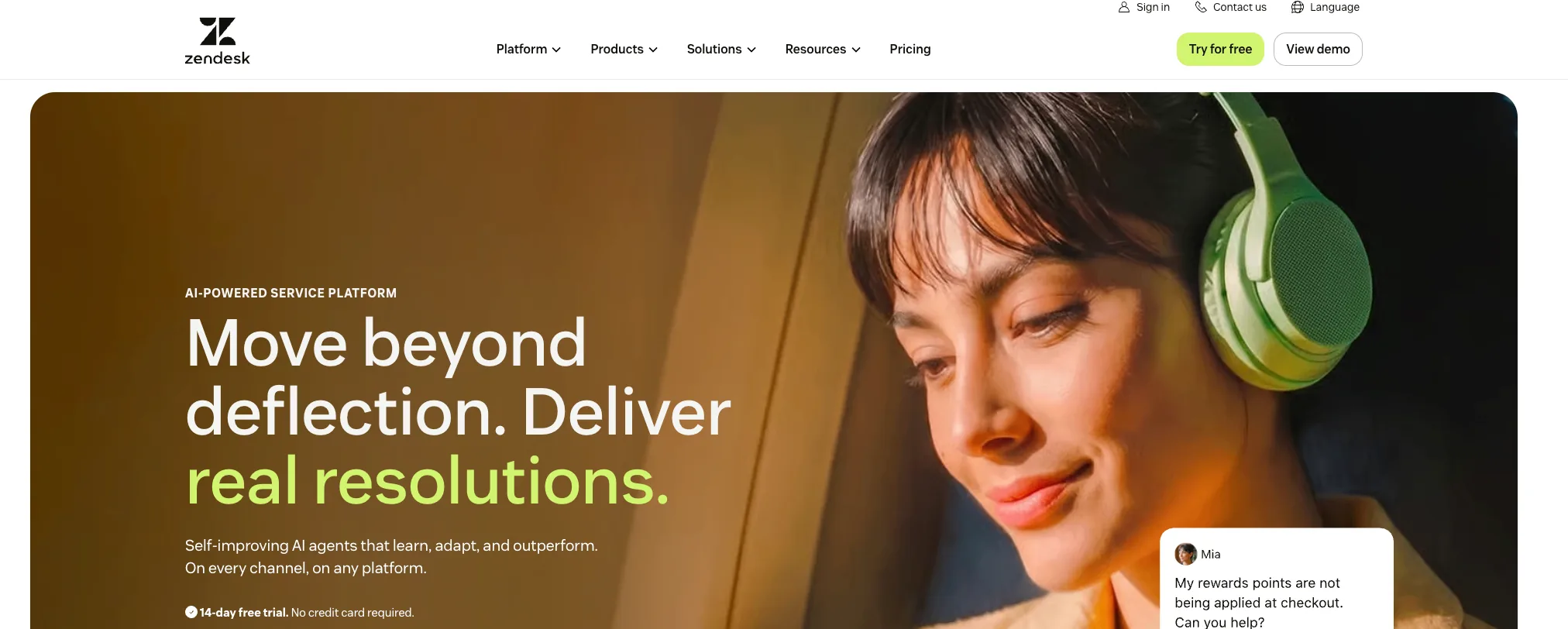
Best for teams that have outgrown simplicity and know it.
Pricing. Suite Team $55 and Suite Professional $115 per agent per month paid yearly. Suite Enterprise with Copilot is contact-sales with no public price.
Why it works as a Help Scout alternative. It has the widest third-party ecosystem of anything here, which addresses the integration ceiling Help Scout names on its own page, and it handles multi-team routing at a scale Help Scout does not attempt.
Where it falls short. Zendesk does not publish a per-resolution AI rate, so you cannot forecast that line without a sales conversation; figures of $1.50 and $2.00 circulate but are reported. It is also the largest jump in complexity from Help Scout in this list, and complexity you have to administer is a cost. What Zendesk's AI actually costs covers the model.
Best for. Teams above roughly 20 agents with someone who owns the configuration.
If your problem is channels or automation
7. Intercom
Best for teams that want the heaviest AI automation available.
Pricing. Essential $29, Advanced $85 and Expert $132 per seat per month on annual billing, or $39, $99 and $139 monthly. Fin AI Agent costs $0.99 per outcome and $9.99 per qualification. Advanced includes 20 free Lite seats and Expert 50.
Why it works as a Help Scout alternative. If the reason you are looking is that Help Scout's AI Answers did not resolve enough at $0.75 a resolution, Intercom is the most direct upgrade, with a published per-outcome rate and a far more capable agent.
Where it falls short. It is the most expensive entry point in this list, and Intercom renamed itself Fin then signed a definitive agreement to be acquired by Salesforce for approximately $3.6 billion on 15 June 2026, expected to close in the fourth quarter of Salesforce's fiscal year 2027. The deal is signed and not closed, which is worth raising before a multi-year term. Intercom Fin's per-outcome pricing covers it in detail.
Best for. Chat-led support with volume that justifies automation-first billing.
8. Gorgias
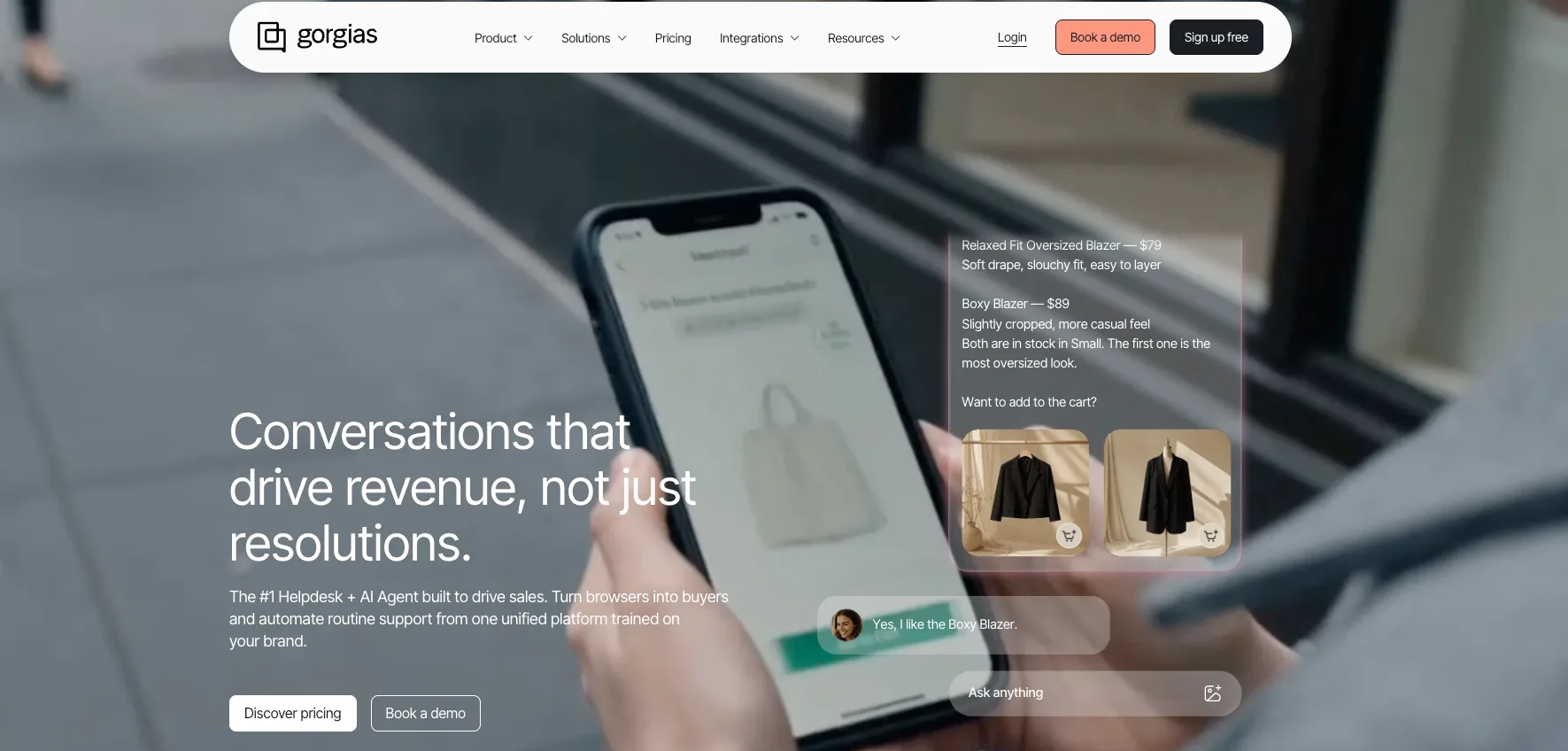
Best for ecommerce brands, and large teams on modest ticket volume.
Pricing. Priced per ticket with no per-agent charge. The helpdesk runs $10, $60, $360 and $900 per month on monthly billing for 50, 300, 2,000 and 5,000 tickets. AI Agent is metered separately at $1.00 per automated interaction monthly and $0.90 annual, with $1.50 past your allowance. Ticket overage is $0.40 on the lower two tiers and $0.36 on the upper two.
Why it works as a Help Scout alternative. It is the only tool here with no per-seat charge, which inverts the economics. A team of twelve pays what a team of three pays at the same ticket volume, so it suits teams whose headcount is high relative to their ticket count.
Where it falls short. It is ecommerce-first. Gorgias says it powers 40% of Shopify brands, and its AI Agent's documented actions are order cancellations, returns and shipping updates. Its pricing page is JavaScript-rendered, so figures quoted elsewhere are often stale.
Best for. Shopify and DTC brands.
If you want to own it
9. FreeScout
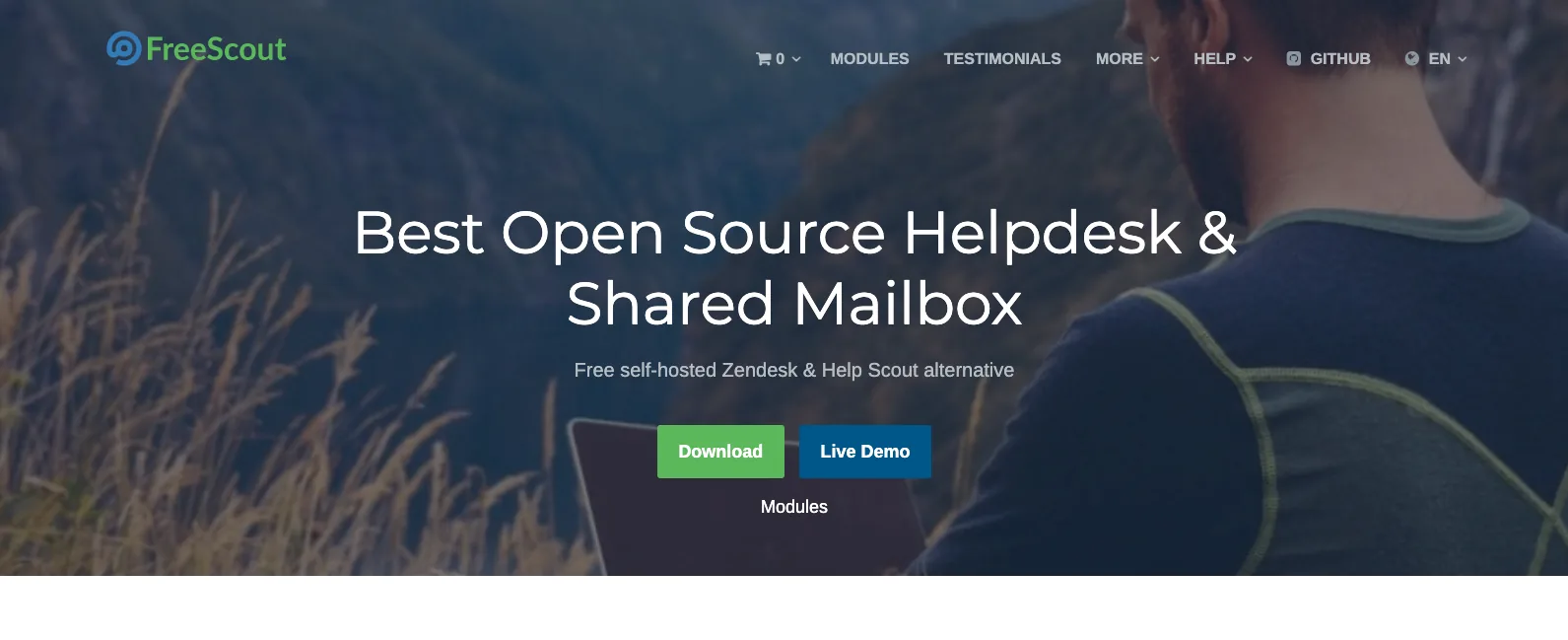
Best for teams that want Help Scout without the vendor.
Pricing. The core application is free and open source, built on PHP and MySQL. One-click installs are available through Pikapods, Zenith, Softaculous, Docker and Cloudron.
Why it works as a Help Scout alternative. FreeScout is an open-source clone of Help Scout, built to work the same way, which makes it the most direct swap in this list. It is also where documented Help Scout customers went after the 2025 pricing change, which is worth knowing if predictability is what you are buying. Note the names are almost identical and the products are unrelated commercially.
Where it falls short. Paid modules are sold through a marketplace and no module prices were published on the pages we read, so you may be budgeting for extensions you cannot price in advance. Self-hosting means owning the server, updates, backups and email deliverability, and deliverability is the one that surprises people, because a self-hosted helpdesk sending from your domain needs SPF, DKIM and a reputation you now manage.
Best for. Small teams with technical capacity that want to own their data. osTicket and Zammad are the other mature open-source options, with the same trade.
What switching from Help Scout actually costs
Leaving Help Scout has three costs, and the one people underestimate is the complexity they take on.
The first is the new subscription, which the profiles cover.
The second is the migration. Conversations and contacts usually move with vendor tooling or a migration service. Workflows, saved replies, tags and Docs content get rebuilt or reformatted, because they do not map cleanly between platforms.
The third is what you are actually buying. People choose Help Scout for its simplicity, so the risk in leaving is over-correcting. A ticketing system with routing rules, SLA policies and a marketplace is more capable and it is also something someone has to own. If your complaint is a $20 Docs site fee, moving to a platform that needs an administrator is a poor trade. If your complaint is that conversations cross four teams and nothing tracks them, it is the right one.
Be honest about which of those you are, before you shortlist.
The AI layer is a separate decision
On every platform in this list the AI layer is priced separately from seats, and six vendors answer that question six different ways.
Help Scout charges $0.75 per resolution. Intercom charges $0.99 per outcome. Gorgias charges $1.00 per automated interaction on top of the ticket fee. Freshdesk charges per session, plus $29 per agent per month for Copilot. Zendesk bills per automated resolution and publishes no rate. Hiver includes AI with no separate fee.
Those six answers are not comparable. A resolution, an outcome, an interaction, and a session are four different units, and the definition decides how often you get billed. Read the definition before you compare the price.
There is a second decision underneath the first. Once you pick a platform, the AI that runs on it doesn't have to be the platform's own. On Zendesk and Intercom, you can run the native AI or a third-party layer, and that choice is independent of the helpdesk you just bought.
This matters most for one group in particular, and Help Scout identifies them itself. Its own page names engineering support workflows, where developers reply to submitters directly, as something it does not serve. A team in that position has a knowledge problem more than an inbox problem, because the answers to their tickets live in past investigations instead of in articles.
Pluno is one of the layers built for that. It is an AI support agent for complex technical tickets that works inside Zendesk and Intercom, and it ingests your resolved support tickets, which is what lets it handle issues that no help center article documents. An agent worked out answers to integration failures and account-specific problems in a ticket, and nobody wrote them up afterward.
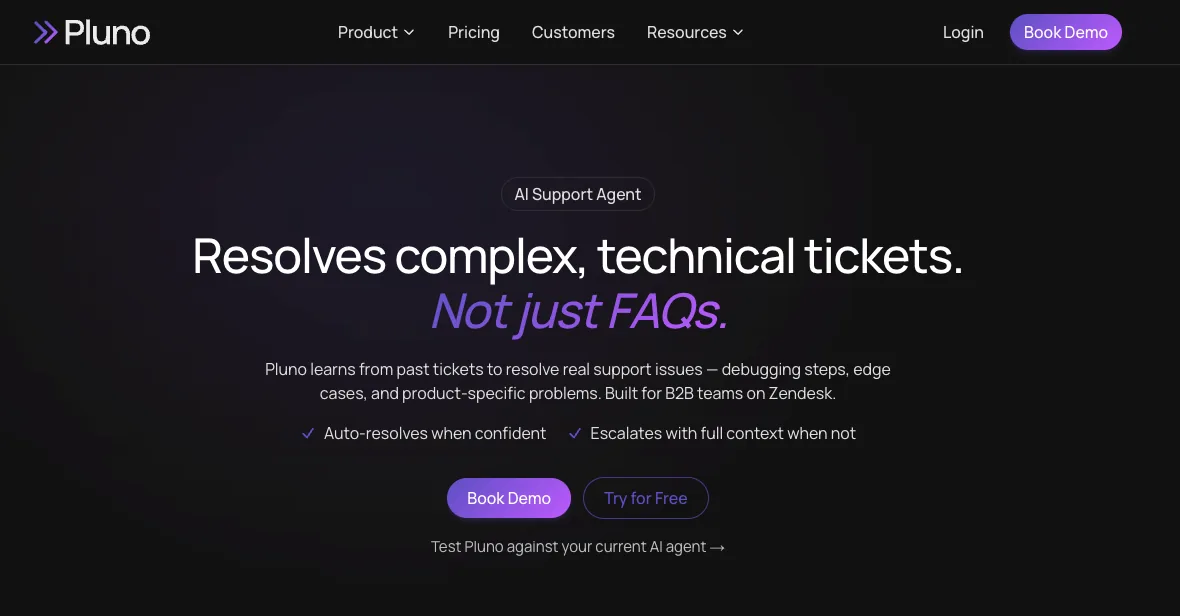
On pricing, Pluno charges €0.90 per resolution, roughly $1 for US readers, and its pricing page defines a resolution as a ticket resolved without human involvement. Escalations are never counted, so partial work is not billed. AI Copilot is €49 per agent per month, and the base fee is custom, based on your average ticket volume.
Two limits worth stating. Pluno needs a body of resolved support tickets to learn from, so a team with a short support history gets less from it. And autonomous deflection on Intercom is arranged case by case per company instead of published, so don't assume it.
If you want the wider set of options there, AI agents that run on Intercom covers them.
How to pick the right Help Scout alternative:
What you should replace Help Scout with depends on whether you are replacing an inbox, a price, or a knowledge problem.
-
If you liked Help Scout and only want a better shared inbox, look at Front if conversations cross teams, Hiver if your team lives in Gmail, or Missive if cost is the constraint.
-
If you left because of cost, Zoho Desk is the cheapest full destination at $7 per user with a free tier for three agents, and Missive is the cheapest shared inbox at $14.
-
If you left because conversations cross teams, Front and Zendesk are the two built for it, and Help Scout's own page agrees by excluding cross-functional work.
-
If you left because of the AI bill, compare the AI models instead of the seats. Hiver includes AI with no separate fee, and Help Scout at $0.75, Intercom at $0.99 and Gorgias at $1.00 are the three that publish a unit rate you can forecast against.
-
If you left because your support got technical, the inbox matters less than the AI layer on top of it, and Zendesk and Intercom are the destinations that keep that decision open.