Salesforce Agentforce pricing has three main consumption models for customer-facing agents: $0.10 per action through Flex Credits, $2 per conversation, or $2 per resolution with the Help Agent. Your reps' Agentforce use is a separate per-user charge, from $5 to $125 a month, unless you buy the $550 Max edition that bundles it. On top of that sit Data 360 credits and implementation, which the pricing page doesn't total for you.
I went through Salesforce's pricing pages, rate cards, help articles and press releases to put the numbers in one place. Salesforce prices are US list prices with a link to their source, Pluno's prices are in euros, and partner estimates are labelled as such.
Prices checked: October 16, 2026.
Disclosure: I work at Pluno, which sells an AI layer that runs inside Salesforce Service Cloud.
To compare the meters fairly, I describe each one the same way:
- Billing unit: what Salesforce counts.
- Price: the list price per unit.
- What's billable: when a charge applies, and when it doesn't.
- What's extra: costs that sit outside the meter.
- Best fit: the kind of usage it suits.
TL;DR: How much does Agentforce cost?
- Customer-facing agents: $0.10 per action on Flex Credits ($500 per 100,000 credits), $2 per conversation, or $2 per Help Agent resolution, which is drawn from Flex Credits. An org can't run Flex Credits and conversations at the same time.
- Your reps: $125 per user a month for the Agentforce for Service add-on. The Max edition, at $550 per user, includes it plus 2.75 million Flex Credits a year.
- Which meter is cheapest: it depends on actions and resolutions. At a 50% resolution rate, the Help Agent averages $1 per conversation, the same as 10 actions on Flex Credits.
- Additional costs: Data 360 credits, implementation, testing and admin time. Salesforce's own worked examples leave Data 360 out.
- Bottom line: model your bill on your own conversation volumes and action counts before you pick a meter, and get implementation quotes in writing.
Salesforce Agentforce pricing at a glance
Here are the main Agentforce prices relevant to support teams, from the Agentforce pricing page and the Service Cloud pricing page.
| What you buy | List price (USD) | Billing unit | Who it's for |
|---|---|---|---|
| Flex Credits | $500 per 100,000 credits | Per action ($0.10 standard, $0.15 voice) | Customer-facing and employee agents |
| Conversations | $2 | Per conversation | Customer-facing agents only |
| Help Agent resolutions | $2 (400 Flex Credits) | Per billable resolution | Customer self-service |
| Service Portal Login or Member | $4 per login or $10 per member | Per login or named member | Help Agent on an authenticated portal |
| Agentforce User License | $5 per user a month | Per user, plus Flex Credits | Metered employee use |
| Agentforce add-ons (Sales, Service, Field Service) | $125 per user a month | Per user | Unmetered employee use |
| Agentforce Industries add-ons | $150 per user a month | Per user | Unmetered employee use in industry clouds |
| Max editions | From $550 per user a month | Per user, annual | The Agentforce add-on, Data 360 and 2.75M Flex Credits a year |
| Salesforce Foundations | $0 | Free add-on | Trying Agentforce on Enterprise Edition and up |
The three main Agentforce pricing models for customer-facing agents
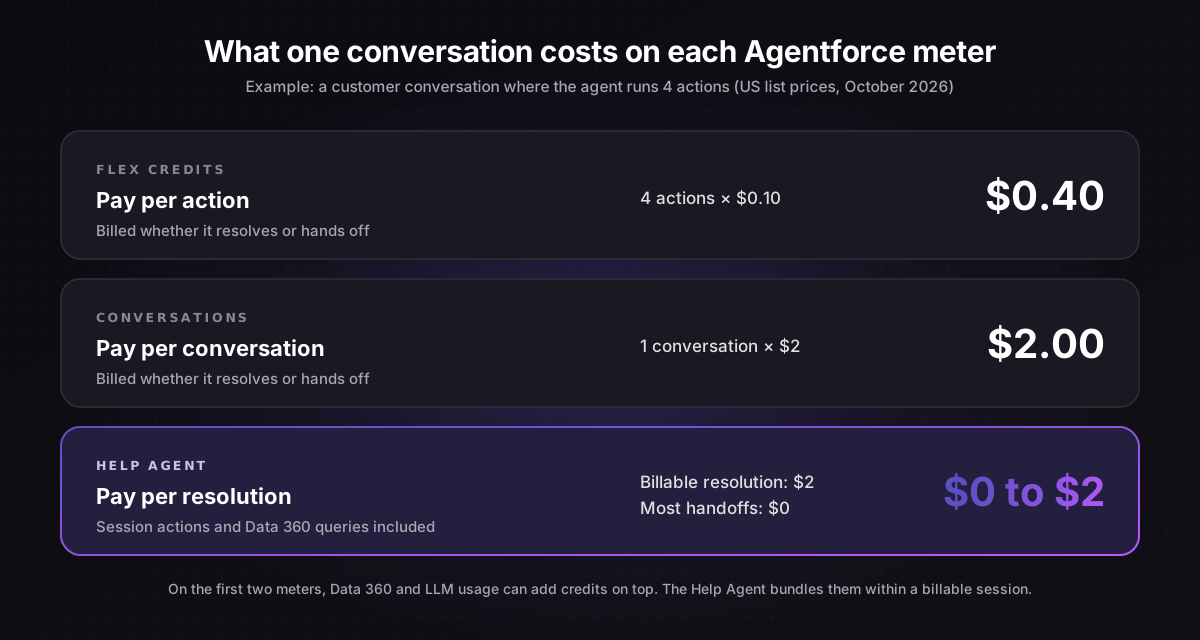
Customer-facing agents are mainly billed in one of three units: actions, conversations or resolutions. These aren't separate credit systems, because Help Agent resolutions are drawn from Flex Credits too, at 400 credits each. Which unit costs least depends on how many actions your conversations take and how many end in a billable resolution.
Flex Credits: pay per action
Flex Credits bill each action the agent runs. A standard or custom action costs 20 credits, and a voice action costs 30, so $0.10 and $0.15 at $500 per 100,000 credits.
- What's billable: every action, whether it runs through the agent's reasoning or a fixed instruction. Escalating to a rep, setting variables and switching topics aren't billed as actions.
- What's extra: Data 360 usage draws on the same credits. Prompt usage types (2, 4 or 16 credits per 2,000 tokens) aren't an automatic surcharge on every action. They apply to features that call the LLM directly, like Service Replies, and separate AI calls inside custom actions may also be billed.
- Rules: unused credits don't roll over, and usage above your entitlement is billed monthly at your contracted rate, with no penalty.
- Best fit: short, structured conversations, like order lookups. Salesforce's own example prices a two-action order-status request at $0.20.
Conversations: Salesforce Agentforce pricing per conversation
The conversation meter charges $2 per conversation, however many actions it takes. It's only for customer-facing agents.
- What counts as one conversation: on web chat, a conversation window lasts until an anonymous visitor ends the chat, or 24 hours for logged-in users. On WhatsApp, SMS and other messaging channels it's 24 hours.
- What's billable: every conversation, resolved or not. Salesforce adds that some features also consume Einstein Requests and Data Services credits.
- The catch: you can't use Flex Credits and conversations in the same org. Switching means swapping all your conversation licenses.
- Best fit: long, action-heavy conversations. At exactly 20 standard actions, both meters cost $2, and above that the conversation meter is cheaper.
Help Agent: pay per resolution
The Agentforce Help Agent, which Salesforce now also calls "Casey", bills $2 per resolution. It launched with this pricing in July 2026.
- What's billable: according to Salesforce's billing rules, a session is billed when the customer gives no negative feedback and isn't handed to a rep. A session with no feedback and no handoff is billed too, so a billed resolution isn't always one the customer confirmed.
- Handoffs: a handoff usually isn't billed. The exception is when the customer gave positive feedback before the transfer, which still counts as a resolution.
- What's included: the agent's actions and its Data 360 queries during a billable session. Preparing and indexing your content in Data 360 is still billed separately.
- Time caps: one resolution covers up to 2 hours of chat or messaging or 10 minutes of voice, so a qualifying resolved 12-minute call counts as two resolutions. One help article also lists up to 3 days for email.
- Portal options: on an authenticated Service Portal, Help Agent can instead be billed $4 per login or $10 per member.
- Best fit: self-service flows where you want most handoffs off the bill. Advanced and Max include access to the Help Agent, and Core can buy it. Under resolution billing, each billable resolution consumes 400 Flex Credits, equivalent to $2 at list price, and included credits can cover that consumption.
Fin and Zendesk also charge per resolution, each with its own definition, which I unpack in Fin pricing and Zendesk AI pricing.
What your reps' Agentforce use costs
Employee-facing use, like the Service Rep assistant, is billed per user. You pick one of three options.
- Agentforce User License, $5 per user a month: gives every employee access, but each use is metered on Flex Credits.
- Agentforce add-on, $125 per user a month: "unmetered" employee use for Sales, Service or Field Service. Industries add-ons cost $150.
- Max edition, from $550 per user a month: includes the add-on, Data 360 and 2.75 million Flex Credits per org per year.
"Unmetered" has limits. Salesforce's metering rules still meter flows that run as an automated user, scheduled jobs and agents that summarize cases on a schedule. Any Data 360 usage those calls trigger still consumes credits.
Which Service Cloud edition includes Agentforce
Salesforce launched new Core, Advanced and Max editions on September 3, 2026. Only Max includes Agentforce for Service. Existing customers on the older Enterprise and Unlimited editions keep their pricing.
| Service Cloud edition | Price per user a month | Agentforce for Service | Help Agent | Flex Credits included per year |
|---|---|---|---|---|
| Starter Suite | $25 | Not offered | Not offered | None |
| Pro Suite | $100 | Not offered | Not offered | None |
| Core | $195 | $125 add-on | Access available to buy, $2 per resolution | 500,000 |
| Advanced | $395 | $125 add-on | Access included, $2 per resolution | 1 million |
| Max | $550 | Included | Access included, $2 per resolution | 2.75 million |
Core, Advanced and Max are billed annually. The Service pricing page shows the credit amount only for Max, so the Core and Advanced figures come from Salesforce's newsroom and Service blog.
What Agentforce costs in practice: a worked example
Salesforce Agentforce pricing is easier to judge with real volumes, so I priced one support queue on all three meters. Replace my assumptions with your own figures before you set a budget.
The scenario: 2,000 customer conversations a month, an average of 4 actions per conversation, and half of them (1,000) ending in a billable resolution. I assume one resolution window per resolved conversation, no billed handoffs and no Data 360 or prompt usage, as in Salesforce's own examples.
Illustrative consumption cost, before included credits and additional services:
| Meter | How it's calculated | Cost per month |
|---|---|---|
| Flex Credits | 2,000 conversations × 4 actions × $0.10 | $800 |
| Conversations | 2,000 conversations × $2 | $4,000 |
| Help Agent | 1,000 resolutions × $2 | $2,000 |
How to read it:
- Flex Credits are cheapest here because the conversations are short. At exactly 20 actions per conversation, Flex Credits and the conversation meter would both cost $2 per conversation.
- The Help Agent costs more than Flex Credits in this scenario, but it bundles each session's actions and Data 360 queries, and the 1,000 handed-off conversations cost nothing.
- Included credits change the math. Max's 2.75 million credits a year work out to about 229,000 a month, more than the 160,000 this scenario uses. A Max org might pay nothing extra for these actions, but Max costs $550 per user.
The more useful comparison is Help Agent against Flex Credits, because it depends on your resolution rate. At $2 per resolution, the Help Agent's average cost per conversation is $2 × your resolution rate. Here's where it breaks even with Flex Credits at $0.10 per action:
| Billable resolution rate | Help Agent, average per conversation | Same cost as this many Flex Credit actions |
|---|---|---|
| 30% | $0.60 | 6 |
| 50% | $1.00 | 10 |
| 70% | $1.40 | 14 |
If your conversations use more actions than the right-hand column, the Help Agent is cheaper on consumption alone. That's before Data 360 queries, which the Help Agent includes and Flex Credits don't.
To run your own numbers, move the sliders below. The calculator uses the same list prices and leaves out the same additional costs.
Agentforce cost estimator
US list prices, October 2026: $0.10 per action on Flex Credits, $2 per conversation, $2 per Help Agent resolution. Excludes Data 360 credits, prompts, seats, setup and included credits.
Flex Credits
$800
4 actions × $0.10
Conversations
$4,000
$2 per conversation
Help Agent
$2,000
$2 × 50% resolved
At these numbers, Flex Credits is the cheapest meter, by $1,200 a month against Help Agent. Treat it as a floor, not a quote.
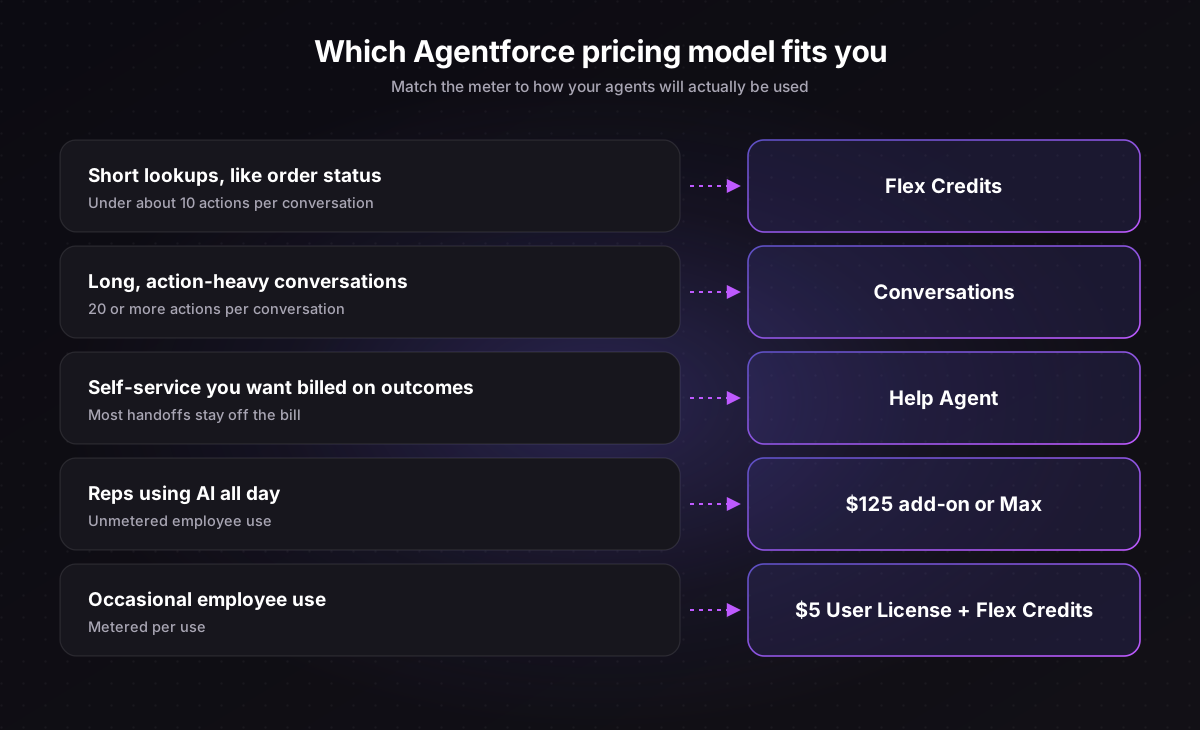
If you'd rather start from usage patterns than numbers, this map shows which Agentforce pricing model usually fits.
Your reps' licenses come on top. For 25 reps on annual list prices:
| Setup for 25 reps | Calculation | Cost per month |
|---|---|---|
| Core + Agentforce for Service add-on | 25 × ($195 + $125) | $8,000 |
| Advanced + Agentforce for Service add-on | 25 × ($395 + $125) | $13,000 |
| Max | 25 × $550 | $13,750 |
These seat prices include Service Cloud itself, not just Agentforce. The difference between rows is what decides whether the bundled credits and Data 360 in Max pay for themselves.
Additional costs to budget for
The meter is only part of the Agentforce bill. Salesforce discloses these costs, but its examples don't add them up for you.
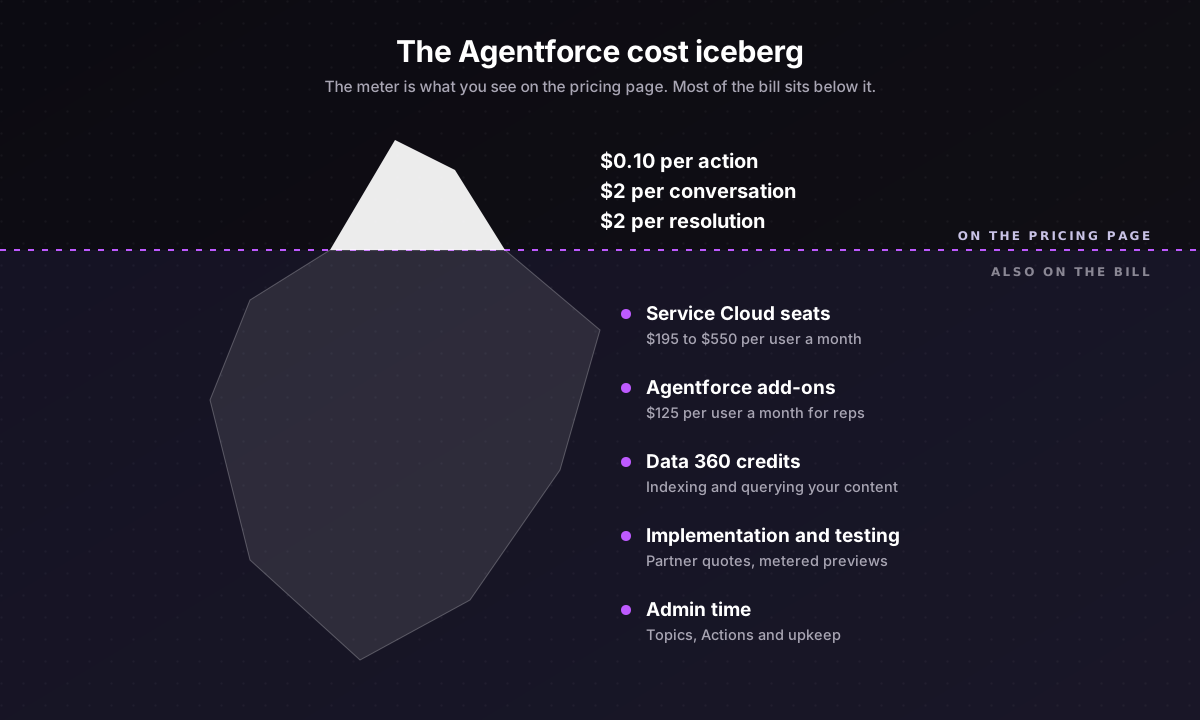
Data 360 credits. Agentforce answers from content stored in Data 360, and indexing and searching it uses credits.
At base-tier rates, the current rate card charges 150 credits per MB to process documents and 3 per million rows queried. Its intelligent document processing costs 600 credits per MB. Rates drop in volume tiers, and vector searches count the vectors in your index.
The Help Agent bundles the queries in a billable session, but preparing and indexing your content is still billed. Every worked example on the Agentforce pricing page ends with "does not include other costs like Data 360 credits."
Implementation. Salesforce doesn't publish a price for its services. Its Phase 0 datasheet promises an agent "deployed in just 4 weeks."
Partner estimates are scoped to specific projects:
- Clientell estimates $48,000 to $95,000 in first-year services for a single-use-case pilot: 50 to 200 Salesforce users, one internal agent, grounded on CRM records, without Data 360.
- Cloud Analogy quotes 4 to 5 weeks for a standard rollout.
Neither is a minimum. Ask for a quote that separates connecting the agent, running a pilot and reaching production.
Testing. Previewing an agent and running tests are metered too. Sandboxes use lower rates: 16 credits per action instead of 20, and Help Agent resolutions cost nothing.
Contracts and support. Most Salesforce products use annual contracts. Premier Success is listed at 30% of net license fees, though the new Core, Advanced and Max editions include it.
Voice. Some customers are billed per Agentforce Voice minute instead of per voice action, and Salesforce doesn't publish that price. Telephony is billed separately as Contact Center Voice Credits.
How Salesforce Agentforce pricing has changed since 2024
Salesforce has changed its Agentforce pricing model several times, which is why older guides often disagree. Here are the main dated changes, all from Salesforce's own announcements.
| Date | Change |
|---|---|
| September 2024 | Agentforce launches at $2 per conversation |
| May 2025 | Flex Credits arrive at $500 per 100,000, or $0.10 per action |
| June 2025 | $125 add-ons and Agentforce 1 Editions from $550, with Enterprise and Unlimited list prices up about 6% from August 1 |
| October 2025 | Data Cloud is renamed Data 360 |
| July 2026 | The Help Agent's $2 per resolution pricing becomes available |
| September 2026 | Core, Advanced and Max editions replace the old lineup, and Max takes over from Agentforce 1 at the same price |
How to estimate and lower your Agentforce bill
Salesforce offers a Flex Credit calculator, but it only works as well as the numbers you feed it. Here's the process I'd follow to turn Salesforce Agentforce pricing into a budget.
- Count conversations by channel. Pull a month of chats, messages and emails, because each channel has its own conversation window and resolution cap.
- Map the actions in your top flows. List the actions behind your five most common requests, like authenticating a customer and looking up an order.
- Price each meter. Multiply conversations by actions at $0.10, conversations by $2, and expected resolutions by $2, then compare.
- Add Data 360. Estimate how many MB of articles and files you'll index and how much you'll query, using the rate card.
- Add seats and services. Add your reps' licenses, the edition you need and a written implementation quote.
Then keep the bill down:
- Design flows with fewer actions. On Flex Credits, every action you remove from a common flow saves $0.10 every time it runs.
- Test in a sandbox first. Sandbox actions cost 16 credits instead of 20, and Help Agent resolutions cost nothing there.
- Watch automated runs. Flows that run as an automated user and scheduled agents are metered, even on "unmetered" add-ons.
- Match the meter to the work. Use Flex Credits for short lookups, conversations for long troubleshooting, and the Help Agent where billing per qualifying resolution fits your support patterns.
- Commit for a discount. Salesforce's buying models give the best rates to pre-purchased credits.
What people actually say about Agentforce pricing
Reviews of Agentforce are mostly positive about what it can do, but the comments on price follow a pattern. These come from an r/salesforce thread on Agentforce pricing and from G2, where Salesforce invited the reviewers.
“Has anyone actually seen real pricing yet? We have been in talks with our rep for weeks and have yet to get a number.”
“It's also ridiculously expensive compared to all our other options for direct or platform based LLMs. As the cost comes down, we'll likely explore it again.”
“Price per conversation sounds expensive, but is actually cheaper if you are getting high volume consumption, especially from the same user, as a conversation is “per user per day”.”
“The consumption-based pricing per conversation or action makes budgeting unpredictable and can escalate quickly at scale.”
“This benefits our business by significantly reducing resolution times, boosting agent productivity, and lowering operational costs while maintaining personalized customer engagement.”
The common thread isn't that Agentforce is too expensive for everyone. It's that teams find it hard to predict the bill before they commit, which is exactly what the calculator above is for.
Is Salesforce Agentforce worth the price?
Agentforce is worth it when your team wants to build and maintain its own agents on Salesforce, with admin capacity for Topics, Actions, Data 360 and testing. Not every deployment is a long project: Salesforce packages the Help Agent with a quick setup for standard self-service. Custom agents grounded in your own data take more work.
If your cases are technical and the answers live in past cases and engineering tools rather than articles, an AI layer is the alternative. Pluno is an AI layer you add directly inside your existing helpdesk, including Salesforce Service Cloud. That way, AI can support every part of your support workflow without changing how your team works.
What Pluno adds for Service Cloud teams:
- Technical case resolution: the AI agent learns from your resolved cases first, then your help center and the tools your team uses, such as Slack or Jira. It replies only when its sources agree.
- Investigation: the Troubleshooting Agent checks code, logs and error tracking to find the root cause of a technical issue.
- Agent assistance: AI Copilot drafts each reply inside Service Cloud, with sources, for your reps to review and send.
- Engineering escalation: Escalation Copilot sends bugs to Slack, Jira, Linear, Microsoft Teams or incident.io with the report filled in, and syncs updates back to the case.
For a sense of results, Innovorder, whose restaurant software spans both software and hardware, resolves 67% of its chat and WhatsApp tickets with Pluno. Setup is quick too: Pluno connects to Service Cloud in hours to a day or two, with no Data 360 to build. Most teams see useful results within days.
What Pluno costs (in euros, monthly billing, from Pluno pricing):
- Platform fee by monthly ticket volume: 249€ for up to 500 tickets, rising with volume (for example, 999€ up to 3,000 tickets). It includes the AI agent, AI Tagging, Escalation Copilot, topic trends and call summaries.
- Usage and seats: 0.90€ for each case the AI agent fully resolves. No resolution fee is charged for cases handed to your team, though the platform fee still applies. AI Copilot is 49€ per agent seat.
- Separate modules: Quality Assurance at 35€ per agent per month, and the Troubleshooting Agent from 99€ a month.
- Still needed: your Service Cloud license.
My Agentforce alternatives comparison puts the two side by side on six support problems, including the bill at 5,000 cases a month. My Salesforce AI agents roundup compares seven AI tools that run inside Service Cloud.
The bottom line
Salesforce Agentforce pricing charges customer-facing agents by action, conversation or resolution, and your reps by user, with Data 360 and implementation on top. Flex Credits suit short conversations, while among Salesforce's meters only the Help Agent keeps most handoffs off the bill.
Model your own volumes on each meter before you sign, and get the implementation quote in writing. If your cases are technical, a free Pluno simulation on your last 50 cases shows what an AI layer inside Service Cloud would answer.
FAQ
What is Salesforce Agentforce pricing based on?
Salesforce Agentforce pricing is based on usage for customer-facing agents and on users for your employees. Customer-facing agents are billed per action, per conversation or per resolution, while reps pay a per-user license or add-on.
How much does Agentforce cost?
Agentforce costs $0.10 per action through Flex Credits, $2 per conversation, or $2 per Help Agent resolution for customer-facing agents. Employee use costs $5 per user a month plus Flex Credits, or $125 per user a month for unmetered use. The Max edition starts at $550 per user a month.
Is Agentforce free?
Not for production use at scale. Salesforce Foundations is a free add-on for Enterprise Edition and up that includes Agentforce tools and some Flex Credits.
Salesforce's Foundations page lists 450,000 credits in one place and 200,000 in its FAQ, so confirm the amount with Salesforce. A free Developer Edition is also available for building and testing.
Is Agentforce included in Salesforce?
Partly, depending on the edition. Core, Advanced and Max include 500,000, 1 million and 2.75 million Flex Credits a year. Advanced and Max also include access to the Help Agent, whose resolutions are still charged.
The full Agentforce for Service package, with unmetered use for your reps, is included only in Max, from $550 per user a month. On Core and Advanced it's a $125 per user add-on, and Starter and Pro Suite don't offer it.
What is the difference between Salesforce and Agentforce?
Salesforce is the company and its CRM platform, including Service Cloud. Agentforce is Salesforce's AI agent platform, which runs on top of that CRM and its Data 360 data layer.
Is unmetered Agentforce usage available for employees?
Yes, with the $125 Agentforce add-ons or a Max edition. Usage still gets metered when it runs as an automated process, like a scheduled flow, and any Data 360 usage it triggers consumes credits.
Can I mix Flex Credits and Agentforce pricing per conversation?
No. Salesforce doesn't support Flex Credits and conversations in the same org. You can combine Flex Credits with per-user add-ons, though.
What is a Flex Credit worth?
One Flex Credit costs $0.005 at the list price of $500 per 100,000. A standard action uses 20 credits ($0.10), a voice action 30 ($0.15), and a Help Agent resolution 400 ($2).