
Every help desk now says it has AI. The word covers everything from a tag suggestion to a bot that closes a ticket on its own, so two products can both claim "AI" and do almost nothing alike.
This guide reviews the 10 best AI help desk software tools in 2026 on two things that matter: what the AI does, and what it costs once you switch it on. Some tools only help your agents, drafting a reply or tagging a ticket while a human sends it. Others resolve tickets end to end with no agent in the loop. The price difference between those two is large, and the billing is where the surprises can hide.
There is also a second route most roundups skip. You do not have to replace your help desk to get better AI. If Zendesk or Intercom already works for your team, you can add an AI layer that fits your needs better on top of it and keep everything else. We cover that route too, because for a lot of B2B SaaS teams it is the cheaper and faster move.
By the end you will know which AI help desk software fits your team size, budget, and stack, how to read the real bill before a sales call, and how to decide between buying a new help desk and adding AI to the one you already have.
TL;DR: which AI help desk fits your team
Start with what kind of support you run, because that decides more than any feature list.
-
High-volume B2B SaaS or technical support: you want AI that learns from the tickets your team has already solved, so it can handle edge cases the help center never documented. Pluno works inside Zendesk and Intercom for exactly this. Pylon suits B2B teams that live in Slack.
-
Consumer or transactional support: the built-in AI on a mainstream platform is usually enough. Zendesk for the most depth and integrations, Intercom's Fin for one of the strongest autonomous resolution bots, Freshdesk for the most value, and Zoho Desk for budget.
-
Segment-specific: Gorgias for e-commerce, Front for shared-inbox teams, Help Scout for small teams that want simplicity, and Kustomer for high-volume conversational support.
-
Watch the billing: the seat price is the smallest part of the bill, because AI assist add-ons and per-resolution fees stack on top. A "$15 per agent" plan can land near $60 to $90 per agent once the AI is doing real work, so model it at your ticket volume before you sign.
What is AI help desk software?
AI help desk software is help desk software with built-in AI that reads incoming messages, drafts or sends replies, and in the strongest tools resolves tickets end to end without a human agent in the loop.
The AI sits on the same core you already know: a shared inbox, ticketing, a knowledge base, and reporting. What changes is how much of the work the software does before a human touches it. At the light end, the AI classifies a ticket, suggests a reply, or writes a summary. At the heavy end, it answers the customer directly and closes the ticket, escalating only what it cannot solve.
Two different readers search this term. Customer-support teams want AI that talks to customers and helps agents. Internal IT teams want AI that answers employees about laptops, access, and passwords. This guide covers the customer-support tools. If you need an internal IT service desk, the tools built for that (Moveworks, Aisera, and similar) are a separate category worth its own comparison.
What makes a help desk "AI" (and what to check before you buy)
Four things separate a real AI help desk from a help desk with a simple AI wrapper bolted on: whether the AI only assists or resolves, where it looks for answers, how it is priced, and how well it fits your stack. Check all four before you commit.
Assist versus autonomous resolution
This is the biggest difference in both impact and price. An assist AI suggests a reply, tags the ticket, or writes a summary, and a human reviews and sends. Freshdesk's Freddy and Zoho's Zia work this way.
An autonomous AI answers the customer and closes the ticket on its own. Intercom's Fin, Zendesk's AI Agents, and Front's Autopilot work this way.
Assist lowers handle time. Autonomous lowers ticket volume. They are billed differently, so knowing which one you are buying changes the whole cost model.
Where the AI looks for answers
Most AI help desks answer from your help center and docs. That works until the product changes faster than the documentation, which is normal in B2B SaaS. When a customer hits a failed data import or an SSO error the docs never covered, a help-center bot has nothing to pull from and either guesses or gives up.
The stronger approach ingests your resolved support tickets, because the real fix for a hard problem usually lives in a ticket your team already closed. The help center rarely documents it. Pluno is one example of the stronger approach. It ingests resolved support tickets so it can handle complex issues the help center never covered, and it works inside Zendesk and Intercom. Check what any tool reads from before you trust it on hard tickets.
Pricing model
AI is almost always a paid layer on top of the base plan. Some vendors charge per agent for assist features. Some charge per resolution or per outcome for autonomous replies. Many charge both. Read the pricing page for the billing unit. That unit is what scales with your volume, and the headline seat price hides it.
Ecosystem fit
The AI is only as useful as the systems it connects to. Check that it works with your CRM, your store, your engineering tools (Jira, Linear, Slack), and the help desk you already run. A tool that cannot reach your order data or your engineering backlog will hand more tickets to humans than its demo suggests.
The 10 best AI help desk software tools in 2026
Each entry covers what the tool does, who it is for, where it falls short, and what its AI costs. Pricing reflects public list rates as of mid-2026, and vendors define resolutions, outcomes, and conversations differently, so treat these as starting points and confirm current rates in your own quote.
Quick comparison
| Tool | Type | AI capability | Autonomous resolve? | Starting price (public, mid-2026) | Best for |
|---|---|---|---|---|---|
| Zendesk | Standalone help desk | Copilot (assist) + AI Agents (autonomous) | Yes, add-on | Suite from ~$55/agent/mo + AI add-ons | Mid-to-large teams wanting depth |
| Intercom (Fin) | Standalone help desk (Fin also runs as a layer) | Fin (autonomous) + Fin Copilot | Yes | Fin from $0.99/outcome | AI-first, product-led teams |
| Freshdesk | Standalone help desk | Freddy (assist) + Copilot add-on | Assist mainly | From ~$15/agent/mo | Value and breadth |
| Zoho Desk | Standalone help desk | Zia (assist) | Assist | Free tier, then ~$14/agent/mo | Budget and Zoho shops |
| Help Scout | Standalone help desk | AI Answers + assist | Partial | ~$25/user/mo | Small teams wanting simplicity |
| Gorgias | Standalone help desk | AI Automate | Partial | Contact sales / quote | E-commerce |
| Front | Standalone help desk | Copilot (assist) + Autopilot (autonomous) | Yes, Autopilot | From ~$25/seat/mo + AI add-ons | Shared-inbox teams |
| Kustomer | Standalone help desk | AI Agents + rep assist | Yes | From ~$89/seat/mo + per-conversation | High-volume conversational support |
| Pylon | Standalone help desk (AI-native) | AI-native triage, replies, escalation | Yes | From ~$59/seat/mo + AI add-on | B2B/SaaS support |
| Pluno | AI layer for Zendesk & Intercom | Deflection AI, Copilot, escalation, troubleshooting | Yes (Deflection AI) | Custom platform fee + €0.90/resolution | B2B SaaS, complex technical tickets |
1. Zendesk
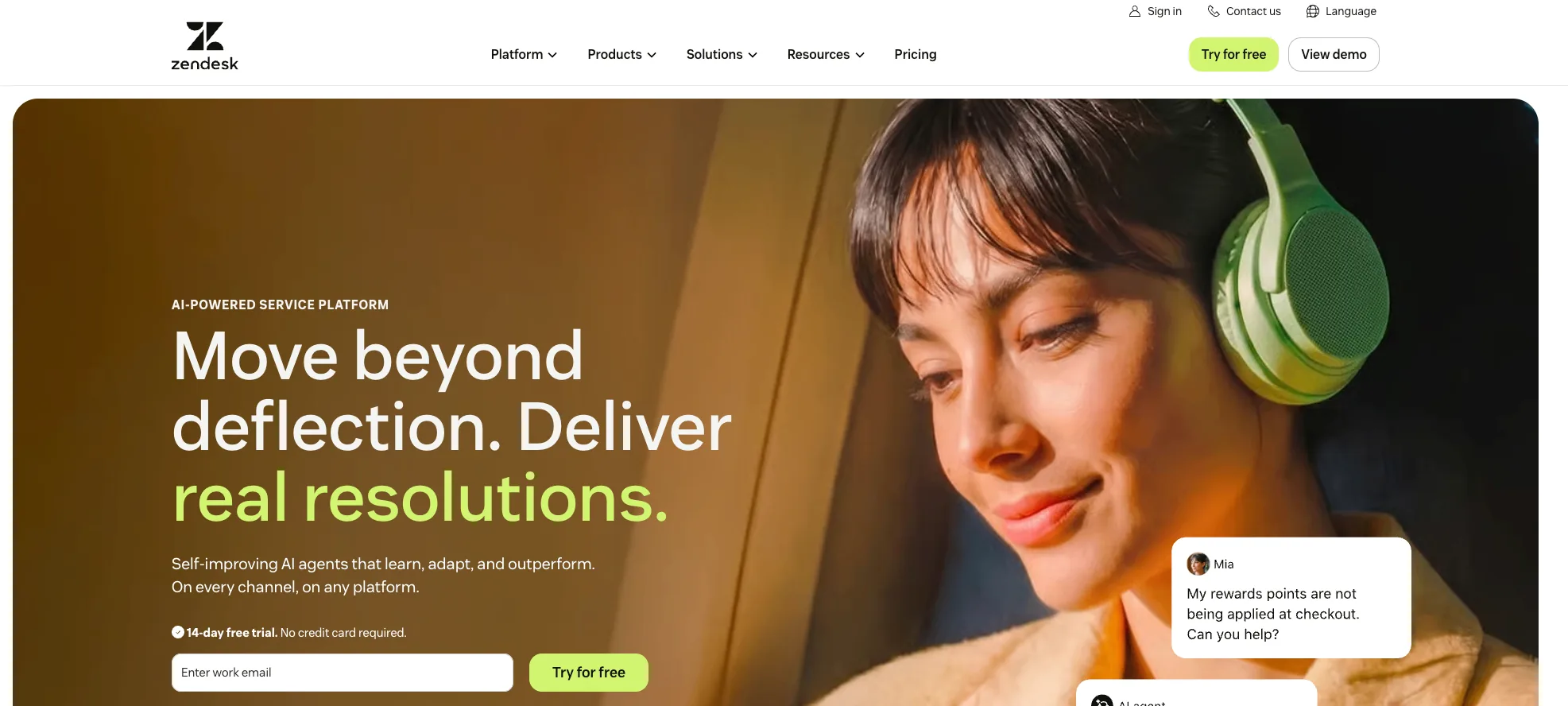
Zendesk is the most mature omnichannel help desk, with a large integration catalog and the deepest feature set here. Its AI comes in two parts. Copilot assists agents with drafts, summaries, and intelligent triage. AI Agents resolve customer conversations autonomously. Intelligent Triage classifies intent, sentiment, and language, and can populate custom fields through entity detection, and admins can build their own intents and entities.
Best for: established mid-to-large teams that want depth, reporting, and a wide app ecosystem.
Where it falls short: the AI is a stacked add-on cost, and the two AI products are separate line items. Escalating a ticket to engineering in Jira or Slack still means an agent writes the summary, repro steps, and impact by hand, so the handoff stays manual.
Pricing: the Suite starts around $55 per agent per month, with Copilot and AI Agents billed on top. See the pricing section for how the add-ons stack.
2. Intercom (Fin)
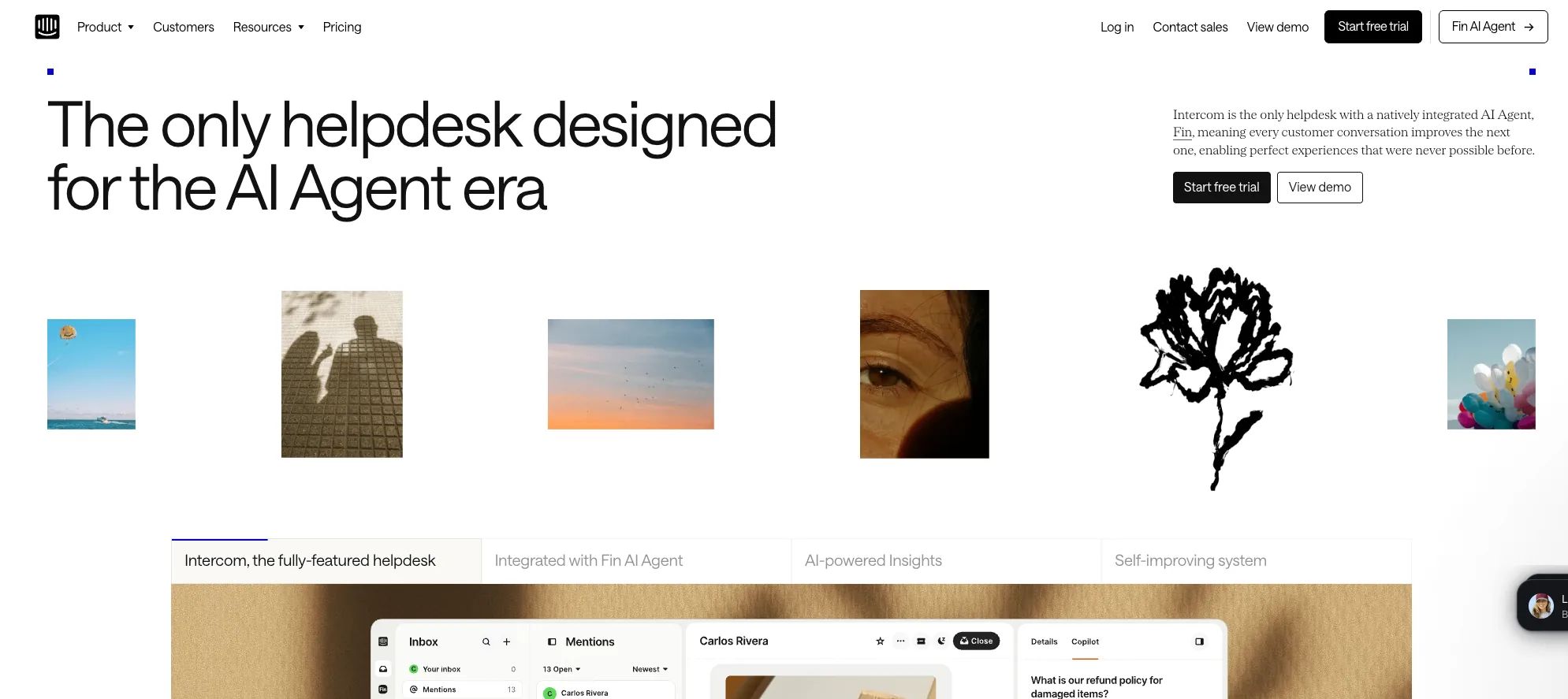
Intercom's Fin is one of the most widely adopted autonomous resolution bots, and it runs inside Intercom or on top of other help desks including Zendesk. It is multilingual and strong on chat-first, product-led support. Fin's real wedges are Procedures, which are natural-language SOPs the AI follows, and Custom Actions, which call your APIs during a conversation.
Best for: SaaS and product-led teams that want autonomous chat resolution.
Where it falls short: Procedures and Custom Actions are manually configured and maintained, so someone writes and updates them as your product changes, and that upkeep grows with your edge cases. Salesforce signed a definitive agreement to acquire Intercom (now trading as Fin) in June 2026 for about $3.6 billion. The deal has not closed and is expected around Salesforce's fiscal Q4 2027, pending regulatory clearance, so weigh it in any long-term commitment.
Pricing: Fin bills from $0.99 per outcome, with a monthly minimum of included outcomes before extra ones are charged. Fin Copilot runs about $35 per user per month. Per-outcome pricing is standard for autonomous AI and is not a drawback on its own.
3. Freshdesk
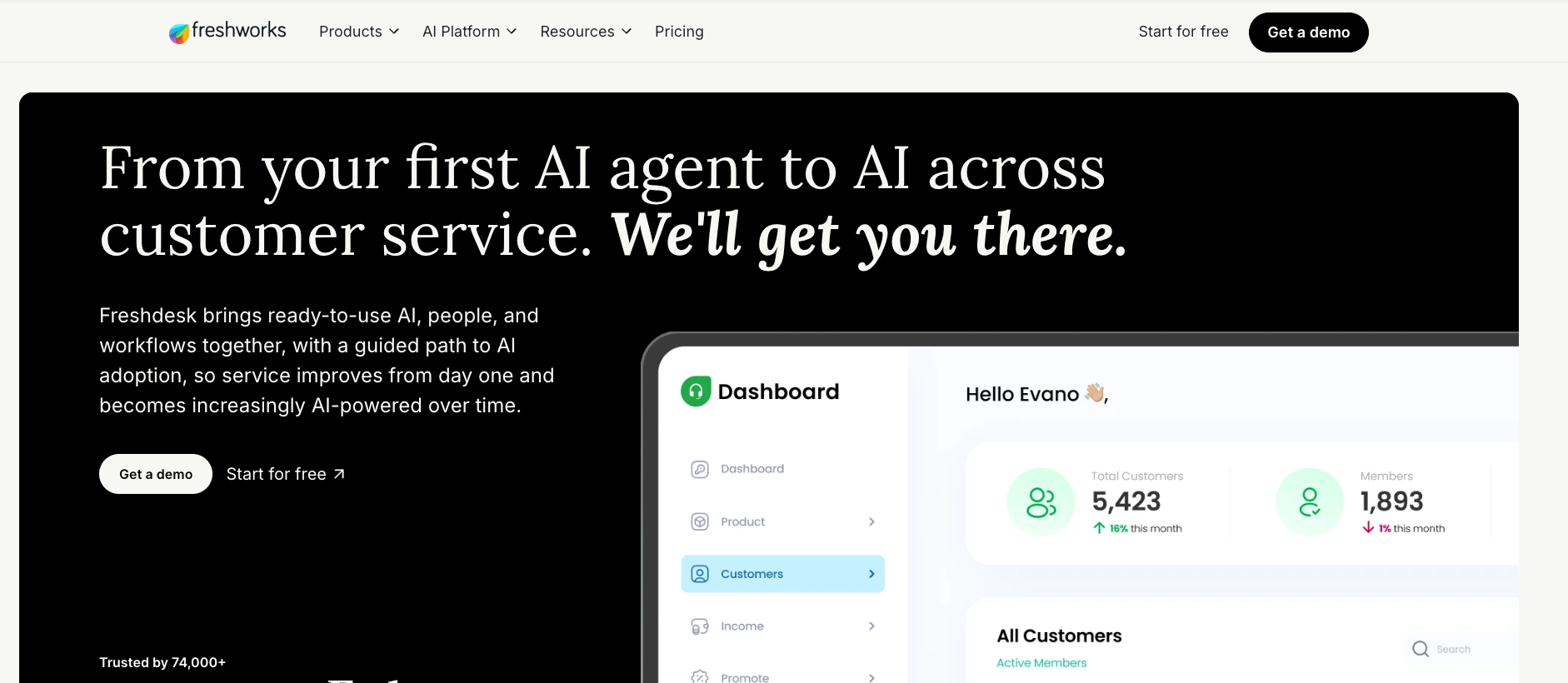
Freshdesk gives small and mid-market teams a lot for the money. Freddy AI handles ticket classification, canned-response suggestions, and basic chatbot flows, with a Freddy Copilot add-on for agent assist. The marketplace is broad, and the base plans are among the cheapest here.
Best for: SMB and mid-market teams that want wide functionality on a budget.
Where it falls short: Freddy mostly assists. It does not resolve complex tickets autonomously, so a human stays in the loop on anything beyond simple flows.
Pricing: base plans start around $15 per agent per month, with the Freddy Copilot add-on billed separately.
4. Zoho Desk
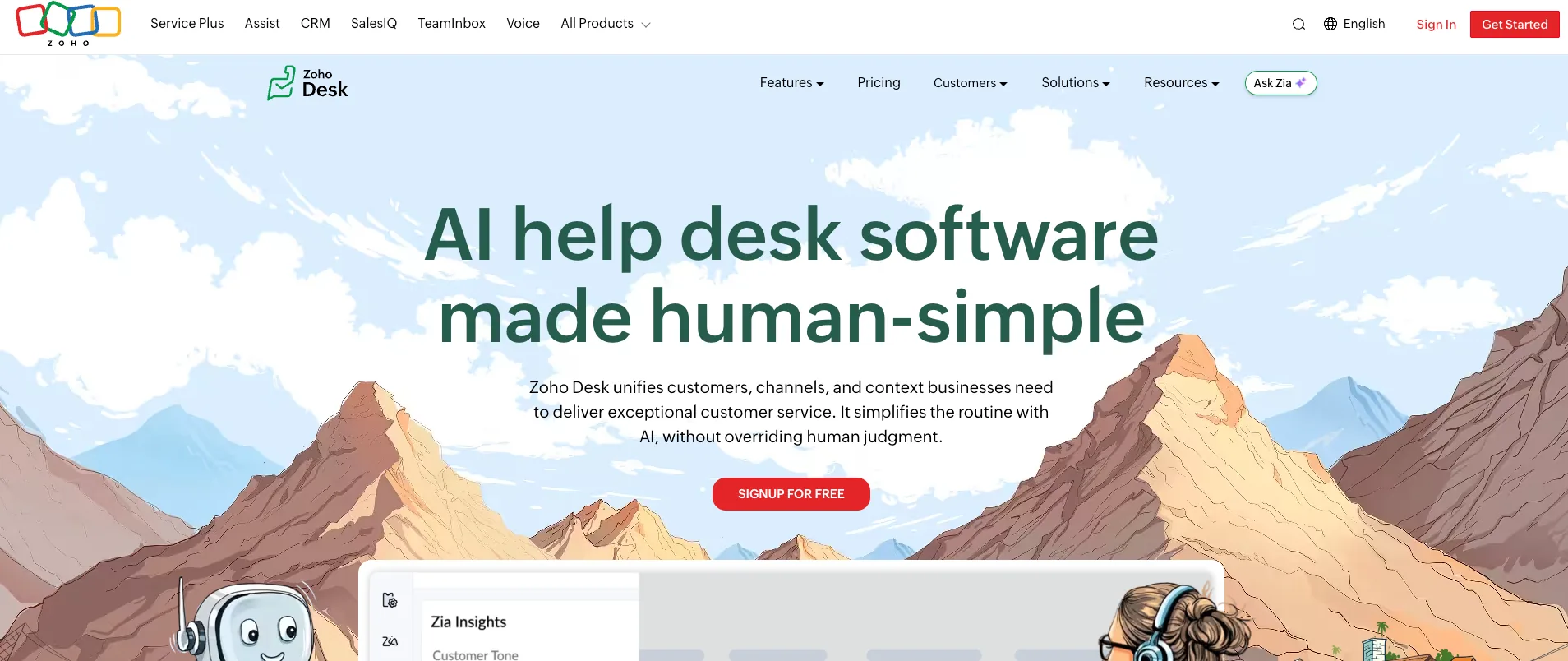
Zoho Desk is the budget pick, especially if you already run Zoho CRM. Its AI, Zia, handles sentiment analysis, anomaly detection, and auto-tagging. Pricing is the friendliest on this list, starting with a free tier.
Best for: cost-sensitive teams and existing Zoho shops.
Where it falls short: Zia assists the agent and does not resolve tickets on its own, so it lightens agent work without cutting ticket volume much.
Pricing: a free tier for small teams, then paid plans from about $14 per agent per month.
5. Help Scout
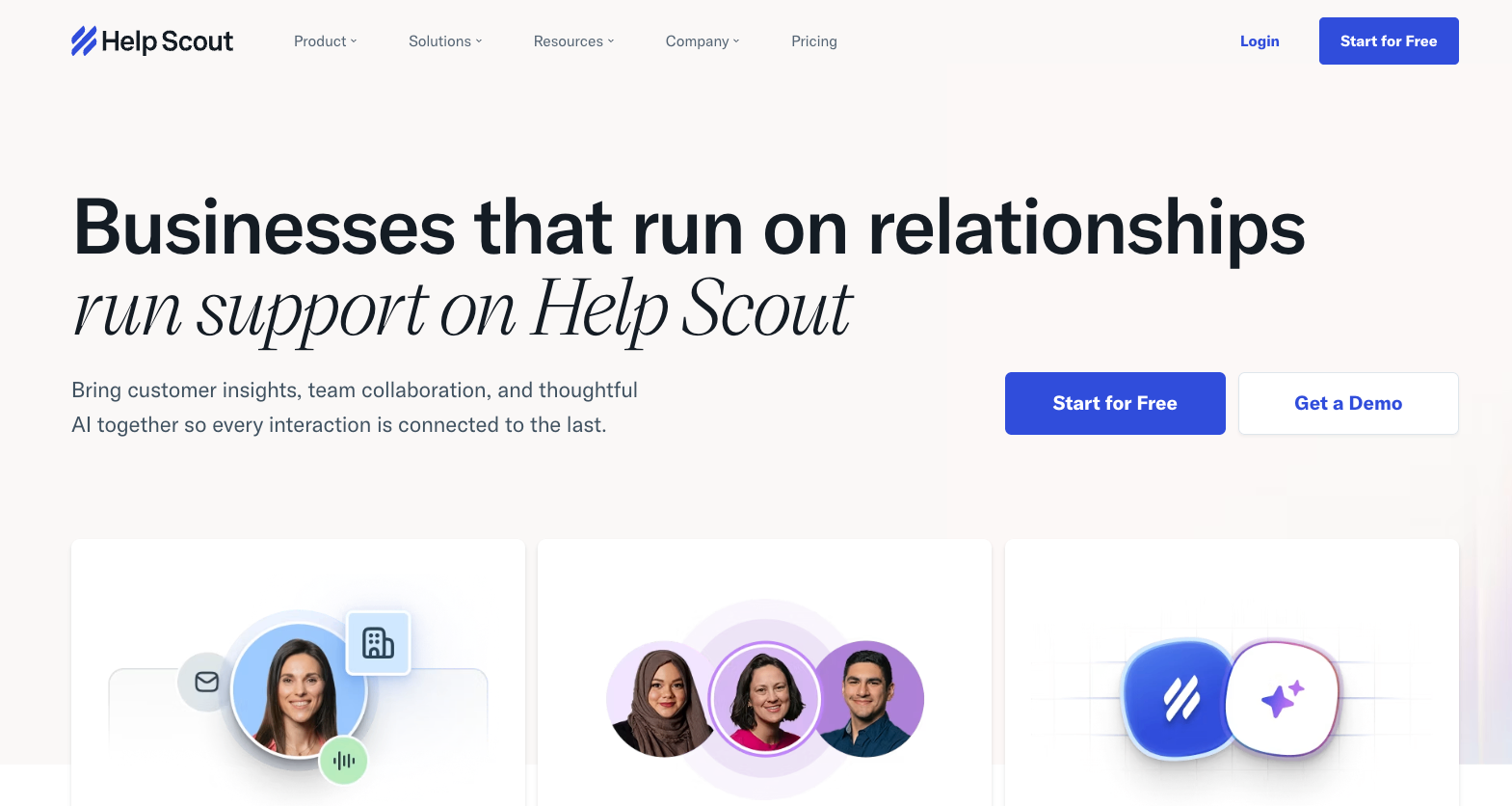
Help Scout is email-first, simple, and fast to set up. Its AI adds reply drafting and AI Answers, which can resolve common questions. It suits teams that value a clean inbox over a large feature surface.
Best for: small teams that want simplicity.
Where it falls short: the AI is lighter than the platforms built around it, and there are fewer advanced workflows for complex routing.
Pricing: around $25 per user per month, with AI Answers billed per resolution.
6. Gorgias
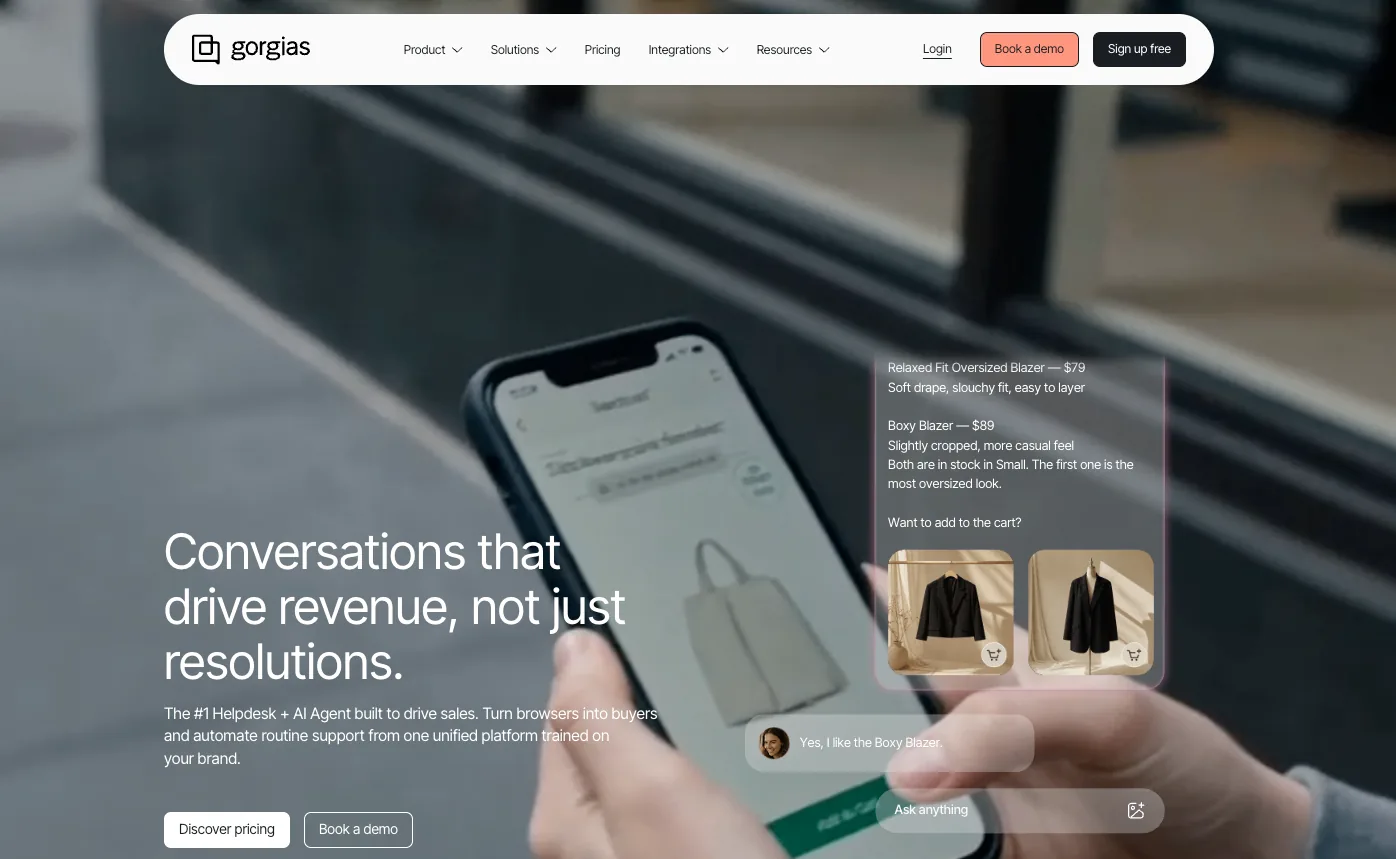
Gorgias is built for online stores, with AI tuned to order status, returns, and storefront questions across Shopify and BigCommerce. For e-commerce support it understands the questions customers ask.
Best for: e-commerce and retail support.
Where it falls short: the fit narrows outside retail, so B2B and technical teams get less value from its order-centric automation. Handed-over conversations are not charged as AI-resolved, so there is no double-billing on handoffs.
Pricing: mostly quote-based; confirm with Gorgias for current rates.
7. Front
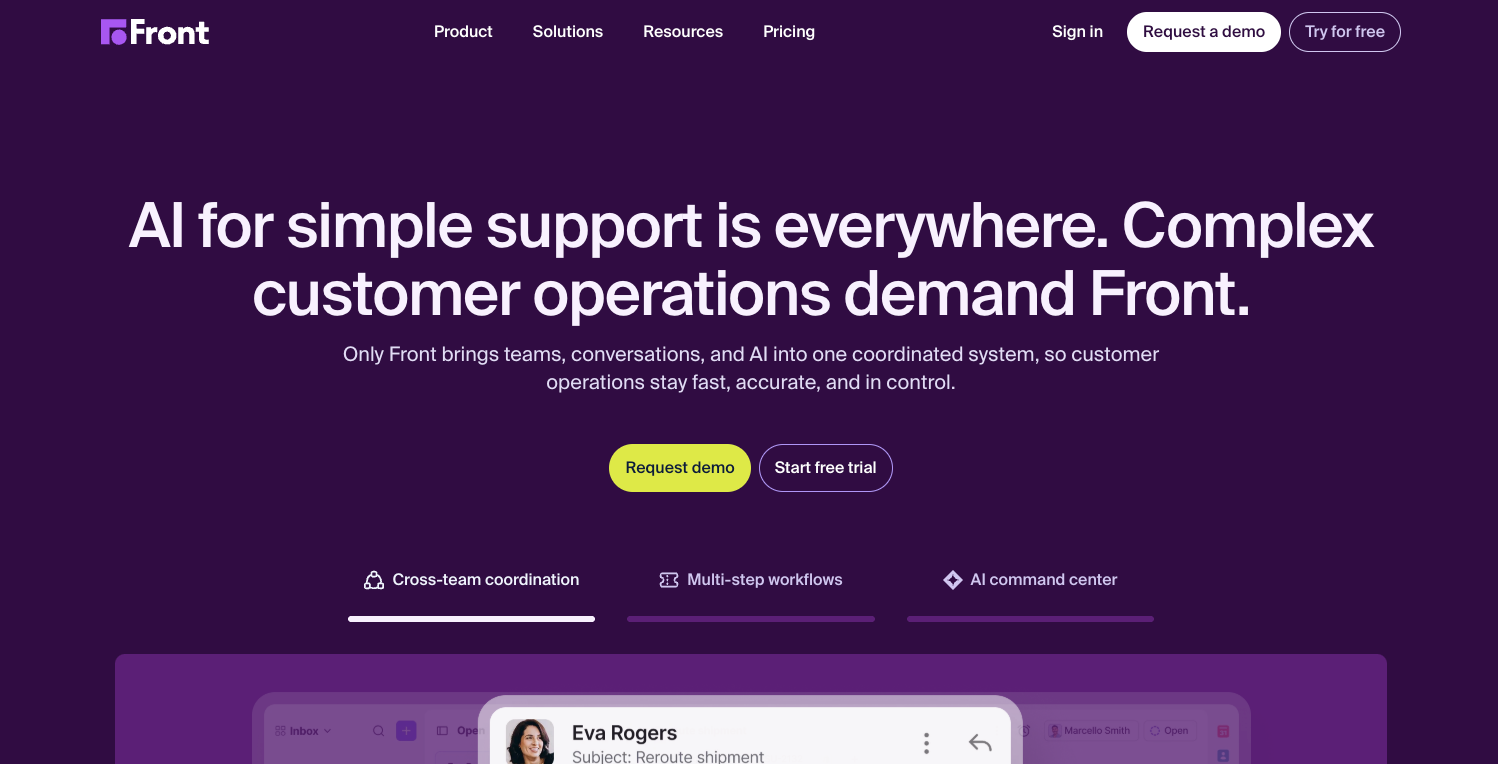
Front runs support out of a collaborative shared inbox across email, chat, SMS, and social. Its AI includes Copilot for assisted drafting and Autopilot, an autonomous agent that resolves conversations. It fits teams that treat email as the primary channel.
Best for: teams that collaborate on email and want AI on a shared inbox.
Where it falls short: the AI features are separate add-ons that grow the bill as you turn more of them on.
Pricing: base plans from about $25 per seat per month, with Copilot billed per seat and Autopilot from $0.89 per resolution.
8. Kustomer
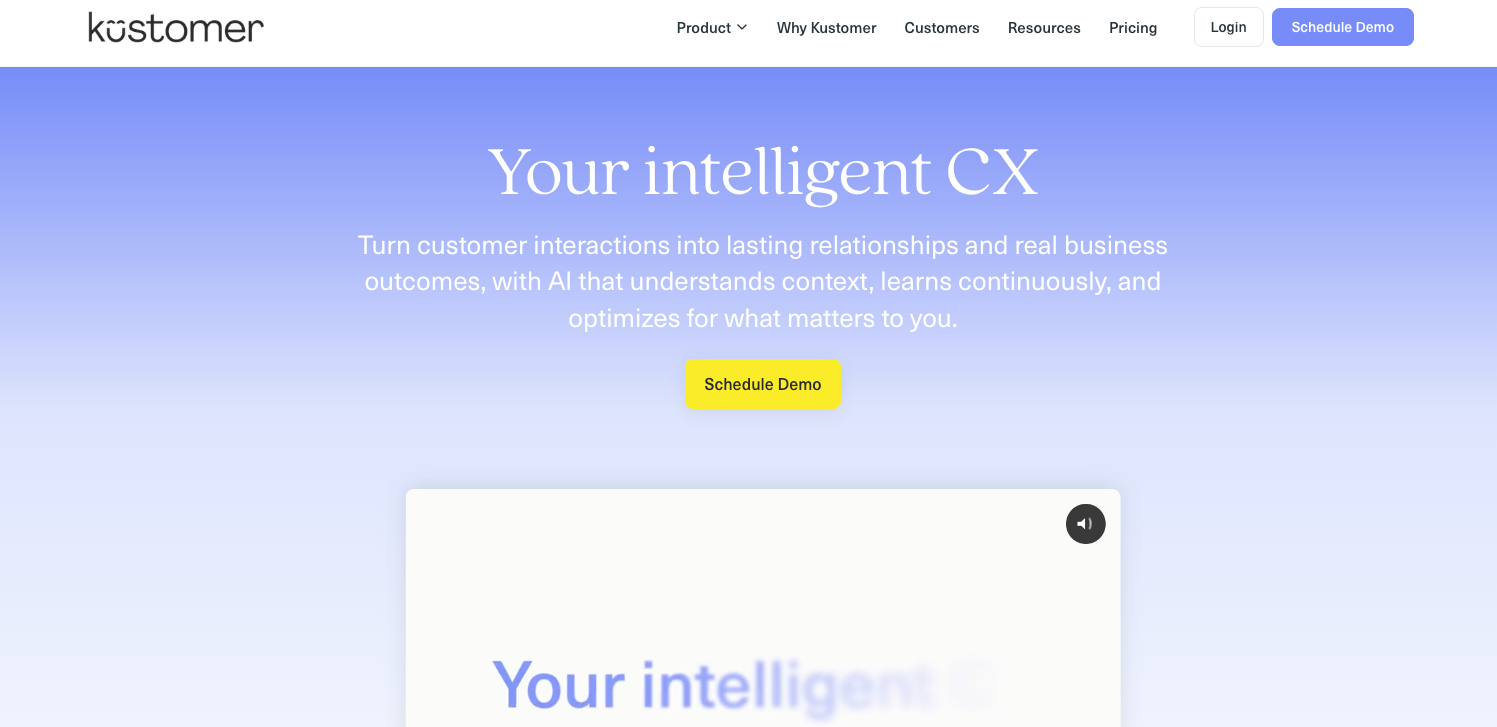
Kustomer targets high-volume conversational support with AI agents for customers and assist for reps. It suits larger teams handling heavy chat and messaging volume.
Best for: high-volume conversational support.
Where it falls short: pricing sits at the premium end, and the per-conversation AI charge adds up as volume climbs.
Pricing: seats from about $89 per month, with AI agents billed per engaged conversation.
9. Pylon
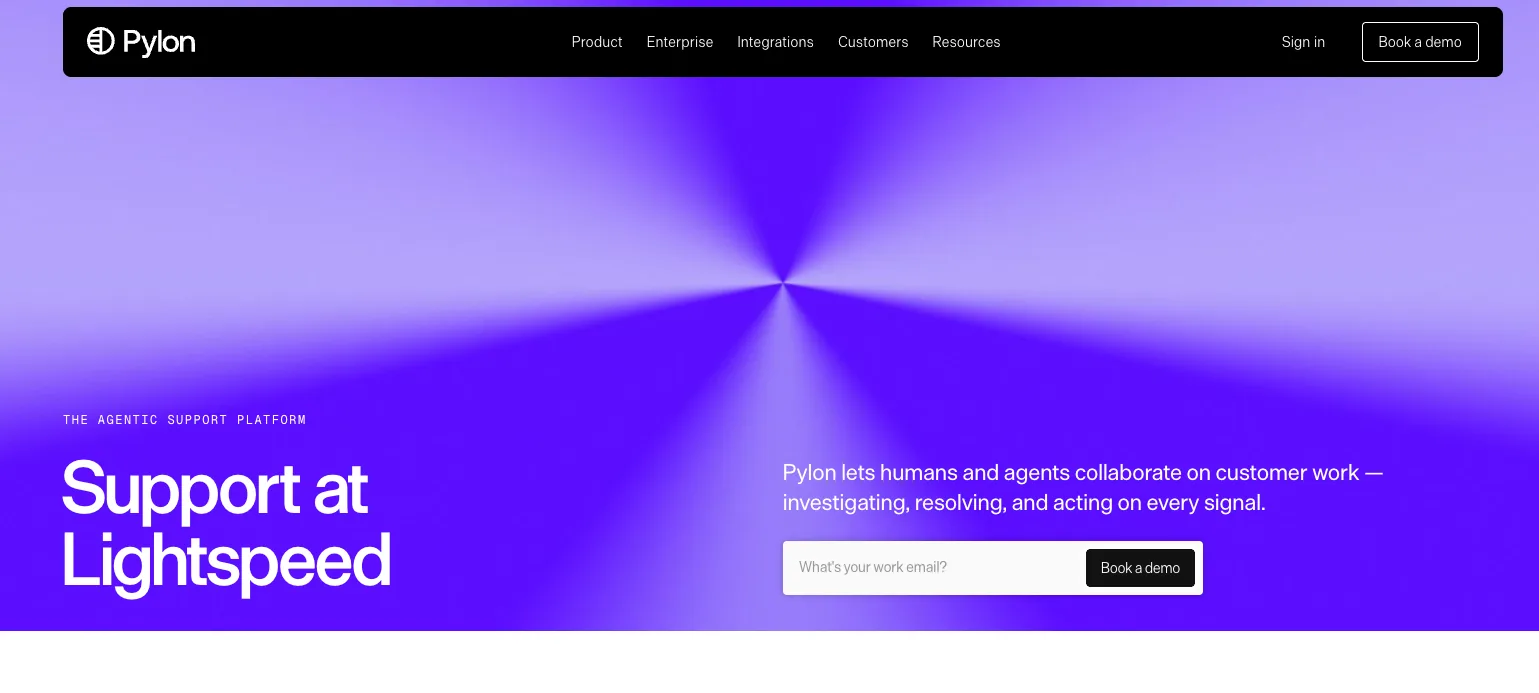
Pylon is an AI-native support platform built for B2B and SaaS teams, covering Slack-connected customers, email, and more. Its AI handles triage, draft replies, classification, and escalation, plus account summaries and health scores. It is the closest AI-native platform on this list to the complex-support use case.
Best for: B2B and SaaS support teams, especially those supporting customers in shared Slack channels.
Where it falls short: per-seat pricing runs high at the top tiers, and it targets B2B, so high-volume consumer support is outside its focus.
Pricing: seats from about $59 per month, with an AI Assistants add-on on higher plans.
10. Pluno
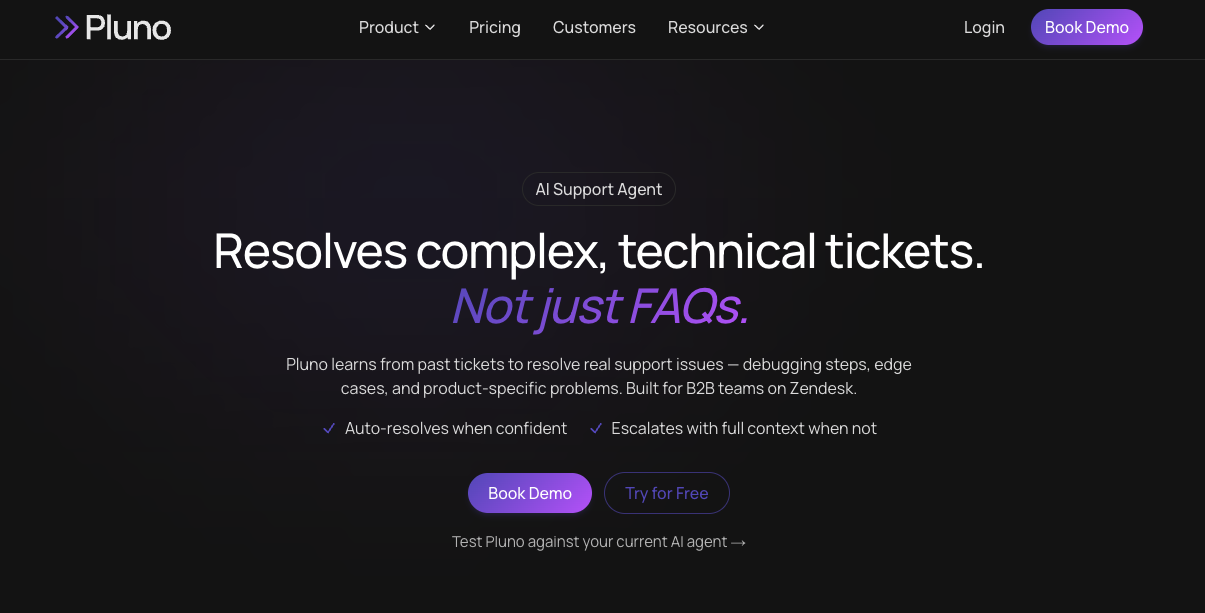
Pluno learns from your resolved support tickets, which is what lets it handle complex issues the help center never documented, and it works inside Zendesk and Intercom.
It is the AI layer for teams whose hardest tickets are technical: a failed import, an SSO misconfiguration, an integration that broke after a release, and more. Instead of building decision trees for every path, you connect Pluno to your help desk and it ingests the tickets your team has already solved.
The product is a set of modules:
-
Deflection AI resolves tickets autonomously on email, web widget, WhatsApp, and other messaging channels, and charges per resolution.
-
AI Copilot drafts replies in the agent sidebar, regenerates them as new messages arrive, and shows the sources behind each answer, with a human reviewing before sending.
-
Troubleshooting Agent investigates across code, logs, session recordings, Sentry, Linear, and databases to confirm a real bug before escalation.
-
Escalation Copilot syncs the ticket two ways with Jira, Slack, and Linear, and writes the escalation summary for you.
Best for: B2B SaaS support teams on Zendesk or Intercom with meaningful ticket volume and technically complex tickets.
Where it falls short: Pluno works as an AI layer inside Zendesk and Intercom, so a team on neither platform is not the fit. It also pays off in proportion to ticket volume, so a small, quiet queue will not see the same return as a busy one.
Pricing: a custom platform fee that scales with your ticket volume, plus €0.90 per resolution on Deflection AI and €49 per agent per month for AI Copilot. Escalations to humans are not billed.
Is adding a new AI layer better than switching to a new AI help desk?
You do not have to switch help desks to get better AI. You can add an AI agent layer on top of the one you already run, keep your workflows and history, and skip the migration entirely.
The layer route wins in a specific situation. Your help desk is fine, but its native AI is weak on your hard tickets, too generic, or too expensive once the add-ons stack. Rather than rip out Zendesk or Intercom and retrain the team, you connect an AI layer that reads your actual tickets and answers from them.
A few options work this way, and they differ in what they read from. Intercom's Fin can run on top of Zendesk as well as inside Intercom. eesel AI and Ada are other layers worth knowing. Pluno is the layer built for B2B SaaS support, because it ingests your resolved support tickets and works inside both Zendesk and Intercom.
Where the layer route earns its keep for technical teams is the part generic bots skip: getting a real bug confirmed and handed to engineering. On Pluno, the Troubleshooting Agent investigates across code, logs, Sentry, Linear, and databases to check whether an issue is a genuine bug or a customer-side fix. When it is a bug, Escalation Copilot opens and syncs the ticket with Jira, Slack, or Linear and writes the summary, repro steps, and impact automatically. The two modules run the loop together, one to investigate and one to hand off. That is work an agent on most platforms does by hand.
What AI help desk software really costs in 2026
The base seat price is the smallest part of the bill once you turn AI on, and that is where teams get surprised in month two. The cost stacks in three layers: the base seat you pay for every agent, the AI assist add-on that turns on Copilot-style drafting, and the per-resolution or per-outcome meter that bills every ticket the AI closes on its own. The table below shows all three side by side. Figures are public list pricing as of mid-2026, vendors define resolutions and outcomes differently, so treat them as starting points and confirm current rates in your own quote.
| Tool | Base seat (public) | AI assist add-on | Autonomous (per resolution/outcome) |
|---|---|---|---|
| Zendesk | Suite ~$55–$169/agent/mo | Copilot ~$50/agent/mo | AI Agents reported $1.50–$2.00/resolution |
| Intercom (Fin) | ~$39–$139/seat/mo | Fin Copilot ~$35/user/mo | Fin from $0.99/outcome (50-outcome monthly minimum) |
| Freshdesk | ~$15–$79/agent/mo | Freddy Copilot ~$29/agent/mo | Freddy AI Agent, billed per session |
| Zoho Desk | Free, then ~$14–$50/agent/mo | Zia (assist, bundled) | Assist mainly, no standalone per-resolution meter |
| Help Scout | ~$25–$90/user/mo | Bundled assist | AI Answers ~$0.75/resolution |
| Gorgias | ~$10–$900/mo (tiered) | AI Automate (bundled) | Per-resolution on AI plans; handoffs not charged |
| Front | ~$25–$105/seat/mo | Copilot +$20/seat/mo | Autopilot from $0.89/resolution |
| Kustomer | ~$89–$139/seat/mo | Rep assist ~$40/user/mo | ~$0.60/engaged conversation |
| Pylon | ~$59–$139/seat/mo | AI Assistants +$50/seat/mo | Bundled into AI-native plans |
| Pluno | Custom, scales with ticket volume | AI Copilot €49/agent/mo | Deflection AI €0.90/resolution (escalations not billed) |
So a "$15 per agent" help desk with real AI running can land near $60 to $90 per agent per month, plus usage. Two things follow from that. Model the cost at your real ticket volume, because the per-resolution meter is what scales while the seat price stays flat. And if your help desk itself is fine, a volume-scaled AI layer can come out cheaper and more predictable than stacking your incumbent's assist add-on and per-resolution meter, though you should check that at your own numbers before assuming it.
Pluno prices on the same logic, in the open. Per-resolution pricing is the industry norm here, so the thing to compare is how the total lands at your volume, not whether a tool meters usage at all.
How to choose the right AI help desk for your team
The decision comes down to your support profile and whether you keep your current help desk. Use these as direct rules.
-
Pick Zendesk if you are a mid-to-large team that wants depth, reporting, and a broad app ecosystem, and you accept paying for AI as add-ons.
-
Pick Intercom (Fin) if you want strong autonomous chat resolution and you are comfortable with per-outcome billing, keeping the Salesforce acquisition in mind for long-term plans.
-
Pick Freshdesk or Zoho Desk if budget leads and assist-level AI covers your tickets.
-
Pick Gorgias if you run e-commerce, or Front if your team works out of a shared email inbox, or Help Scout if you are a small team that wants simplicity.
-
Pick Pylon if you are B2B/SaaS and support customers in Slack.
-
Add an AI layer like Pluno if your help desk is fine and your problem is the AI: you run complex technical tickets on Zendesk or Intercom and want answers grounded in the tickets your team has already resolved, without a migration.