Intercom pricing starts at $29 per seat per month on annual billing and runs to $132 per seat on the Expert plan. Fin, its AI agent, is billed separately at $0.99 per outcome. On monthly billing the same three plans cost $39, $99 and $139 per seat.
Those five numbers are the easy part. Seats are the predictable half of an Intercom bill and the AI meter is the half that moves, and for most support teams the AI line ends up larger than the seat line.
Two other things make this a confusing year to price Intercom. The company renamed itself Fin, and on 15 June 2026 Salesforce signed a definitive agreement to acquire it for approximately $3.6 billion, which is worth knowing before you sign anything multi-year.
Below is every line that can appear on the invoice, plus the arithmetic for two teams with identical headcount and identical ticket volume whose bills differ by nearly $11,000 a year. You should be able to forecast your own number before you take a sales call.
All figures were verified against Intercom's own pages on 16 August 2026. Pricing in this category moves quickly, so check the live page before you build a business case on it.
Key takeaways
-
Three plans, two prices each. Essential $29, Advanced $85 and Expert $132 per seat per month on annual billing. Monthly billing costs $39, $99 and $139.
-
Fin is metered separately at $0.99 per outcome on every plan, and $9.99 for a qualification outcome. Fin charges once per conversation.
-
Lite seats are free and capped. Advanced includes 20, Expert includes 50, Essential includes none, and you cannot buy more.
-
Three add-ons stack on top. Pro from $99 a month, Proactive Support Plus at $99 a month, and Copilot at $29 per agent per month on annual billing or $35 on monthly.
-
Intercom is now called Fin, and Salesforce signed an agreement to acquire it on 15 June 2026 for approximately $3.6 billion. The deal is expected to close in the fourth quarter of Salesforce's fiscal year 2027, so it is signed and not yet closed.
Intercom pricing at a glance
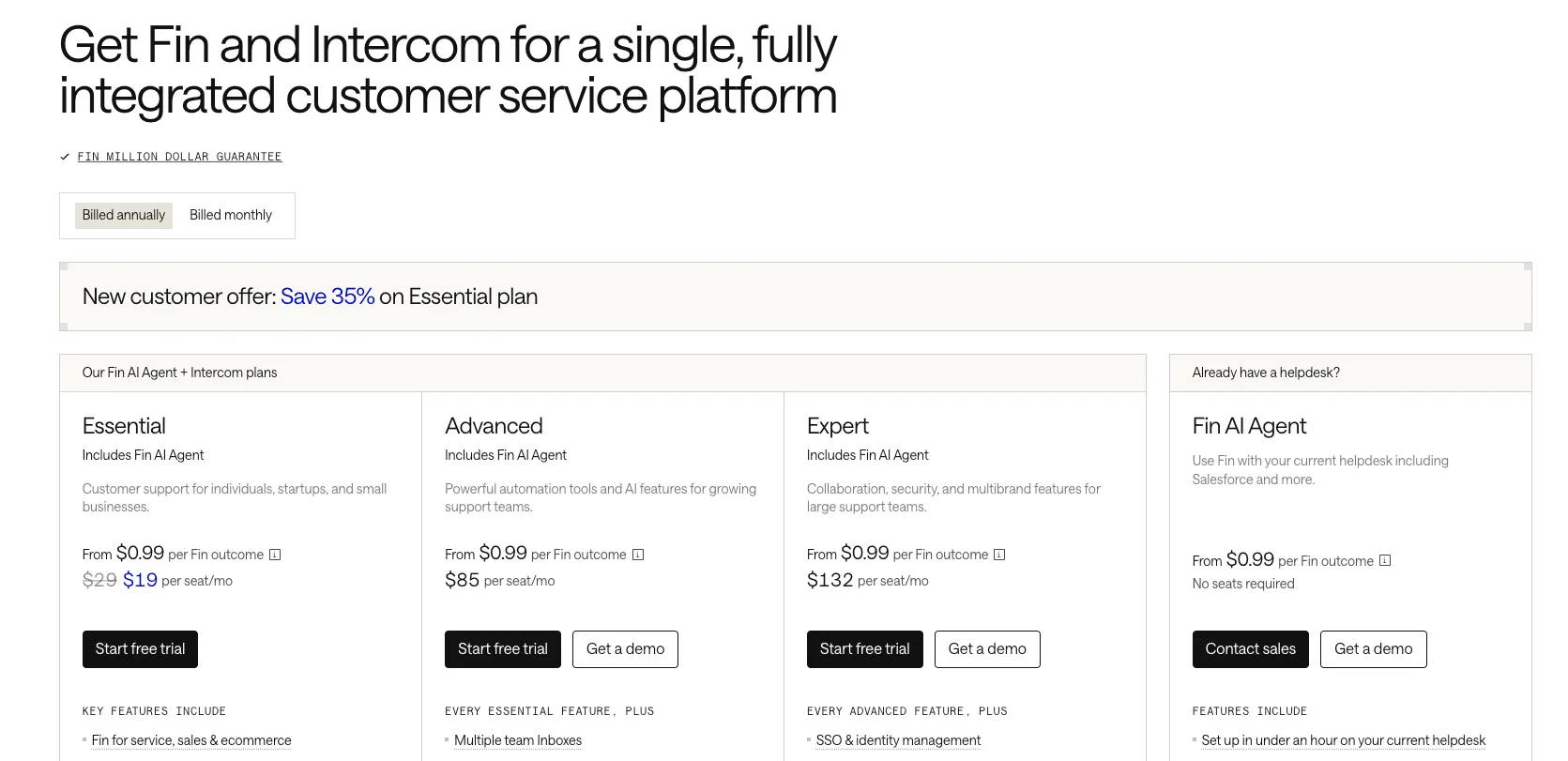
Intercom pricing has three seat tiers and one usage meter.
| Plan | Annual billing (per seat/mo) | Monthly billing (per seat/mo) | Free Lite seats | What it adds |
|---|---|---|---|---|
| Essential | $29 | $39 | 0 | Fin AI Agent, Messenger, shared inbox and ticketing, pre-built reports, public help center |
| Advanced | $85 | $99 | 20 | Multiple team inboxes, workflows automation builder, round-robin assignment, private and multilingual help center |
| Expert | $132 | $139 | 50 | SSO and identity management, HIPAA support, SLAs, multibrand Messenger and help center |
If you have read three articles about Intercom pricing and seen three different price sets, the table above is why. Some publications quote the annual rate and some quote the monthly rate, and few of them say which one they are using. Intercom publishes both columns together on its own help page, so neither set is wrong.
The size of that gap changes as you move up. Monthly billing costs 34% more than annual on Essential, 16% more on Advanced and 5% more on Expert. The annual discount shrinks as the plan gets more expensive, which is the opposite of what most buyers expect.
Everything that is not a seat sits in a second table.
| Line item | Price |
|---|---|
| Fin AI Agent outcome | $0.99 |
| Fin qualification outcome | $9.99 |
| Pro add-on | From $99/mo |
| Proactive Support Plus add-on | $99/mo |
| Copilot | $29 per agent/mo (annual) or $35 (monthly) |
| Email campaigns, SMS, WhatsApp, phone | Usage-based, rates not published |
What changed in 2026: the Fin rebrand and the Salesforce acquisition
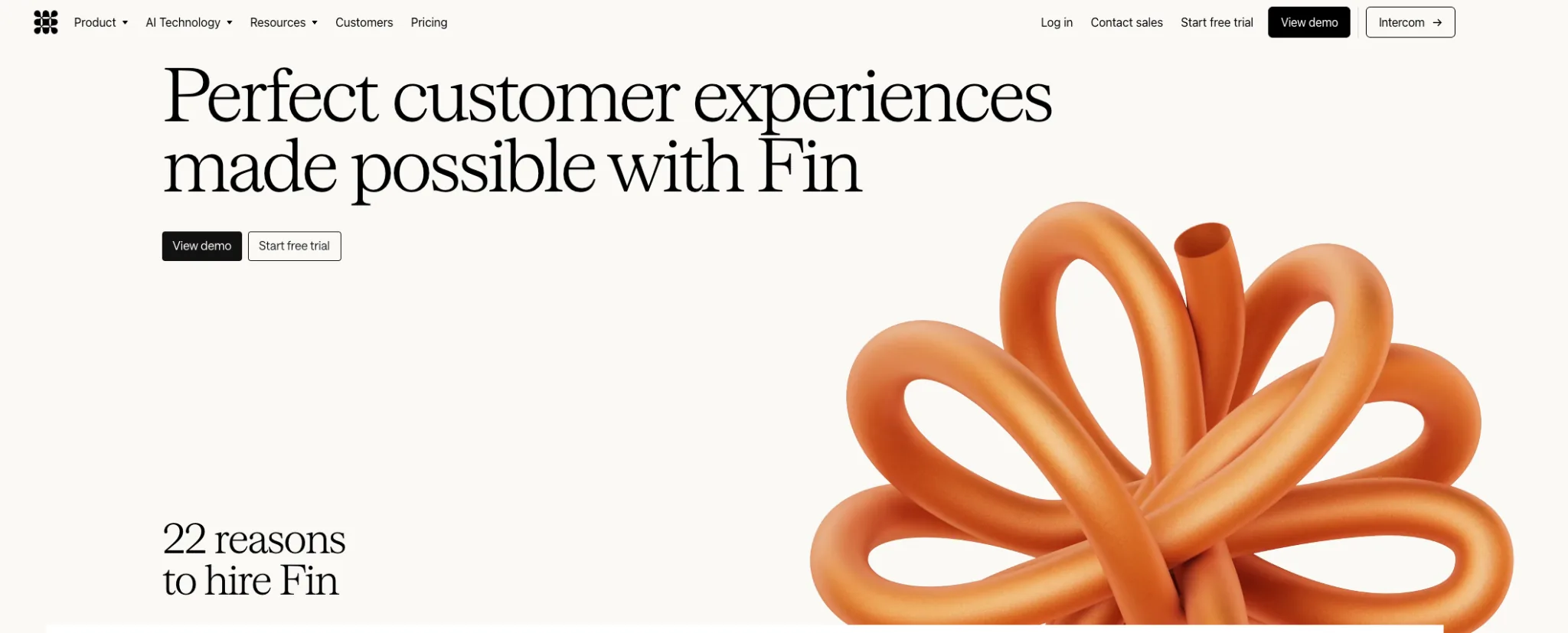
Intercom renamed itself Fin, and on 15 June 2026 Salesforce signed a definitive agreement to acquire it for approximately $3.6 billion.
The rename came first. Intercom's own announcement describes the change as capping "our transformation," which happened weeks before the acquisition news. The practical effect for anyone shopping is that the company, the platform and the AI agent now share a name, while the pricing page still lives at intercom.com/pricing and most of the internet still says Intercom.
Salesforce expects the deal to close in the fourth quarter of its fiscal year 2027. Until then it is signed and not closed, which matters because nothing about the current price sheet has changed as a result of it.
Neither source says anything about future pricing. Salesforce's press release covers the strategic fit with Agentforce and makes no commitment to existing customers on price. Intercom's post emphasises leadership continuity and says little will change in practice. Salesforce's release also states that Fin's agents resolve on average 76% of support volume end to end, and that Fin serves over 30,000 companies. Both of those are Salesforce's and Fin's numbers, presented in a deal announcement, so treat them as vendor claims. They are not independent findings.
If you are signing an annual or multi-year contract this quarter, the useful move is to ask two questions before you sign. Ask what price protection applies for the length of the term, and ask what the renewal uplift cap is. Those answers are worth having in writing regardless of who owns the company when you renew.
Intercom pricing plans in detail
Intercom has three plans, and the difference between them is automation and administration.
Essential: $29 per seat/month annual, $39 monthly
Essential includes the Fin AI Agent, the Messenger, a shared inbox with ticketing, pre-built reports and a public help center. Fin is available here at the same $0.99 per outcome as on every other plan, so the AI is not what you buy by moving up.
Two things catch people out on Essential. There is no workflows automation builder, so routing and escalation logic has to be handled by hand. And Essential includes no Lite seats at all, which means every colleague who needs to see a conversation costs a full seat.
Essential fits a small team working one inbox with a public help center.
Advanced: $85 per seat/month annual, $99 monthly
Advanced adds multiple team inboxes, the workflows automation builder, round-robin assignment, a private and multilingual help center, and 20 free Lite seats.
The jump from Essential is roughly 2.9 times the per-seat price, which is the biggest single step in Intercom's pricing. What you buy with it is automation and multi-team routing. If you run one queue and assign by hand today, the step is hard to justify. If you have separate tier-one, billing and technical queues, it is the plan that makes them work.
Advanced is the default tier in most cost models, including the two worked examples below.
Expert: $132 per seat/month annual, $139 monthly
Expert adds SSO and identity management, HIPAA support, SLAs, a multibrand Messenger and help center, and 50 free Lite seats.
One detail is worth checking if you are on monthly billing. The gap from Advanced to Expert is $47 a seat on annual billing and $40 a seat on monthly, because Expert's annual discount is so much smaller. A team paying monthly that needs SLAs or SSO is closer to Expert than the annual figures suggest.
Expert fits regulated industries, multi-brand operations and anyone whose security review requires SSO.
Intercom Seats
Intercom bills full seats and gives Lite seats away, and the difference is whether the person replies to customers.
A full seat gives complete access to everything on your plan. Anyone who answers a customer needs one, at $29, $85 or $132 a month depending on the tier.
A Lite seat is free and limited. Someone on a Lite seat cannot reply to conversations or create new ones, access the full conversation list, manage automation, help center articles, or the Knowledge Hub, access people or company data, or run imports. They can see what they are pulled into and contribute internally.
Lite seats are the right home for finance, legal, design, and engineering colleagues who get looped in on a ticket a few times a month. Advanced includes 20, and Expert includes 50.
The money-costing constraint is the cap. Intercom's help center states you cannot purchase additional Lite seats beyond your plan's allocation. Once you run out, the next colleague who needs access has to take a full seat, which on Advanced is $85 a month for someone who may never send a reply.
The Essential-to-Advanced decision is therefore partly a Lite seat decision. If 15 people outside your support team need visibility, Advanced's 20 included Lite seats cover them for free. On Essential, those same 15 people would each need a full seat, which is $435 a month before counting anyone in support.
Fin AI Agent pricing: how $0.99 per outcome works
Fin costs $0.99 per outcome, and four things count as an outcome.
-
Resolution. No further help is requested after Fin's last answer.
-
Procedure handoff. Fin completes a Procedure you configured to hand off to a human.
-
Disqualification. Fin determines a prospect does not match your qualification criteria.
-
Qualification. Fin matches a prospect to your criteria. This one is billed at $9.99.
Fin charges once per conversation, so a long back-and-forth costs the same as a single exchange. The rate is the same on Essential, Advanced and Expert.
The mechanic worth understanding is how a resolution gets recorded. Fin counts one when no further help is requested after its last answer, which is a time-based close. Nothing confirms the problem was fixed, so a customer who gives up and goes to a competitor produces the same billing event as a customer whose problem was solved.
Escalations Fin makes by default are not billed. A handoff only becomes a billable outcome when it completes a Procedure you configured for it, which is worth knowing before you write those Procedures.
Fin adds no integration, setup or platform fees. Intercom's page states there are "no additional costs, such as integration fees, setup fees, or platform charges." Running Fin on a helpdesk other than Intercom carries a minimum of 50 outcomes a month. Standalone plans also state that minimum commitments apply without publishing what the commitment is, so ask for that figure in writing.
For the full per-resolution analysis, including how the outcome definitions play out over a billing period, see the full breakdown of Intercom Fin's per-resolution pricing.
The add-ons that sit on top of your plan
Three add-ons sit on top of seats and Fin outcomes, and together they can add several hundred dollars a month.
Copilot: $29 per agent/month annual, $35 monthly
Copilot is agent assist. It drafts replies and surfaces answers inside the inbox, and it is priced per agent, so a team of eight pays for eight. Each agent gets 10 free Copilot conversations and 10 AI auto-translation conversations a month before the paid tier applies.
You will see both $29 and $35 quoted for Copilot across published guides, and both are correct. The $29 figure is the annual-billing rate on Intercom's pricing page and the $35 figure is the monthly rate. The two figures are the same price on two different billing terms.
Pro: from $99/month
Pro includes Operator and advanced AI performance analysis. Intercom lists it as "from $99/mo," so the figure is a starting point that varies by workspace.
Proactive Support Plus: $99/month
Proactive Support Plus covers Posts, Checklists, Product Tours, Surveys and the Series campaign builder.
If you have searched for the price of Intercom product tours, surveys or banners separately, this add-on is the answer. Those features are not sold individually. They come bundled here, which means a team that wants product tours alone still pays the full $99.
Several published guides state that Proactive Support Plus includes 500 messages. We could not confirm that allowance on any Intercom page, so treat it as unverified and ask about it directly.
What Intercom actually costs: two worked examples
An eight-person support team on Advanced with Copilot, Proactive Support Plus and 1,800 Fin outcomes pays about $2,793 a month.
Published cost estimates for Intercom range from around $1,000 to nearly $3,000 a month for broadly similar setups, and most of them do not show their arithmetic. Both examples below show every line so you can swap in your own numbers.
Example 1: an eight-person team on Advanced, annual billing
-
8 full seats × $85 = $680/mo
-
Copilot for 8 agents × $29 = $232/mo
-
Proactive Support Plus = $99/mo
-
4,000 tickets a month, 45% handled by Fin = 1,800 outcomes × $0.99 = $1,782/mo
-
Total: $2,793/mo, or $33,516 a year
Seats account for $680 of that monthly total and Fin accounts for $1,782, so the AI line is more than two and a half times the seat line.
Most budgeting conversations start with headcount, because headcount is the number finance already tracks. On this bill headcount is the smaller half.
Example 2: the same team, the same tickets, a different ticket mix
Now keep everything fixed except what the tickets are about. Same eight people, same plan, same add-ons, same 4,000 tickets a month. The product is technical B2B software, and Fin closes 22% of the volume instead of 45%.
-
Seats, Copilot and Proactive Support Plus = $1,011/mo
-
4,000 tickets, 22% handled by Fin = 880 outcomes × $0.99 = $871/mo
-
Total: $1,882/mo, or $22,584 a year
Same price sheet, same team, same ticket count, and an annual difference of $10,932. Nothing in that gap comes from Intercom's pricing. All of it comes from what the tickets are about.
Why two teams with the same ticket volume get very different bills
Your Fin bill is ticket volume multiplied by deflection rate multiplied by $0.99. Two of those three numbers are on the price sheet. The one that isn't is the one that determines your total.
Deflection rate gets discussed as a property of the AI, and it is partly that. Mostly it is a property of your tickets. Fin answers from documented content, so the rate it reaches tracks how much of your volume is already written down somewhere in an article, a macro or a past conversation it can draw on.
For a consumer or transactional product, a lot of it is. Password resets, plan changes, order status, how to invite a teammate. Those questions have documented answers, and an AI agent working from documentation resolves them well.
For technical B2B software, much less of it is. A CSV import that fails for one customer because of their column mapping. An SSO login loop caused by a misconfigured claim on the customer's identity provider. An API returning 200 with an empty payload. A webhook that stopped firing after a plan change. Those answers come from diagnosis. The diagnosis lives in the ticket where an agent worked it out, because nobody wrote it up as an article afterward.
You can test which world you are in this week, and it takes an hour. Take your last 50 escalated tickets and count how many were resolved using information that already exists in a written article. That count is your input to the Fin forecast, and it will be more accurate than any vendor benchmark.
If the number is high, the published price is a decent forecast and Intercom's own resolution figures are likely to hold for you. Your constraint is documentation coverage, and improving the help center will move your automation rate more than changing tools would.
If the number is low, your constraint is knowledge and your bill is the symptom. You will pay per seat for the platform and per outcome for an AI layer that closes a minority of your volume, and writing more articles will not close the gap quickly, because the knowledge only exists as work your agents already did.
Where a different AI layer changes the arithmetic
The second case is what Pluno is built for. Pluno is an AI support agent for complex technical tickets that works inside Zendesk and Intercom. It ingests your resolved support tickets, which lets it handle account-specific and product-specific issues the help center never documented.
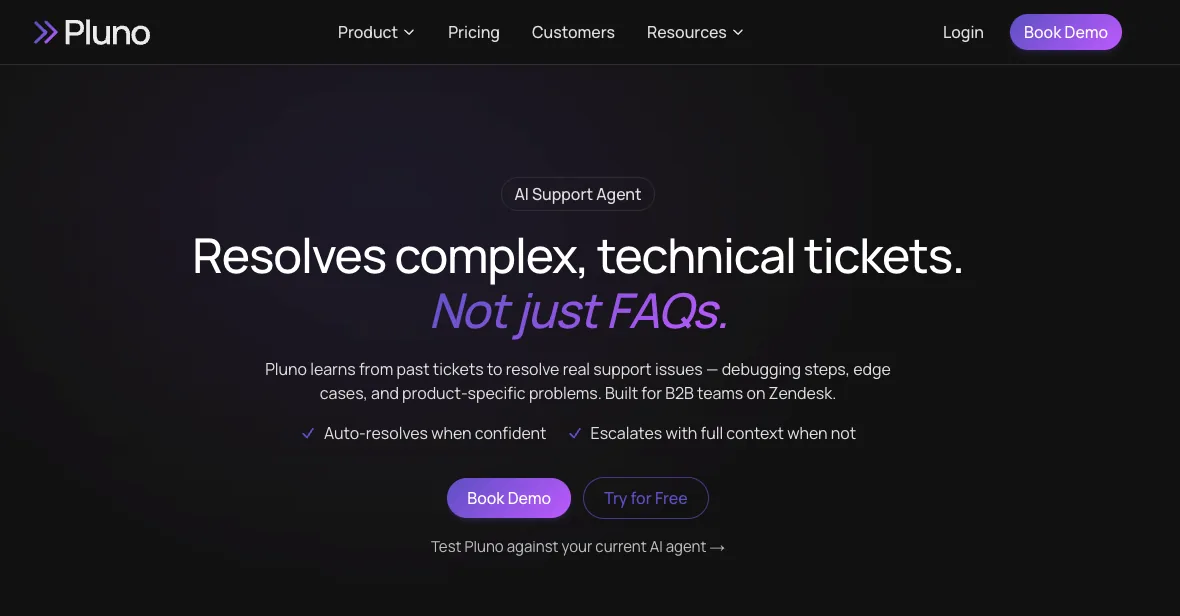
Both Fin and Pluno bill per outcome, so the billing model isn't the difference. What differs is what counts as billable and how you check it.
Rates across this category are not directly comparable, because every vendor defines a resolution, an outcome and a conversation differently. Compare the definitions before you compare the numbers.
For autonomous chat and email resolution, the relevant module is Deflection AI (module name pending Syed's sign-off before it becomes a link). Pluno charges €0.90 per resolution, roughly $1 for US readers, and its pricing page defines a resolution as a ticket Pluno resolves without human involvement. Escalations are never counted, so partial work is not billed. The window is 72 hours after Pluno's last reply, with no further response from the customer. Every AI-resolved ticket is tagged in the helpdesk and exportable for any billing period, so you can reconcile an invoice against the ticket record instead of taking the count on trust. AI Copilot, the agent-assist module, is €49 per agent per month. The base fee is custom, based on your average ticket volume.
Where it falls short is worth stating plainly. Pluno needs a body of resolved support tickets to ingest, so a team with a short support history gets less out of it than a team with years of history. Autonomous deflection on Intercom is arranged case by case per company and isn't published, so don't assume it from this page.
How to keep the Intercom bill predictable
Five things keep an Intercom bill predictable, and the first one has to happen before you switch Fin on.
-
Set usage alerts and limits at Settings > Usage. Intercom's help center frames them as the way to avoid an unexpected bill. You configure alerts and limits, and Intercom does not document an automatic hard spend cap that applies by default.
-
Remember that Fin outcomes reset every month and do not carry over. Billing periods are monthly and tied to your invoice dates, so a quiet January buys you nothing in a busy February.
-
Model your worst month, not your average. Per-outcome billing means the budget has to survive your peak, and a product launch or an incident moves ticket volume more than headcount ever does.
-
Audit Lite seat usage before you add a full seat. If the person never replies to a customer, a free Lite seat covers them, up to your plan's allocation.
-
Get the unpublished numbers into the quote. Channel rates and any minimum commitment are not on the pricing page, so ask for both in writing before you sign.
If you are trying to work out your own deflection rate, the fastest way is to look at the tickets you have already resolved. See how Pluno handles complex tickets →
Free trial, the startup program and discounts
Intercom offers a 14-day free trial with no credit card, no permanently free plan, and an early-stage program that discounts the first year by 93%.
The free trial
The trial runs 14 days and needs no credit card to start. It covers every feature on your chosen plan, including the Fin AI Agent, Pro, Proactive Support Plus and unlimited Copilot, plus unlimited team seats for the duration.
When it ends, your workspace stays saved but inactive until you pick a plan, and Fin and your help center pause as soon as the subscription goes inactive.
The trial is more generous than anything you will buy, since both add-ons are switched on and Copilot is uncapped. Budget from the plan you intend to purchase. What the trial feels like will overstate it.
There is no free plan
Intercom's plans help article states it directly. There is no free tier, only the trial and the early-stage program below.
The Early Stage startup program
Intercom's early-stage program has published terms, and it is the largest discount available on the platform.
Eligibility requires all three of the following: up to $10M in funding, fewer than 15 employees, and not being a current Intercom customer.
The discount runs on a three-year ladder. Year one is 93% off, year two is 50% off and year three is 25% off. Intercom lists year-one helpdesk pricing from $33 a month under the program.
Fin is included and metered. Year one covers 300 Fin outcomes a month, year two covers 150 and year three covers 75, with 15 Fin qualifications a month held across all three years. Phone, SMS and WhatsApp are charged at list price and sit outside the discount.
Two things are worth modelling before you build on it. The ladder is a glide path to list price, so the year-three step is where the full cost arrives. And 300 outcomes a month is a hard ceiling. A team resolving 500 tickets a month through Fin pays $0.99 for everything above the allowance from month one.
Annual billing and negotiation
Annual billing is the discount available to everybody. It saves roughly 26% on Essential, 14% on Advanced and 5% on Expert, so it is worth most to the teams paying least.
Procurement services publicly advertise help negotiating Intercom contracts, which tells you that list price and paid price are not always the same at volume.
When Intercom is the right buy, and when it isn't
Intercom is worth it when most of your tickets are already answered somewhere in writing.
Buy it when:
-
You want one vendor covering messaging, help center, ticketing and AI, with one bill and one place to configure things.
-
Your support is largely documented and transactional, so Fin resolves a high share of your volume and the per-outcome rate works in your favour.
-
The Messenger, product tours and proactive messaging side of the product matters to you, since that is where Intercom is strongest against pure ticketing tools.
-
Your plan's Lite seat allocation covers the colleagues outside support who need visibility.
Think harder when:
-
Your ticket volume is high and your deflection rate is low, which is the combination that makes per-outcome billing expensive.
-
You need a hard spend cap. Intercom documents usage alerts and limits you configure yourself, and no automatic cap that applies by default.
-
WhatsApp or phone is a primary channel, since those rates are not published and cannot be forecast from the pricing page.
-
You are about to sign multi-year while the Salesforce acquisition is pending.
It is worth being fair about the transparency here. Intercom publishes its seat prices in both billing terms, publishes its AI rate, publishes what counts as a billable outcome, and gives you a public calculator to model your own bill. Several vendors in this category publish none of that. The complexity of an Intercom bill comes from how many meters it has running at once.
If your next question is what the alternatives cost, three related breakdowns cover it: Intercom Fin AI alternatives, a direct comparison of Fin and Pluno, and what Zendesk's AI costs.
Frequently asked questions
How much does Intercom cost per month? Intercom costs $29, $85 or $132 per seat per month on annual billing, depending on whether you are on Essential, Advanced or Expert. On monthly billing the same plans cost $39, $99 and $139 per seat. Fin outcomes and add-ons are billed separately on top of the seat price.
How much does Intercom's Fin AI agent cost? Fin costs $0.99 per outcome on every Intercom plan, and $9.99 for a qualification outcome. Fin charges once per conversation, and four things count as a billable outcome: a resolution, a Procedure handoff, a disqualification and a qualification. Running Fin on a non-Intercom helpdesk carries a 50-outcome monthly minimum.
Does Intercom have a free plan or a free trial? There is no free plan. There is a 14-day free trial with no credit card required, covering every feature on your chosen plan including Fin, Pro, Proactive Support Plus and unlimited Copilot. Early-stage companies with under $10M in funding and fewer than 15 employees can also get 93% off their first year.
What is a Lite seat in Intercom? A Lite seat is a free seat for colleagues who need visibility but never reply to customers. Lite seats cannot reply to or create conversations, access the full conversation list, or manage automation and help center content. Advanced includes 20 and Expert includes 50. Essential includes none, and you can't purchase extra Lite seats.
Is Intercom still called Intercom after the Salesforce acquisition? The company renamed itself Fin in 2026. Salesforce signed a definitive agreement to acquire it on 15 June 2026 for approximately $3.6 billion, with the deal expected to close in the fourth quarter of Salesforce's fiscal year 2027. The acquisition is signed and has not yet closed, and neither company has announced pricing changes.