The best Gorgias alternatives in 2026 are CommSlayer, Richpanel, Re: amaze, Intercom, Tidio, Zendesk, Freshdesk, Zoho Desk, and Yuma AI, and which one fits depends on whether your problem is the bill, the AI, or the fact that Gorgias is built around Shopify.
Most competitor guides stop at "Gorgias charges per ticket, so costs rise with volume" without doing the actual math. Here's what it breaks down to: a Basic plan bundles 300 tickets into a $60 fee ($0.20 each), but overages cost $0.40 per ticket - exactly twice the rate. Other guides point to per-seat pricing as the fix, but that misses the real issue: Gorgias's overage rate and allowance structure are the problem, not usage-based billing itself.
Below are nine alternatives grouped by the reason you are leaving, each with its price, what it fixes and where it falls short, plus what switching costs and five if-then rules for picking. I read every price on the vendor's own pricing page on 16 August 2026, with Gorgias's in a browser because an automated fetch returns no pricing at all, which is why figures quoted elsewhere are often stale.
Key takeaways
-
Choose CommSlayer if the invoice is what broke. Free for 300 conversations a month with unlimited seats, $0.15 overage against Gorgias's $0.40, and a spending cap you can set at $0. Shopify-only.
-
Choose Richpanel if you are a lean team on heavy volume. $99 per seat per month with no per-ticket fee, so four agents on 1,200 tickets run about $456 against $855 on Gorgias Basic.
-
Choose Re:amaze if several people dip into support part-time. Starter is $59 flat for unlimited team members, capped at 500 responded conversations, and it is the only flat unlimited-seat fee here.
-
Choose Intercom if the AI is why you are leaving. $29 per seat per month on annual billing with Fin at a published $0.99 per outcome, the strongest agent in this lineup and the most expensive entry point.
-
Choose Tidio if your support is mostly live chat. Free for 50 billable conversations with 10 seats on every plan, Lyro from $32.50 a month.
-
Choose Zendesk if you now sell beyond Shopify at scale. $55 per agent per month paid yearly, the widest ecosystem here, and no published per-resolution AI rate.
-
Choose Freshdesk if the move off Shopify has to be cheap. $19 per agent per month on annual billing, though Freddy AI is metered twice and the 500 sessions everyone quotes are a one-time allowance.
-
Choose Zoho Desk if cost is the only complaint. Free forever for 3 agents with no clock and no conversation cap, then $7 per user per month, against $90 for the Gorgias bundle.
-
Choose Yuma AI if the helpdesk is fine and only the AI is failing. It runs on top of Gorgias, so you change the AI without a migration, from $14,400 a year on a 12-month commitment.
Why brands leave Gorgias
Gorgias overage costs exactly twice what a ticket inside your allowance costs, on every published tier.
Four guides, one diagnosis
The agreement across this topic is unusual and worth reporting on its own. Four guides published by four competing vendors reach the same conclusion: the per-ticket model couples cost to growth and the AI underdelivers.
These are competitor-published guides, so treat them as reported. The AI complaint in particular comes from one vendor describing what its own prospects told its sales team, which is worth knowing and is not a finding.
What none of the four does is the arithmetic, and the arithmetic is one division on a page Gorgias publishes.
The overage is exactly double, on every tier
Gorgias prints the included allowance and the overage rate on the same card. Divide one by the other:
| Plan | Included rate | Overage rate | Multiple |
|---|---|---|---|
| Starter | $10 ÷ 50 = $0.20 | $0.40 | 2× |
| Basic | $60 ÷ 300 = $0.20 | $0.40 | 2× |
| Pro | $360 ÷ 2,000 = $0.18 | $0.36 | 2× |
| Advanced | $900 ÷ 5,000 = $0.18 | $0.36 | 2× |
It holds to the cent on all four published tiers.
The AI meter behaves the same way at a different ratio. Included AI works out at $1.00 per interaction on monthly billing and $0.90 on annual, against a $1.50 overage.
The practical conclusion is short. Buy the plan whose allowance covers your peak month, because every unit past it costs twice what it did inside.
This is not a trick. Charging more at the margin than inside a committed block is ordinary commercial structure, and Gorgias publishes both numbers openly. The problem is that nobody tells buyers the multiple is there. For the full price sheet, see the Gorgias pricing breakdown.
The AI covers about a tenth of your tickets
Divide the included AI interactions by the included tickets and the second meter comes into focus:
| Plan | Interactions | Tickets | Coverage |
|---|---|---|---|
| Starter | 30 | 50 | 60% |
| Basic | 30 | 300 | 10% |
| Pro | 190 | 2,000 | 9.5% |
| Advanced | 530 | 5,000 | 10.6% |
Every tier above Starter bundles AI for roughly a tenth of your volume. A brand automating 30% of its tickets, which is a good operational result, is paying $1.50 each on two thirds of them. That is what the complaint about expensive AI costs in money.
Starter is the outlier, bundling 30 interactions against 50 tickets. Proportionally it is far more generous than anything above it.
The plan inversion
Here is what the doubling does in practice. Take a four-agent store handling 1,200 tickets a month, with 300 of them resolved by the AI.
On Basic:
-
Helpdesk base = $60
-
900 tickets over the allowance × $0.40 = $360
-
AI base = $30
-
270 interactions over the allowance × $1.50 = $405
-
Total: $855 a month
On Pro:
-
Helpdesk base, 2,000 tickets included, no overage = $360
-
AI base = $190
-
110 interactions over the allowance × $1.50 = $165
-
Total: $715 a month
The cheaper plan costs $140 a month more. Once overage runs hot, the tier above is often cheaper than the tier you are on, and nothing in the product tells you. Before you shortlist a replacement, run this on your own numbers, because moving up a tier is free and a migration is not.
The 9 best Gorgias alternatives at a glance
| Tool | Best for | Pricing model | Starting price | AI cost |
|---|---|---|---|---|
| CommSlayer | Shopify stores whose bill moved | Per conversation, unlimited seats | Free for 300/mo | Included; $0.075 per extra AI message |
| Richpanel | Small teams on high volume | Per seat, no ticket fee | $99/seat/mo | $0.20 per AI conversation |
| Re:amaze | Small teams with many part-time repliers | Per member, or flat | $29/member/mo, or $59 flat | 5 resolutions on Basic |
| Intercom | Brands that want the strongest AI | Per seat + per outcome | $29/seat/mo annual | $0.99 per outcome |
| Tidio | Chat-led stores on a budget | Per conversation | Free for 50/mo | Lyro from $32.50/mo |
| Zendesk | Selling beyond Shopify at scale | Per agent | $55/agent/mo paid yearly | Per resolution, rate not published |
| Freshdesk | Cheapest mainstream ticketing | Per agent | $19/agent/mo annual | $49 per 100 sessions |
| Zoho Desk | The cheapest option off Shopify | Per user | Free for 3 agents | Included per tier |
| Yuma AI | Keeping Gorgias and fixing the AI | Per resolution | $14,400/yr | ~$0.75–$1.20 per resolution |
AI rates are not directly comparable. Each vendor defines a resolution, an outcome, an interaction and a conversation differently, so compare the definitions before the numbers.
The 9 best Gorgias alternatives, reviewed
If the bill is the problem
1. CommSlayer
Best for Shopify stores that left because the bill moved without warning.
Pricing. Conversation-based per account with unlimited agent seats on every plan. Free covers 300 conversations a month. Plus is $39/mo for 800. Scale is $299/mo for 6,000. Enterprise is custom from 60,000. Overage runs $0.15 per extra conversation and $0.075 per extra AI agent message. Social media comments are unlimited and do not count toward your limit.
Why it works as a Gorgias alternative. Compare like for like. CommSlayer's free tier carries the same 300 conversations that Gorgias charges $60 for on its Basic helpdesk fee, its overage is $0.15 against $0.40, and seats are unlimited on every plan including the free one. It also lets you set a spending cap at $0, so overage cannot happen unless you allow it. Gorgias documents usage alerts and limits you configure, and no automatic hard cap that applies by default. For a reader whose complaint is a surprise invoice, that difference matters more than the unit rate.
Where it falls short. It is Shopify-exclusive and says so plainly, so it solves nothing if you have expanded past Shopify. It is a younger and narrower product than Gorgias, with a thinner integration surface and a shorter track record. On pricing stability, it raised paid prices 35% in December 2025, existing customers kept their old rates, and the free plan was untouched.
Best for. Shopify stores under a few thousand conversations a month.
2. Richpanel
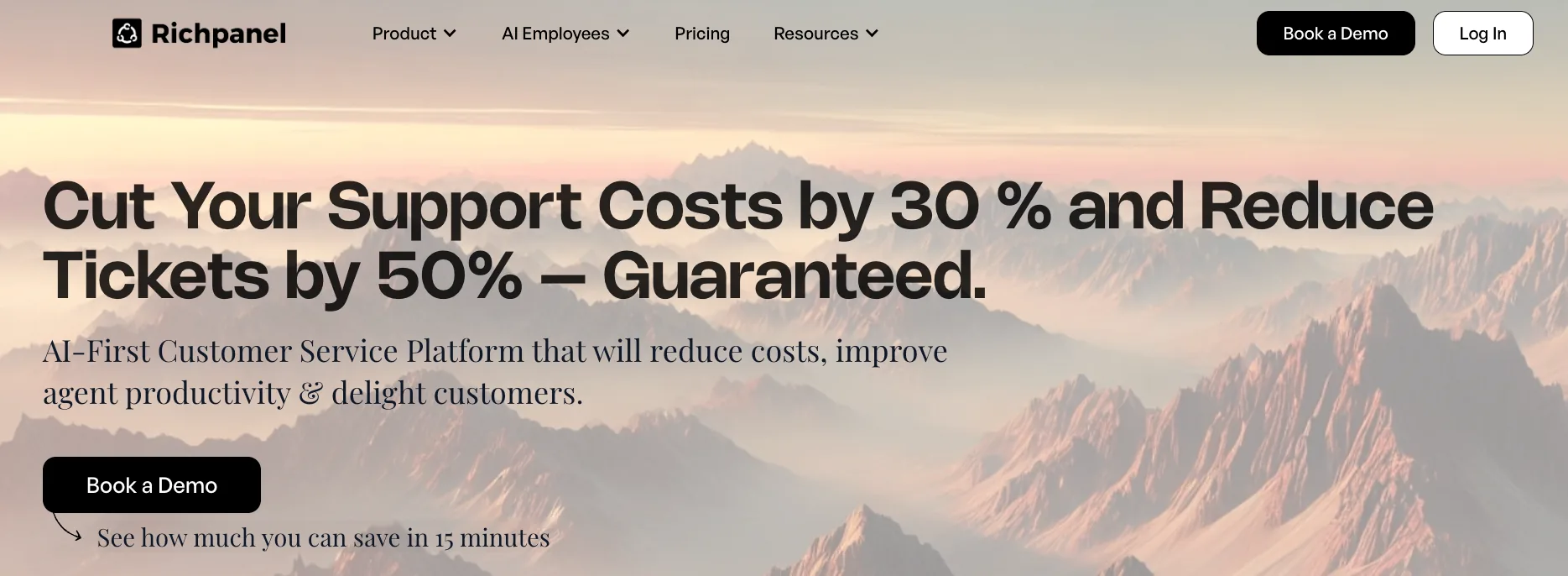
Best for small teams handling high-ticket volume.
Pricing. One plan at $99 per seat per month with no per-ticket fee. AI is billed at $0.20 per AI-handled conversation, where a conversation is the whole back-and-forth thread instead of a single message. A returns and exchanges add-on starts at $99/mo. A QA agent, a social media agent and a self-service portal are included.
Why it works as a Gorgias alternative. It is the structural inverse of Gorgias. Gorgias charges per ticket and never per seat; Richpanel charges per seat and never per ticket. For four agents handling 1,200 tickets, that is $396 in seats plus $60 for 300 AI conversations, against $855 on Gorgias Basic. The economics flip in your favour exactly where Gorgias's flip against you.
Where it falls short. $99 a seat is the highest per-seat price in this lineup, so it punishes a large team the way Gorgias punishes a busy month. There is no free tier and no cheaper entry plan.
Best for. Lean teams with heavy volume, which is the profile Gorgias's model penalises most.
3. Re:amaze
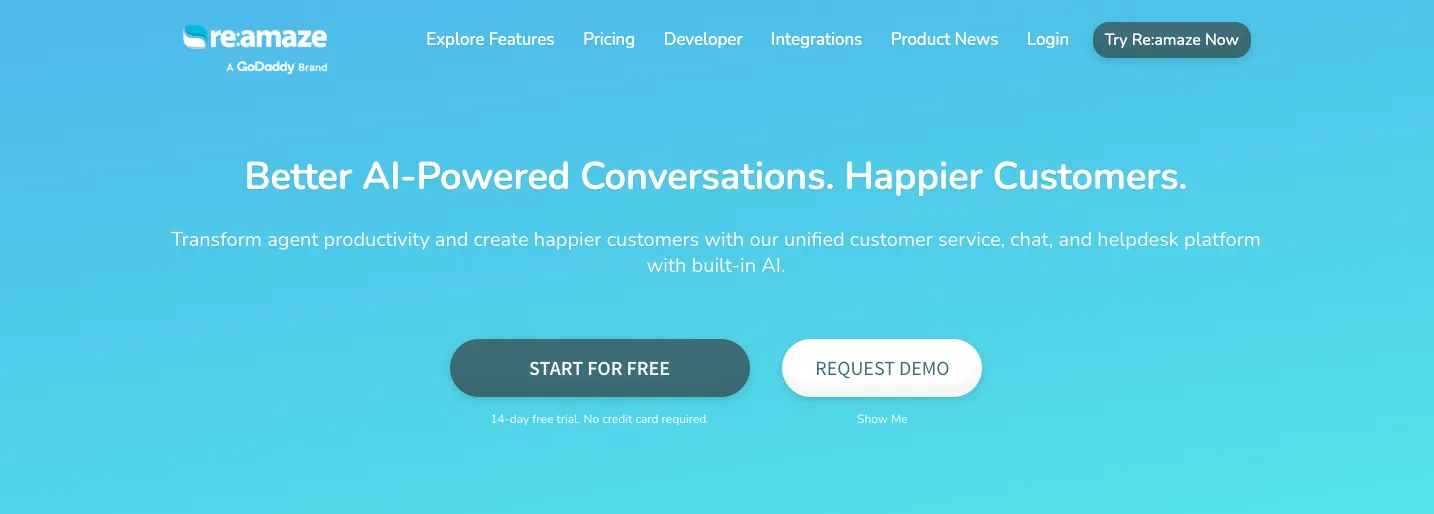
Best for small teams where several people dip into support.
Pricing. Basic $29, Pro $49 and Plus $69 per team member per month, with 10% off annually. Starter is a $59 flat rate per month for unlimited team members, capped at 500 responded conversations. Basic includes the Re:amaze AI Agent with 5 resolutions a month. Pro adds multiple brands, SMS and voice. There is a 14-day trial with Plus features and no credit card.
Why it works as a Gorgias alternative. The flat-rate Starter is the only unlimited-seat flat fee in this lineup. For a store where the founder, a part-time assistant and a warehouse lead all answer tickets occasionally, $59 covers everyone, which neither a per-seat nor a per-ticket model does well.
Where it falls short. The AI allowance on Basic is 5 resolutions a month, and no AI overage rate was published on the pages we read, so an AI-heavy store cannot forecast that line at all. The 500-conversation cap on Starter is tight for anything beyond a small store.
Best for. Small stores with several occasional repliers and light AI needs.
If the AI is the problem
4. Intercom
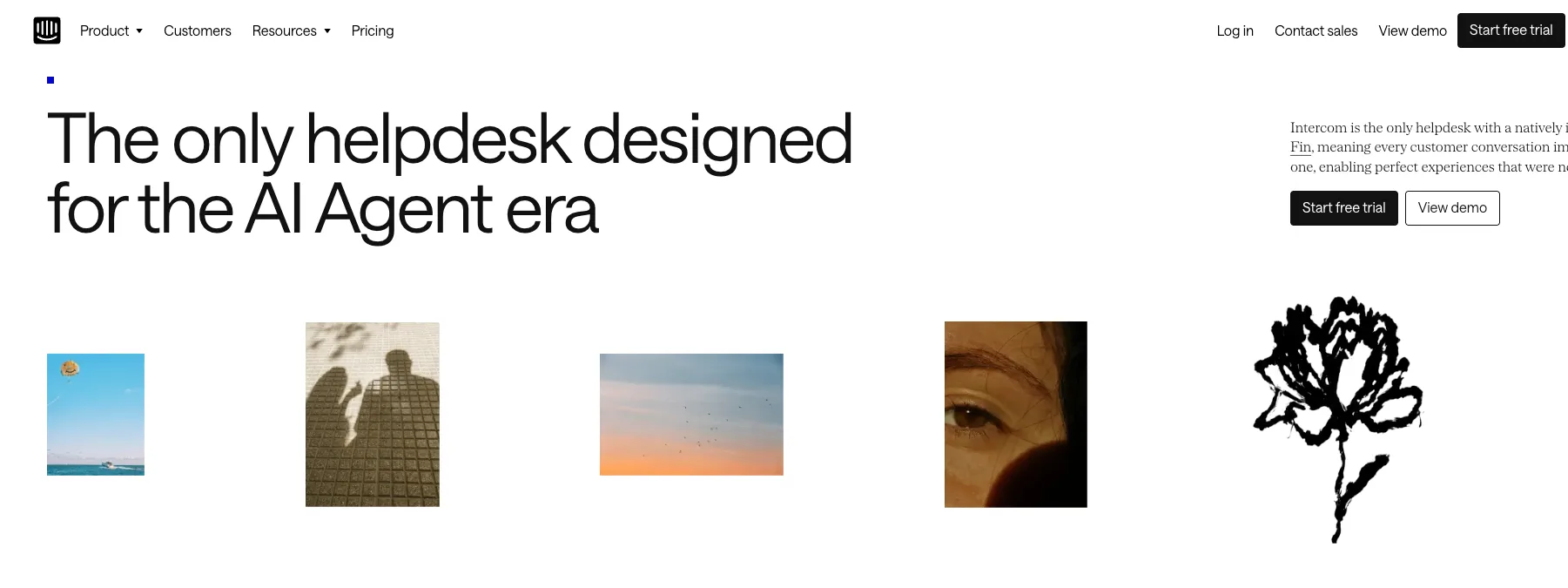
Best for brands that want the strongest AI agent available.
Pricing. Essential $29, Advanced $85 and Expert $132 per seat per month on annual billing, or $39, $99 and $139 monthly. Fin AI Agent costs $0.99 per outcome and $9.99 per qualification. Advanced includes 20 free Lite seats and Expert 50.
Why it works as a Gorgias alternative. If the AI is why you are looking, this is the most direct upgrade. Fin is one of the most widely adopted autonomous agents in the category and its unit rate is published, which is more than Zendesk offers.
Where it falls short. It is the most expensive entry point here and the least Shopify-native option in the first six. Intercom also renamed itself Fin, then signed a definitive agreement to be acquired by Salesforce for approximately $3.6 billion on 15 June 2026, expected to close in the fourth quarter of Salesforce's fiscal year 2027. The deal is signed and not closed, which is worth raising before a multi-year term. Intercom Fin's per-outcome pricing covers the model in full.
Best for. Brands with volume that justifies automation-first billing.
5. Tidio
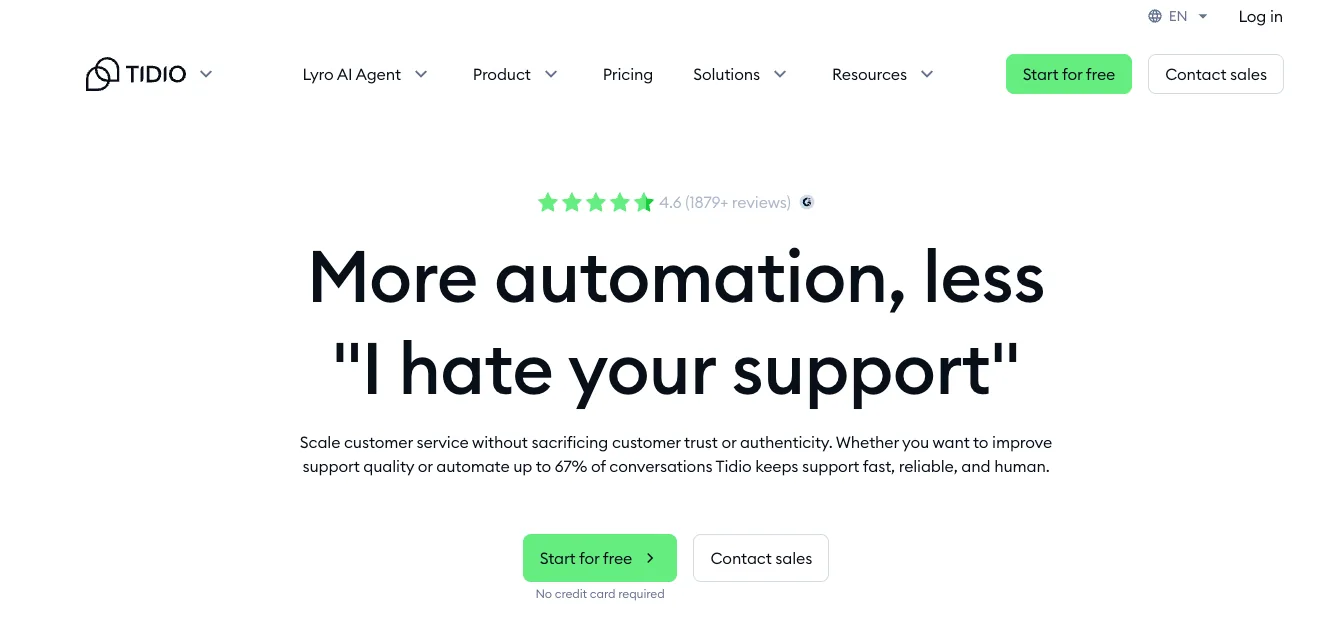
Best for chat-led stores on a budget.
Pricing. The free plan covers 50 billable conversations a month, 50 one-off Lyro AI conversations and 10 seats. Starter is $24.17/mo on annual billing or $29 monthly for 100 conversations. Growth starts at $49.17/mo annual or $59 monthly from 250. Plus starts at $300/mo plus usage. Premium is contact-sales from 3,000 Lyro conversations, with a guaranteed 50% Lyro resolution rate and pay-per-resolution billing available.
Why it works as a Gorgias alternative. Ten seats come with every plan including the free one, which suits a small store where everyone answers chat and a per-seat model would be punitive. Lyro is the cheapest route into a capable AI agent in this lineup.
Where it falls short. The conversation caps at the bottom are low, and the 50 Lyro conversations on Free and Starter are a one-off allowance instead of a monthly one. It is chat-led, so it is a lighter helpdesk than Gorgias and thinner on email-heavy support.
Best for. Small stores whose support is mostly live chat.
If you have outgrown Shopify-only
6. Zendesk
Best for brands selling beyond Shopify at scale.
Pricing. Suite Team $55 and Suite Professional $115 per agent per month paid yearly. Suite Enterprise with Copilot is contact-sales with no public price.
Why it works as a Gorgias alternative. It is platform-agnostic with the widest ecosystem here, which is the direct answer to the Shopify scoping problem. It is also the most-searched head-to-head in this category, so if you are weighing Gorgias against Zendesk you are in good company.
Where it falls short. Zendesk does not publish a per-resolution AI rate, so you cannot forecast that line without a sales conversation; figures of $1.50 committed and $2.00 pay-as-you-go circulate widely, and no Zendesk page carries either. It has none of Gorgias's native Shopify depth, and it is the second most expensive seat here. What Zendesk's AI actually costs covers the model.
Best for. Multi-channel brands above roughly 20 agents, or anyone whose store has outgrown a single platform and needs the integration surface to match.
7. Freshdesk
Best for the cheapest mainstream ticketing platform.
Pricing. Growth $19, Pro $55 and Enterprise $89 per agent per month on annual billing. Freshdesk Omni is a separate product line at $29, $79 and $119. Freddy AI Copilot costs $29 per agent per month and Freddy AI Agent costs $49 per 100 sessions.
Why it works as a Gorgias alternative. It is platform-agnostic at the lowest entry price of any full ticketing system here, so it is the budget answer for a brand that has outgrown Shopify-only.
Where it falls short. Its free plan is a six-month program for two agents, cut from ten agents effective 15 November 2024, so it is not a landing place. AI is metered twice, once per agent for Copilot and once per session for the AI Agent, and the 500 sessions commonly quoted are a one-time signup allowance instead of a monthly one.
Best for. Cost-driven moves off Shopify-only.
8. Zoho Desk
Best for the cheapest option off Shopify.
Pricing. Free forever for 3 agents. Express $7, Standard $14, Professional $23 and Enterprise $40 per user per month on annual billing.
Why it works as a Gorgias alternative. It is the cheapest paid entry anywhere in this article, and its free tier is the only one here with no clock and no conversation cap. Three agents at $0, then $7 each, against Gorgias Basic at $90 for the bundle. For a store whose only complaint is cost, it is the shortest path to a smaller bill.
Where it falls short. Express carries a hard five-seat ceiling. Monthly billing is reported at 30 to 50% above annual, which is a wide range and is not published. The pricing page renders in Indian rupees by default. Its ecommerce depth is shallow next to anything in the first group.
Best for. Cost-driven moves where ecommerce features are not the priority, and small teams that want somewhere free to land while they decide.
If you want to keep Gorgias
9. Yuma AI
Best for brands whose only complaint is the AI.
Pricing. Outcome-based with no per-seat charge. Starter is $14,400 a year for roughly 12,000 resolutions, about $1.20 each. Growth is $40,000 for roughly 48,000, about $0.83 each. Scale is $90,000 for roughly 120,000, about $0.75 each, trending toward a $0.55 floor at higher volume. It requires a 12-month commitment and includes the first 30 days free with no setup fees. You pay only for tickets fully resolved with no human involvement.
Why it works as a Gorgias alternative. It is the one option here that is not a replacement. Yuma runs on Gorgias, and also on Zendesk, Shopify and Salesforce, which means if the helpdesk is fine and the AI is what is failing, you can change the AI without moving the helpdesk. That is a cheaper change than a migration and nobody else on this SERP develops it.
Where it falls short. The entry point is $14,400 a year with a 12-month commitment, so this is an enterprise-scale layer. A store on Gorgias Basic is not the buyer, and for most of this article's readers that puts it out of reach.
Best for. High-volume brands already happy with Gorgias as a helpdesk.
What switching actually costs
Leaving Gorgias has three costs, and the one nobody mentions is the Shopify depth you give up.
The first is the new subscription, which the profiles cover.
The second is the migration. Conversations and contacts usually move with vendor tooling or a migration service. Rules, macros, autoresponders and integrations get rebuilt, because they do not map cleanly between platforms.
The third is what you lose. Gorgias's Shopify integration is why most of these brands chose it: order actions inside the helpdesk, Shopify data feeding the AI, and an app ecosystem built around the same platform. Moving to Zendesk or Freshdesk fixes the bill and costs you all of that. Moving to CommSlayer, Richpanel or Re:amaze keeps more of it, which is why they sit in the first group.
One check before any of it. If the bill is your only complaint, run the tier arithmetic from the section above on your own numbers first. Moving up a Gorgias tier is free and sometimes cheaper than staying where you are, and it is always cheaper than a migration.
The AI layer is a separate decision
Seven vendors in this article price AI seven different ways.
Gorgias charges $1.00 per automated interaction on top of the ticket fee. Richpanel charges $0.20 per AI-handled conversation. Intercom charges $0.99 per outcome. Freshdesk charges per session plus $29 per agent for Copilot. Tidio charges per Lyro conversation. Yuma charges roughly $0.75 to $1.20 per resolution depending on volume. Zendesk bills per automated resolution and publishes no rate.
Those seven answers are not comparable. A resolution, an outcome, an interaction and a conversation are four different units with four different definitions, and the definition decides how often you get charged. Read the definition before you compare the price.
Yuma has already demonstrated the more useful point. It runs on Gorgias and on Zendesk, which means the AI layer is a decision separate from the helpdesk underneath it. That pattern is not unique to ecommerce. On Zendesk and Intercom you can run the platform's native AI or a third-party layer, and that choice is independent of which helpdesk you just bought.
The right layer depends on what your tickets are about. A brand that has expanded past Shopify into marketplaces, a custom stack or B2B wholesale usually ends up on Zendesk or Intercom, and its tickets change shape on the way. Order status becomes integration questions, API errors and account-specific configuration, and those answers do not live in help centre articles.
Pluno is an AI support agent for complex technical tickets that works inside Zendesk and Intercom. It ingests your resolved support tickets, which lets it handle issues nobody ever wrote up because an agent worked each one out inside a ticket and moved on.
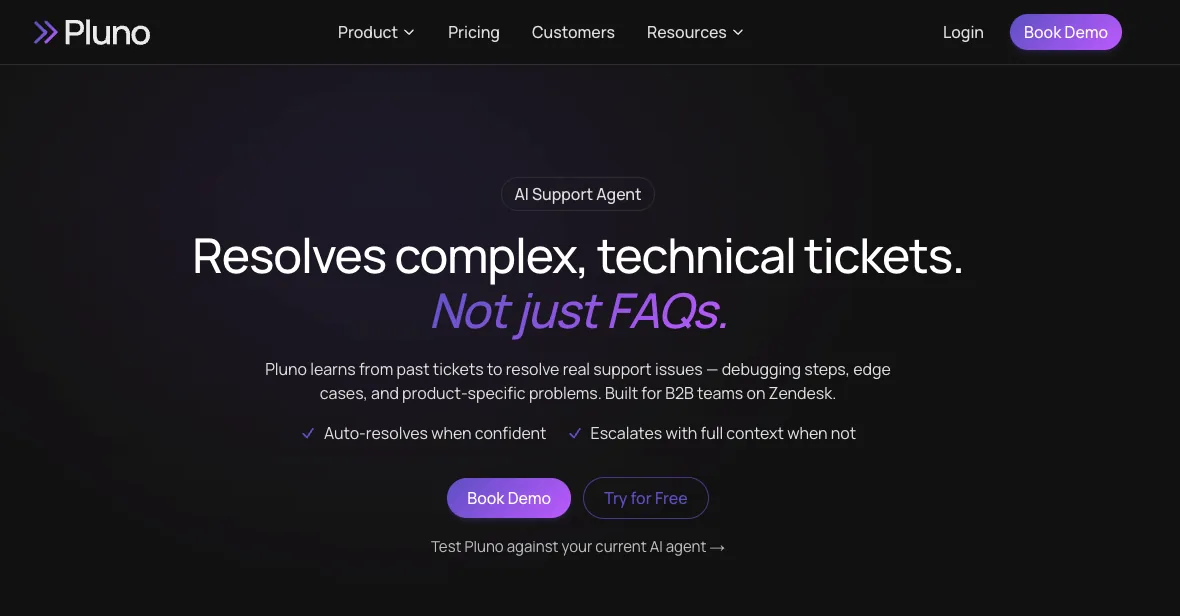
On pricing, Pluno charges €0.90 per resolution, roughly $1 for US readers. AI Copilot is €49 per agent per month, and the base fee is custom, based on your average ticket volume.
Two limits worth stating. Pluno needs a body of resolved support tickets to learn from, so a team with a short support history gets less from it. And autonomous deflection on Intercom is arranged case by case per company instead of published, so don't assume it.
If you want the wider set of options on that platform, AI agents that run on Intercom covers them.
How to pick the best Gorgias alternative
What you should replace Gorgias with depends on whether your problem is the bill, the AI, or the platform.
-
If your bill moved without warning, run the tier arithmetic before anything else. Moving up a Gorgias tier can cost less than staying where you are, and it costs less than migrating either way.
-
If the bill is the problem and the tier maths doesn't fix it, CommSlayer is the cheapest like-for-like on Shopify, and Zoho Desk is the cheapest off it. Richpanel is the answer if your team is small and your volume is large.
-
If the AI is the problem and the helpdesk is fine, Yuma runs on Gorgias, though only at enterprise volume. Below that, Richpanel at $0.20 a conversation is the cheapest AI in this lineup.
-
If you have expanded past Shopify, Zendesk and Freshdesk are the platform-agnostic answers, and you'll trade Shopify depth for breadth.
-
If your support has moved beyond orders, the helpdesk matters less than the AI layer on it, and Zendesk and Intercom are the destinations that keep that decision open.
Frequently asked questions
Why is my Gorgias bill higher than my plan price? Overage. Gorgias charges $0.40 per extra ticket on Starter and Basic and $0.36 on Pro and Advanced, which is exactly double the effective rate of a ticket inside your allowance. The AI meter runs separately and charges $1.50 for every interaction past your included allocation.
Who are Gorgias's main competitors? In ecommerce, CommSlayer, Richpanel, Re:amaze and Tidio. Among general helpdesks, Zendesk, Freshdesk and Zoho Desk. Intercom competes on AI capability, and Yuma AI is a layer that runs on Gorgias instead of replacing it.
What is the cheapest Gorgias alternative? CommSlayer has a free plan covering 300 conversations a month with unlimited agents, on Shopify only. Off Shopify, Zoho Desk is free for three agents and $7 per user after that. Tidio's free plan covers 50 conversations with 10 seats.
Does Gorgias charge twice when its AI resolves a ticket? Yes on a full AI resolution, once as a ticket and once as an automated interaction. No on a handoff: if the AI passes the conversation to a human, you pay the ticket fee only, which is worth knowing because several vendors charge on both sides of a handoff.