Support volume keeps climbing, and the tickets are getting harder. Customers ask questions your help center never documented, and your team answers the same product-specific problems over and over. An AI chatbot for customer service is supposed to take that load off. The catch is that "best" means something different for a 5-person ecommerce store than it does for a B2B SaaS team fielding SSO failures and failed data imports.
This guide compares seven of the strongest AI customer service chatbots in 2026 based on the factors that determine fit: whether the tool resolves tickets or only deflects them, how it learns, what it can act on, how it escalates, where it responds, who has to configure it, and how you pay. The list is ordered by which team each tool suits.
By the end you will know which tool to shortlist and how to forecast the bill before you take a sales call.
Note: Pricing across these tools is hard to compare directly, because each vendor counts resolutions, outcomes, and conversations differently, and rates shift by region, billing term, and plan. Treat every figure below as a starting point to confirm in your own quote.
TL;DR: the 7 best AI chatbots for customer service
The best pick depends on your stack, your ticket complexity, and how you want to pay. Here it is by buyer profile:
-
B2B SaaS on Zendesk or Intercom, technical tickets: Pluno learns from your resolved support tickets, so it answers edge cases the docs never covered. Fin by Intercom is one of the most widely adopted agents and takes actions through configured workflows.
-
Standardizing on one platform: match the tool to your stack. Zendesk AI Agents for Zendesk teams, Freshchat (Freddy AI) for Freshworks teams.
-
SMB or ecommerce: Tidio (Lyro) pairs live chat with an AI agent, and Gorgias is built for Shopify order support.
-
Enterprise that wants to design and own custom flows: Ada is automation-first with heavy customization.
Two things decide which of the seven tools fits your team:
-
How it learns. Does the tool learn from your own resolved tickets, or does someone have to build and maintain the flows and procedures it follows. That gap predicts how well it handles your hardest tickets.
-
How it bills. Per resolution, per agent seat, or a custom usage deal, which changes how predictable your cost is at volume.
Whatever you shortlist, simulate it against your own historical tickets before you commit, because a headline resolution rate from someone else's customer base will not transfer to yours.
What is an AI customer service chatbot?
An AI customer service chatbot is software that reads a customer's question in plain language and either resolves it end-to-end or routes it to a human, drawing on answers from your knowledge sources rather than a fixed script.
Older bots matched keywords and pushed people through menu trees. Modern ones use language models to interpret intent, hold context across a conversation, and pull answers from a help center, past conversations, and connected systems.
It's worth noting that two terms get mixed up all the time, so it's important to be clear about what each one actually means:
-
Deflection means the bot handles a question so it never reaches a human.
-
Resolution means the issue is closed.
A bot can deflect a ticket by answering a FAQ and still leave the real problem open. The tools that close tickets and can take an action like updating an order or creating a ticket are usually called AI agents. The difference matters when you compare vendors because some price based on deflection and others on resolution.
How we picked the best AI chatbots for customer service?
We evaluated each tool on its published capabilities, pricing model, documentation, and fit within a real support stack. We then ordered the list by which team each tool suits best.
We analyzed each AI chatbot according to eight things that matter to you (and that will confirm whether some tool is a good fit for you or not):
-
Resolution or deflection. Does it close the ticket, or hand back a canned answer and call it handled?
-
How it learns. Does it learn from your resolved support tickets, or does someone have to write and maintain the flows and procedures it follows? The way a tool learns is the axis that best predicts accuracy, especially in industries that frequently receive "complicated" tickets (such as B2B SaaS).
-
Action execution. Can it do something in a connected system, like update an account or open a ticket, or only answer?
-
Escalation quality. When it hands off, does the human get full context, and can it route an engineering-bound issue into Jira or Linear?
-
Channel coverage. Where the tool can respond: web, email, messaging, social, voice.
-
Deployment and configuration ownership. Who builds it, who maintains it, and how long setup takes?
-
Pricing model. Per resolution, per agent seat, or custom usage, and how predictable that is at your volume?
-
Stack fit. Does it work with the helpdesk you already run?
Note: If you already run Zendesk or Intercom, one point deserves to be flagged early. Your real decision is not "which standalone bot." It is about whether to use your helpdesk's native AI or an AI layer that runs within the same helpdesk. We come back to that in the decision section.
Side-by-side comparison of the 7 best AI chatbots for customer service
| Tool | Best for | How it learns / resolves | Pricing model |
|---|---|---|---|
| Fin by Intercom | Teams wanting a widely adopted, action-taking agent | Content recommendations from past conversations, plus configured Procedures | Per outcome (from $0.99) |
| Zendesk AI Agents | Teams standardizing on Zendesk | Native intent models, external knowledge sources, ticket data | Per agent seat + automated-resolution add-on |
| Pluno | B2B SaaS teams on Zendesk or Intercom with complex, technical tickets | Learns from your resolved support tickets and connected systems | Per resolution (€0.90) + custom platform fee |
| Ada | Enterprises that want to design and own custom automation | SOPs, Playbooks, and APIs you configure | Custom, usage-based (sales-led) |
| Tidio (Lyro) | SMB and ecommerce wanting live chat plus AI | Help center and product content | Per seat, from ~$29/mo |
| Freshchat (Freddy AI) | Teams already on the Freshworks suite | Help center and past tickets in Freshworks | Per agent seat, from ~$15/mo |
| Gorgias | Ecommerce and Shopify stores | Store data and order context | Per automated resolution ($0.60–$1.27) |
1. Fin by Intercom
Fin is Intercom's AI agent, and it is one of the most widely adopted agents in support. It resolves questions across channels and can take actions through workflows you configure.
Best for: teams that want a mature, broadly deployed agent and are willing to write and maintain the procedures it follows.
Key capabilities:
-
Resolves customer questions across web, messaging, and email, with content recommendations drawn from past conversations.
-
Procedures, which are natural-language SOPs the agent follows step by step.
-
Custom Actions, which call your APIs mid-conversation to do things like look up an order.
-
Reporting on resolution and customer satisfaction.
Fin connects to Intercom, Zendesk, Salesforce, and common knowledge bases. Public pricing starts from $0.99 per outcome with a 50-outcome monthly minimum, and Fin Copilot for agents is around $35 per user per month (confirm current figures). Default escalations are not billed, though a configured Procedure handoff can be billable, so read the outcome definition closely.
Where it falls short. Procedures and Custom Actions are powerful, and they are hand-built and maintained. For a B2B SaaS product with a long tail of edge cases, coverage grows only as fast as someone writes and updates those SOPs, and that upkeep is an ongoing cost that lands on your team.
2. Zendesk AI Agents
Zendesk AI Agents extend the Zendesk support suite with automation across messaging, email, and web. They resolve common issues, pull customer data from connected systems, and hand off to agents with context. For a team already committed to Zendesk, the appeal is that everything lives on one platform.
Best for: teams standardizing on Zendesk that want automation built into the suite they already run.
Key capabilities:
-
AI agents that answer and resolve across Zendesk channels.
-
Intelligent Triage, which classifies intent, sentiment, and language and fills custom fields through entity detection, with admin-defined custom intents and entities.
-
External knowledge sources through the Resolution Platform, including Guru, Confluence, web crawlers, and data from Jira, Slack, and Salesforce.
-
Handoff with conversation context and reporting.
Zendesk suites start around $55 per agent per month, and automated resolution is priced separately. Reported per-resolution rates run about $1.50 for committed volume and about $2.00 for pay-as-you-go, which are third-party figures that do not appear on the public seat-pricing page. Copilot for agents is around $50 per agent per month (confirm current figures). One scheduling note: Zendesk's Relate 2026 changes retire the older AI Agents Essential tier, with end-of-life dates in December 2026, so check which tier a quote covers.
Where it falls short. Zendesk AI performs best within Zendesk, and the automated-resolution charge sits on top of seat cost, making total spend harder to forecast at high volume. Its knowledge spans connected sources, so the real limits for technical teams are the depth of engineering context and long-term ticket memory.
3. Pluno
Pluno is an AI support agent for complex technical tickets that works inside Zendesk and Intercom, and it learns from your resolved support tickets, so it answers product-specific and edge-case questions the help center never documented. That knowledge model is the point. In B2B SaaS the product changes faster than the docs, and the answers to your hardest tickets already live in tickets your team resolved before.
Best for: B2B SaaS teams on Zendesk or Intercom whose tickets are technical, such as SSO failures, failed data imports, and integration errors.
If you already run one of those helpdesks, Pluno is the AI-layer side of the "native AI or Pluno" choice. It is an alternative to the helpdesk's native AI and works within the same helpdesk you already use.
Key capabilities:
-
Deflection AI resolves autonomously by ingesting your resolved support tickets, help center, uploaded files, and connected systems, and it runs an iterative research process, conducting several knowledge searches per query before answering.
-
When it cannot resolve a ticket, it escalates with a full research summary of what it found and tried, so the agent picks up where the AI stopped instead of starting over. It does not force a resolution to inflate a metric.
-
AI Copilot drafts replies and diagnostic walkthroughs for agents from resolved support tickets, the help center, and connected systems. Because drafts are agent-reviewed before sending, Copilot carries lower customer-facing risk than autonomous replies.
-
For engineering-bound issues, the Troubleshooting Agent investigates across code, logs, Sentry, and Linear, and the Escalation Copilot two-way syncs the ticket to Jira, Slack, and Linear. The engineering loop needs both modules working together.
Pluno connects to Zendesk, Intercom, Jira, Slack, Linear, Sentry, Notion, and custom APIs. Deflection AI is priced at €0.90 per resolution (roughly $1), AI Copilot is €49 per agent per month (around $53) for designated teammates, and the platform fee is custom based on your average ticket volume. Escalations to a human are never billed, and every AI-resolved ticket is tagged in the helpdesk so admins can verify before they pay.
Where it falls short. Pluno is built for teams already on Zendesk or Intercom, so it is not a standalone helpdesk you adopt on its own. It is aimed at complex B2B SaaS support, so a high-volume consumer or ecommerce team that mostly answers "where is my order" will get more from a store-native tool.
4. Ada
Ada is an automation-first customer service platform built for enterprises that want to design and own their automation. It leans on low-code tools, so a team can shape conversation flows and connect backend systems without heavy engineering, and it covers voice as a core channel alongside chat.
Best for: enterprises that want to build and control custom automation flows and have the resources to maintain them.
Key capabilities:
-
Low-code builder for conversation flows, backed by SOPs, Playbooks, and API actions.
-
Integrations with CRMs, payment systems, and order management.
-
Omnichannel coverage across web, mobile, social messaging, and voice.
-
Reporting on containment and escalation. Ada Glass adds a handoff and agent-assist layer.
Ada does not publish pricing. Third-party estimates put it in a usage-based range of roughly $1 to $2.50 per resolution. The actual number comes from a sales conversation, so confirm it in a quote.
Where it falls short. Ada's model is built around flows, SOPs, and APIs you configure, so it is not centered on learning from your resolved technical tickets. The sales-led pricing and the build-and-maintain effort also mean a longer path to value than a tool you switch on inside your existing helpdesk.
5. Tidio (Lyro AI)
Tidio pairs live chat with an AI agent called Lyro, and it is a common pick for SMB and ecommerce teams. It is quick to set up and connects to Shopify and WooCommerce, so a small team can answer FAQs, order questions, and product queries without adding headcount.
Best for: small and mid-size teams, especially ecommerce, that want live chat and an AI agent together.
Key capabilities:
-
Lyro answers FAQs, order-status questions, and product queries from your content.
-
Built-in live chat with routing to human agents.
-
Prebuilt templates for support and ecommerce workflows.
-
Integrations with Shopify, WordPress, and WooCommerce.
Tidio's paid plans start around $29 per month, with a free tier that caps Lyro conversations (confirm current figures). Tidio reports Lyro resolving about 67% of conversations, which is the vendor's own figure and is not directly comparable across tools.
Where it falls short. Tidio is built for SMB and ecommerce, so it thins out on complex, technical B2B tickets that need reasoning over past resolutions and engineering context. Teams that outgrow simple deflection tend to look for a deeper agent.
6. Freshchat (Freddy AI)
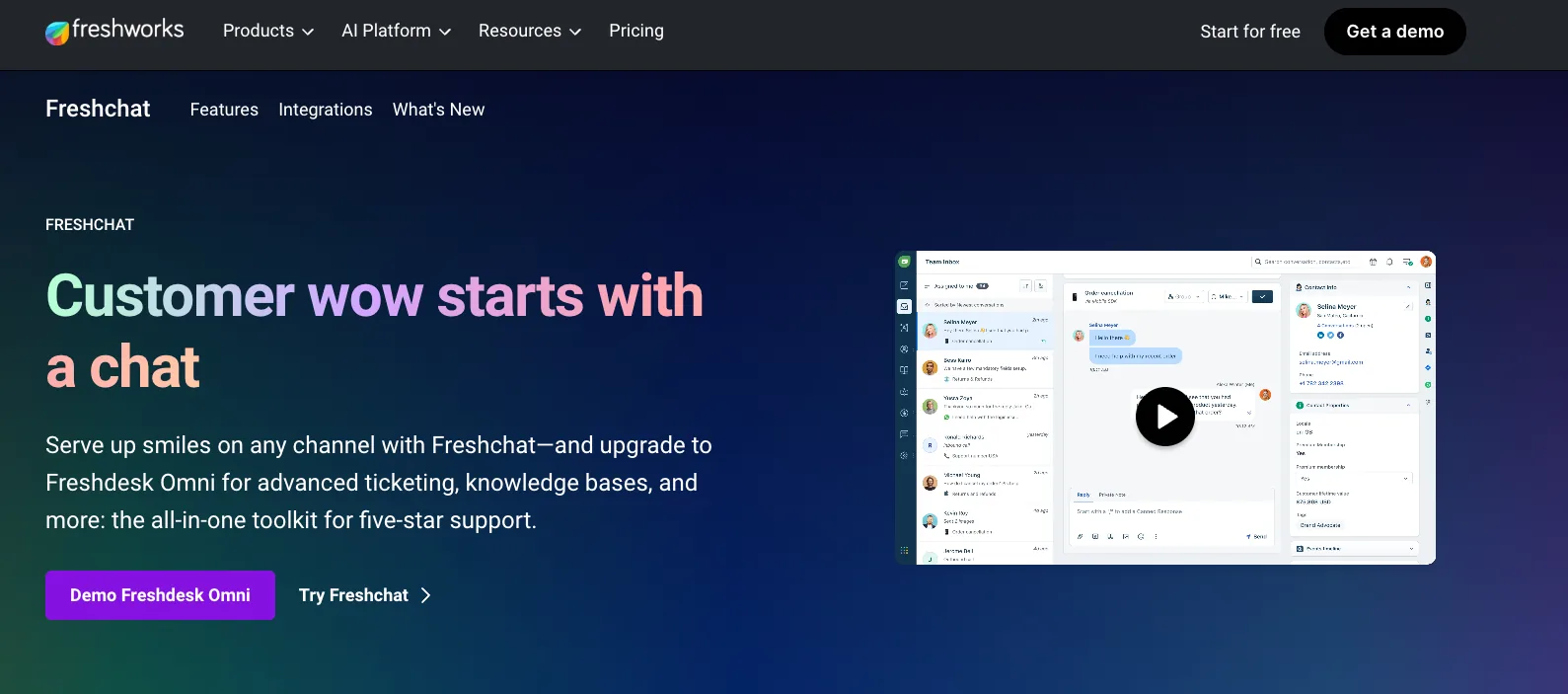
Freshchat is Freshworks' messaging product, and Freddy AI is the automation layer on top of it. For a team already inside the Freshworks suite, Freddy is the low-friction option, because it answers common questions and triages incoming tickets without a separate integration project.
Best for: teams already on the Freshworks suite that want AI built into the tools they run.
Key capabilities:
-
Freddy answers common questions from your help center and past tickets.
-
Auto-triage reads incoming tickets and fills priority, category, and type.
-
Bot builder for support and lead workflows.
-
Handoff to human agents inside Freshchat.
Freshchat plans start around $15 per agent per month, with AI features on higher tiers (confirm current figures).
Where it falls short. Freddy is strongest inside Freshworks, and its pull weakens if the rest of your stack lives elsewhere. A team on Zendesk or Intercom gets less from adopting a second ecosystem than from an AI option that works inside the helpdesk it already runs.
7. Gorgias
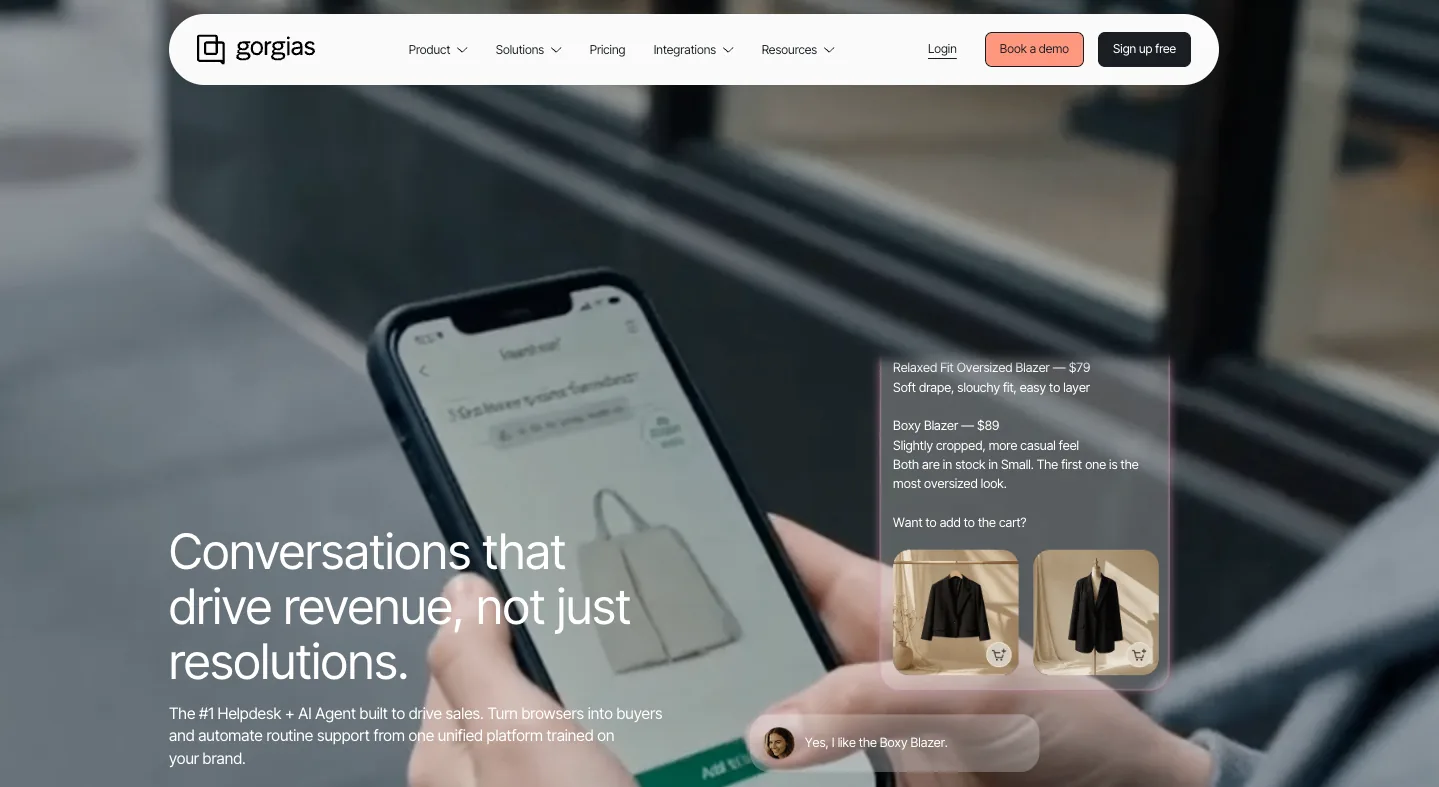
Gorgias is a support platform built for ecommerce, and its AI deflects order-related questions using live store data. It plugs into Shopify, Magento, and BigCommerce, so it can pull real order details into a conversation and answer the transactional questions that fill an ecommerce queue.
Best for: ecommerce and Shopify stores that want to deflect high-volume order questions.
Key capabilities:
-
Deflects order-status, returns, and product questions with real-time store data.
-
One-click escalation to human agents.
-
A unified inbox across chat, email, SMS, and social.
-
Rules and tagging to speed up repetitive workflows.
Gorgias charges per automated resolution, roughly $0.60 to $1.27 depending on plan, with entry pricing from about $10 per month (confirm current figures). A handed-over conversation is not charged as an AI resolution, so a handoff does not double-bill.
Where it falls short. Gorgias is purpose-built for ecommerce order support, so a B2B SaaS team with technical, product-specific tickets will find it outside its lane. Its strength on Shopify is the flip side of a narrow focus.
How to choose the right AI customer service chatbot for your team
The right tool depends on your stack, your ticket complexity, and how you want to pay. Here is how the seven sort out.
-
Pick Gorgias or Tidio if you run high-volume ecommerce or Shopify order support. Both pull live order data and deflect transactional questions cheaply, and Tidio adds live chat for a small team.
-
Match the tool to your suite if you are standardizing on one platform. Choose Zendesk AI Agents on Zendesk and Freshchat with Freddy on Freshworks, because the tightest integration is the native one. Or Fin AI if you're on Intercom.
-
Pick Ada if you are an enterprise that wants to design and own custom automation flows. It gives you low-code control over flows, SOPs, and APIs, if you have the resources to build and maintain them.
-
Pick Fin if you want a widely adopted, action-taking agent and can maintain the procedures it follows. It resolves across channels and calls your APIs mid-conversation, and its coverage tracks how much SOP work you put in.
-
Look at Pluno if you already run Zendesk or Intercom and your tickets are complex and technical.
Frequently asked questions
What is the best AI chatbot for customer service? There is no single best one, because the right pick depends on your stack, ticket complexity, and billing preference. B2B SaaS teams on Zendesk or Intercom with technical tickets tend to fit Pluno or Fin, ecommerce teams fit Gorgias or Tidio, and suite-committed teams fit Zendesk AI Agents or Freshchat. Simulate a shortlist against your own tickets before deciding.
What is the difference between an AI chatbot and an AI agent? A chatbot answers questions, often from a script or a knowledge base. An AI agent goes further and can take actions in connected systems, like updating an order or creating a ticket, and can resolve an issue end to end. Most of the tools worth buying in 2026 are agents, though many are still marketed as chatbots.
What is the difference between resolution and deflection? Deflection means the bot handled a question so it never reached a human. Resolution means the underlying issue is closed. A bot can deflect by answering a FAQ and still leave the real problem open, which is why vendors that bill on resolution and vendors that bill on deflection are not measuring the same thing.
Can AI chatbots handle complex or technical support tickets? Some can, and the deciding factor is how the tool learns. A tool that learns from your resolved support tickets can answer product-specific and edge-case questions the help center never documented, while a tool that depends on hand-built flows only covers the paths someone configured. For technical B2B support, test a tool on your hardest historical tickets before you trust it.
Which AI chatbot is best if I already use Zendesk or Intercom? Your real choice is between your helpdesk's native AI and an AI layer that works inside the same helpdesk. Native AI is the fastest to turn on. An AI layer such as Pluno learns from your resolved support tickets and can route engineering-bound issues into Jira and Linear, which suits teams with complex, technical tickets. Run both against your own tickets to see which resolves more of them.