Your executive team wants AI in support this quarter. You have a shortlist of vendors who all describe themselves the same way, and no obvious way to tell them apart.
The problem is not that the market is crowded. The problem is that "AI customer service company" can mean two different things:
-
An AI layer. You keep the helpdesk you already run, and the AI connects to it and works your existing tickets. You buy it separately, so you can replace the AI without touching the helpdesk.
-
An AI helpdesk. The AI is part of the platform itself, from the same vendor on the same invoice.
Those two carry different migration risks, different timelines, and different bills, and most roundups list them side by side as if you could choose between them on features. Getting the category wrong is expensive. Gartner found that only 24% of service and support leaders see positive financial returns on their AI use cases, and BCG found that roughly nine in ten struggle to navigate vendors and integrators. Buyers are comparing brands when the decision that drives the outcome is which kind of vendor they need.
So this guide sorts the nine vendors below into those two groups. Five are AI layers, and four are AI helpdesks.
By the end of this guide, you will know exactly which AI customer service company is the best fit for your specific use case.
TL;DR
-
If you run technical B2B SaaS support on Zendesk or Intercom, Pluno is the AI customer service layer built for it. Pluno ingests your resolved support tickets, which is how it resolves the complex issues your help center never documented, and its Troubleshooting Agent investigates logs, code, and error tracking to reach root cause on tickets that need diagnosis. It installs into your existing helpdesk, so nothing gets replatformed.
-
If your volume is high and your intents repeat, the other layers are built for autonomous resolution at scale: Fin AI, Decagon, Sierra, and Ada. Fin is self-serve with a published per-outcome rate, so you can start without talking to anyone. Decagon, Sierra, and Ada each mean a custom quote and custom onboarding, so plan for a sales cycle before you even see a number.
-
If you want one vendor and one bill, buy the AI helpdesk you are already on: Zendesk AI, Gorgias for Shopify brands, Freshworks Freddy AI for small teams, or Salesforce Agentforce if Salesforce is your system of record. The tradeoff is capability on specific jobs, because a specialised layer can beat a built-in AI at a narrow task. Whether that matters depends on your use case.
-
Check what you are being billed for before you compare prices. These nine vendors bill on four different units. Per resolution, per outcome, per 24-hour session, and per credit consumed. Two vendors with almost the same feature list can cost very different amounts at the same ticket volume, so run your own numbers against each vendor's unit before you take a sales call.
All pricing below was verified in July 2026. Rates vary by region, billing term, plan packaging, and usage, so confirm figures in your own quote.
What is an AI customer service company in 2026?
An AI customer service company sells software that reads a customer's question, decides what to do about it, and either resolves the issue or hands it to a human with the context attached. The category spans autonomous AI agents, copilots that assist human agents, and the AI bundled into helpdesk platforms.
The word that gets stretched is "agent," so here is the distinction that matters.
-
An AI agent reasons and acts. It plans a sequence of steps, calls the systems it needs, and closes the ticket end to end.
-
A chatbot matches and suggests. It follows a preconfigured flow or keyword match and points the customer at a help article.
-
A copilot drafts for a human. A human agent reviews the draft and sends it, so a person stays in the loop on every reply.
Which type of AI customer service software do you need?
Are you willing to change helpdesks in the next twelve months?
If the answer is no, you need an AI layer. Pluno, Fin AI, Decagon, Sierra, Ada. A layer connects to the helpdesk you already run and works your existing tickets, so there is no data migration, no new interface for your human agents, and no contract to unwind.
Depth is your second decision, because it varies widely inside this group.
-
Pick Pluno if your tickets are technical. It ingests your resolved support tickets to handle the issues your help center never documented, then investigates the systems behind them.
-
Look at Fin AI, Decagon, Sierra, or Ada for high-volume autonomous resolution. All four bring their own agent-building environment and channel stack, and all four expect a project to deploy.
If the answer is yes, or you are already committed to a platform, you need an AI helpdesk. Zendesk AI, Gorgias, Freshworks Freddy AI, Salesforce Agentforce. The AI ships with the platform, so you get one vendor, one invoice, one support contract, and the shortest path to something running. Whether the built-in AI is enough depends on the jobs you need it to do, and if it falls short on the ones that matter, adding a layer on top puts you back to two vendors.
You need a different list if voice or Slack carries your volume. PolyAI and Parloa build for phone volume, so start there if most contacts arrive as calls. NiCE Cognigy, Kore.ai, and Omilia are built around IVR, workforce management, and voice at scale, and Forrester's Conversational AI Platforms For Customer Service, Q2 2026 evaluated 14 providers in that market on 16 April 2026. Pylon and ClearFeed serve teams whose customers reach them in shared Slack channels, where an inbox-shaped tool fights the workflow.
All 9 AI customer service companies compared at a glance
The Type column tells you whether you keep your helpdesk, and the billing unit decides your bill. Six of these nine publish a unit price you can multiply by your own volume.
| Company | Type | Billing unit | Public unit price | Billed when the AI escalates? | Best for |
|---|---|---|---|---|---|
| Pluno | AI layer | Per resolution | €0.90 per resolution | No, escalations are never counted | Technical B2B SaaS support |
| Fin AI | AI layer | Per outcome | From $0.99 per outcome | Procedure handoffs bill $0.99 | One vendor across many helpdesks |
| Decagon | AI layer | Not published | Contact sales | Not published | High-volume consumer support |
| Sierra | AI layer | Per outcome, tiered by complexity | Not published | In most cases no charge | Enterprise voice support |
| Ada | AI layer | Not published | Contact sales | Not published | Non-technical CX teams |
| Zendesk AI | AI helpdesk | Per automated resolution | $1.50 committed, $2.00 pay-as-you-go | Assisted escalations and unverified contained resolutions excluded | High email and chat volume |
| Gorgias | AI helpdesk | Per resolved conversation, plus a ticket fee | $0.90 per resolution on annual billing | No AI fee when a human takes over | Shopify brands |
| Freshworks Freddy AI | AI helpdesk | Per 24-hour session | $49 per 100 sessions | The unit is defined by interaction, not outcome | Small teams on a tight budget |
| Salesforce Agentforce | AI helpdesk | Flex Credits, conversations, or resolutions | $2 per resolution, or $0.10 per action | No charge on a human request | Teams already running Salesforce |
The four billing units are not variations on the same thing, because each one charges you for something different.
-
Per resolution. You pay when the AI closes a ticket on its own.
-
Per outcome. Wider than a resolution, since an outcome can also be a qualified lead or a saved cancellation, and each type can carry its own price.
-
Per 24-hour session. You pay once for everything one customer does in a day, however many messages that takes, so your bill tracks unique daily users.
-
Per credit or action. You pay for each step the AI takes, so a ticket needing five tool calls costs more than one needing two.
Decagon, Sierra, and Ada publish nothing at all. Vendor rates are also not directly comparable, because each company defines a resolution, an outcome, and a conversation differently.
The 5 best AI customer service layers for the helpdesk you already run
These five connect to the helpdesk you already run, so your human agents keep working where they work today. Pluno and Fin AI publish a unit price you can multiply by your own ticket volume. Decagon, Sierra, and Ada each mean a custom quote.
1. Pluno, best for technical B2B SaaS support
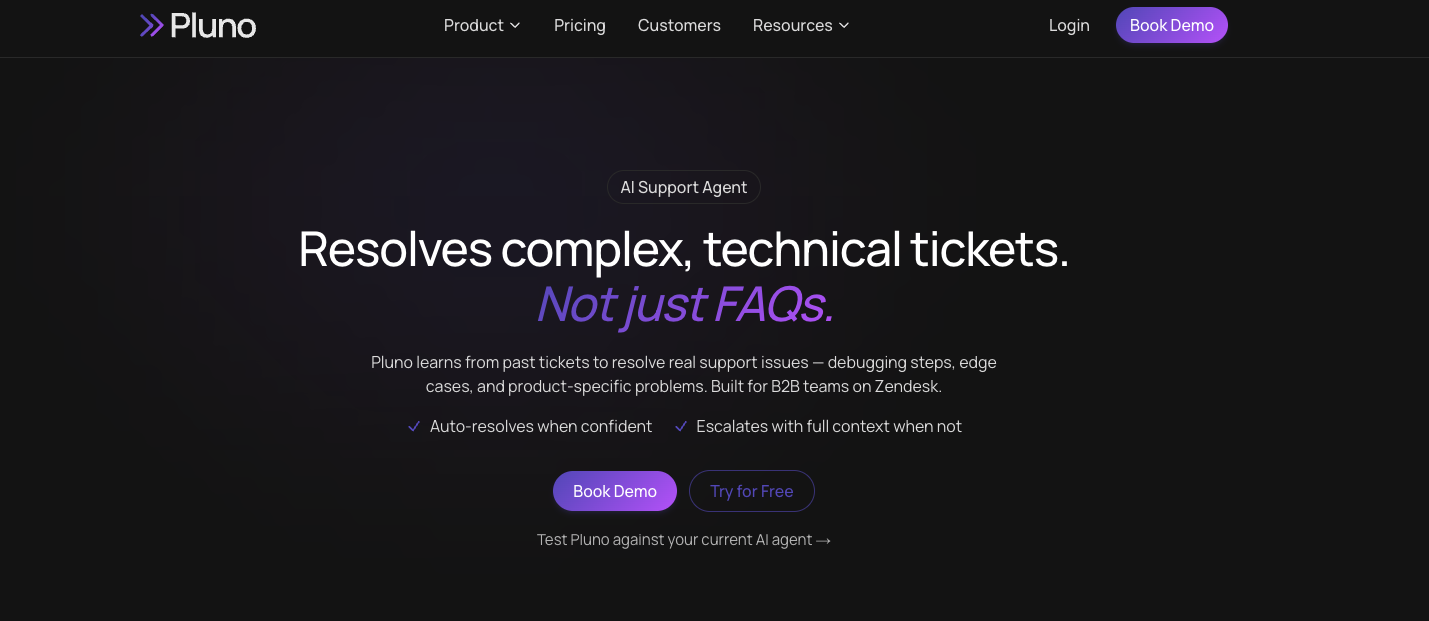
Pluno ingests your resolved support tickets and investigates the systems behind them, so it resolves technical issues that help-center-trained AI agents escalate.
What it is. An AI support agent for complex technical tickets that works inside Zendesk and Intercom. Pluno ingests your resolved support tickets, which is what lets it handle issues the help center never documented, a gap that is normal in B2B SaaS where the product ships faster than the docs.
How it resolves. Deflection AI resolves tickets autonomously on email, the web widget, WhatsApp, social, and Zendesk Messaging, drawing on resolved support tickets, the help center, uploaded files, and custom API integrations. Where the answer needs diagnosis, the Troubleshooting Agent investigates code, logs, session recordings, Sentry, Linear, and databases to find root cause, and it can open a GitHub pull request after approval. Support and engineering both use it, so support confirms a bug before escalating and engineering receives the investigation already done.
On escalation. The engineering loop needs two modules. The Troubleshooting Agent investigates, then Escalation Copilot creates the Jira, Slack, or Linear item with the brief written and syncs status and comments back into the ticket both ways.
Pricing. €0.90 per resolution (roughly $0.98), and escalations are never counted, so partial work never appears on the invoice. A ticket is marked resolved 72 hours after Pluno's last reply if the customer does not respond. AI Copilot is €49 per agent per month, and the platform fee is custom and scales with your monthly ticket volume. See Pluno's published pricing.
Where it falls short.
-
Helpdesk coverage. Pluno works with Zendesk and Intercom only. Other helpdesks are not supported today.
-
No live voice. Call Insights & Summary transcribes and summarises call recordings, and it does not answer calls.
2. Fin AI, best for one vendor across many helpdesks

Fin executes real backend actions on several helpdesks, and it prices every outcome the same whether or not a human finishes the job.
What it is. One of the most widely adopted AI support agents, and an autonomous agent that runs on Intercom's own helpdesk as well as third-party helpdesks including Zendesk, Salesforce, HubSpot, Freshworks, and Gorgias.
How it resolves. Fin takes real actions including refunds, cancellations, account changes, and multi-step workflows against live data in systems like Stripe, Shopify and others. Procedures are multi-step business rules written in plain language with branching logic, authored by the support team and testable through simulations, and Data Connectors are the API layer underneath. Procedures carry an ongoing cost. Somebody writes each one, and somebody keeps it current every time the product changes, and in B2B SaaS the edge cases multiply faster than a team can document them. That maintenance lands on the support team. Pluno derives the same flows from resolved support tickets, which is a different design philosophy reaching the same outcome.
On escalation. Fin passes the full conversation with context and history into your human agents' existing workflow, and it escalates when confidence thresholds are not met.
Pricing. From $0.99 per outcome, with a 50-outcome monthly minimum that works out to about $49.50. There is no separate base fee and no bundle of included resolutions, though an unpublished minimum commitment applies on third-party helpdesks. Fin treats 24 hours of customer disengagement as an assumed resolution and refunds one if the customer returns. Copilot is $35 per user per month billed monthly. See a fuller Fin and Pluno comparison.
Where it falls short.
-
Qualification outcomes cost ten times a resolution at $9.99 each, and the detail sits in a help-centre FAQ while the pricing page does not carry it.
-
You pay for some escalations. A configured Procedure handoff bills $0.99 even though a human completes the work.
-
Copilot's price depends which page you read. fin.ai lists $35 per user per month and intercom.com lists $29 billed annually, so get the figure written into your quote.
3. Decagon, best for high-volume consumer support
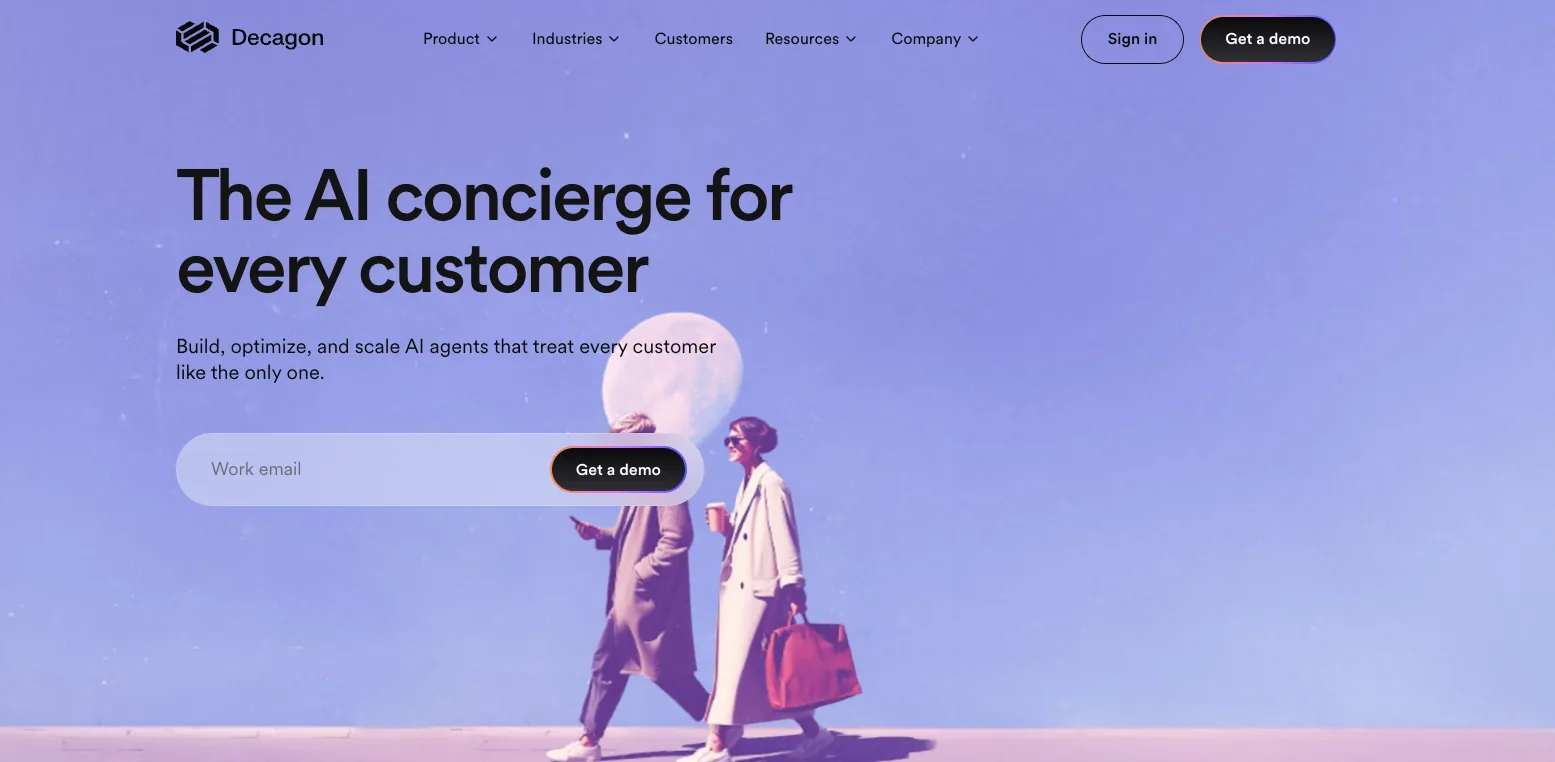
Decagon lets a support team write AI agent behaviour as plain-language procedures while engineering keeps version control, and it publishes no pricing at all.
What it is. An AI layer for chat, voice, and email that connects to Zendesk, Salesforce, and Intercom, and which raised a $250 million Series D in January 2026 at a $4.5 billion valuation. Agent Operating Procedures are the product's centre: you define workflows in natural language, the way you would write an SOP for a human agent, and engineering versions them with Git-based tracking while support owns the authoring.
How it resolves. Decagon takes action on a customer's behalf across Zendesk Sunshine, Salesforce, and other systems, and connects to internal systems through MCP and its own APIs. Guardrails cover brand voice, escalation, and hallucination, and Agent Traces expose the reasoning, runtime, and latency behind each decision, which is the audit trail a support lead needs when a reply goes wrong.
On escalation. Live chat escalation, automated email routing with handoff, and inbound call forwarding to human agents.
Pricing. Custom enterprise pricing. Decagon's pricing URL returns a 404, and we found no unit price, rate card, or calculator on the site. Per-resolution figures circulating in comparison articles all originate on competitors' blogs, so get a quote.
Where it falls short.
-
Nothing to model. No published unit means no budget forecast without a sales cycle.
-
Case-study rates come without a definition of a resolution. Decagon quotes resolution and deflection percentages per customer, and none states what counted as resolved or over what window.
-
The headline cost figure is not solely its own. Decagon's Chime case study footnotes its cost reduction to Chime's 2025 S-1 filing, and the same page notes Chime works with a range of technology partners.
4. Sierra, best for enterprise voice support
Sierra charges on outcomes and handles voice as a first-class channel.
What it is. An enterprise AI layer that you build in Sierra's own Agent Studio and then deploy across web chat, mobile, WhatsApp, SMS, email, and phone. Agents can also be published into ChatGPT, so customers can reach your support without visiting your site.
How it resolves. Sierra's AI agents act on the customer's behalf through its integrations. Voice is a real strength, since Sierra handles inbound and outbound calls, copes with interruptions and accents, and is built to replace an IVR tree. Payments are the other differentiator: Sierra holds PCI DSS Level 1 Service Provider certification and routes cardholder data through dedicated infrastructure that stays out of its core platform and away from the models.
On escalation. Sierra routes to care teams with the conversation context attached.
Pricing. Custom and outcome-based. Sierra charges on resolved conversations, saved cancellations, and upsells, tiered by complexity, and says that in most cases there is no charge when a conversation goes unresolved or gets escalated. Sierra publishes no figure, and the per-resolution prices in circulation come from competitors' pages.
Where it falls short.
-
No rate, no chargeable-resolution definition. Outcome pricing is only as good as the definition of an outcome, and Sierra publishes neither.
-
No integration catalogue. Sierra's Agent Studio page cites "40+ pre-built integrations" to knowledge bases, systems of record, and contact centres, and names none of them. Its documentation sits behind a login under confidentiality terms, and there is no listing in the Zendesk Marketplace or Salesforce AppExchange. Two customer stories name systems in passing, a Salesforce case at Sonos and Gladly at Chubbies, so this is about what Sierra discloses and not what it can connect to. Expect to get helpdesk compatibility written into the contract.
5. Ada, best for non-technical CX teams building complex flows
Ada gives a non-technical CX team the most explicitly documented read-and-write access to backend systems in this list.
What it is. An AI layer, Toronto-based and building in this category since 2016. Playbooks are the core: multi-step SOP automation built in plain language or from uploaded SOPs through a no-code interface, published as vertical Playbooks for travel, ecommerce, gaming, financial services, SaaS, and insurance.
How it resolves. Ada's documentation is the clearest in this group, stating that an Ada AI agent reads from and writes to CRM, OMS, ERP, and ticketing systems in real time, including checking inventory, updating a record, and processing a transaction. The GDS integrations are a differentiator no other vendor here matches: Amadeus, Sabre, and Galileo by Travelport give it PNR access, rebooking, cancellations, and refunds, which makes it the obvious shortlist for travel. Voice is a core channel alongside messaging and email, and Ada is explicit that it does not build for deflection.
On escalation. Handoff across messaging, email, and voice, with context passed into Zendesk, Salesforce, Genesys, NICE CXone, Twilio Flex, and Amazon Connect.
Pricing. Custom and sales-led, and Ada's pricing URL redirects to a demo request. Third-party pricing analyses report figures in the range of $1 to $3.50 per resolution, and those are estimates, so confirm the number in your own quote. See the wider field in Ada alternatives worth comparing.
Where it falls short.
-
No published pricing of any kind. Ada's pricing URL redirects to a demo request, so there is no way to size the cost before a sales call.
-
Complex integrations need developers. Ada states in its own FAQ that connecting a custom backend or building workflows spanning multiple systems typically requires developer involvement, which changes the timeline for a CX-owned rollout.
-
Deflection-first buyers will find it opinionated. Ada rejects deflection as a goal, so if your target metric is contact reduction, expect friction in how the platform reports success.
The 4 best AI customer service help desks
In these four the AI ships with the platform, so it is one vendor, one invoice, and one support contract.
6. Zendesk AI, best for high email and chat volume on one platform
Zendesk AI publishes a per-resolution rate on its pricing page, and runs two different resolution-billing models depending on which one your account sits on.
What it is. The AI built into the Zendesk Suite, covering AI agents, the Copilot add-on, and Intelligent Triage. Zendesk's acquisition of Forethought has closed, and Forethought AI agents now appear on the Zendesk pricing page.
How it resolves. AI agents and Copilot Auto Assist take actions including field updates and returns processing through Action Builder, which is consumption-billed above your plan allowance. Intelligent Triage classifies every request by topic, entity, sentiment, and language and populates existing custom ticket fields through entity detection. Zendesk renamed "intent" to "topic" on 11 June 2026 and classifications now reach Suite and Support Professional and above at no extra cost, so any guide telling you Intelligent Triage requires Enterprise is out of date. Zendesk AI also ingests external sources including Guru, Confluence, and web crawlers, so the range of sources is not where the difference sits. Depth of engineering context and ticket memory is.
On escalation. Zendesk's resolution model has three tiers as of 18 May 2026. An assisted escalation means a human finished, a contained resolution completed but failed verification, and a verified resolution passed after a 72-hour no-follow-up window. The first two do not count against your allowance.
Pricing. Support Team starts at $19 per agent per month paid yearly, the Suite runs $55 for Team and $115 for Professional, and Suite Enterprise with Copilot is sales-gated. The Copilot add-on is $50 per agent per month. The pricing page lists automated resolutions at $1.50 committed and $2.00 pay-as-you-go, against an included allotment that runs from 5 resolutions per agent per month on Team to 15 on Enterprise. See alternatives to Zendesk's native AI.
Where it falls short.
-
Two price lists, one product. The pricing page still advertises the count-based model at $1.50 and $2.00 per resolution, while the help centre documents a newer dollar allowance, from $2 to $10 per agent seat per month and capped at $5,000 a year, whose example prices Zendesk labels placeholders and refers to sales. Which model you are on depends on when Zendesk migrates your account, and it gives 30 days' notice.
-
Jira escalation is largely hand-filled. Zendesk's documentation states that copying fields brings only the subject and the most recent comment, mandatory form fields cannot be removed, and bidirectional syncing of the same field is not supported. Compare how native Jira escalation compares.
-
Slack works for notification and stops there. Human agents cannot close tickets or edit fields from Slack, and comments over 1,000 characters will not insert into a side conversation.
-
Sunset dates to plan around. AI Agents Essential and the legacy bot builder both reach end of life on 10 December 2026.
Teams that want to keep Zendesk as the help desk have a second option for the AI itself. An AI layer installs into the same instance, so Zendesk stays your system of record while a different vendor supplies the automation, and how the native option compares sets the two side by side.
7. Gorgias, best for Shopify brands
Gorgias resolves order, return, and subscription questions natively for Shopify brands, and its AI agent will not run without a connected Shopify store.
What it is. A conversational commerce platform for Shopify brands, positioned as something other than a general helpdesk. AI Agent 3.0 shipped in summer 2026.
How it resolves. Order tracking, returns, refunds, subscription changes, and order edits all run through a two-way Shopify sync, so the AI reads live order state and does not ask the customer for it.
On escalation. Brands set rules for which topics always route to a human and which auto-escalate, and full Shopify order history sits in the same inbox, so the context sits in one place and nothing has to transfer. Whether a generated summary accompanies the handoff is not documented.
Pricing. Plans run from $10 to $900 per month by ticket volume, billed per ticket, so team size does not move the price. AI Agent is a separate add-on at $0.90 per resolved conversation on annual billing and $1.00 monthly, and Gorgias does not charge the AI fee when a human steps in. One cost is easy to miss: for accounts created after 28 May 2025, an AI-resolved ticket also counts as a helpdesk ticket, so a resolution carries both fees.
Where it falls short.
-
AI Agent requires Shopify. Gorgias documentation lists a connected Shopify store as a prerequisite, so its BigCommerce, Magento, and WooCommerce customers cannot run it, and there is no voice channel for the AI agent.
-
Chat automation covers 15 languages, and flows and article recommendations appear only in languages you have translated yourself.
-
Complexity beyond commerce. Practitioners consistently report it handling orders and shipping well and struggling once tickets get more technical.
8. Freshworks Freddy AI, best for small teams on a tight budget
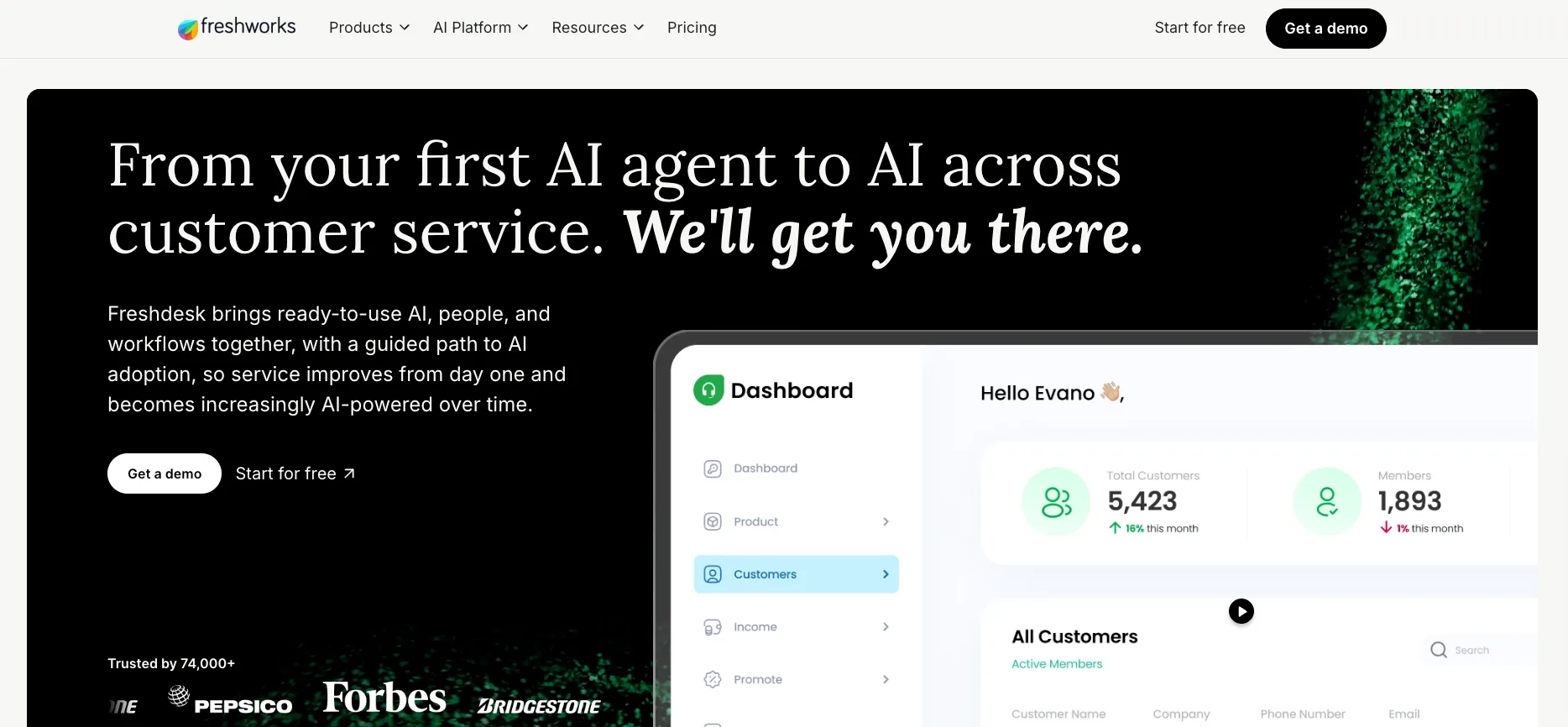
Freddy AI is the cheapest entry point in this list and the only one that bills by time window.
What it is. The AI inside Freshdesk and Freshdesk Omni, covering the Freddy AI Agent for customer-facing automation and Freddy Copilot for agent assist.
How it resolves. Freshworks says the agent takes real-time actions including refunds and order updates, through Agentic Workflows built in AI Agent Studio, with more than 50 prebuilt and Shopify, Stripe, PayPal, and FedEx named. No public list separates the write actions that work out of the box from those needing a custom build, so ask for that list in a demo.
On escalation. Freshworks says human agents receive full context but does not document whether the human gets a summary, the raw transcript, or both. The summary generator is a paid Copilot capability, and the AI Agent handoff does not include it.
Pricing. Freshworks defines a session as all interactions between one end user and the AI agent inside a 24-hour window, so one customer with five chats in a day counts as one session and cost scales with unique daily users. At $49 per 100 sessions that is roughly $0.49 per user-day. Freshdesk starts at $19 per agent per month annually, and Freddy AI Copilot is $29 annually or $35 monthly per agent on Pro and above, so ten agents on Pro billed monthly works out to about $1,010.
Where it falls short.
-
The unit makes cross-vendor comparison hard. A session bills whether or not anything was resolved, so convert to a cost per resolved ticket at your own volume before you decide.
-
The 500 free sessions are one-time. Freshworks documentation describes them as a one-time allowance for new customers, and the pricing card does not say so.
-
On standalone Freshdesk, AI Agent Studio builds email agents only. Freshworks' pricing pages list three AI Agent rows for Freshdesk against six for Omni, and Conversational AI Agent, Vertical AI Agent, and Agentic Workflows are all Omni-only.
None of these five lets you forecast a monthly bill from published information. Two publish nothing, one publishes plans while gating the rate that matters, one publishes rates you cannot forecast from, and one has never published a figure.
9. Salesforce Agentforce, best for teams already running Salesforce
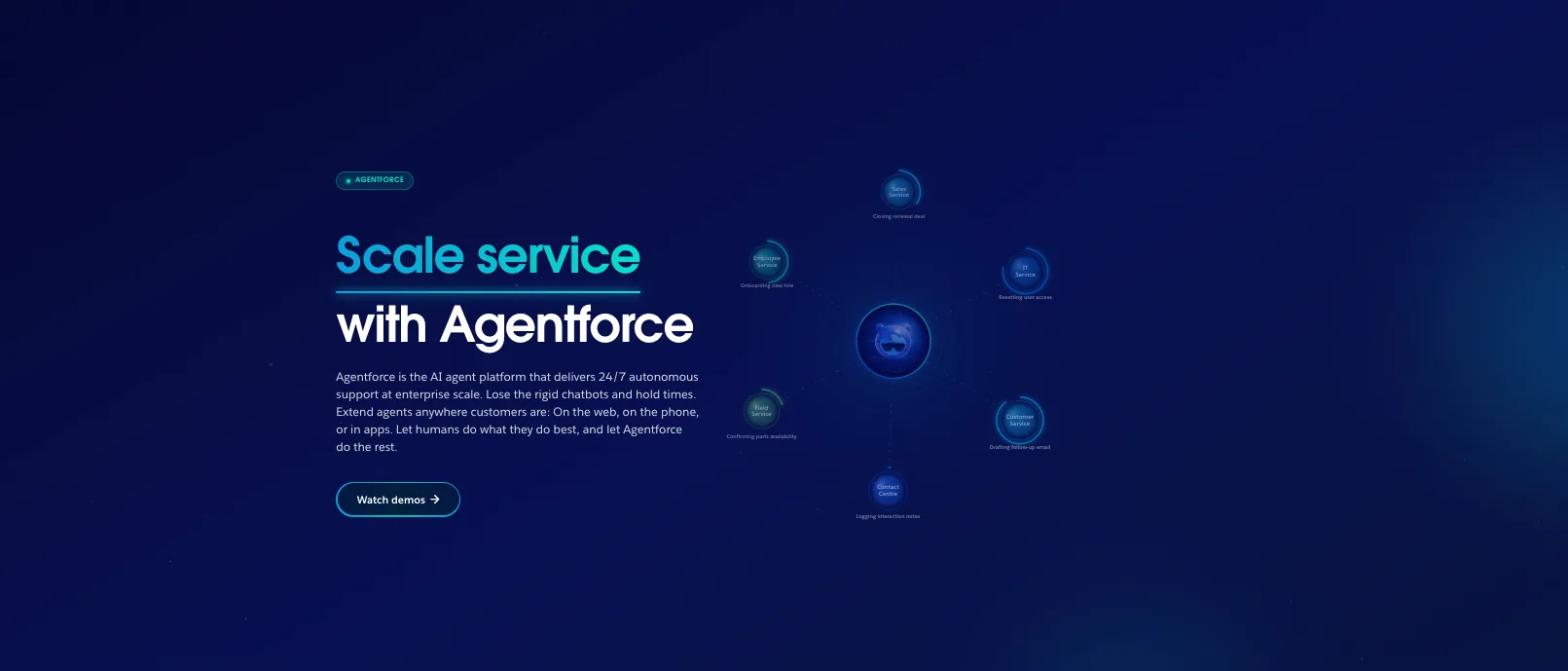
Agentforce puts the AI on the same record as your CRM data, and meters it across three models you have to choose between.
What it is. Salesforce's agent layer. The buyer-facing product is Agentforce Help Agent under Agentforce Self-Service, generally available since July 2026, with no-code setup, grounding on Salesforce Knowledge plus uploaded files and crawled URLs, and voice, web, portal, and messaging enabled from one screen.
How it resolves. A prepackaged action library manages cases, and add-on actions cover order management, appointment scheduling, and account management. Its resolution figure is worth citing because Salesforce discloses what it measures: on help.salesforce.com, Agentforce handled 4.3 million inquiries and resolved 70% of them. The denominator and the property are both named, more than any other vendor here offers, though "resolved" is undefined and no time window is given.
On escalation. The AI agent passes complete customer context to your service team, and Salesforce does not charge when a customer gives negative feedback or asks for a human.
Pricing. Three metering models, and you pick one. Flex Credits cost $500 per 100,000 credits, with a standard action consuming 20 credits and a voice action 30, so about $0.10 and $0.15 per action. Conversations cost $2 each. Help Agent Resolutions cost $2 each and include unmetered actions and Data 360 queries during the interaction. Service Cloud seats sit underneath, from $25 to $550 per user per month.
Where it falls short.
-
Nine or more pricing constructs for one product family, and Flex Credits and conversations cannot coexist in the same org, so a multi-use-case enterprise commits to one metering philosophy globally.
-
The published examples understate the bill. Salesforce footnotes every pricing example to exclude Data 360 credits, which most grounded deployments consume.
-
Unused Flex Credits do not roll over, and cost tracks workflow design more than volume, so an AI agent calling five tools costs more than twice one calling two.
Bottom line
The type decides your shortlist, and the billing unit decides your bill.
-
Pick Pluno if your tickets are technical and you run Zendesk or Intercom. It ingests your resolved support tickets to handle what the help center never documented, then investigates logs, code, and error tracking to reach root cause. €0.90 per resolution, and escalations are never billed.
-
Pick Fin AI if you want one agent across several help desks with a rate you can model today. From $0.99 per outcome, self-serve, and a Procedure handoff bills the same as a resolution.
-
Pick Decagon, Sierra, or Ada if volume is high, intents repeat, and you can run an implementation project. All three price through sales, so budget the evaluation time as well as the licence.
-
Pick Zendesk AI, Gorgias, Freshworks Freddy AI, or Agentforce if you are already on that platform and want one vendor and one invoice. Gorgias needs a connected Shopify store to run its AI agent, and standalone Freshdesk gets email agents only.
-
Then test the two things that predict month three. Ask for the list of write actions available without custom development, and escalate a multi-step ticket to see exactly what reaches the human.
-
Simulate on your own tickets before you sign. Pull 100 real tickets weighted to your actual mix and include the hard ones, then score resolution, escalation quality, and wrong answers separately. No industry containment benchmark exists, so your own history is the only honest benchmark.
If your tickets are complex and technical, start with the simulation. Pluno ingests your resolved support tickets, which is how it resolves the issues your help center never documented and that help-center-trained AI agents escalate. It investigates logs, code, and error tracking to reach root cause, and it works inside Zendesk and Intercom, so nothing gets replatformed to find out.
Every figure in this guide was verified in July 2026. Pricing changes frequently and varies by region, billing term, and plan packaging, so confirm current rates with each vendor before you budget.
Frequently asked questions
What are the top AI customer service companies in 2026?
Nine vendors cover most shortlists, and they split two ways. The AI layers, which connect to the helpdesk you already run, are Pluno, Fin AI, Decagon, Sierra, and Ada. The AI helpdesks, where the AI ships with the platform, are Zendesk AI, Gorgias, Freshworks Freddy AI, and Salesforce Agentforce. Voice-heavy and contact-centre buyers need a different list.
How much do AI customer service companies cost?
The unit matters more than the number. Published rates include Pluno at €0.90 per resolution, Gorgias at $0.90 per resolved conversation annually, Fin AI from $0.99 per outcome, Freshworks at $49 per 100 sessions, and Agentforce at $2 per resolution. Zendesk lists $1.50 committed and $2.00 pay-as-you-go per automated resolution, while Decagon, Sierra, and Ada publish nothing at all.
What is the difference between an AI agent and a chatbot in customer service?
An AI agent reasons through a problem, calls the systems it needs, and closes the ticket. A chatbot matches keywords or follows a preconfigured flow and points the customer at an article. The test is whether it can complete an action like a refund without handing off. If it cannot, it is answering questions and the resolution rate is measuring deflection.
Do I need to replace my helpdesk to use AI customer service software?
No. An AI layer connects to the helpdesk you already run and works your existing tickets, so there is no data migration and no new interface for your human agents. The alternative is the AI helpdesk you are already paying for. The tradeoff is that a layer adds a second vendor and invoice, while a built-in AI may not match a specialised layer on the specific jobs you care about.