Most teams are leaving Fin AI (by Intercom) because it marks tickets as resolved when they aren't, responses come across as robotic, and complex tickets keep ending up back with human agents. On the other hand, it's also not the right fit for specific use cases you might have.
This guide covers four Fin AI alternatives, each picked for a specific use case where Fin tends to fall short: voice-heavy support, long-relationship industries with action-heavy work, Shopify e-commerce, and complex technical B2B troubleshooting.
The point of this article is to help you find the right Fin AI alternative - whether you're a Zendesk user, running on a different platform entirely, or evaluating options outside of Intercom. It's not a "best of" ranking. It's about matching the right tool to your team's actual needs.
TL;DR
Fin AI is a strong fit if you run high-volume conversational support inside Intercom and your questions mostly have answers sitting in your help center.
On the other hand, it struggles when it marks tickets as resolved - and charges you for them - even when the customer's issue wasn't actually fixed, when responses feel robotic, when answers live outside the help center, or when your support involves voice or technical B2B troubleshooting.
However, there are four Fin AI alternatives that can help you provide better support if you fit some of these specific use cases:
- Decagon is the best choice if voice is your primary support channel, and you handle 5,000+ conversations per month at the enterprise tier. Sub-second voice latency through an ElevenLabs partnership, plus outbound campaign tooling, are the features Fin doesn't match.
- Sierra is a good Fin alternative if you operate in financial services, healthcare, insurance, or subscription businesses where customer relationships span months or years and the AI needs to take real actions (process payments, save cancellations, modify accounts) rather than just answer questions.
- Gorgias is a good alternative if you sell on Shopify and want AI to drive revenue (pre-purchase recommendations, upsells, returns) as well as deflect tickets. Live Shopify data access (orders, catalog, inventory, customer tags) plus a pre-purchase Shopping Assistant are the differentiators. However, there's a trade-off - Gorgias is itself a helpdesk, so adopting it means replacing Intercom entirely.
- Pluno is the best Fin AI alternative for teams currently evaluating Fin - especially if you sell a technical B2B product (SaaS, hardware, fintech) and most tickets require complex troubleshooting, with answers living in past tickets, Slack, Confluence, Sentry, Jira, and other knowledge sources rather than your help center. The main differentiator is that past resolved tickets are Pluno's primary knowledge source, so the AI learns how your team actually solves issues. When evidence is thin, it escalates to a full diagnostic context rather than guessing. Pluno integrates natively with both Intercom and Zendesk, so you can connect it without changing your existing helpdesk.
Here's how each tool stacks up against Fin on the most important criteria:
| Criteria | Fin AI | Decagon | Sierra | Gorgias | Pluno |
|---|---|---|---|---|---|
| Best for | High-volume conversational support inside Intercom | Voice-heavy enterprise consumer brands | Long-relationship industries (financial services, healthcare, subscriptions) where AI takes real actions on payments and accounts | Shopify e-commerce stores | Complex technical B2B products with a lot of technical tickets & troubleshooting |
| Integration with Intercom | Native | API-based | API-based | No. Replaces Intercom (Gorgias is itself a helpdesk) | Native. Also works with Zendesk |
| Channels | Chat, email, SMS, WhatsApp, voice | Voice (sub-second), chat, email, SMS | Chat, SMS, WhatsApp, email, voice, ChatGPT | Email, chat, social, voice, SMS | Email, web widget, Intercom and Zendesk messaging (no voice) |
| Resolution approach | Help center, URLs, uploaded docs, custom Actions | KB plus AOPs (workflows) plus helpdesk and tool integrations | Agent Data Platform persists customer history across channels and sessions; Ghostwriter generates agents from SOPs and call transcripts | Help center plus live Shopify data (orders, catalog, inventory, customer tags) | Past resolved tickets (primary), Knowledge Base, Slack, Confluence, Jira, Sentry, DataDog, APIs, and more |
| Past-ticket learning | Limited (Intercom history only) | Via integrations | Via training data configuration | Not used; help center plus Shopify data instead | Core methodology; the primary knowledge source |
| Action-taking | Custom Actions for backend calls (refunds, lookups) | Refunds, order updates, account changes via integrations | Level 1 PCI-compliant payments inside voice; refunds, returns, account changes via integrations | Shopify-native actions (refunds, returns, order edits, discount codes) | Auto-tagging, field filling, Jira issue creation, Slack escalation; not built for transactional actions like refunds |
| Confidence-based escalation | No; deflection-style. Counts no-reply as resolved | Watchtower QA monitors output; supervisor model flags hallucinations | Supervisor models check output; Monitors flag outlier conversations | Not differentiated; standard pass-through escalation | Yes, evidence-thresholded. Escalates with summary, evidence, and next steps when unsure |
| Setup time | Hours to days inside Intercom | ~6 weeks with dedicated Forward-Deployed Engineers | 4 to 10 weeks initial; 3 to 6 months to fully optimize | Days inside Gorgias | Days; native Marketplace install, learns from historical tickets immediately |
| Pricing model | Per resolution plus per seat | Custom enterprise | Outcome-based, fully custom | Helpdesk tier plus per AI resolution (resolution also counts as billable helpdesk ticket) | Monthly and annual plans with base fee plus €0.90 per resolution |
| Public pricing | Yes ($29 to $132 per seat plus $0.99 per resolution) | No | No | Yes ($10 to $900 per month plus $0.90 to $1.00 per resolution) | Custom pricing for base fee (based on the ticket volume) + €0.90 per resolution |
| Free trial / simulation | 14-day trial | None | None | 7-day trial | 14-day trial |
| Compliance | SOC 2, GDPR | SOC 2, GDPR | SOC 2, ISO 27001, ISO 42001, HIPAA, GDPR, EU AI Act | SOC 2, GDPR | SOC 2 Type 2, GDPR |
Why Teams Leave Fin AI
Three complaints come up consistently in customer conversations and review threads.
1. Fin marks tickets as resolved when they're not - Fin counts a conversation as resolved when the customer doesn't reply within a set window, even if the underlying issue was never solved. Smartness, a lodging tech company supporting thousands of operators, switched off Fin specifically because of "Forced resolutions with Intercom Fin that didn't actually solve customer issues."
- To make the problem even worse, Intercom charges you for these forced resolutions - so teams pay per "resolution" even when the underlying issue wasn't solved.
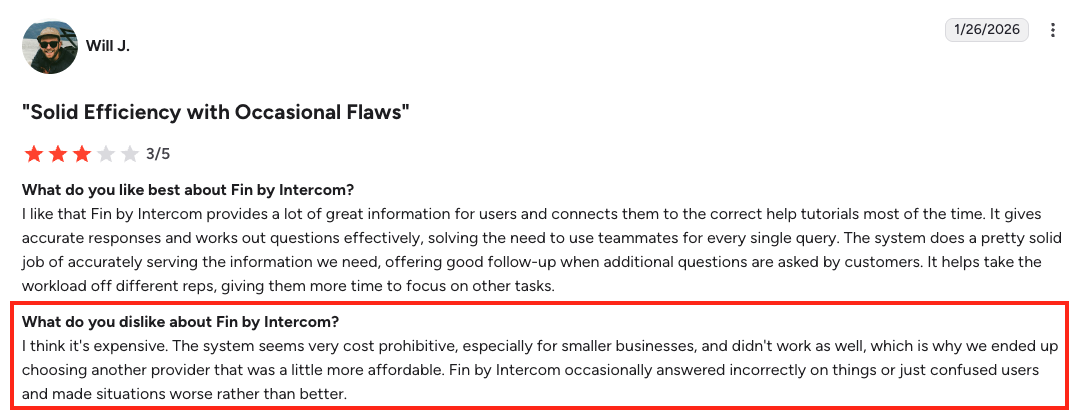
2. Responses feel robotic - Multiple teams describe Fin's replies as "blocks of text" rather than the warm, conversational tone customers expect.
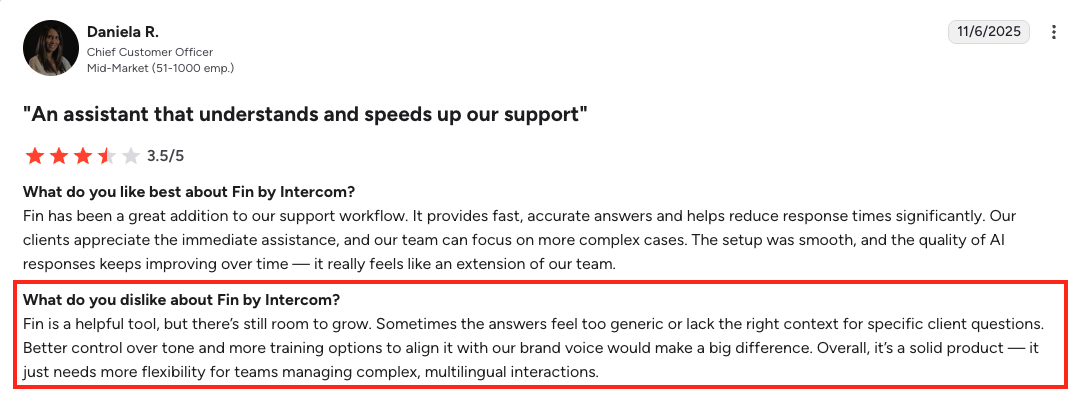
3. Fin only knows what's in the help center - When the answer to a complex ticket lives in a past ticket, a Slack thread, or an internal tool, Fin escalates instead of resolving (or even worse, offers a wrong advice). For technical products, that means the bulk of complex troubleshooting still lands on human agents.
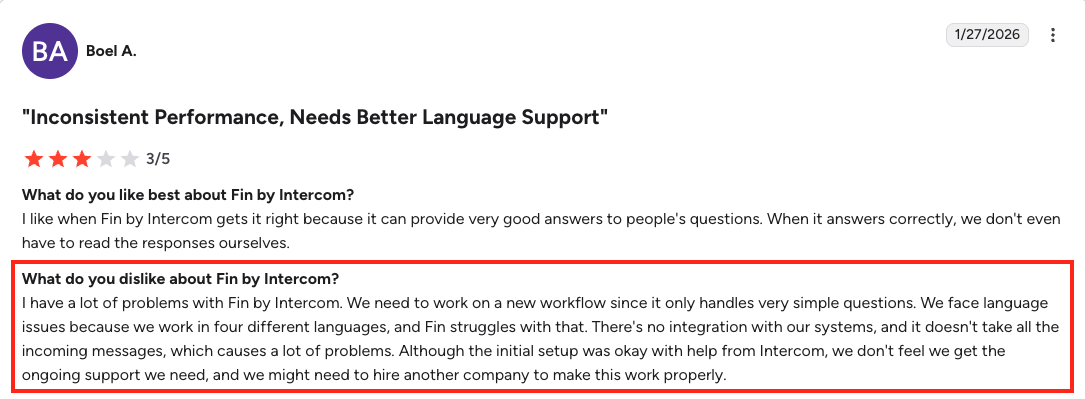
Deep Dive into 4 Best Intercom Fin AI Alternatives
Three Fin AI alternatives on this list (Decagon, Sierra, Pluno) let you keep Intercom as your main helpdesk and swap Fin's AI underneath. The other one (Gorgias) requires leaving Intercom for a different platform. Each section compares the tool to Fin on the same five criteria, then lists where the tool itself falls short.
Let's see the deep dives on the best Fin AI alterantives for specific use cases:
1. Decagon - Best Intercom Fin AI alternative for voice-first customer support teams
Decagon is an AI agent platform built around voice as a primary channel. Decagon handles inbound and outbound calls with sub-second latency through an ElevenLabs partnership, plus chat and email through the same intelligence layer with cross-channel memory.
Decagon vs Fin - side-by-side comparison
| Criteria | Fin AI | Decagon |
|---|---|---|
| Resolution approach | Help center articles, URLs, uploaded docs, and custom Actions for backend calls | KB articles plus Agent Operating Procedures (workflows defined in natural language) plus integrations to Salesforce, Intercom, Zendesk, Confluence |
| Escalation behavior | Resolves or hands off; resolution counts even if customer doesn't reply | Watchtower QA monitors output before customer sees it; supervisor model flags hallucinations; PII redacted automatically |
| Setup and deployment | Hours to days inside Intercom; days to weeks via Zendesk/Salesforce connector | ~6 weeks with dedicated Forward-Deployed Engineers |
| Pricing model | $0.99 per resolution plus $29 to $132 per seat per month | Custom enterprise; no public pricing. |
| Helpdesk fit (Intercom) | Native | API integration with Intercom. |
Where Decagon falls short
- Decagon can be fairly expensive - Reported median annual contract is around $386K per Vendr marketplace data.
- Agent-side Copilot (Agent Assist) embeds into Zendesk and Salesforce, not Intercom - Decagon's customer-facing AI works with Intercom for chat and email routing, but if your team also wants AI-drafted responses and real-time context for human agents working inside the Intercom Inbox, that part won't run there.
- Implementation requires engineering involvement - Agentic Operating Procedures can be written in plain English (no coding required) but advanced workflows still need engineering to build and maintain.
- Built for enterprise volume - Below ~5,000 conversations per month, the deployment overhead doesn't pay back.
Who should use Decagon instead of Fin AI?
Decagon is best for high-volume consumer brands where voice is at least 30% of the support mix and the AI needs to handle inbound calls at near-human latency without sacrificing quality at scale.
Three things separate Decagon from Fin and from the other alternatives in this guide:
- Sub-second voice latency plus outbound voice capability - Decagon Voice 2.0 handles inbound calls with sub-second latency through an ElevenLabs partnership, including interruption handling, customizable tone, and branded caller IDs.
- Agent Operating Procedures (AOPs) - Decagon's core methodology: workflows defined in natural language and mixed with code where deeper logic is needed. CX teams configure agent behavior in plain English while engineers maintain integrations and guardrails.
- Watchtower for always-on QA - Watchtower monitors agent output in real time, flagging hallucinations and policy violations before they reach the customer rather than after the conversation ends.
2. Sierra - Best Intercom Fin AI alternative for financial services, healthcare, and subscription businesses
Sierra is an AI agent platform built for businesses where customer relationships span months or years and the AI needs to take real actions on payments and accounts, not just answer questions. It runs across chat, SMS, WhatsApp, email, voice, and ChatGPT through a single agent built on Sierra's Agent OS.
Sierra vs Fin - side-by-side comparison
| Criteria | Fin AI | Sierra |
|---|---|---|
| Resolution approach | Help center articles, URLs, uploaded docs, and custom Actions for backend calls | Agent Data Platform unifies unstructured conversation data (chats, calls, emails) with structured enterprise data (CRM, billing, transactions, inventory) to give the agent persistent memory across sessions and channels. Ghostwriter generates agents from uploaded SOPs, transcripts, photos, and audio recordings |
| Escalation behavior | Resolves or hands off; resolution counts even if customer doesn't reply | Supervisor models check output before delivery; monitors flag outlier conversations; PII automatically encrypted and masked |
| Setup and deployment | Hours to days inside Intercom; days to weeks via Zendesk/Salesforce connector | 4 to 10 weeks initial; 3 to 6 months to fully optimize |
| Pricing model | $0.99 per resolution plus $29 to $132 per seat per month | Outcome-based; you only pay when the agent achieves a defined successful outcome (saved cancellation, completed application, processed renewal) |
| Helpdesk fit (Intercom) | Native | Sits above existing CX stack via API and SDK; not a marketplace plugin. Pairs with Intercom for live chat, ticketing, and help center |
Where Sierra falls short
- Sierra is enterprise-priced - Year-one contracts typically run $200K to $350K, with implementation fees often $50K to $200K on top.
- Long deployment time - Initial deployment is 4 to 10 weeks and full optimization is 3 to 6 months.
- Vendor-led deployment - Sierra's team typically handles configuration directly, and post-launch changes can require their services team. This slows iteration compared to self-serve products where your CX team can make changes without filing a ticket.
Who should use Sierra instead of Fin AI?
Sierra is best for businesses in financial services, healthcare, insurance, and subscription categories where customer relationships span months or years and the AI needs to take real actions on payments and accounts.
Three things separate Sierra from Fin and from the other alternatives in this guide:
- Persistent customer memory across the lifetime of the relationship. The Agent Data Platform connects unstructured data (past chats, calls, emails) with structured data (CRM, billing systems, transaction history, policies) so a returning customer is not treated like a new conversation.
- Level 1 PCI-compliant payments inside voice and chat. The agent can collect card and ACH payments directly inside the conversation, with no transfer to a human or fallback.
- Outcome-based pricing - You pay when the agent achieves a defined business outcome (a saved cancellation, a completed application, a processed renewal), not per-conversation or per-resolution. The vendor incentive aligns with your business outcome rather than with conversation volume.
3. Gorgias - Best Fin AI alternative for Shopify & e-commerce companies
Gorgias is a Shopify-native helpdesk with built-in AI Agent designed for e-commerce. It combines support automation with shopping assistance for pre-purchase recommendations and upsells. It's important to note that Gorgias is a helpdesk, so adopting it means replacing Intercom entirely.
Gorgias vs Fin AI - side-by-side comparison
| Criteria | Fin AI | Gorgias |
|---|---|---|
| Resolution approach | Help center articles, URLs, uploaded docs, and Actions | Help center plus live Shopify data (orders, catalog, inventory, customer tags); OpenAI partnership tuned for e-commerce |
| Escalation behavior | Resolves or hands off; resolution counts even if customer doesn't reply | Resolves or hands off; AI Agent can take real actions like processing returns and editing orders |
| Setup and deployment | Hours to days inside Intercom | Days inside Gorgias; you migrate from Intercom to Gorgias |
| Pricing model | $0.99 per resolution plus $29 to $132 per seat per month | Helpdesk tier ($10 to $900 per month) plus $0.90 to $1.00 per AI resolution; the AI-resolved ticket also counts as a billable helpdesk ticket |
| Helpdesk fit (Intercom) | Native | Replaces Intercom; AI Agent works only on Shopify |
Where Gorgias falls short
- AI Agent is Shopify-only - Stores on BigCommerce, Magento, or WooCommerce can use the helpdesk but not the AI Agent. You'll also need to switch completely away from Intercom.
- AI tickets are double-billed - Each AI-resolved ticket counts as a paid AI resolution and also consumes one billable helpdesk ticket from your plan allocation.
- Limited order data access - AI Agent can only read the last 10 Shopify orders per customer, which matters for repeat buyers and edge-case order history questions.
Who should use Gorgias instead of Fin AI?
Gorgias is best for Shopify e-commerce brands where the AI needs to drive revenue (recommendations, upsells, cart recovery) as well as deflect tickets.
Two things separate Gorgias from Fin AI and from the other alternatives in this guide:
- Native Shopify data access - Gorgias is built on a direct Shopify integration that pulls live order data, product catalog, inventory levels, and customer tags into every conversation. The AI Agent can answer "where is my order" with the actual tracking link, process a return, edit a shipping address, or apply a discount code without escalating to a human.
- Shopping Assistant for pre-purchase revenue - Gorgias has a Shopping Assistant that engages browsers before purchase, recommends products from your live catalog, answers pre-sale questions, and offers exit-intent discounts.
4. Pluno - Best Fin AI alterantive for complex B2B technical tickets
Pluno is an AI agent for Intercom and Zendesk, built for B2B teams where the answers to complex tickets live in past resolved tickets, Slack threads, Confluence, Notion, Jira issues, and engineering tools rather than the help center. Pluno learns troubleshooting flows from how senior agents have actually solved similar issues in the past.
Pluno integrates natively with both Intercom and Zendesk, so you can connect it to your existing helpdesk without migrating to another platform.
Pluno vs Fin AI - side-by-side comparison
| Criteria | Fin AI | Pluno |
|---|---|---|
| Resolution approach | Help center articles, URLs, uploaded docs, and Actions | Past resolved tickets (the primary source) plus help center, Slack, Jira, Sentry, DataDog, Confluence, and APIs; learns diagnostic flows from how the team has actually solved similar issues |
| Escalation behavior | Resolves or hands off; resolution counts even if customer doesn't reply | Confidence-thresholded; only resolves when evidence is sufficient. When confidence is low, escalates with a summary, evidence, and next steps so a human agent doesn't restart from zero |
| Setup and deployment | Hours to days inside Intercom | Days; native Marketplace install; learns from historical tickets immediately |
| Pricing model | $0.99 per resolution plus $29 to $132 per seat per month | Annual usage-based contract |
| Helpdesk fit (Intercom) | Native | Native integration with Intercom, also available on the Zendesk Marketplace; no migration required |
Where Pluno falls short
- Past-ticket learning needs ticket history - Pluno's strongest results come once it has roughly 1,000 resolved tickets to learn from.
- Not suitable for B2C and e-commerce companies - Pluno is built for B2B software companies that often have technical tickets that require custom troubleshooting. It doesn't have the same level of integrations and data as other Fin AI alternatives that serve B2C and e-commerce companies on this list, hence it's not the right fit for those companies.
Who should use Pluno instead of Fin AI?
Pluno is best for B2B technical product teams (SaaS, hardware, fintech, developer tools) where most support tickets require real diagnosis and the answers usually live in past resolved tickets, Slack threads, and Jira issues rather than help center articles.
Three things separate Pluno from Fin and from the other alternatives in this guide:
- Past resolved tickets are the primary knowledge source - Most AI agents use help center articles as the primary source and treat past tickets as supplementary or as training data if they're used at all. Pluno is different - every resolved ticket becomes part of the knowledge base, including the diagnostic flow the agent took to reach the resolution.
- Confidence-thresholded escalation instead of deflection-style - Fin and most deflection tools count a conversation as resolved when the customer doesn't reply within a window. That means reported resolution rates can hide unsatisfied customers who walked away frustrated. Pluno only marks a ticket resolved when evidence is sufficient to support the answer.
- Two-way engineering tool sync for cross-team escalations - When a ticket needs engineering involvement (a bug, a system issue, a feature request), Pluno creates the Jira issue with full customer context, troubleshooting history, and reproduction details, then syncs status updates back to your helpdesk automatically. Support stops chasing engineers for status updates and customers get faster, more accurate updates.
"We love that Pluno's automatically commenting on the ticket if the customer is asking for updates. We're getting internal comments on the Zendesk ticket from Pluno when the Jira ticket is updated. That back and forth communication is huge and I haven't seen it personally in any other AI tools that we've explored."
Sarala Conlan, Sr. Customer Support Manager at Kojo
Final Comparison - What's the best Fin AI alternative for you?
| Your situation | Best Fin AI alternative | Why it wins this use case |
|---|---|---|
| Voice is at least 30% of your support mix | Decagon | Sub-second inbound voice latency through ElevenLabs, plus really good outbound voice (campaigns, callbacks, voicemail). |
| You operate in financial services, healthcare, insurance, or subscription businesses where customers come back over months or years and the AI needs to take real actions on payments and accounts | Sierra | Agent Data Platform persists customer history across sessions and channels, Level 1 PCI compliance lets the agent collect card and ACH payments inside the conversation, and outcome-based pricing aligns vendor incentives with your business outcomes |
| You run a Shopify store and AI should drive revenue (recommendations, upsells, cart recovery) as well as solve/deflect support tickets | Gorgias | Native Shopify integration with live order, catalog, and inventory data, plus a Shopping Assistant for pre-purchase engagement that none of the other tools ship |
| Your tickets are technical B2B and most answers live in past resolved tickets, Slack threads, Confluence, Notion, or Jira issues rather than the help center | Pluno | Past resolved tickets are the primary knowledge source, the agent escalates with full diagnostic context when confidence is low instead of guessing, and two-way sync with Jira, Sentry, and DataDog handles cross-team escalations |
| Your tickets are mostly common inquiries with a well-maintained help center, and Intercom works fine | Stay on Fin | Fin is strongest on KB-grounded common inquiries inside Intercom, and the time-to-value is hard to beat |
If you're working for a software company and often get technical tickets that require complex troubleshooting, book a free demo call with Pluno experts to see how they can help you optimize your customer support operations, reduce costs, and solve more tickets with AI.