Most Zendesk teams running complex B2B support have hit the same wall. The native Zendesk AI handles FAQ-style tickets well, but it struggles when the answer lives in a Slack thread, a Jira issue, or a six-month-old resolved ticket that was never written up as a help-center article.
The honest question is not whether Pluno is "better than" Zendesk's AI. Pluno is a Zendesk Marketplace app that installs into your Zendesk and runs as your AI layer. The real question is which AI layer fits your support operation: Zendesk's native AI, or Pluno.
TL;DR
- Pick Zendesk's native AI if the team is fully invested in Zendesk's platform, ticket complexity is mostly FAQ-shaped, the help center is well-maintained, voice is a primary channel, or HIPAA-eligible compliance is required.
- Pick Pluno if support tickets need diagnostic reasoning, the team's resolution knowledge lives in past tickets and engineering systems (Slack, Jira, Sentry, Linear, internal APIs, session recordings), or engineering escalations are a regular part of the weekly support workload.
Zendesk AI Overview in 2026
Zendesk's AI offering has five main components.
| Component | What it does | Pricing |
|---|---|---|
| AI Agents | Autonomous resolution across messaging, email, web forms; includes agent builder, hybrid procedures, API integrations, reasoning controls (May 2026 unified offering) | Included in Suite plans |
| Voice AI Agents | End-to-end phone call automation: intent capture, triage, resolution, escalation to live agents | EAP since February 2026; requires Zendesk Voice |
| Zendesk Copilot | Agent assist (reply drafts, summaries, tone adjustment, macro suggestions, voice transcripts); includes Admin Copilot | $50/agent/month standalone; bundles at $155 (Suite Pro + Copilot) and $209 (Suite Enterprise + Copilot); capped free Copilot uses on Suite Professional+ |
| Per-resolution pricing | Billing for AI Agent automated resolutions | $1.50 committed / $2.00 PAYG; 72-hour customer-inactivity window; auto-overage billing since January 2026 |
| Forethought AI Agents | Multi-agent stack (Solve, Triage, Assist, QA, Discover) with Resolution Learning Loop | Varies by plan; integration into Zendesk Suite UI ongoing through 2026 |
| Other add-ons | Zendesk QA, Workforce Management, Advanced Data Privacy | $35, $25, $50 per agent/month respectively; WFM+QA bundled at $50 |
Pluno for Zendesk Overview in 2026
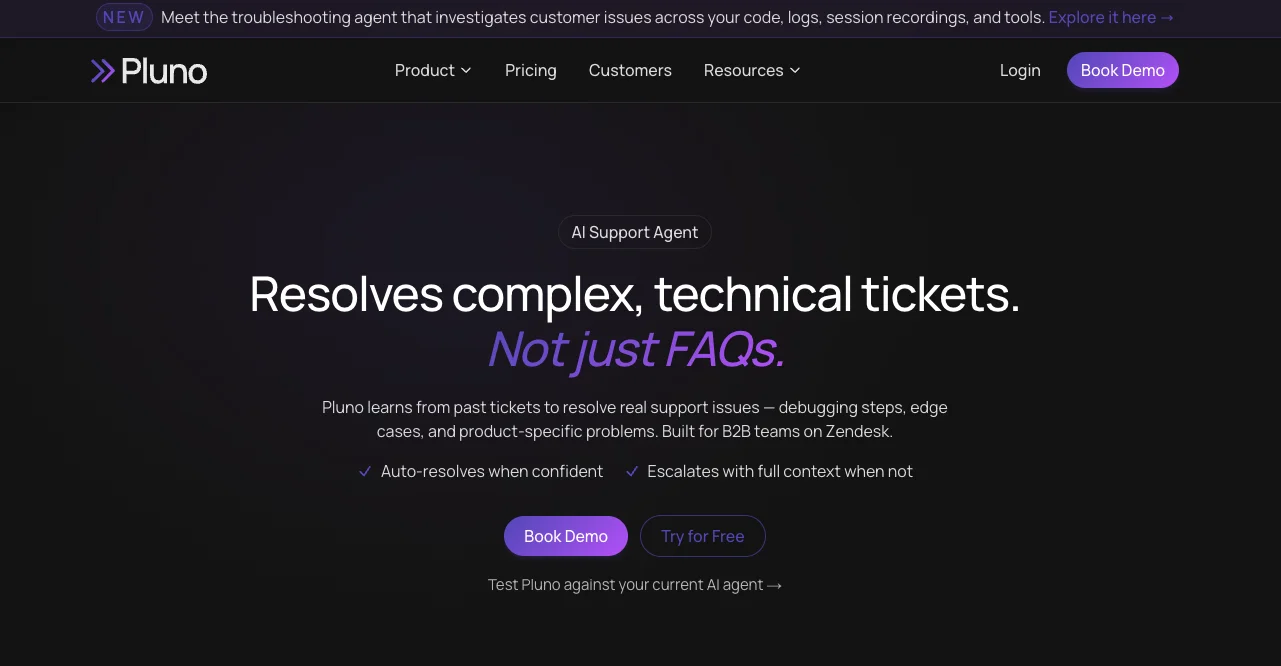
Pluno is a Zendesk Marketplace app with eight modules:
| Module | What it does | Pricing |
|---|---|---|
| Deflection AI | Autonomous resolution from past tickets, help center, internal docs, Slack threads, Jira issues, and connected APIs | €0.90 per autonomous resolution; 72-hour customer-inactivity window |
| AI Copilot | Agent assists in the Zendesk sidebar; regenerates when new customer messages arrive | €49 per agent per month; admins designate which teammates get access |
| Escalation Copilot | One-click escalations from Zendesk to Jira or Slack with auto-generated reports and two-way sync | Included in the platform fee (starting at €249/mo) |
| Troubleshooting Agent | Investigates customer issues across code repositories, logs, session recordings, databases, and engineering tools like Sentry and Linear to surface root causes for complex tickets | €99 per month for around 50 investigations |
| AI Tagging and Field Filling | Auto-categorization and custom field filling on plain-language instructions | Included in the platform fee |
| Quality Assurance | Scores 100% of conversations (tickets, chats, calls) against custom criteria (binary, five-level, or numerical) with reasoning per score | €35 per agent per month |
| Call Insights and Summary | Transcribes voice recordings attached to Zendesk tickets and generates summaries using a customizable template | Included in the platform fee |
| Ticket Trends and Topic Insights | Ticket clustering, recurring issue detection, prioritization signals | Included in the platform fee |
Where Pluno and Zendesk AI look for answers
Edge to Pluno on both past-ticket learning and knowledge source breadth. Past resolved tickets feed directly into Pluno's answer-generation pipeline, with no suggestion queue or human review gate. Pluno also reads operational systems (Slack, Jira, connected APIs) and engineering tools (Sentry, Linear, DataDog via the Troubleshooting Agent) that Zendesk's native AI does not natively support. Zendesk's Forethought is narrowing the past-ticket gap on the Zendesk side, but the model remains "AI suggests, humans curate" rather than direct learning, and depth varies by plan.
This is where the products differ most. Both read from your Zendesk knowledge base, but they handle past tickets very differently.
Zendesk's native AI on past tickets
Before the Forethought acquisition, Zendesk's AI Agents grounded their answers in the help center, macros, and procedures. Past tickets were not part of the primary answer-generation pipeline. Macros captured some recurring patterns and teams could write up resolution workflows as procedures, but the AI did not learn directly from past resolved conversations.
After the March 2026 Forethought acquisition, this is changing. Forethought's Resolution Learning Loop ingests past resolved interactions and uses them to detect workflow gaps and propose new procedures for the team to review. The proposed procedures still require human review and approval before going live, so the model is closer to "AI suggests, humans curate" than the direct past-ticket learning that drives Pluno. Integration into the standard Zendesk Suite UI is in progress, with depth varying by plan.
Pluno's past ticket handling
Past resolved tickets feed directly into Pluno's answer-generation pipeline. There is no suggestion queue, no human review gate, and no requirement to write tickets up as help-center articles first.
Pluno runs an iterative process across all configured knowledge sources for each query, with answers grounded in evidence that the agent can trace back to the underlying sources.
Why the difference matters for B2B SaaS support
Help-center-first designs work well when resolution knowledge is meant to live in articles. They are less helpful when the real answers live in past tickets that have never been written up.
This is a common pattern in B2B SaaS support: troubleshooting flows get worked out in conversation, documented in a Jira issue or a Slack thread, and never make it into the help center.
Other knowledge sources
Pluno's Copilot and Deflection AI read Slack threads, Jira issues, internal APIs, internal documentation, Notion (with native page-level selection), Confluence, uploaded PDFs and documents, and crawled web pages. The Troubleshooting Agent module extends this to code repositories, logs, session recordings, and engineering tools like Sentry, Linear, and DataDog.
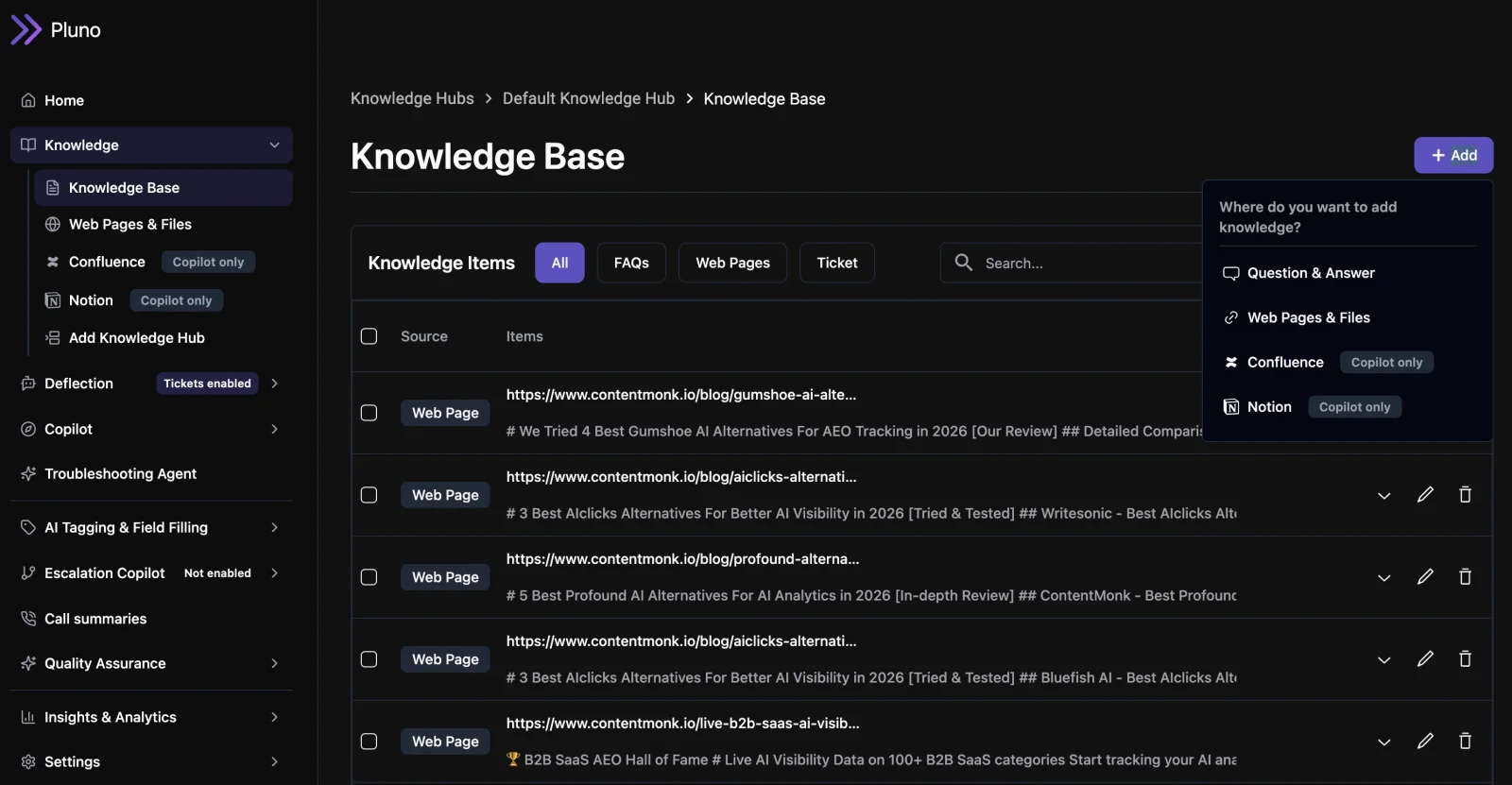
Zendesk's native AI primarily reads help center articles, macros, and procedures. With Forethought, Zendesk gains additional reach through Forethought's connectors, with availability varying by your plan.
Autonomous resolution: Zendesk AI Agents vs Pluno Deflection AI
Edge to Pluno on complex B2B technical tickets where the answer requires diagnostic reasoning and lives in past tickets or engineering systems. Edge to Zendesk on live voice and on teams that want a single-vendor experience covering voice, WFM, and AI together.
Both products handle autonomous resolution. The mechanics differ in what each one is optimized to resolve.
How do Zendesk AI Agents generate answers? With the May 2026 unified packaging, every Suite customer's AI Agents can answer FAQ-style questions with generative replies from the help center, configure multi-step conversation flows through the agent builder, run hybrid procedures that combine generative and scripted responses, and execute actions against external systems via custom actions.
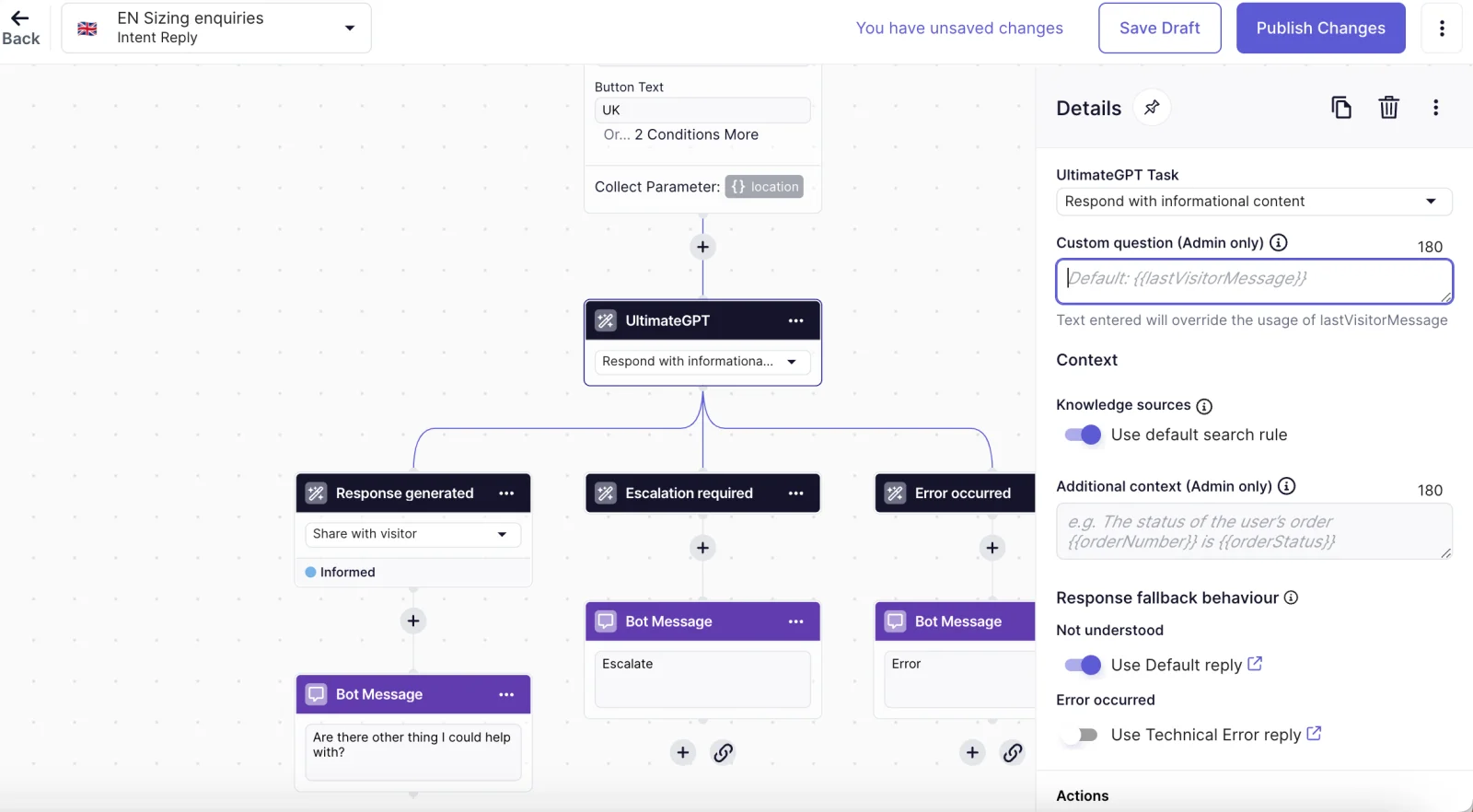
How does Pluno Deflection AI generate answers? Pluno runs an iterative search across past resolved tickets, the help center, internal documentation, Slack threads, Jira issues, and connected APIs. It generates an answer using evidence from these sources with citations attached. When context is insufficient, the AI asks diagnostic questions before answering.
Diagnostic conversations
Pluno's autonomous flow gathers information when a ticket is ambiguous, asking questions like product version, error code, when the issue started, or reproduction path. The diagnostic patterns are picked up from how the team has historically resolved similar tickets.
Zendesk AI Agents support diagnostic flows through Procedures, which are natural-language workflows that a team member writes for each scenario the AI should handle. Procedures define what the AI asks, what conditions branch the conversation, and when to hand off. For a B2B SaaS team with many possible edge cases, this becomes ongoing configuration and maintenance work for the support manager or admin whenever the product or process changes.
Action-taking
Both products support action execution against external systems during a conversation. Zendesk AI Agents use Custom Actions and Procedures, both of which are manually configured and maintained as the underlying APIs or workflows change. Pluno uses connected APIs to handle the same kinds of operations.
Innovorder, a Pluno customer in the restaurant tech space, achieves a 67% resolution rate on complex B2B tickets spanning both software and hardware support.
Supported Channels
Both products cover email and form tickets plus Zendesk Messaging across the web widget, mobile SDK, WhatsApp, Facebook Messenger, and Instagram. Zendesk additionally covers live voice through Zendesk Voice and Voice AI Agents. Pluno does not handle live voice.
Confidence handling and escalation
Both products escalate to human agents when AI confidence is low or when the conversation requires human action. Both also treat customer silence after an AI reply as a form of billing resolution.
Pluno counts a ticket as resolved when Pluno sends the last public message, and the customer has not replied within 72 hours. Escalations to humans are not billed regardless of what the customer does after the handoff. Every AI-resolved ticket is tagged in the helpdesk so admins can verify and review which tickets were billed before each cycle.
Zendesk uses the same 72-hour customer-inactivity window for AI Agent resolutions and bills the resolution when the window closes.
Agent copilot: Zendesk Copilot vs Pluno AI Copilot
Edge to Pluno on knowledge source breadth (operational systems like Slack and Jira, past tickets across all channels, contextual reasoning on complex tickets). Edge to Zendesk Copilot on tight integration with voice transcripts on Zendesk Voice tickets and on Admin Copilot for system configuration help.
Both copilots live in the Zendesk sidebar, both draft replies, and both let teams customize tone and rules. The substantive differences are in what each copilot reads, what additional capabilities each ships with, and how each is priced.
What knowledge sources does Zendesk Copilot read? Help center articles, macros, procedures, customer profile data, and the assigned ticket's own history. Reply suggestions are drawn from these sources, with macro suggestions and tone adjustment available on demand.
What knowledge sources does Pluno AI Copilot read? Past resolved tickets across all channels including email, the help center, internal documentation, Slack threads, Jira issues, connected APIs, Notion (with native page-level selection), Confluence, uploaded documents, and crawled web pages.
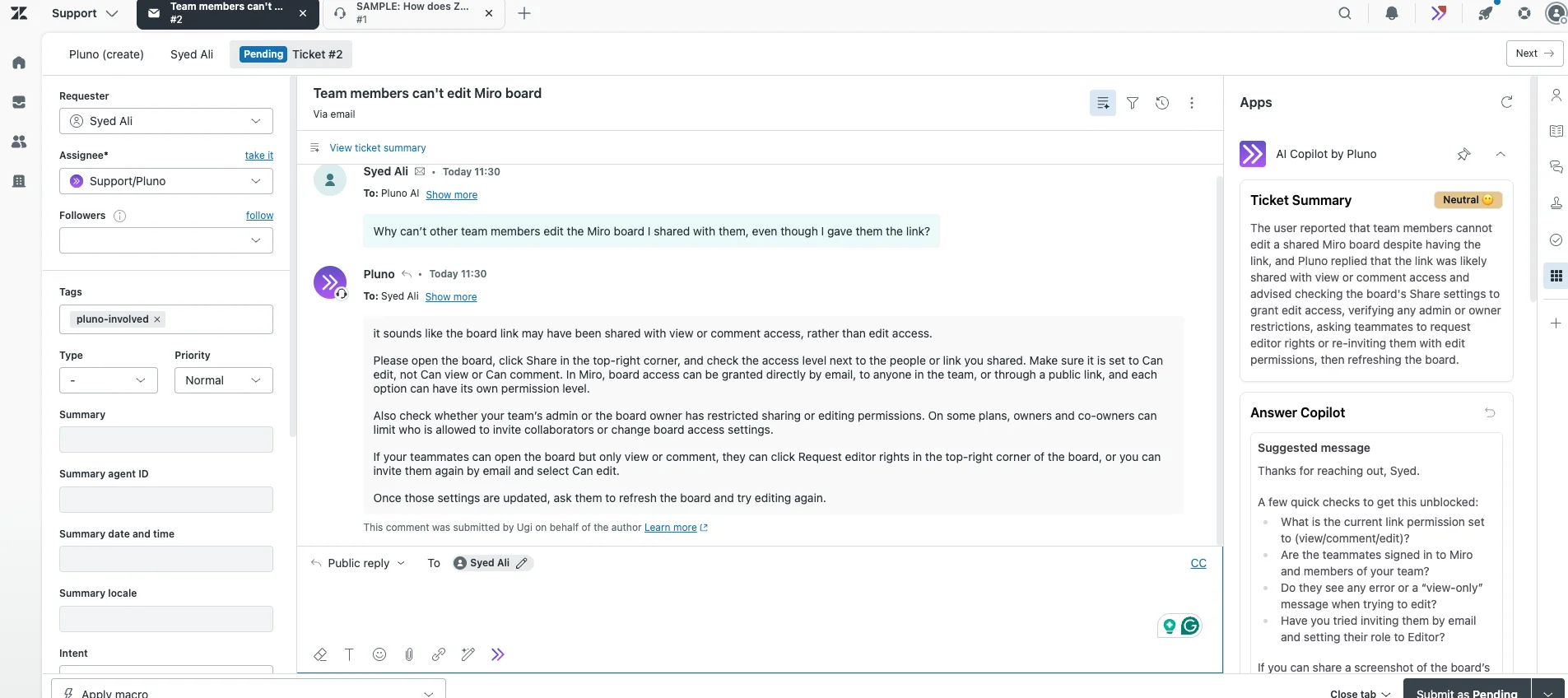
What's their drafting behavior? Zendesk Copilot generates a suggested reply when the agent opens a ticket. Pluno AI Copilot generates a suggested reply automatically and regenerates when new customer messages arrive in the thread.
Context for complex tickets. Beyond drafting a reply, Pluno AI Copilot surfaces underlying context and reasoning, helping agents understand the issue before responding. Zendesk Copilot is focused on drafting and answer suggestions.
Customization. Both support workflow rules for tone, length, brand voice, and conditional behavior. Pluno's workflows are configured in the Pluno workspace using plain-language instructions. Zendesk's customization is configured through admin settings and Procedures, with Procedures themselves requiring manual setup and ongoing maintenance as the team's needs evolve.
Pricing. Zendesk Copilot is $50/agent/month standalone or bundled with Suite plans; Suite Professional+ includes capped free Copilot uses. Pluno AI Copilot is €49 per agent per month. Admins designate which teammates use the Copilot, so teams pay only for the agents who actually have access to it.
Support-to-engineering loop: Pluno's Troubleshooting Agent and Escalation Copilot vs Zendesk
Pluno connects support and engineering with two modules. The Troubleshooting Agent investigates customer issues across code, logs, and engineering tools, and both support and engineering use it. The Escalation Copilot creates engineering issues and keeps them in sync with Zendesk.
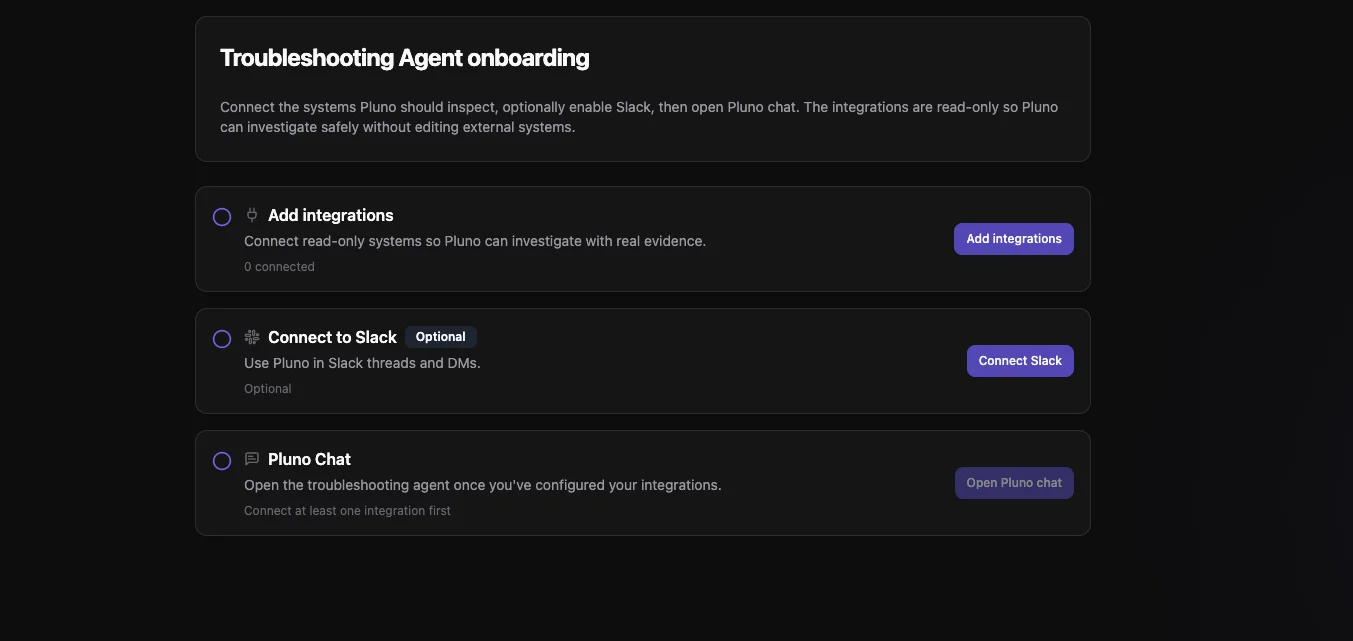
Troubleshooting Agent. Pluno's Troubleshooting Agent investigates customer issues across code, logs, session recordings, and connected tools (Sentry, Linear, databases, and similar). Support teams use it to diagnose customer-side fixes and confirm whether an issue is an actual bug before it reaches engineering. Engineering uses it to debug and surface recommended fixes. Either way, the relevant system state lands on the ticket, so nobody has to dig through observability dashboards or code repos by hand.
Escalation Copilot. When an issue needs engineering attention, Pluno's Escalation Copilot creates Jira issues or Slack threads directly from a Zendesk ticket using a customizable template. The issue or thread carries reproduction details, customer impact, the relevant ticket history, and a generated summary. Updates flow in both directions. When engineering moves an issue, the Zendesk ticket is updated to reflect it. When the customer adds context in Zendesk, engineering sees it on the other side. Support stops chasing engineering for status.
Kojo, a Pluno customer in construction procurement, reports same-day Jira ticket creation on tickets that previously took days to reach engineering.
"Now with Pluno, we're able to escalate things to Jira that same day. Nothing's going in the backlog when we're just waiting to make a ticket."
Sarala Conlan, Sr. Customer Support Manager at Kojo
How Zendesk handles the engineering loop. Zendesk has standard integrations to Jira and Slack that surface ticket data and create linked issues. When an agent escalates, they write the issue out by hand. The summary, reproduction steps, and customer impact get filled in manually on every escalation.
There is no native equivalent to Pluno's Troubleshooting Agent for code, log, and session-recording investigation, and no productized two-way sync layer that packages reproduction details and mirrors updates across systems. Teams that want either behavior in Zendesk build it themselves through Zendesk's integrations and workflow automations, with the configuration and ongoing maintenance that entails.
Final comparison: Edge to Pluno on both modules. The Troubleshooting Agent compresses tier-1-to-tier-2 investigation cycles. The Escalation Copilot productizes the Zendesk-to-Jira and Zendesk-to-Slack handoffs, with built-in reproduction details and customer context.
Operational modules: QA, AI tagging & voice
Both products extend beyond core resolution and copilot work. Three areas where the operational module surfaces differ meaningfully:
Support QA. Both products score 100% of conversations, rather than a sampled subset. They differ in how the scoring works. Pluno's Quality Assurance grades each conversation against criteria the team writes in plain language (binary, five-level, or numerical), attaches reasoning to every score, and surfaces that feedback to the agent in the Zendesk sidebar once a ticket is resolved.
Zendesk QA relies on built-in evaluation, automated risk detection, and coaching insights for both human and AI agents. On price, the two line up. Pluno's QA is an optional add-on at €35 per agent per month, and Zendesk QA is a separate add-on at $35 per agent per month.
AI tagging and field filling. Pluno AI Tagging runs automatically on incoming tickets. It reads the content, applies categorization, and fills the custom Zendesk fields your team already uses, following plain-language instructions the admin writes (for example, tag any ticket mentioning a failed API call as "integration issue").
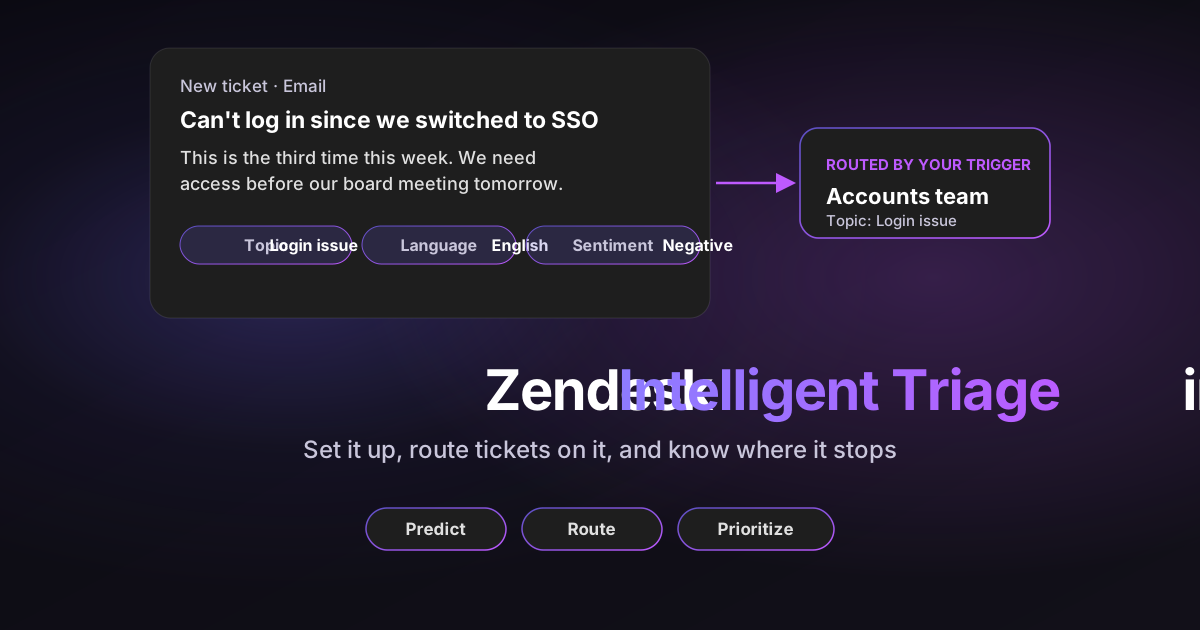
Zendesk's intelligent triage classifies tickets by topic (called intent before June 2026), sentiment, and language, and its entity detection can populate custom fields with details like product names. Its classifications are free for reporting on Suite Professional and up, but routing on them with triggers needs the Copilot add-on.
The two differ in scope. Zendesk works from its own topic and entity model, with custom topics and entities you configure. Pluno fills the specific fields and tags your team has already set up, on rules you describe in plain language, and your existing triggers route on them.
Voice and call processing. Zendesk supports live voice natively through Zendesk Voice, with Voice AI Agents in early access for autonomous voice resolution. Pluno does not handle live voice. When a Zendesk ticket includes a voice recording from a customer call, Pluno's Call Insights transcribes the recording and generates a summary using a template the team configures.
Zendesk AI vs Pluno side-by-side comparison
| Capability | Zendesk AI | Pluno |
|---|---|---|
| What it is | Native AI features in Zendesk Suite plus Forethought (acquired March 2026) | Zendesk Marketplace app, runs inside Zendesk |
| Autonomous resolution | AI Agents (unified offering as of May 2026, with previously-paid Advanced features now included in Suite plans) | Deflection AI |
| Agent copilot | Zendesk Copilot ($50/agent/month standalone, or Suite Professional + Copilot at $155, Suite Enterprise + Copilot at $209); capped Copilot features free on Suite Professional+ | AI Copilot at €49/agent/month |
| Knowledge sources | Help center, macros, procedures; Forethought adds past tickets and learned procedures (rollout in progress) | Past tickets, help center, Slack, Jira, connected APIs, internal docs, Notion, and Confluence. Engineering systems (Sentry, Linear, DataDog) are accessed by the Troubleshooting Agent module. |
| Past-ticket learning | Limited pre-Forethought; expanding via Forethought integration | Yes, primary methodology since day one |
| Confidence handling | 72-hour customer-inactivity window for resolution counting | 72-hour customer-inactivity window; escalations to humans not billed; every AI-resolved ticket tagged in helpdesk for verification |
| Voice support | Native via Zendesk Voice; Voice AI Agents in early access | No live voice; Call Insights transcribes voice recordings attached to Zendesk tickets and generates summaries |
| QA | Zendesk QA add-on at $35/agent/month | Quality Assurance add-on at €35 per agent per month |
| Tagging | Intelligent triage (free for reporting on Suite Professional+; routing on it needs the Copilot add-on) | AI Tagging |
| Engineering escalation | Standard Zendesk integrations to Jira and Slack | Escalation Copilot with two-way sync and reproduction packaging |
| Engineering investigation | No native equivalent; teams build investigation flows through workflow automations and integrations | Troubleshooting Agent investigates across code, logs, session recordings, and engineering tools (Sentry, Linear, DBs) |
| Per-resolution rate | $1.50 committed / $2.00 PAYG | €0.90 |
| Free trial | Suite trial with limited resolutions | 14-day Marketplace trial, all modules unlocked, no usage limits |
| Compliance | SOC 2, ISO 27001, HIPAA-eligible (verify plan), GDPR | SOC 2 Type II, GDPR |
| Platforms | Zendesk only (native) | Zendesk and Intercom (native integrations) |
How to choose between Zendesk AI and Pluno?
Pick Pluno if:
- Tickets require diagnostic reasoning and answers live in past tickets, Slack threads, Jira issues, or internal APIs
- Engineering escalations are a regular part of the weekly support workload
- The team has tried help-center-first AI and watched it fail on complex tickets
- The team is on Zendesk today and wants a Marketplace install with self-serve setup
Kojo, a five-person B2B SaaS support team, tried Zendesk's built-in AI first:
"We did try their one that comes with the plan. It's really basic, but it wasn't quite for us."
Sarala Conlan, Sr. Customer Support Manager at Kojo
Pick Zendesk AI if:
- The team is fully invested in Zendesk's platform and wants one vendor for ticketing, voice, WFM, and AI
- Tickets are mostly FAQ-shaped with a well-maintained help center
- Voice is a primary channel
- HIPAA-eligible compliance is required
- The Forethought capabilities generally available at the publish date cover the team's diagnostic needs
FAQ
Does Pluno replace Zendesk?
No. Pluno is a Zendesk Marketplace app that installs into your Zendesk. It reads your tickets and writes back into Zendesk, working as the AI layer on top of your existing setup. Pluno does not replace Zendesk; it makes the support you already run on Zendesk more capable.
How did Zendesk's May 2026 AI packaging change affect this comparison?
Zendesk unified AI Agents Essential and Advanced on May 11, 2026. Previously-Advanced capabilities (agent builder, multi-step procedures, external API integrations) are now included in Suite plans at no additional cost, eliminating the $50/agent/month add-on.
How does Forethought-by-Zendesk change this comparison?
Forethought is now part of Zendesk's AI portfolio, with capabilities like the Resolution Learning Loop bringing past-ticket-aware functionality into Zendesk's stack. Forethought continues as a standalone product accessible from Zendesk and other helpdesks. Coverage and depth of integration into the standard Zendesk Suite UI vary by plan and rollout timing.
What does Pluno's free trial include?
Every Pluno module (Deflection AI, AI Copilot, Escalation Copilot, Troubleshooting Agent, AI Tagging and Field Filling, Quality Assurance, Call Insights and Summary, and Insights and Trends) is unlocked for 14 days with no usage limits and no credit card required. The trial installs from the Zendesk Marketplace.
Does Pluno work for voice support?
Pluno's Call Insights & Summary transcribes voice recordings attached to Zendesk tickets and generates summaries using a customizable template. It does not handle live phone calls. Teams running voice as a primary channel will need Zendesk Voice or an equivalent voice AI product.
Is my data secure with Pluno?
Pluno is SOC 2 Type II and GDPR-compliant. LLMs are hosted via Microsoft Azure, so model providers do not have access to customer data and no models are trained on it.
Which one is better at resolving complex technical tickets?
Pluno is built around past-ticket learning, and its AI Copilot reads operational systems like Slack and Jira along with connected APIs. The Troubleshooting Agent module adds investigation across code, logs, session recordings, and engineering tools like Sentry and Linear. This combination is well-suited to complex B2B technical support where the answer lives outside the help center. Zendesk's unified AI Agents now include procedure-building capabilities baseline, and Forethought integration adds past-ticket-aware functionality with rollout varying by plan.
Can I install Pluno from the Zendesk Marketplace today?
Yes. Pluno installs from the Zendesk Marketplace, with a 14-day trial that unlocks every module against real tickets before committing.