Intercom Fin AI pricing is $0.99 per resolution, and that number is easy to quote in a sales call. The harder question is what you pay at the end of the month. If you run support for a B2B SaaS team and you're pricing out an AI agent, the sticker rate is only the starting point. Your real cost per resolution depends on which outcomes get billed, whether you're on Intercom's seat plans, how many "resolutions" were real fixes, and which add-ons you switch on.
This guide breaks down the current 2026 model and walks through a worked example so you can estimate your own number before you sign anything. Pricing changes often, and every vendor defines a resolution differently, so treat the figures here as a starting point and confirm your own quote. The aim is to forecast the bill before the demo call and avoid the month-two surprise that shows up in so many support-team Reddit threads.
Key takeaways
-
Fin costs $0.99 per billable outcome, with a minimum of 50 outcomes per month on a standalone plan.
-
A resolution is one of several billable outcomes. Qualification outcomes cost $9.99, ten times a resolution.
-
Run Fin with Intercom and you also pay per-seat plans from $39 to $139 per seat per month.
-
You get billed on assumed resolutions, where the customer stops replying, so the effective cost per truly solved ticket runs higher than $0.99.
-
Add-ons stack: the Pro add-on is $99 per month, Copilot is $35 per user per month.
-
Fin bills in USD only, which adds currency exposure for teams outside the US.
How much does Intercom Fin AI cost?
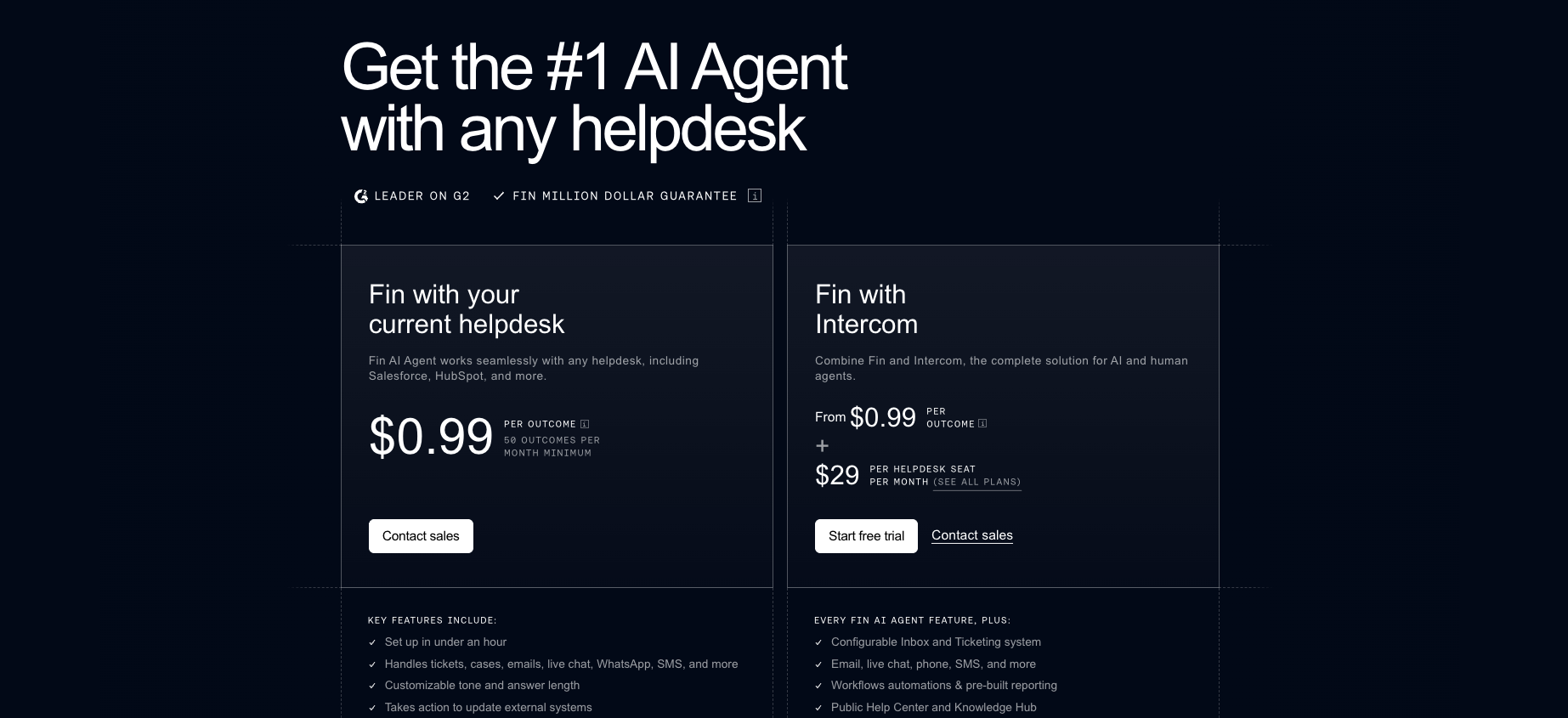
Intercom Fin AI pricing is $0.99 per billable outcome, with a minimum of 50 outcomes per month. That much is on the pricing page. What the page doesn't put front and center is that the total you pay depends on how you buy Fin and what counts as an outcome.
Fin is sold two ways. You can run it standalone on a helpdesk you already use, or you can run it bundled with Intercom's own helpdesk on a seat plan. The per-outcome rate is the same in both cases. The rest of the bill is not. The sections below work through each part so the real number becomes clear.
The two ways to buy Fin: standalone vs Fin with Intercom
There are two ways to buy Fin, and they price differently. Fin on your existing helpdesk is $0.99 per outcome with no seat fees. Fin bundled with Intercom adds a per-seat plan on top of the outcome charges.
Fin on your existing helpdesk
Fin works with Zendesk, Salesforce, HubSpot, and Freshdesk without an Intercom subscription. You pay $0.99 per outcome, minimum commitments apply, and there are no seat, setup, or integration fees. This route is sold through Intercom's sales team, so it isn't available through self-serve signup. You still pay your existing helpdesk separately, so this is the AI cost on top of whatever you already run.
Fin with Intercom
Bundle Fin with Intercom's helpdesk and you choose a seat plan. The plan sets your per-seat price, and Fin outcomes are billed on top of it.
| Intercom plan | Monthly / seat | Annual / seat | Lite seats included |
|---|---|---|---|
| Essential | $39 | $29 | None |
| Advanced | $99 | $85 | 20 |
| Expert | $139 | $132 | 50 |
So on Intercom your monthly bill is seats plus outcomes. On another helpdesk it's outcomes only, plus that helpdesk's own cost. Getting this distinction right matters, because the seat line is where a lot of the real cost hides for teams that assumed "$0.99 per resolution" was the whole story.
What counts as a billable Fin outcome?
A resolution is one of several billable outcome types, so "$0.99 per resolution" is shorthand for the resolution outcome. Fin bills you when a conversation reaches an outcome, and there are four of them.
| Outcome | What triggers it | Price |
|---|---|---|
| Resolution | No further help requested after Fin's last answer | $0.99 |
| Procedure handoff | Fin completes a configured hand-off to a human | $0.99 |
| Disqualification | A prospect doesn't match your criteria | $0.99 |
| Qualification | A prospect matches your criteria and gets routed | $9.99 |
Fin charges one outcome per conversation, even when it takes several actions inside that conversation. You aren't charged when a conversation passes to your team without reaching an outcome. The $9.99 qualification outcome is the one teams overlook, because it costs ten times a resolution and applies to sales-style routing instead of support answers.
The mechanic that moves your bill most is how a resolution gets counted. Fin recognizes two kinds:
-
A confirmed resolution is when the customer affirms the answer, with something like "Ok thanks."
-
An assumed resolution is when the customer exits the conversation without asking for more help.
Both are billed. Assumed resolution is where the effective cost per truly solved ticket climbs, because a customer who gives up and leaves counts the same as a customer whose problem was fixed.
On complex technical tickets, where a customer might disappear to try a workaround, that gap is wider than on simple FAQ traffic.
The real cost per resolution: a worked example
The real cost per resolution is higher than $0.99 once assumed resolutions and, on Intercom, per-seat fees are counted in the same bill. The math below is a hypothetical. Swap in your own numbers.
Suppose your team handles 2,000 support conversations a month and Fin resolves 60% of them:
-
Sticker math: 1,200 resolutions at $0.99 is about $1,188 in outcome charges.
-
Adjust for assumed resolutions: if even 15% of those 1,200 were customers who gave up before getting a real fix, you paid for roughly 180 resolutions that didn't solve anything. Your effective cost per truly solved ticket rises from $0.99 toward $1.16.
-
Add seats, if you're on Intercom: five Advanced seats at $99 is $495 a month on top of outcomes.
-
Add any qualification outcomes and add-ons: a handful of $9.99 qualifications and a $99 Pro add-on push the total further.
In this hypothetical, the "$0.99 per resolution" plan lands closer to $1,700 a month all in, and the cost per truly resolved ticket sits above the sticker. None of these are Intercom's quoted figures. They're a model you should re-run with your own volume, resolution rate, and seat count. The point is that the headline rate and the invoice are two different numbers.
Why the Fin bill can be hard to predict
Fin's bill is hard to predict because you pay more as it resolves more, so success itself raises the cost. A month where Fin gets better, or where a product launch spikes ticket volume, is a month where the invoice goes up. That's the dynamic behind support teams reporting that their Intercom billing jumped with no change to their plan.
Intercom does give you levers to keep it in a known range. You can set configurable spend alerts and limits, and you get real-time usage reporting. For teams that want a fixed number, Intercom offers pre-committed resolution buckets, where you buy a block of resolutions in advance, and it applies discounted rates to overages instead of a premium. Used together, these turn an open-ended usage bill into something a finance team can plan around. They don't remove the underlying fact that cost tracks volume, so a fast-growing or seasonal support operation should model the high months instead of the average.
Add-ons and extras that change your total
Beyond per-outcome charges, several add-ons change what you pay. The Pro add-on is $99 per month for analysis of 1,000 conversations. Copilot, the agent-assist product, is $35 per user per month, with 10 conversations per month included on full seats before the paid add-on applies. Fin Voice is priced custom through sales. Channels like SMS, WhatsApp, and phone are billed by usage on top of everything else.
Non-US teams should watch one more line. Intercom bills in USD only. If your budget is in euros or pounds, your real cost moves with the exchange rate, which adds a variable you don't control.
How to decide if Intercom Fin is worth it
Per-resolution pricing is the standard model, so the model itself isn't the question. What decides your real cost is what counts as a billable resolution and whether you can verify it.
-
Fin fits if your volume is predictable and mostly FAQ, where a resolution usually means a real fix.
-
Look closer if your volume is high or spiky, or you handle a lot of complex tickets, where assumed resolutions inflate the count.
Rates across vendors aren't directly comparable, because each one defines a resolution differently. Map any per-unit price to your own tickets before you trust it.
For a Zendesk or Intercom team, the real decision is which AI layer runs on the helpdesk you already have, the native AI or Pluno. Pluno is an AI support agent for complex technical tickets that learns from your resolved support tickets, so it handles the edge cases your help center never documented. It works inside Zendesk and Intercom, with agent-assist and one-click escalations on Intercom through the Pluno Copilot Chrome extension.
Pluno isn't cheaper on paper. You pay a platform fee tied to your ticket volume, €0.90 per autonomous resolution on top, and €49 per agent per month for Copilot if you use it. The difference is in how resolutions get billed:
-
Longer window. A ticket is marked resolved 72 hours after Pluno's last reply with no response, so an unhelped customer has time to come back before the charge lands.
-
No charge for escalations. When a ticket goes to a human, you don't pay for partial work.
-
Every resolution is tagged. Filter the tag in your helpdesk to audit exactly what you were billed, with an export of resolved ticket IDs for any billing period.
That verifiability answers the bill-shock worry, and because Pluno resolves complex tickets from resolved-ticket learning, more of what it bills is a genuine fix instead of a customer who gave up.
[Pluno book a demo CTA]
The bottom line
-
Fin's headline is $0.99 per outcome, but your real cost per resolution depends on seats, outcome types, assumed resolutions, and add-ons.
-
Model the bill on your own ticket volume and resolution rate, and plan for the high months instead of the average.
-
Watch the $9.99 qualification outcome and the USD-only billing if either applies to you.
-
Use spend limits, alerts, and pre-committed buckets if you want a predictable invoice.
-
Before you sign, run any AI layer, native AI or Pluno, against your hardest historical tickets so you're comparing real resolutions instead of headline rates. Book a Pluno walkthrough tailored to your ticket volume.
Frequently asked questions
How much does Intercom Fin cost per resolution? Fin costs $0.99 per billable outcome, and a resolution is one type of outcome. A qualification outcome costs $9.99. Standalone plans carry a minimum of 50 outcomes per month.
Does Fin charge for conversations it doesn't resolve? You aren't charged when a conversation passes to your team without reaching an outcome. You are charged for assumed resolutions, where the customer stops replying after Fin's last answer, even if the issue wasn't fully solved.
Is Fin cheaper than Intercom's seat plans? They're separate charges. On Intercom you pay a seat plan from $39 to $139 per seat per month plus $0.99 per outcome. Standalone Fin on another helpdesk is outcome-only, with no seat fee.
Can I use Fin without paying for Intercom? Yes. Fin runs on Zendesk, Salesforce, HubSpot, and Freshdesk at $0.99 per outcome, with minimum commitments. This route is sold through Intercom's sales team, so it isn't available through self-serve signup.
Is Intercom Fin worth it for B2B SaaS support? It depends on how predictable your volume is and how complex your tickets are. Run a simulation on your own historical tickets, and compare the AI-layer options on your helpdesk, the native AI or Pluno, before you commit.