Forethought AI is an enterprise AI agent platform for customer support, and since March 2026 it's owned by Zendesk. It's now sold as Forethought AI agents by Zendesk: Solve resolves tickets on its own, and add-ons such as Triage, Assist and QA cover routing, reply drafts and scoring. It still runs on help desks other than Zendesk, and every plan is priced by quote. If you're here for the 5 best Forethought alternatives, they're further down.
My verdict: Forethought AI is a strong pick for large, high-volume teams with deep ticket history and budget for a 30 to 90 day rollout. For technical B2B support, where fixes sit in past tickets, logs and code, Pluno is the stronger choice. It runs inside the help desk you already use, answers from your resolved tickets, troubleshoots with your connected systems and publishes its prices.
Test Pluno on your 50 most recent tickets
How I reviewed it: I worked from forethought.ai, Zendesk's help center, pricing page and newsroom, press coverage of the acquisition, G2 and Capterra, all checked on October 27, 2026. I didn't run Forethought on a live account, and its help docs now sit behind a login. Treat its answer quality as unmeasured until you test it on your own tickets (the test is at the end).
I score Forethought and each alternative on the same six yardsticks:
- Help desk fit: where the AI agent runs, and what you need to switch it on.
- Knowledge sources: the content it's allowed to answer from.
- Actions: the changes it can make in your help desk and other tools.
- Handoff: what your team gets when the AI agent stops.
- Pricing: the billing unit, and whether you can see a price before a sales call.
- Setup: who does the work, how long it takes and how you test first.
Each yardstick, and each capability in the comparison table, gets one of three ratings:
- Strong: an official page documents it, it's on the plan you'd buy, and it works for technical B2B tickets without a workaround.
- Partial: it exists, but it's gated by plan, add-on or data volume, limited in scope or needs a workaround.
- Not found: no official vendor page documents it as of October 27, 2026.
TL;DR: Is Forethought AI worth it in 2026?
- For technical B2B support, Pluno is the stronger pick. It answers from your resolved tickets, investigates with your code, logs and error tracking, escalates bugs to engineering with the research done and never bills an escalation.
- The bottom-line number: Forethought says it works best with 20,000+ past tickets and at least 2,000 email or chat tickets a month. Below those volumes, make a Proof of Value on your own tickets a condition before you commit. Pluno's plans start at up to 500 tickets a month.
- Pricing is quote-only. Every plan is a platform fee plus an outcome-based fee, with a Proof of Value instead of a free trial and most teams live in 30 to 90 days.
- Where Forethought wins: big-volume teams that need voice, 100+ languages and one AI layer across many help desks. Its Browser Agent also clicks through internal tools that have no API. Pluno works through APIs and your connected systems, and its Product Agent acts for users inside your own product.
What is Forethought AI, and what changed after Zendesk bought it?
Forethought AI is a set of AI agents for customer support that trains on a company's past tickets and runs on top of its help desk. It started in 2017, won TechCrunch Battlefield in 2018 and raised about $115 million before Zendesk announced the deal on March 11, 2026 (TechCrunch). The price wasn't disclosed.
Here's how the Zendesk Forethought deal played out:
- March 11, 2026: Zendesk announces the acquisition and promises Forethought customers "uninterrupted service". It says the deal speeds up its roadmap "by over a year", with native voice automation and computer use for systems without an API.
- March 26, 2026: the deal closes, and Zendesk says Forethought will "work seamlessly within Zendesk and across any platform".
- May 2026: at Relate, Zendesk presents the Resolution Learning Loop as part of its own platform, the self-improving layer it bought Forethought for.
- June 4, 2026: "Forethought AI agents by Zendesk" goes on sale. Zendesk customers buy it as an add-on, and companies on other help desks can buy it on its own.
Today forethought.ai carries a "Forethought is now part of Zendesk" banner. Co-founder Sami Ghoche, CEO at the time of the deal, is listed as Vice President, Applied AI, and co-founder Deon Nicholas as an advisor (Forethought's about page).
What you actually buy
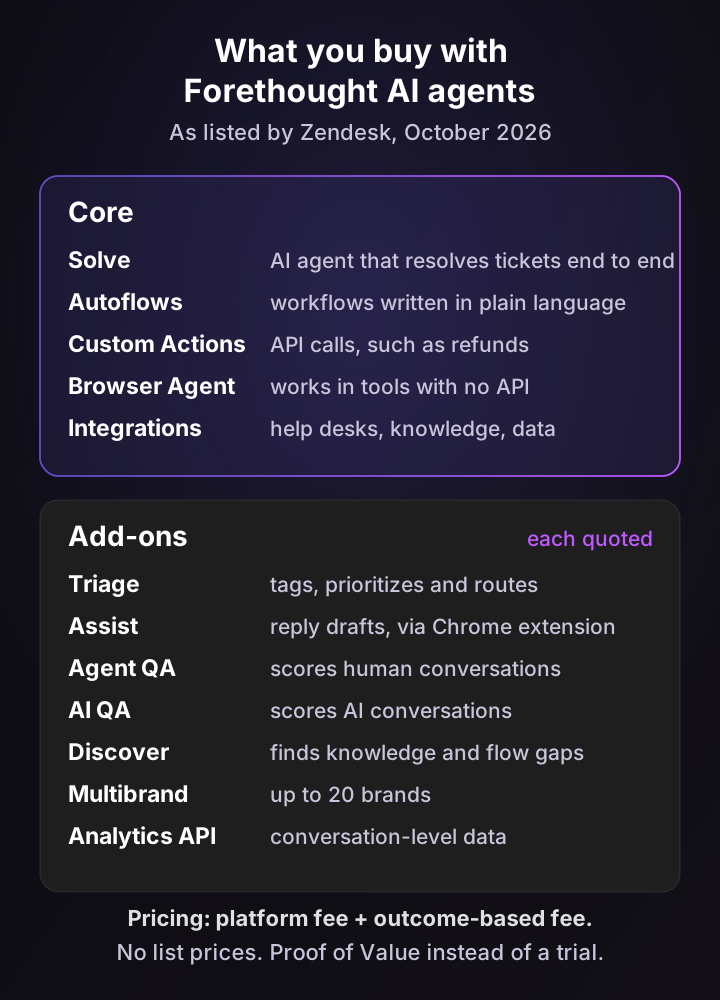
Zendesk's product page for Forethought splits the lineup into a core and add-ons:
- Solve (core): the customer-facing AI agent. It follows Autoflows, workflows you write in plain language instead of decision trees, and calls your APIs through Custom Actions.
- Browser Agent (in Solve): launched in October 2025, it can "log in, click, and type" in internal tools that have no API.
- Triage (add-on): tags, prioritizes and routes tickets with models trained on your history, plus ready-made sentiment, language and spam models.
- Assist (add-on): drafts replies and suggests articles and workflows for human agents. It runs as a Chrome extension over your help desk, not as a native sidebar app.
- Agent QA and AI QA (add-ons): score human and AI conversations against your rubric.
- Discover (add-on): mines past tickets for knowledge and workflow gaps and drafts articles and new Autoflows.
- Multibrand and Analytics API (add-ons): up to 20 brands, and conversation-level data in your own tools.
Forethought's own pricing page draws the line differently: its Team plan already includes ready-to-use triage models and AI QA, and only Discover, Multibrand and the Analytics API appear as add-ons. Ask your rep which of these your quote includes in the plan and which it prices on top.
Zendesk AI agents vs Forethought: which one is Zendesk selling you?
Zendesk now sells two AI agents, and they're easy to mix up. Zendesk AI agents come with every Suite and Support plan, run only in Zendesk and bill per automated resolution. Forethought AI agents are a separate, quote-based product that also runs on Salesforce and other platforms.
If you're all-in on Zendesk, ask your account rep whether the quote covers Zendesk AI agents or Zendesk Forethought, and why. My Zendesk AI vs Pluno comparison covers the native agent in depth.
How Forethought AI scores on 6 yardsticks
Forethought rates Strong on help desk fit, knowledge and actions, and Partial on handoff, pricing and setup. Each yardstick below links to the official page behind it.
Help desk fit: 70+ integrations, sold through Zendesk
Forethought lists 70+ integrations across help desks, CRMs, knowledge sources and other tools. The help desks include Zendesk, Salesforce, Intercom, HubSpot, Kustomer, Gladly, ServiceNow, Front and Freshworks. That reach is its biggest structural strength, and Zendesk confirms the plans are "available for purchase for any customer", whatever help desk you use.
Two details matter in practice. A logo on the integrations page doesn't tell you which products work with that help desk, so ask which of Solve, Triage and Assist your help desk supports. And Assist runs as a Chrome extension, so your agents work in a browser layer over the help desk rather than in its own sidebar.
Rating: Strong.
Knowledge sources: trained on your past tickets, with a volume threshold
Forethought Solve is "trained on your historical data" from day one (Solve page), and its connectors cover Confluence, Notion, Guru, Google Drive, SharePoint, Document360 and more. That's the right foundation, because the answers to most support questions already sit in tickets your team closed.
The catch is scale. Forethought's own FAQ says its AI "performs effectively" with 20,000+ historical tickets and needs at least 2,000 email or chat tickets a month "to operate smoothly". A 15-person SaaS team handling 900 tickets a month doesn't meet that bar.
Rating: Strong, if your volume clears the threshold.
Actions: Custom Actions plus a Browser Agent
Custom Actions call your API endpoints for jobs such as refunds or account updates, and the Browser Agent works in tools with no API at all. That pairing is rare, and it's useful for teams whose back office runs on older admin panels.
What I didn't find is native investigation of technical problems. Forethought documents no built-in reading of logs, error tracking or code, so a ticket like "our webhook stopped firing after we rotated the API key" would need you to build that access as custom actions.
Rating: Strong.
Handoff: full conversation context, routed by Triage
When Solve can't resolve a ticket, the handoff "includes full context" from the AI conversation, and Triage can classify and prioritize it for routing. Custom handoff models start on the Professional plan.
What Forethought doesn't document is a research summary listing the sources the agent checked and why it stopped. I also found no engineering escalation that files the bug in a tool such as Jira or Slack and syncs updates back to the ticket. My guide to autonomous customer service explains why that note decides how fast an agent can pick up.
Rating: Partial.
Pricing: platform fee plus outcomes, by quote
Every Forethought plan is "Get a Quote", built from a platform access fee and an outcome-based fee. I break it down in the pricing section below.
Rating: Partial, because you can't price it before a sales cycle.
Setup: sales-led, 30 to 90 days
Forethought offers a Proof of Value on your data instead of a free trial, and "most teams are fully set up within 30–90 days" (FAQ). Results can come faster for narrow use cases: Grammarly's first version went live in a week and a half. G2 reviewers put the average time to implement at two months.
Rating: Partial.
Forethought scorecard
| Yardstick | What Forethought offers | Rating |
|---|---|---|
| Help desk fit | 70+ integrations, help desks incl. Zendesk and Salesforce; Assist runs as a Chrome extension | Strong |
| Knowledge sources | Trained on past tickets, plus 18+ knowledge connectors; needs 20,000+ tickets | Strong (at volume) |
| Actions | Custom Actions, Browser Agent, Autoflows; no native log or code analysis | Strong |
| Handoff | Full conversation context and Triage routing; no documented research summary | Partial |
| Pricing | Platform fee plus outcome fee, quote only | Partial |
| Setup | Sales-led, Proof of Value, 30 to 90 days | Partial |
Forethought pricing: how the quote is built
Forethought pricing isn't published. Its pricing page describes "a blend of platform access fees and an outcome-based pricing cost", warns that "additional usage charges may apply" above plan limits and puts a "Get a Quote" button on every plan. Zendesk's Forethought product page sends you to Zendesk Sales too, and its subscription guide says the plans are "available for an annual recurring fee".
So ask for the quote as separate lines: the annual platform commitment, the outcomes it includes, the price per extra outcome, each add-on and the renewal terms. Pluno, by contrast, publishes its modules and prices and starts with a free trial.
The three plans differ mainly by channel and by how much the AI does for your knowledge base:
| Plan | Adds | Price |
|---|---|---|
| Team | AI agents for chat and mobile, Autoflows, custom actions, ready-made triage models, multilingual, AI QA | Quote |
| Professional | Email, voice and Slack AI agents, AI insights, multibrand, custom handoff models | Quote |
| Enterprise | Solve API, knowledge gap detection with article drafts, Autoflow generation, Analytics API, enterprise security controls | Quote |
The plan table matters more than it looks. If most of your tickets arrive by email, you're shopping at Professional or above from the start.
Costs that aren't in the quote's headline
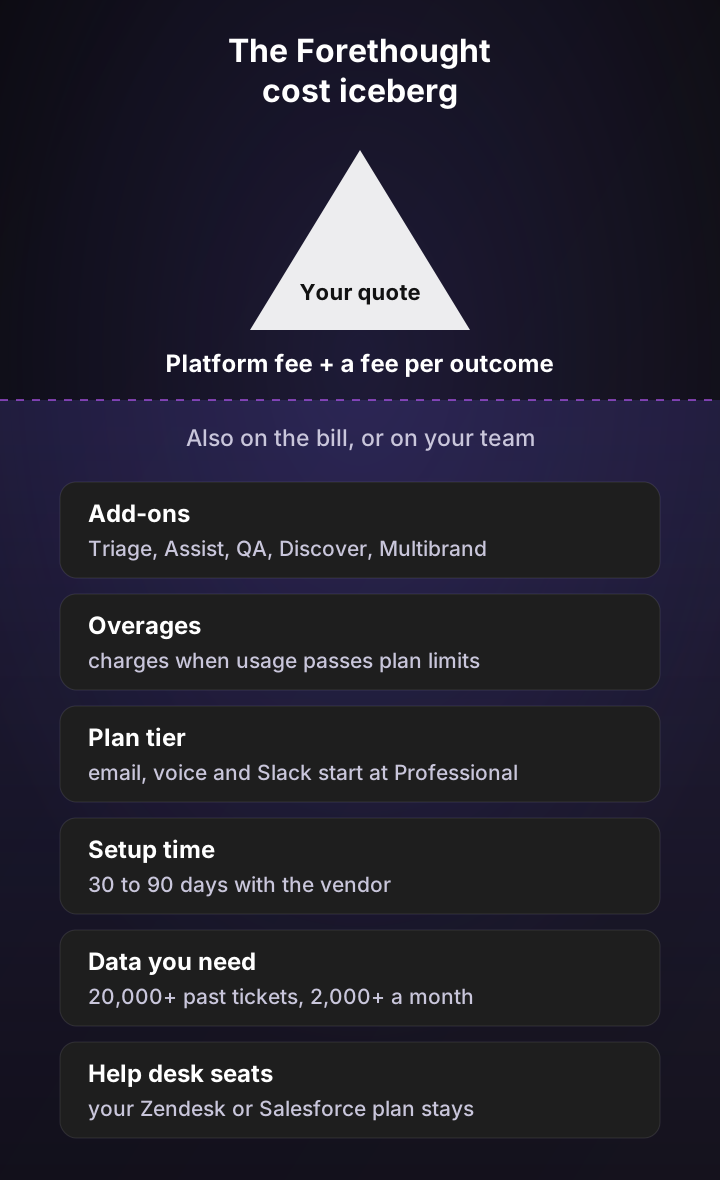
Under the platform fee and outcome price sit the costs that depend on your setup:
- Add-ons: Zendesk lists Assist, Triage, Agent QA, AI QA, Discover, Multibrand and the Analytics API as add-ons to Solve. Forethought's plan table includes basic triage and AI QA from Team, so check what your quote counts as extra.
- Overages: usage above your plan's limits is billed extra, and the terms come from your contract.
- Your team's time: a 30 to 90 day rollout with Forethought's team, plus the work of writing and testing Autoflows.
- Data you need first: Forethought recommends 20,000+ past tickets and asks for 2,000+ email or chat tickets a month. If you're below that, ask for a Proof of Value on your own tickets before you sign.
- Your help desk stays: Forethought sits on top of Zendesk, Salesforce or another help desk, so those seats remain on the bill.
One G2 reviewer called it "incredibly cost prohibitive" next to the Zendesk features they already had. That review dates from 2022, but it shows how the comparison can land for a smaller team.
How Forethought compares with published prices
Without list prices, the fairest benchmark is what other vendors publish for the same unit of work:
- Zendesk AI agents: included in every Suite and Support plan with a monthly allowance, then $1.50 per resolution committed or $2.00 pay-as-you-go. My Zendesk AI pricing guide has the full breakdown.
- Fin: a $49 monthly base plan that includes 50 outcomes, then $0.99 per extra outcome. An outcome is a resolution the customer confirms or a successful Procedure handoff; a customer asking for a person or a default escalation isn't billed. See my Fin pricing guide.
- Pluno: a platform fee from 249€ a month for up to 500 tickets (210€ billed annually), plus 0.90€ per ticket it resolves with no human involved (Pluno pricing). Escalations are never billed.
Ask Forethought for its outcome price in the same terms, then divide the full monthly quote by the tickets it would resolve. That cost per resolution is the number to compare.
Run your own numbers
Plug your Forethought quote and your 50-ticket test results into this model. It shows the tickets left for your team and the total monthly cost of each tool, as a scenario estimate built from your own inputs.
Forethought vs Pluno: workload and total cost from your test
Forethought publishes no prices, so enter the platform fee and the price per outcome from your own quote, in US dollars. Enter each tool's correct resolutions out of the same 50 tickets, plus any other outcomes it would bill under its contract (for example a billed handoff, or a ticket closed without a verified fix). The model scales them to your monthly volume. It's a scenario estimate, not a forecast, so try a lower and a higher resolution count. Pluno list prices, October 2026: the platform fee for your ticket volume, 0.90€ per resolved ticket, optional AI Copilot seats at 49€ and the Troubleshooting Agent from 99€, converted at the ECB rate of 23 October 2026 (1 EUR = 1.1193 USD). Your help desk plan stays the same with either tool, so it's left out.
Enter how many of your 50 test tickets each tool resolved correctly, then your Forethought quote, to see the tickets left for your team and your total monthly cost.
What people say about Forethought
Reviewers mostly praise Forethought's deflection and insights, and criticize its learning curve, the time it takes to get reporting right and the cost. The quotes below come from G2 and Capterra, with the date each was posted.
“Forethought's chat widget is a valuable tool that allows our Customer Support team to proactively solve over 70% of inbound support cases. Our customers use it everyday.”
“Forethought gives us valuable insights into the common questions our clients ask and helps us build out flows that make it easier to achieve higher deflection rates.”
“Forethought typically has a higher than expected learning curve, making it a bit challenging to get ramped up and know exactly how to implement it best for specific use cases.”
“We also did have to work very closely with Forethought over many months to get to a state where the reporting output/dashboard gave us what we needed for our operations”
“Some of the changes that seem like they would be easy to make require a code change or backend support from their team. The cost can initially seem high but is quickly covered in the return on auto solved tickets.”
“It was incredibly cost prohibitive. Already having a program, like Zendesk, that has a similar integration (that we just hadn't set up yet) the cost that Forethought was charging us was quite staggering.”
Several of these reviews predate the acquisition, so read them as experiences rather than a current verdict. No review I found discusses support or contracts since Zendesk took over.
For a broader signal, Forethought AI Agents holds 4.3 out of 5 from 166 reviews on G2 and 4.5 out of 5 from 11 reviews on Capterra. Many of the G2 reviews are marked as invited on behalf of the vendor.
Who should use Forethought AI (and who shouldn't)
Use Forethought AI if you handle well over 2,000 email or chat tickets a month and have years of ticket history. It's also a strong fit if you need voice, 100+ languages or a Browser Agent for internal tools without an API. Teams running several help desks across regions get one AI layer over all of them.
Look elsewhere if your volume sits below Forethought's threshold, your tickets need troubleshooting in logs and code, or you want a price before a sales cycle. The same goes if your agents should work in a native help desk sidebar rather than a browser extension.
In short, its pros are reach, scale, languages and learning from past tickets. Its cons are quote-only pricing, a long rollout, a high data threshold and no built-in investigation tools.
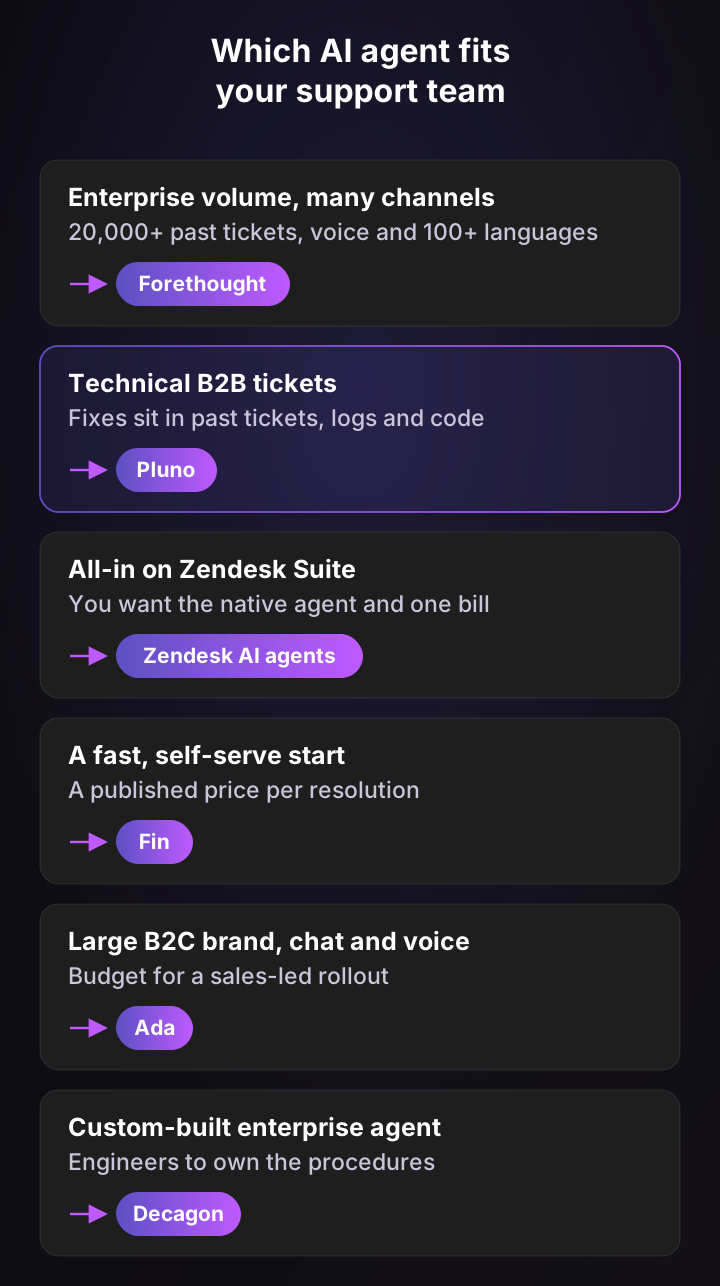
The map pairs each situation with a tool. Enterprise volume across many channels fits Forethought, and technical B2B tickets fit Pluno. Zendesk AI agents suit teams all-in on Zendesk Suite, Fin a fast self-serve start, Ada large B2C brands and Decagon teams that want a custom-built agent.
5 best Forethought alternatives for support teams
The best Forethought alternative for technical support is Pluno, because it works from the resolved tickets and systems where technical answers live, with plans from 500 tickets a month. If you're weighing alternatives to Forethought AI for other reasons, the other four fit narrower cases:
- Zendesk AI agents for Zendesk Suite teams that want the native agent on one bill.
- Fin for a fast, self-serve start with a published price.
- Ada for large B2C brands on chat and voice.
- Decagon for enterprises that want a custom-built agent.
All five connect to Zendesk, Forethought's main help desk, but the channels and depth vary. Pluno runs as a native app in the Zendesk ticket sidebar, while others work through messaging integrations or their own channels. Fin, Ada and Decagon also connect to Salesforce Service Cloud. I took each fact from the vendor's own site on October 27, 2026.
1. Pluno: best for technical support teams
Pluno is an AI layer for the help desk your team already uses, and it works inside Zendesk as a native app. Pluno goes beyond basic customer service automation by resolving complex technical issues using historical tickets, troubleshooting context, AI assisted workflows, and engineering escalations, while also equipping human agents with AI Copilot and quality assurance.
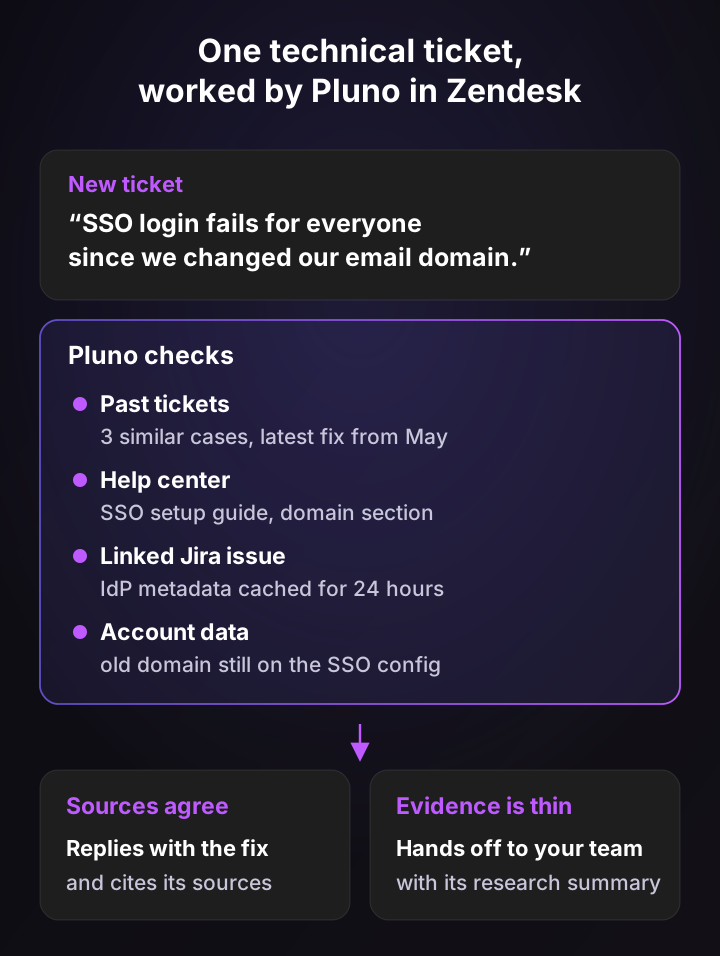
The illustration follows one ticket about SSO failing after an email domain change. Pluno checks similar past tickets, the help center, a linked Jira issue and the account's data, then either replies with the fix and its sources or hands the ticket to your team with its research.
On the six yardsticks:
- Help desk fit: a native app in the Zendesk ticket sidebar, so views, macros and reports stay where they are. The same platform runs on Intercom, Salesforce Service Cloud, HubSpot, Jira Service Management and Freshdesk.
- Knowledge sources: your resolved tickets are the main source, and plans start at up to 500 tickets a month. Pluno rebuilds the troubleshooting steps your team actually used, favoring the latest successful ones, and adds your help center, docs, files and tools such as Slack, Jira, Confluence or Notion.
- Actions: custom API actions read or write live data mid-conversation, and unlimited AI Workflows set rules such as silent escalations or priority routing.
- Handoff: Pluno grounds troubleshooting in historical resolutions and connected knowledge, validates available evidence, and provides researched handoffs when human intervention is required. The handoff lists the tickets it checked and suggested next steps, and escalation forms can collect required details from the customer first.
- Pricing: a platform fee from 249€ a month for up to 500 tickets (210€ billed annually), plus 0.90€ per resolution. A resolution is a ticket Pluno resolves with no human involved, marked resolved 72 hours after its last reply if the customer doesn't write back. Escalations are never billed, and every AI-resolved ticket is tagged in your help desk so you can check the bill. Optional modules are priced separately: AI Copilot at 49€ per seat, the Troubleshooting Agent from 99€ a month (about 50 investigations) and Quality Assurance at 35€ per agent. See Pluno pricing.
- Security: SOC 2 Type II certified, GDPR compliant with a DPA, all data processed in Europe, models hosted on Microsoft Azure and no models trained on customer data.
- Setup: the Pluno team connects your help desk with you on your onboarding call, imports your past tickets and sets up your first modules, with a 14-day free trial.
For a sense of the total: a team with 3,000 tickets a month on an annual plan pays an 850€ platform fee. If Pluno resolves 1,200 of those tickets, that adds 1,080€, and the Troubleshooting Agent's first tier adds 99€, for 2,029€ a month before any Copilot seats.
Where Forethought adds add-ons around Solve, Pluno puts the tools for technical work on one platform:
- Troubleshooting Agent: say a customer's CSV import keeps timing out. It checks recent deploys and the related code, the account's state in your database, matching errors in Sentry or Datadog and the session recording, and links every finding to its evidence. It recommends a fix and opens a pull request only after you approve, from 99€ a month.
- Escalation Copilot: files bugs where engineering works, such as Slack, Jira, Linear, Microsoft Teams or incident.io, with the report filled in, and copies updates back onto the ticket.
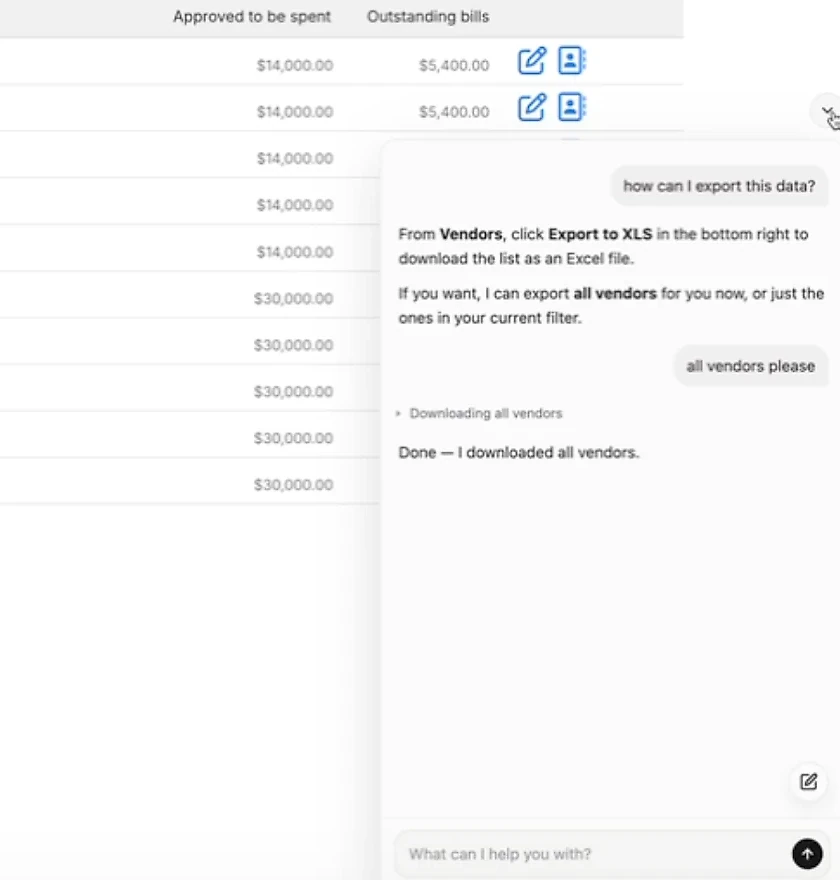
- Product Agent: a chat inside your own product that reads the user's setup and acts for them. In this sandbox demo we recorded, a user asks how to export vendor data, and it runs the export.
- Help for your human team: AI Copilot drafts a reply with sources in the native sidebar for every new message, AI Tagging & Field Filling sets fields and priority, and Quality Assurance scores every resolved ticket at 35€ per agent.
Innovorder, Velotric and Smartness all run Pluno inside Zendesk. Innovorder's AI agent resolves 67% of its chat and WhatsApp tickets, with replies in under a minute, Velotric's handles 58% of routed tickets, and Smartness cut its first response time to 22 minutes, down from hours.
"I compared Pluno with Fin by Intercom, and Pluno was miles ahead!"
Joseph D'Apuzzo, Customer Support Manager at Smartness
Test Pluno on your 50 most recent tickets
2. Zendesk AI agents: best for teams all-in on Zendesk Suite
Zendesk AI agents are the native agent in every Suite and Support plan, and the product Zendesk is folding Forethought's learning loop into.
- Help desk fit: Zendesk only, across messaging, email and voice (voice needs Zendesk voice).
- Knowledge sources: your help center plus sources such as Google Drive and PDFs, imported once or on a schedule. Past tickets aren't documented as an answer source.
- Actions: integrations and actions that read and write data in external systems, with procedures written in plain language.
- Handoff: native, to your Zendesk agents. Resolutions are only billed when no human was involved.
- Pricing: an included allowance, then $1.50 per resolution committed or $2.00 pay-as-you-go. The pricing page still lists 5 automated resolutions per agent a month on Team and 10 on Professional. Since May 18, 2026, Zendesk's help center describes a dollar allowance instead: $2 per agent a month on Team, $5 on Growth and Professional and $10 on Enterprise, up to $5,000 a year. Check which model your contract uses.
- Setup: self-serve, with a 14-day free trial.
Best for: Zendesk teams that want one vendor and one bill. Watch out for: a per-resolution price above most alternatives, and no answers drawn directly from past tickets. My Zendesk AI alternatives roundup goes deeper.
3. Fin: best for a fast, self-serve start
Fin started life as Intercom's AI agent, and Salesforce completed its purchase in September 2026. It's also the most searched-for comparison with Forethought.
- Help desk fit: Zendesk email and contact-form tickets plus Zendesk messaging (Fin for Zendesk), Salesforce Service Cloud cases and chat (Fin for Salesforce), and eight other help desks.
- Knowledge sources: syncs your Zendesk help center and other content. Fin's AI Agent uses your knowledge base as its source of truth; synced Zendesk and Salesforce ticket history feeds Insights, content suggestions and Fin Copilot's answers for your human agents.
- Actions: Procedures for multi-step workflows, with data through APIs, data connectors or MCP.
- Handoff: transfers the ticket to your Zendesk team with an AI summary.
- Pricing: a $49 monthly base plan with 50 outcomes included, then $0.99 per outcome. Confirmed resolutions and successful Procedure handoffs are billed; ordinary escalations aren't.
- Setup: self-serve, with a 14-day free trial.
Best for: teams that want to be live in days with a published price. Watch out for: knowledge centered on articles, so a thin help center caps what it resolves. My Fin alternatives roundup goes deeper.
4. Ada: best for large B2C brands on chat and voice
Ada is an AI agent platform for high-volume consumer brands, with a Zendesk partnership and Salesforce handoffs.
- Help desk fit: Zendesk messaging, Sunshine Conversations and Zendesk Talk, plus Salesforce chat and messaging. Ada's Zendesk page doesn't describe it working Zendesk email tickets.
- Knowledge sources: your help center through Zendesk Guide. Ada's docs don't list past tickets as a knowledge source.
- Actions: tools and Playbooks for multi-step procedures, plus a Salesforce block that creates, updates or looks up cases.
- Handoff: creates tickets and escalates to Zendesk agents with the conversation.
- Pricing: not published; you book a 30-minute call.
- Setup: sales-led.
Best for: consumer brands with chat and voice at scale in many languages. Watch out for: quote-only pricing and help center knowledge. See my Ada pricing guide and Ada alternatives.
5. Decagon: best for a custom-built enterprise agent
Decagon builds enterprise AI agents for chat, email and voice around Agent Operating Procedures (AOPs), which mix plain language with code.
- Help desk fit: syncs tickets and acts in Zendesk, Salesforce and Intercom.
- Knowledge sources: ingests historical tickets after removing personal data, plus Confluence and other content tools.
- Actions: AOPs call your APIs and systems, with voice through Amazon Connect, RingCentral or SIP.
- Handoff: to human agents in the connected help desk.
- Pricing: not published. Decagon describes two models: a fixed rate per conversation, or a higher rate per resolution with escalations free.
- Setup: sales-led.
Best for: enterprises with engineers to own the agent's procedures. Watch out for: quote-only pricing and a build that leans on your team.
Capability comparison for technical support
| Capability | Pluno | Forethought | Zendesk AI agents | Fin | Ada | Decagon |
|---|---|---|---|---|---|---|
| Answers from past tickets directly | Strong | Partial (needs 20,000+) | Not found | Not found for the AI Agent (history feeds Copilot and Insights) | Not found | Strong |
| Technical troubleshooting (logs, code, errors) | Strong (Troubleshooting Agent add-on, from 99€/month) | Partial (custom actions, Browser Agent) | Partial (actions only) | Partial (APIs and MCP) | Partial (tools only) | Partial (AOPs with code) |
| Engineering escalations with sync back | Strong (5 tools, two-way) | Not found | Partial (Zendesk's Jira integration) | Not found | Not found | Not found |
| Help desks | 6, incl. Zendesk and Salesforce | Zendesk, Salesforce, Intercom and more (70+ integrations) | Zendesk only | 10, incl. Zendesk and Salesforce | Zendesk, Salesforce and others | Zendesk, Salesforce, Intercom |
| Published price | Yes | No | Yes | Yes | No | No |
| Try before you buy | 14-day trial, free 50-ticket test | Proof of Value | 14-day trial | 14-day trial | Demo | Demo |
Ratings use the definitions from the introduction, based on each vendor's official pages on October 27, 2026. Forethought rates Partial on past tickets here because the threshold gates smaller teams; above it, its training on history is a real strength.
Pricing side by side
| AI agent | Billing unit | Price (October 2026) | Setup | Best for |
|---|---|---|---|---|
| Pluno | Platform fee + per resolution with no human involved | From 249€/month + 0.90€ per resolution; optional Copilot, Troubleshooting Agent and QA | Onboarding with the Pluno team, 14-day trial | Technical support teams |
| Forethought | Platform fee + per outcome | Quote only | Sales-led, 30 to 90 days | Enterprise volume, many channels |
| Zendesk AI agents | Per automated resolution | Included allowance, then $1.50 committed or $2.00 | Self-serve, 14-day trial | Zendesk Suite teams |
| Fin | Per outcome, incl. Procedure handoffs | $49/month with 50 outcomes, then $0.99 each | Self-serve, 14-day trial | A fast start |
| Ada | Not published | Quote only | Sales-led | Large B2C brands |
| Decagon | Per conversation or per resolution | Quote only | Sales-led | Custom-built enterprise agents |
Prices are in each vendor's own currency, and the billing units differ. The calculator above turns your Forethought quote and Pluno's list prices into one comparable number.
Test Pluno on your 50 most recent tickets
How to test Forethought against Pluno on 50 tickets
A head-to-head test on your own tickets is the only comparison that settles this. Here's a two-week method with one sample used throughout:
- Sort your 150 most recent tickets. Tag each by type (how-to question, account change or technical problem) and by channel, so you know your real mix.
- Use your 50 most recent tickets as the test set for every vendor, and check their type and channel mix against the 150. If a quiet week skewed it, run the test after a typical week.
- Keep the test set out of the training data. Ask each vendor to confirm that the 50 tickets' own resolutions aren't in the knowledge it answers from during the test.
- Check Forethought's threshold first. Count your past tickets and your monthly email and chat volume against the 20,000 and 2,000 it asks for.
- Run the 50 through each tool. Ask Forethought to include them in its Proof of Value, and ask Pluno to run your 50 most recent tickets side by side with your team's answers.
- Score blind against a written rubric. Have a reviewer who doesn't know which tool wrote which answer check correctness, the evidence cited, whether any action was safe and whether escalating was the right call.
- Report five numbers per vendor: correct resolutions, incorrect answers, escalations, the human work left (and how many handed-off tickets got a usable research summary), and the outcomes the vendor would bill under its contract.
- Compare cost per correct resolution. Enter each vendor's results and your Forethought quote in the model above. It scales them to your monthly volume as a scenario estimate, so rerun it with a lower and a higher resolution count to see the range.
Ask each vendor for its SOC 2 report, data processing region and DPA during the same two weeks, so security review doesn't add a month at the end.
If you're unsure which ticket types to hand to AI first, my customer support automation guide shows how to size the queue.
The bottom line
Forethought AI gives large support teams a mature AI agent that learns from their ticket history, speaks 100+ languages and connects to most major help desks, now with Zendesk behind it. It's held back by quote-only pricing, a 30 to 90 day rollout, a 20,000-ticket threshold and no built-in investigation tools.
For technical support, Pluno is the stronger choice. It answers from your full ticket history, troubleshoots with your systems, prepares your agents in a native sidebar and escalates bugs with the research done. Test it on your 50 most recent tickets and compare.
FAQ
What is Forethought AI?
Forethought AI is a set of AI agents for customer support, owned by Zendesk since March 2026 and sold as Forethought AI agents by Zendesk. Solve resolves tickets on its own, and add-ons cover routing (Triage), reply drafts (Assist), QA and knowledge gaps (Discover). It trains on a company's past tickets and runs on Zendesk, Salesforce and other help desks.
Who acquired Forethought?
Zendesk. It announced the deal on March 11, 2026 and completed it on March 26, 2026, without disclosing the price. Forethought AI agents by Zendesk went on sale on June 4, 2026.
How much does Forethought AI cost?
Forethought doesn't publish prices. Every plan (Team, Professional and Enterprise) is quoted as a platform access fee plus an outcome-based fee (pricing page), with overages above plan limits and add-ons quoted separately. Zendesk sells the plans for an annual recurring fee, and you get a Proof of Value on your data instead of a free trial.
Is Forethought part of Zendesk now?
Yes, but it's still a separate product. Zendesk AI agents come with every Zendesk plan and run only in Zendesk. Forethought AI agents are quoted separately and can run without the Zendesk platform, on help desks such as Salesforce, Intercom and Kustomer.
Does Forethought work with Salesforce?
Yes. Forethought lists Salesforce among its help desk integrations, and Zendesk confirms that companies on other platforms can buy it. Ask which products (Solve, Triage, Assist) your Salesforce setup supports before you sign.
Who founded Forethought AI?
Deon Nicholas and Sami Ghoche founded Forethought in 2017. Sami Ghoche was CEO when Zendesk bought the company and is now listed as Vice President, Applied AI, with Deon Nicholas as an advisor.
Fin vs Forethought: which is better for enterprise support?
Fin is faster to start and publishes its price ($49 a month with 50 outcomes included, then $0.99 per outcome). Forethought trains on your past tickets and adds Triage, voice and a Browser Agent, but it's quote-only and takes 30 to 90 days. For technical tickets, test both against Pluno on the same 50 tickets.
Can Forethought AI learn from past tickets?
Yes. Solve trains on your historical data and Discover mines past tickets for gaps. Forethought's FAQ says it performs effectively with 20,000+ past tickets and needs 2,000+ email or chat tickets a month. Pluno also answers from your resolved tickets, rebuilding the troubleshooting steps your team used, and its plans start at up to 500 tickets a month.
What is the best Forethought alternative?
Pluno, for technical support teams. It runs inside Zendesk and five other help desks and answers from your resolved tickets. Its Troubleshooting Agent investigates with your code, logs and error tracking, Escalation Copilot files bugs for engineering with the research attached, and its prices are published. Zendesk AI agents suit Zendesk Suite teams, and Fin suits a fast self-serve start.