Ada is one of the most established AI agents in customer service, and it is built for high-volume, consumer-style support at enterprise scale. Its own demo page calls a company with 300,000 support conversations a year a good fit.
Most teams searching for an Ada alternative do not look like that. They run leaner, they want to see the agent work before they commit, and their hardest tickets go well beyond FAQs. Ada's pricing is sales-gated, starts in the tens of thousands per year, and climbs into six figures at scale, on an annual contract you sign before you have watched it resolve one of your own tickets. For the wrong team, that is a heavy commitment to make on trust.
Most of these agents sit on top of your existing helpdesk, so this guide compares them through a Zendesk lens, the most common setup for teams weighing these tools and the place they integrate and differ most. If you're on Zendesk, it's written for you.
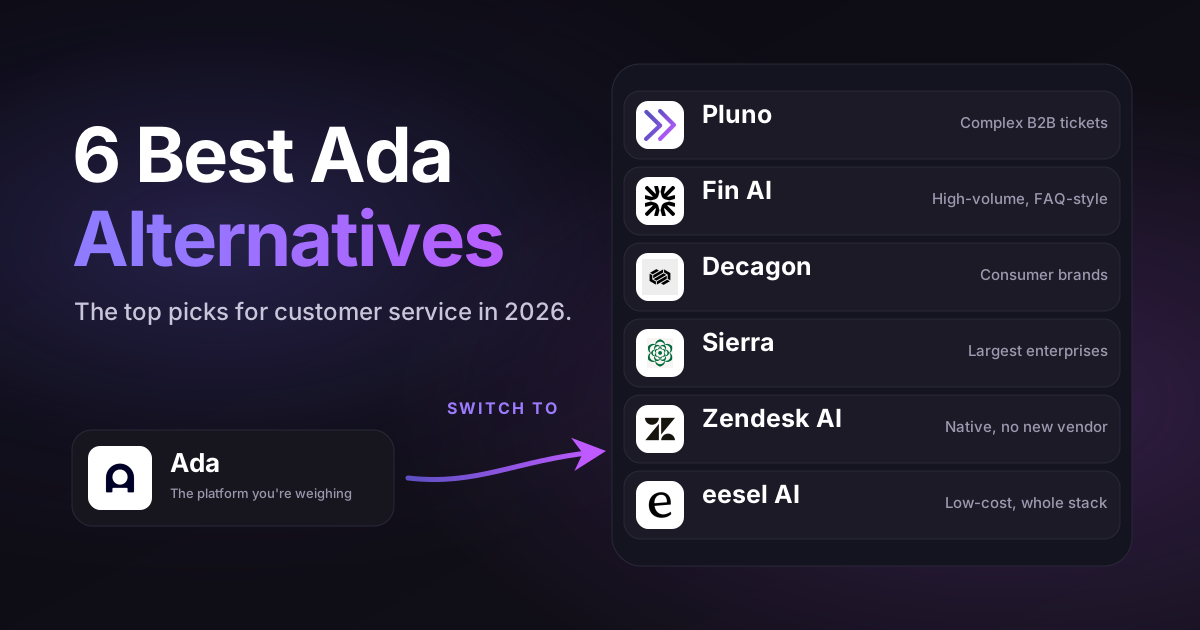
The right alternative depends on the kind of support you run. Here are the six best Ada alternatives in 2026, and who each one is for.
Short on time? The quick version
- If you're already running on Zendesk and receive a lot of complex, technical tickets that need logs, a Jira issue, and the memory of how you solved this last time, choose Pluno. It reads your resolved tickets where the real answers live.
- If your tickets are mostly common, FAQ-style questions and you want a proven agent across channels, choose Fin AI.
- If you're a large consumer brand with a testing culture and the budget to build and tune your own agent, choose Decagon.
- If you're one of the largest brands and want Sierra's team to build and run a fully custom agent for you, one tuned to sound exactly like your brand, choose Sierra.
- If you're already deep in Zendesk and want the native layer with no extra vendor, choose Zendesk AI, now stronger after the Forethought acquisition.
- If you're a lean team that wants the lowest-cost agent that plugs into all your tools, choose eesel AI.
How the tools compare side by side
| Pluno | Ada | Fin AI | Decagon | Sierra | Zendesk AI | eesel AI | |
|---|---|---|---|---|---|---|---|
| Best for | Complex B2B SaaS tickets on Zendesk | Enterprise omnichannel and voice | High-volume, FAQ-style support | Consumer brands with a testing culture | The largest brands, an agent built specifically for them | Zendesk teams staying native | Low-cost agent across your whole stack |
| Knowledge sources | Resolved tickets, help center, Slack, Jira, Sentry, APIs | Help center, connected sources, Playbooks, APIs | Help center, saved replies, past conversations, URLs, docs | Knowledge base, AOP workflows, connected systems | SOPs, transcripts, customer data (built per brand) | Help center, ticket history, Forethought resolutions | Past tickets, help center, Confluence, Notion, Google Docs, 100+ apps |
| Complex technical tickets | Pulls past tickets, logs, Sentry, and Jira to diagnose and resolve | Playbooks and connected data; resolved tickets not the primary source | Help-center grounded, shallow on past tickets | Strong on complex consumer flows, lighter on B2B-technical | Custom build, tuned for brand CX over technical depth | Help-center grounded, Forethought adds resolution recall | Generalist across connected docs and tickets |
| Voice | No live voice, transcribes and summarizes calls | Built for voice, talker and thinker engine | Text-first, some voice support | Strong, low-latency voice | Voice across chat, email, SMS, WhatsApp | Voice AI Agents | No voice, text only |
| Setup | Self-serve, minutes to install | Sales-led, 2 to 6 weeks | Self-serve, hours | Sales-led, multi-week | Sales-led, several weeks | Self-serve, hours to days | Self-serve, minutes to hours |
| Pricing | Platform fee + €0.90/resolution + €49/agent | Custom, sales-led; reported ~$30k+/yr + $1–$3.50/resolution | $0.99/outcome, 50/mo min + seats | Custom enterprise pricing | Outcome-based, custom enterprise pricing | Reported ~$1.50–$2.00/resolution + ~$50/agent | $0.40/task self-serve, no seat fee; enterprise adds platform fee |
| Free trial | Yes, 14-day plus simulation | No self-serve trial | Yes | No | No | Yes, inside Zendesk | Yes, $50 credits |
| On Zendesk | Marketplace app - best for B2B teams on Zendesk today | Marketplace app, multi-platform | Connector, multi-platform | Connector, multi-platform | Connector, multi-platform | Built in - native with Zendesk, also works elsewhere | Marketplace app, multi-platform |
What Ada gets right, and where it falls short
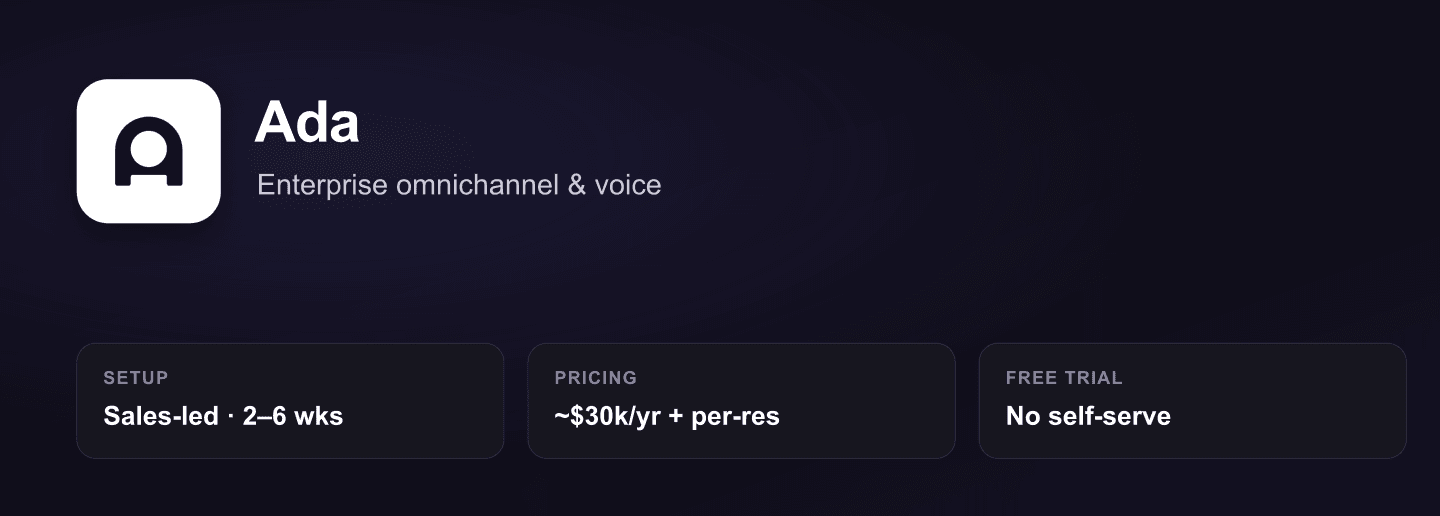
Ada has been building customer-service AI since 2016, and it's one of the most mature platforms on this list. Here are some of Ada's strengths:
- Voice is where Ada stands out. In February 2026, it launched a Unified Reasoning Engine, a mix of models with a fast "talker" for conversation and a deeper "thinker" for multi-step reasoning, and pushed its Playbooks and Coaching toward voice, the hardest and most expensive channel to automate. If voice support is included in the majority of your tickets, Ada is one of the few agents actually built for it.
- Playbooks are Ada's other standout feature. These are structured, multi-step workflows you build from a plain-language description, an uploaded SOP, or a flowchart. For predictable transactional jobs like refunds, identity checks, an address change, or replacing a lost card, they're strong, and the agent shows its reasoning step by step while an adherence checker keeps it on the rails.
Beyond those two, Ada covers the enterprise basics well. SOC 2 Type II, HIPAA, GDPR, PCI DSS, and AIUC-1 certification. Voice handles 42 languages, with wider coverage on chat and email.
The problems come down to three things: pricing, setup, and knowledge.
- Pricing. Ada doesn't share it publicly, and the rates teams report paying are high. Reported figures indicate a platform fee of around $30,000 per year, $1 to $3.50 per resolution, a median deal near $70,000 (Vendr), and six figures at enterprise scale. There's no self-serve trial, so you commit to an annual, often multi-year contract before you've watched it work on your own tickets.
- Setup. It takes real work. Plan for two to six weeks plus people to design the conversations. Ada's own research found 36% of CX leaders say their teams aren't resourced to manage, audit, and coach AI agents in the first place.
- Knowledge. Ada answers from your help center, connected sources, Playbooks, and business logic, but resolved technical tickets are not its primary answer source. How an agent finds its answers is the biggest factor in whether it fits your team, so it gets its own comparison below.
Pluno: best Ada alternative for complex B2B SaaS support on Zendesk
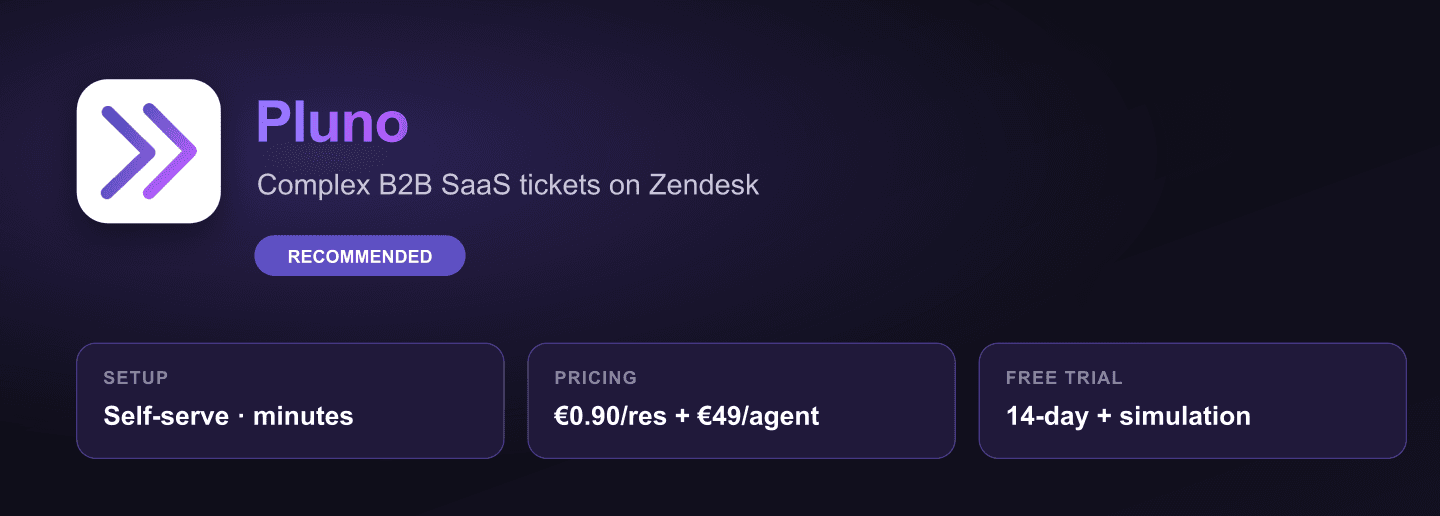
Pluno is the AI Agent for teams already running on Zendesk. It's built for Zendesk today, with Intercom on the roadmap. Where Ada and most agents start from your help center, Pluno's Deflection AI learns from your resolved tickets and uses them directly when it answers. The best fix to a messy ticket is usually buried in past tickets and is never visible inside your help center. Pluno is built to solve that.
How it answers:
- Deflection AI handles autonomous resolution and only replies when it's confident. When it isn't, it escalates and writes a summary, an evidence trail, and suggested next steps into the ticket as an internal note, so the agent picks up with context already there.
- AI Copilot is the human-in-the-loop side, drafting replies in the Zendesk sidebar from past tickets across every channel and generating diagnostic walkthroughs for technical cases. When a ticket needs deeper digging, the Troubleshooting Agent works through code, logs, Sentry, and Linear to tell whether it's a real bug, and Escalation Copilot turns it into an enriched Jira issue or Slack thread with the report written for you, then syncs updates back to Zendesk.
Setup: Installation takes a few minutes. There's a 14-day trial and a free simulation that runs Pluno against your own past tickets before you decide.
Pricing: a platform fee that scales with ticket volume, €0.90 per autonomous resolution, and AI Copilot at €49 per agent per month for the teammates you choose. Escalations are never billed. Read more on the pricing page.
Where it falls short: if you're not on Zendesk, Pluno isn't your tool yet (Intercom integration is in progress). It also isn't a voice-first platform like Ada or Sierra, so you can't use it to run voice-agent customer support.
Fin AI: best Ada alternative for high-volume, FAQ-style support
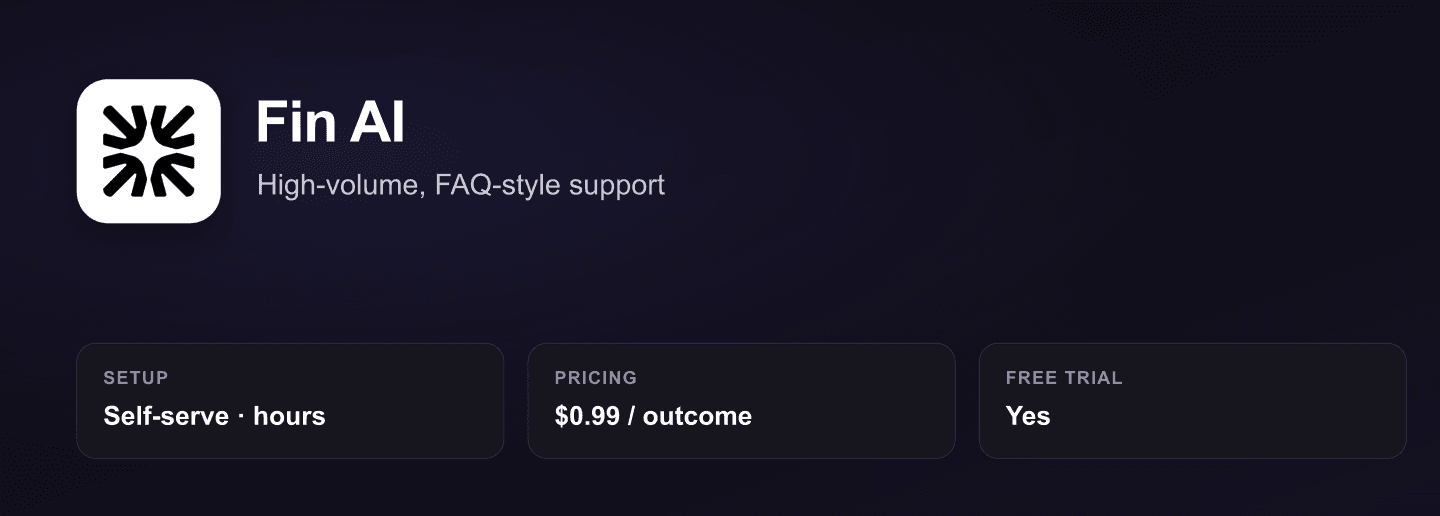
Fin is one of the most widely adopted autonomous agents on the market, and it is proven on high-volume, standard support. Intercom renamed the company to Fin in 2026. In June 2026, Salesforce signed an agreement to acquire Fin for about $3.6 billion. The deal has not closed yet, and Fin is set to fold into Salesforce's Agentforce platform. The product still runs on top of Zendesk, Salesforce, or HubSpot, or inside Intercom's own helpdesk, and it answers from your help center, saved replies, and past conversations. For buyers, the open question is whether the Zendesk connector and helpdesk-agnostic pricing survive the move to Salesforce.
How it answers: Fin generates answers grounded in your knowledge and conversation history, and handles multi-step jobs through Procedures, natural-language workflows you write and maintain. Custom Actions and data connectors let it make API calls mid-conversation.
Setup: fast, with most teams live in hours.
Pricing: $0.99 per outcome with a 50-outcome monthly minimum (about $49.50), and no setup, integration, or platform fee. Unlimited teammates are included on the any-helpdesk plan. Copilot is a separate add-on at $35 per user per month, and running Fin inside Intercom adds a paid seat from $29 per month.
Where it falls short: the real bill usually lands above the headline once outcomes and the Copilot add-on stack up. Fin counts a resolution when the customer stops replying after its last answer, and it also bills Procedure handoffs as outcomes. Conversations passed to a human without an outcome are free. Because billing is automatic, a conversation where Fin gave the final answer can still count even if the customer never returned. It is strong on help-center deflection and weaker on reasoning from how your team resolved the same issue before.
Decagon: best Ada alternative for consumer brands with a testing culture
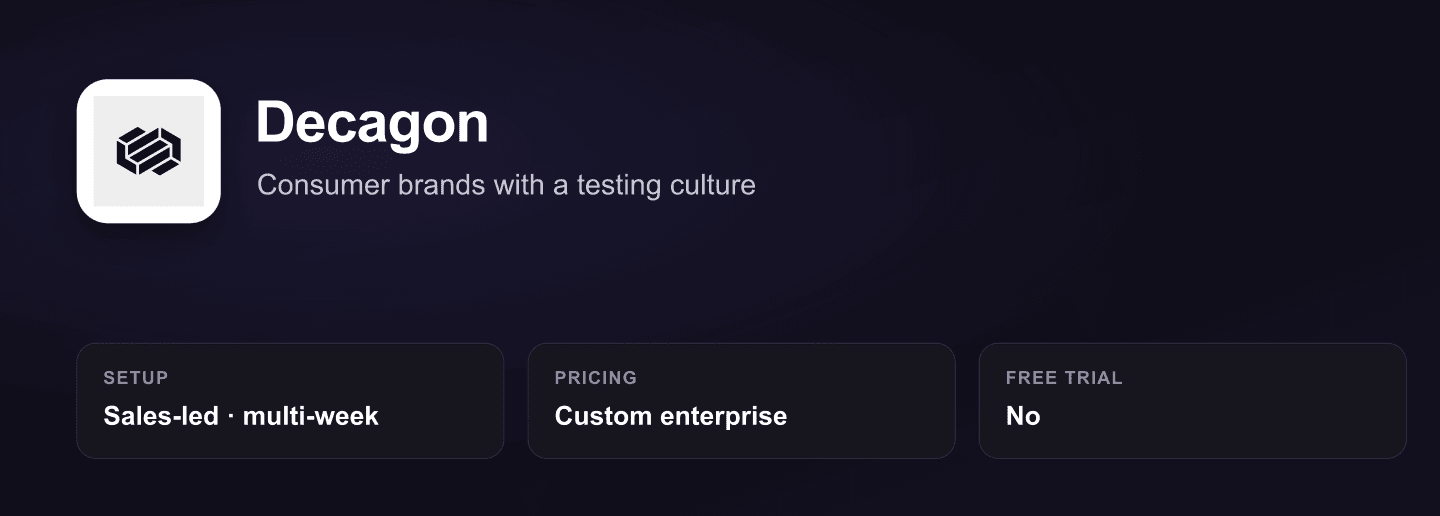
Decagon came out of stealth in mid-2024 and scaled fast, reaching a valuation of around $4.5 billion in 2026 with customers like Duolingo, Chime, Hertz, Notion, and Affirm. It's built for large consumer brands that want to build and tune their own agent, with deep experimentation tooling.
How it answers: Decagon's main feature is Agent Operating Procedures, natural-language workflows that act like SOPs for the AI. It pairs those with A/B experiments and Watchtower-quality monitoring, so teams can test and optimize the agent's behavior over time. Like Ada's Playbooks and Fin's Procedures, the workflows are written and maintained by hand, which gives you tight control and a maintenance bill that grows with your edge cases. It also has strong, low-latency voice. Its Agent Assist is reportedly Zendesk-only.
Setup: sales-led and multi-week, with no self-serve signup or free trial.
Pricing: custom enterprise pricing, not public. You will need a sales conversation to get real numbers.
Where it falls short: it's built for big consumer brands with budgets and CX operations teams. For a mid-market B2B SaaS team, it's a lot of cost and rollout for a fit that Ada already struggles to justify. Reviewers also flag some product immaturity, which is normal for a company moving this quickly.
Sierra: best Ada alternative for the largest brands that want an agent built for them
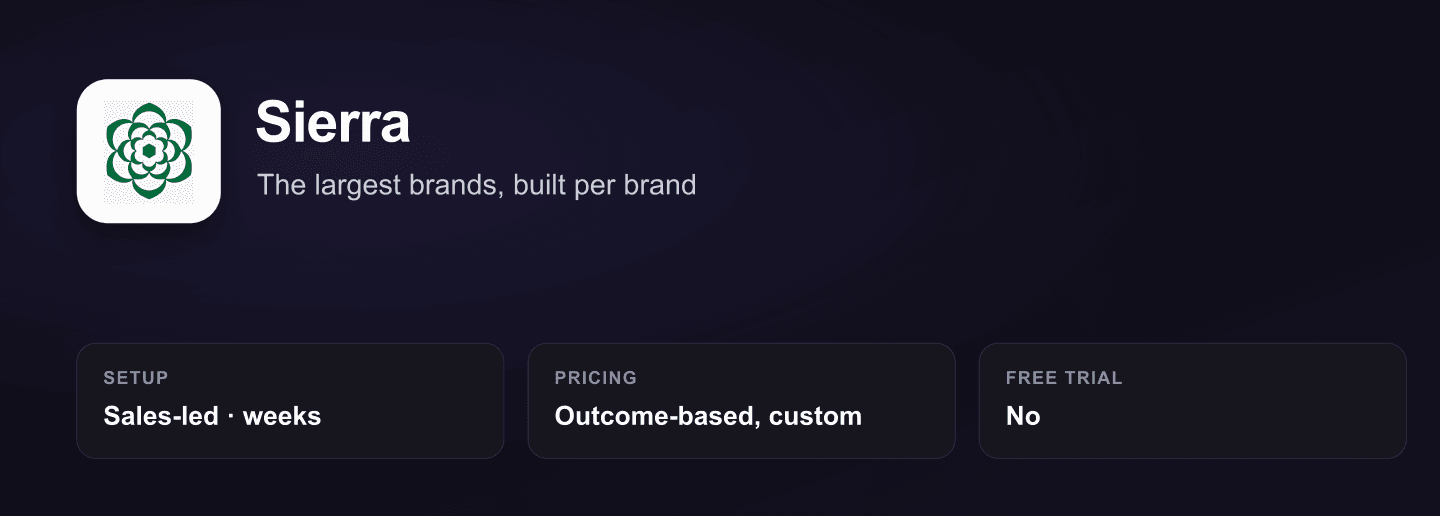
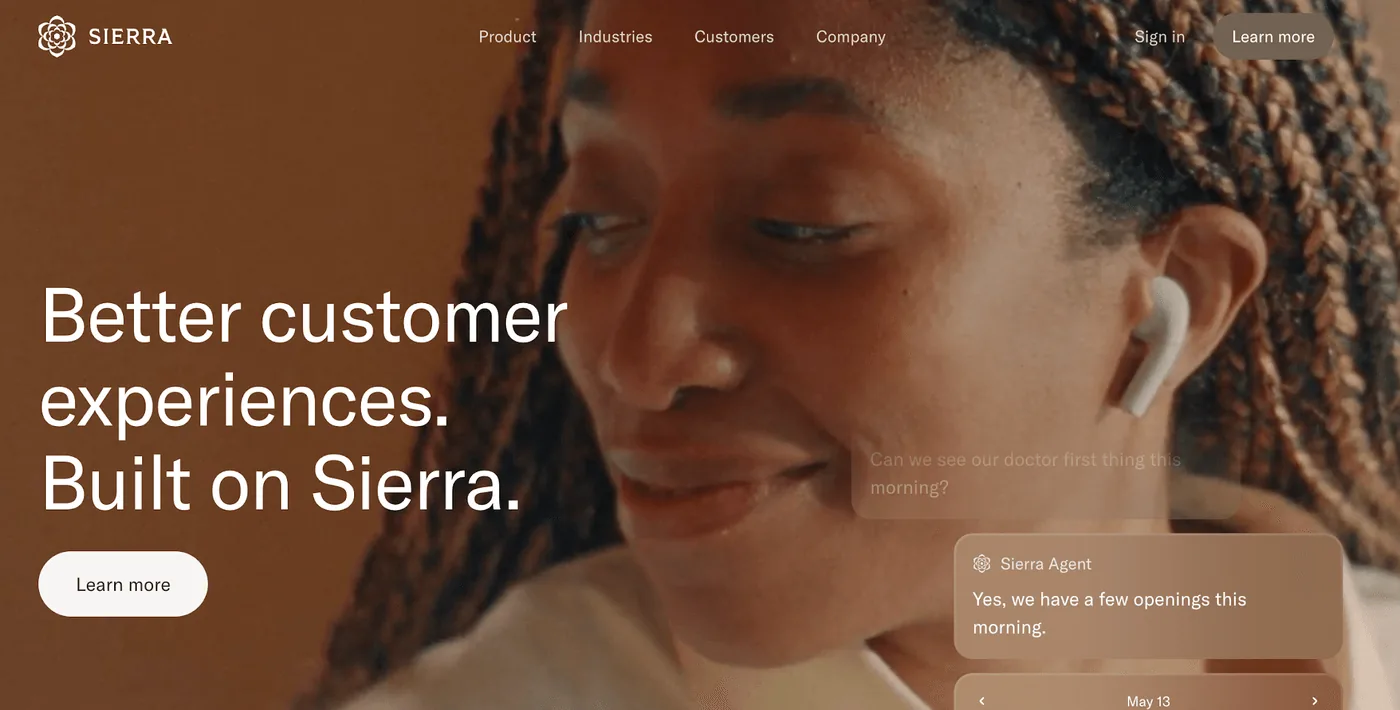
Sierra, in two years, has become one of the biggest names in enterprise AI agents, with a valuation above $15 billion in 2026, $150 million-plus in ARR, and more than 40% of the Fortune 50 as customers. Sierra's own team builds and runs a fully custom agent for you, tuned to sound like your brand, and it's aimed at the very largest enterprises.
How it answers: Sierra's Ghostwriter builds your agent from SOPs and transcripts, and an agent data platform adds memory and customer context to personalize replies. It runs across chat, voice, email, SMS, and WhatsApp, and the implementation is high-touch, with real brand and voice work.
Setup: sales-led and consultative. It's a project you staff and plan for.
Pricing: outcome-based, so you pay for the resolutions Sierra delivers, wrapped in multi-year enterprise agreements. It is the most enterprise-focused option here, and typically among the most expensive.
Where it falls short: for most teams, reading an Ada alternatives post, Sierra is the opposite direction. It's further up-market, more hands-on, and more expensive. If you're leaving Ada because it was too expensive and too heavy, Sierra is more of both. It earns its place here because plenty of large brands genuinely weigh the two.
Zendesk AI: best Ada alternative for Zendesk teams that want to stay native
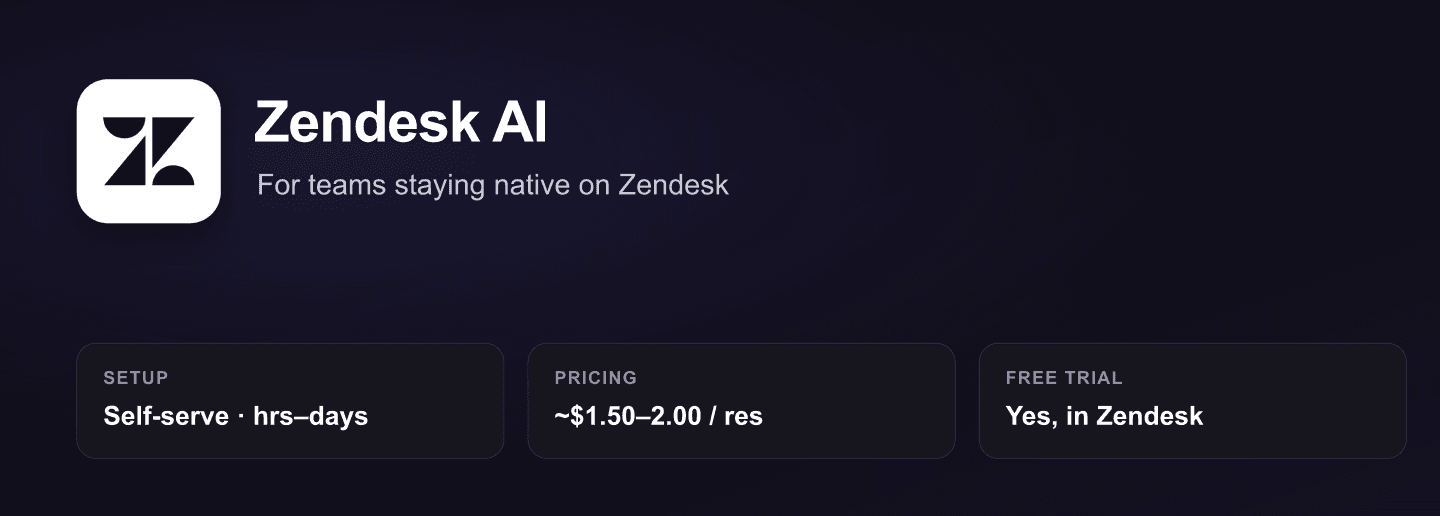
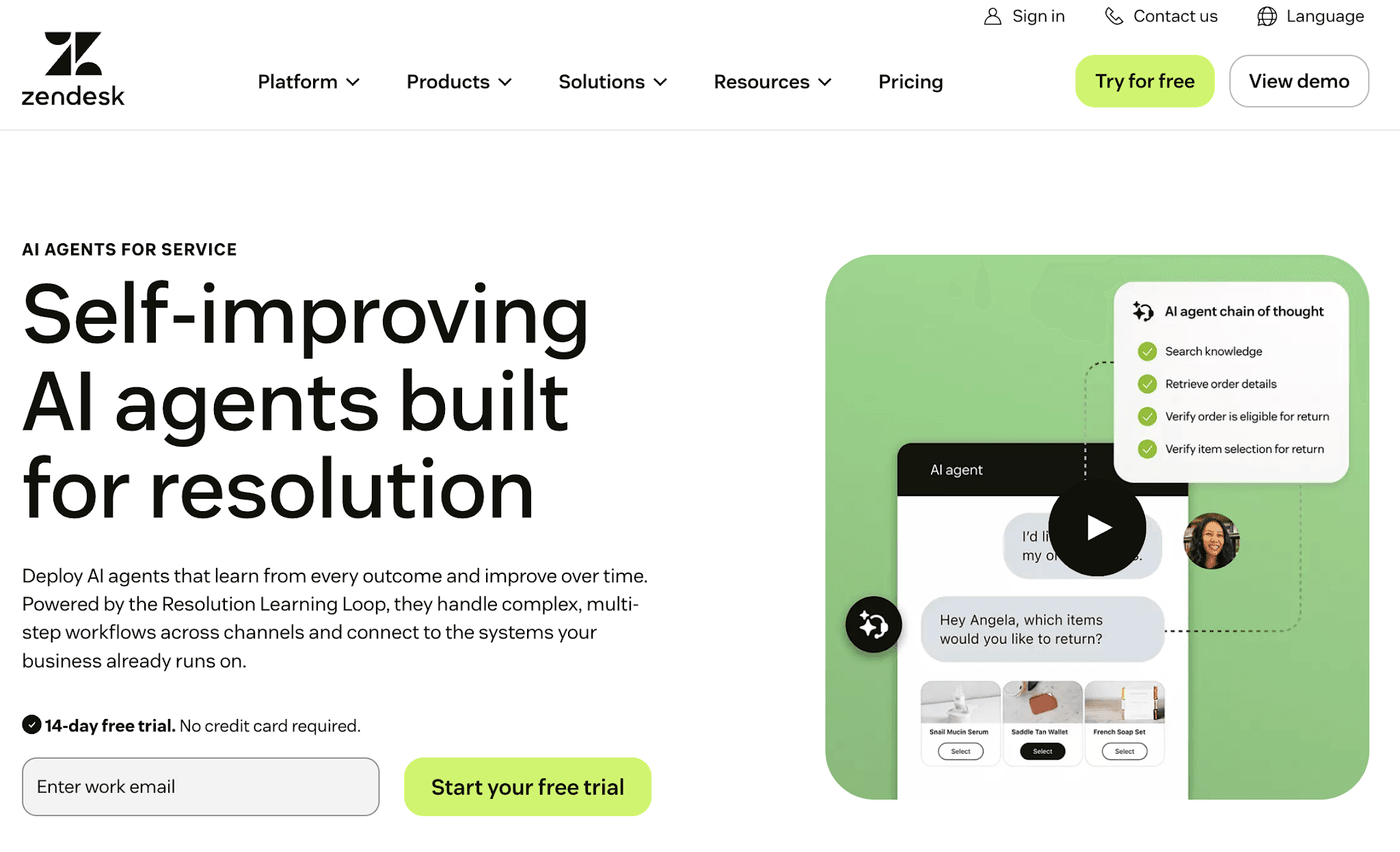
If you're already on Zendesk, the native AI is the zero-integration option (rather than using third-party Zendesk AI agents). You turn it on inside the tool you already run, with no extra vendor to add. Zendesk's acquisition of Forethought, now closed, added self-improving AI agents and stronger resolution recall to the native layer.
How it answers: Zendesk's AI Agents draw on your help center, connected knowledge sources, and ticket history, so they're strong on FAQ-style tickets and weaker on complex troubleshooting that needs engineering context, log analysis, and recall of how a past ticket was resolved. Zendesk AI Copilot assists your human agents within the Agent Workspace by drafting from the same sources.
Setup: native, so there's no integration to build. The layers are configured separately, though.
Pricing: Zendesk does not publish a flat self-serve rate. Reported rates put automated resolutions at $1.50 each for committed volume or $2.00 pay-as-you-go, with Copilot around $50 per agent per month and Advanced AI sales-led and custom-priced. The layers are priced separately, so going all-in compounds. A 25-agent team turning on Copilot and Advanced AI can clear $6,000 a month over the base Suite plan.
Where it falls short: the native AI can pull in external knowledge through Confluence, web crawlers, and its Federated Search API, but it is not built to investigate engineering systems like logs and Sentry, recall the exact past-ticket fix, or run the troubleshoot-then-escalate workflow that complex B2B tickets need.
Eesel AI: best Ada alternative for a low-cost agent across your whole tool stack
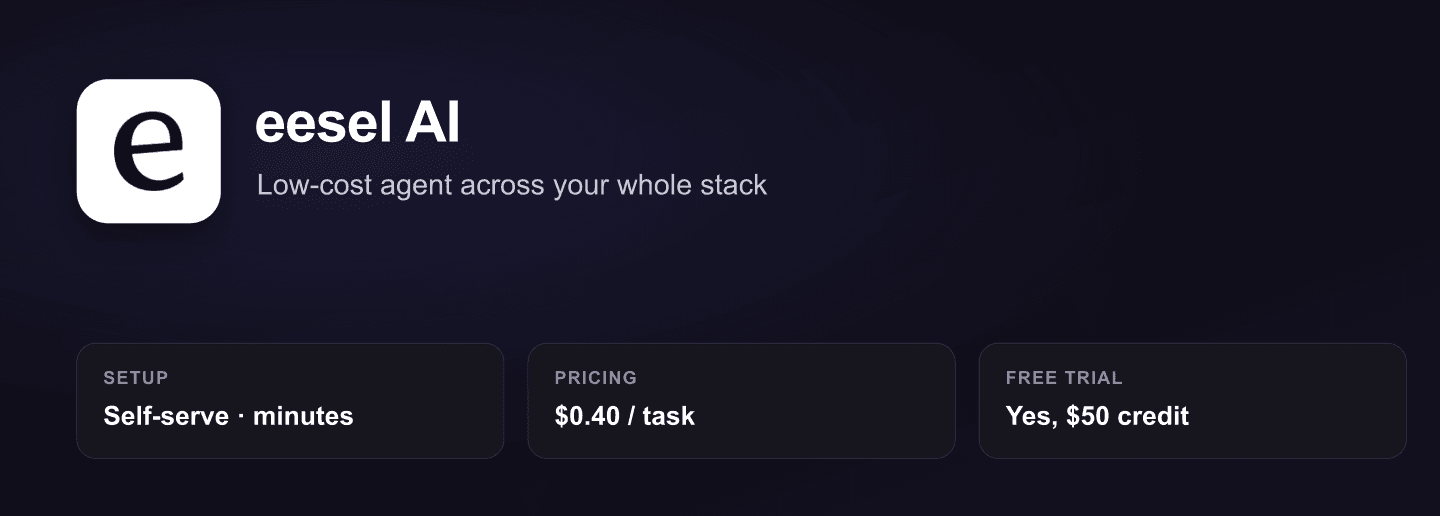
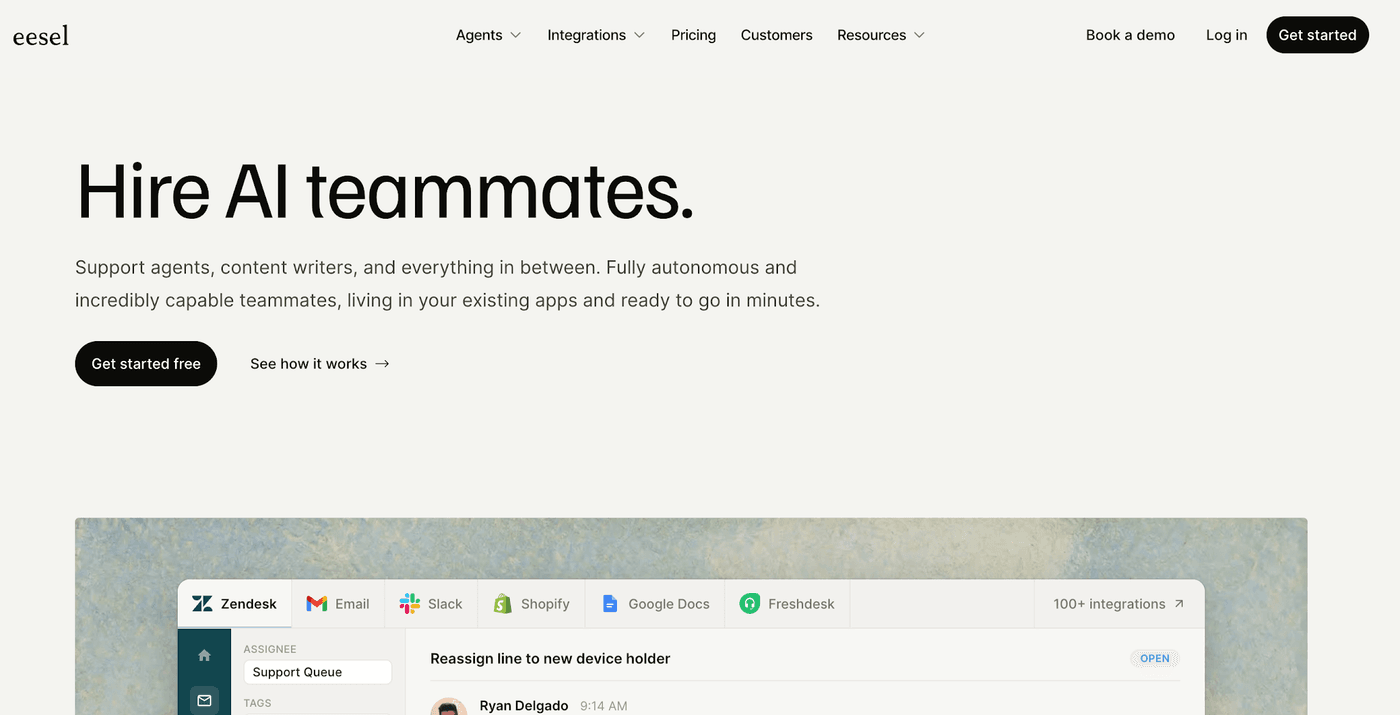
Eesel is the lightweight, low-cost option that plugs into the tools you already use. It publishes its pricing, sets up without a sales call, and connects across Zendesk, Slack, Notion, Confluence, Google Docs, Shopify, and 100-plus other apps.
How it answers: eesel ingests broadly from your connected tools and learns from past tickets among many sources, then drafts and sends replies, escalating when needed. Non-technical teams coach it from a dashboard.
Setup: self-serve and quick.
Pricing: task-based at $0.40 per helpdesk task on the self-serve plan, with no per-seat fee and no monthly minimum, plus $50 in free trial credits. The Enterprise tier adds a flat $1,000 per month platform fee.
Where it falls short: it's a generalist. If your support is mostly common questions across a few tools, that's a strength. If your hardest tickets need cross-system diagnosis and a clean handoff to engineering, a specialist will go deeper.
The bottom line: what's the best Ada alternative for you?
No single tool wins this outright. One question settles most of it: where do the answers to your hardest tickets live?
If they live in a maintained help center and your volume is consumer or e-commerce, a help-center-first agent covers you, and Fin, eesel, or Ada itself will do the job. If you are an enterprise brand that wants a custom-built agent and has the team and budget to tune it, Sierra and Decagon are built for that. If you want the native Zendesk layer with no extra vendor, Zendesk's own AI is the zero-integration choice, strongest on FAQ-style tickets and grounded in your help center and connected sources.
If the answers live in past tickets, Slack, Jira, logs, and Sentry, a help-center-first agent will keep escalating the tickets that matter most. Pluno is built for that case. It learns from your resolved tickets, answers when it is sure, and hands off with full context when it is not. For a B2B SaaS team on Zendesk with complex, technical tickets, Pluno resolves the cases a help-center-first agent escalates.
FAQ
What does Ada cost? Ada doesn't publish pricing. Reported figures point to a platform fee from around $30,000 a year plus $1 to $3.50 per resolution, with a median deal near $70,000 and six figures at enterprise scale. There's no self-serve trial, so you'll confirm the real number in a sales conversation.
Does Ada learn from past support tickets? Not as a primary answer source. Ada answers from help-center content and the structured knowledge you connect, and it analyzes failed conversations to flag content gaps. If your team's best answers are sitting in old tickets your help center never captured, that's a real limitation, and it's the main reason B2B SaaS teams look elsewhere.
What's the best Ada alternative for a Zendesk team? It depends on your tickets. For FAQ-style consumer volume, Zendesk's native AI or Fin do the job. For complex technical tickets that need cross-system context, Pluno is built for Zendesk and learns from your resolved tickets directly.
Is there an Ada alternative with transparent pricing and no contract? Yes. Fin publishes $0.99 per outcome, eesel publishes task-based pricing, and Zendesk's native AI is self-serve. Ada, Decagon, and Sierra are all sales-gated.