AI agents now handle a growing share of customer support work, and for most teams in 2026, the question is which one to use. The options differ in how they work, what they cost, and which teams they suit, and those differences are hard to see from a product page. The goal here is to make them clear.
This guide compares seven AI support agents we selected for this review: Pluno, Fin by Intercom, Decagon, Sierra AI, Ada, Zendesk AI, and Salesforce Agentforce. For each one, we cover who it is built for, how it learns, what it costs, and where it falls short.
We based the review on vendor documentation, public pricing pages, G2 and Capterra ratings, and practitioner discussions on Reddit. Pricing models are hard to compare head-to-head, so read the numbers as a starting point and confirm them in your own quote.
By the end, you should know which agent fits your team, how each one bills, and how much of your ticket volume it can take off your agents' plate. You will also be able to forecast your likely cost before a sales call and compare these tools on the same terms.
TL;DR: Which AI support agent fits your team
-
If your tickets are complex and technical and you run support on Zendesk or Intercom, look at Pluno. It learns from your resolved support tickets, so it handles issues the help center never documented.
-
If you run high-volume conversational support across chat, email, and social, Fin by Intercom is one of the most widely adopted agents for this use case.
-
For large enterprises that need chat, voice, and email on a single platform, Decagon and Sierra AI are the two most talked-about options, both sold on custom enterprise contracts.
-
If you want an established automation platform with strong voice support, look at Ada.
-
If you are already on Zendesk and want the built-in option, Zendesk AI is the native baseline.
-
If your team runs on Salesforce Service Cloud, Salesforce Agentforce is the native fit.
These vendors also bill differently, and that affects your total more than any single feature. Some charge per resolution, some per outcome, some per conversation, and some by custom enterprise contract. Those units are not the same, so a low per-unit price does not always mean a lower total.
What is an AI agent for customer support?
An AI agent for customer support is software that uses large language models to understand a customer's issue and either resolve it end to end or route it to a human with context. It connects to your helpdesk, your knowledge sources, and often your CRM, then works across channels like chat, email, and voice.
The useful distinction is between deflection and resolution. Deflection handles documented, repetitive questions, the ones already answered in your help center. Resolution handles tickets where the answer depends on account context, past tickets, engineering systems, logs, or live API data. Plenty of agents handle deflection well, and fewer handle resolution.
What separates them is where they look for answers. Some agents learn from help-center content. Some follow workflows and procedures a person builds and maintains by hand. A few learn from resolved support tickets, which is what lets them handle edge cases the documentation never captured. That difference decides how many of your complex tickets an agent can close.
The 7 best AI agents for customer support in 2026 - side-by-side comparison
| Tool | Best fit | Main knowledge source/approach | Pricing model | Works inside |
|---|---|---|---|---|
| Pluno | Complex, technical B2B SaaS support | Resolved support tickets, plus connected systems | Per resolution + custom platform fee | Zendesk, Intercom |
| Fin by Intercom | High-volume conversational support | Content recommendations from past conversations + built Procedures | From $0.99 per outcome | Intercom + other helpdesks |
| Decagon | Enterprise multi-channel automation | Agent Operating Procedures (natural-language workflows) | Custom enterprise | Standalone platform |
| Sierra AI | Fortune 500 conversational CX | Configured agents with brand guardrails | Custom, outcome-based | Standalone platform |
| Ada | Enterprise automation with voice | Reasoning Engine over SOPs, Playbooks, APIs | Custom, sales-led | Standalone platform |
| Zendesk AI | Teams already on Zendesk | Help center + external knowledge sources | Reported per resolution | Zendesk (native) |
| Salesforce Agentforce | Salesforce Service Cloud teams | Salesforce data + configured actions | $2 per conversation or Flex Credits | Salesforce (native) |
Prices vary by region, billing term, usage, and plan packaging. The figures here are a starting point, and vendors define resolution, outcome, and conversation differently, so confirm the numbers in your own quote.
1. Pluno: best for complex, technical B2B support
Best fit: B2B SaaS teams with technical products where tickets need real troubleshooting.
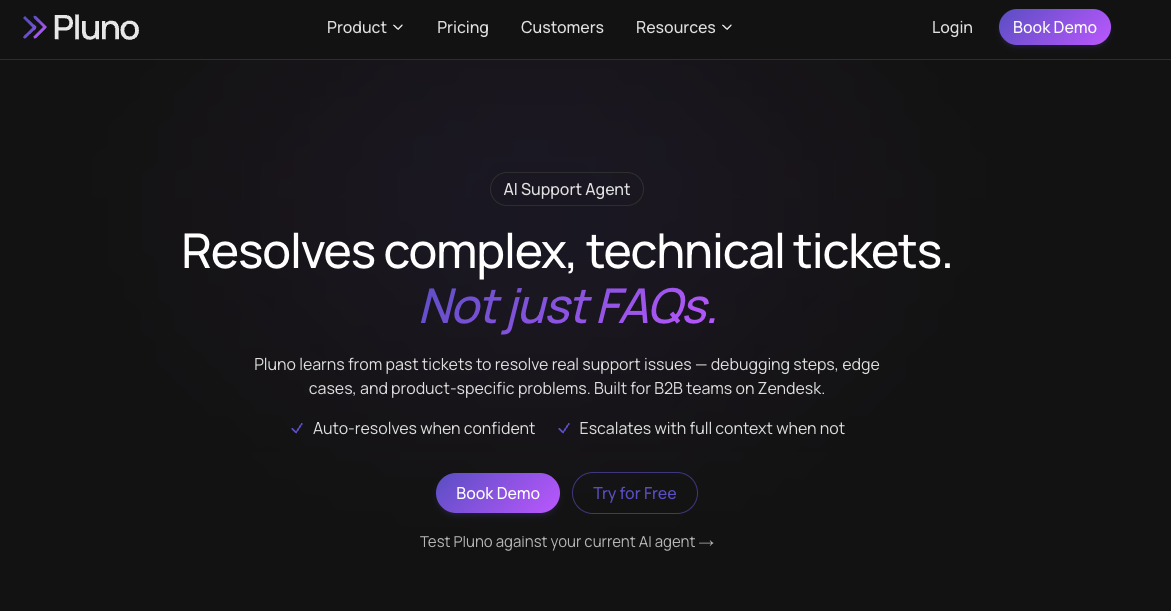
Pluno is an AI support agent for complex technical tickets that works inside Zendesk and Intercom. It learns from your resolved support tickets, which is what lets it handle issues the help center never documented. In B2B SaaS the product changes faster than the docs, so the knowledge needed to fix a hard ticket usually lives in past resolutions and connected systems instead of a help article.
That learning model is the difference. Most agents answer from documentation. Pluno ingests resolved support tickets to learn the troubleshooting steps, diagnostic questions, and edge-case fixes your team already worked out, then applies them to new tickets. When it has enough evidence, its Deflection AI resolves the ticket. When it does not, it escalates to a human with the full diagnostic context attached.
Key modules:
-
Deflection AI resolves tickets autonomously on email, web widget, WhatsApp, social, and Zendesk Messaging, using resolved tickets, help center, uploaded files, and custom API integrations.
-
AI Copilot drafts on-brand replies and diagnostic walkthroughs inside the agent sidebar. Drafts are agent-reviewed before sending, so Copilot carries lower customer-facing risk than autonomous replies.
-
Escalation Copilot syncs tickets two-way with Jira, Slack, and Linear so support and engineering stay in step.
-
Troubleshooting Agent investigates across code, logs, Sentry, Linear, and databases when a ticket needs engineering-level diagnosis.
Pricing is usage-based. Deflection AI is EUR 0.90 (about $0.98) per resolution, AI Copilot is EUR 49 (about $53) per agent per month, and the platform fee is custom based on your average ticket volume. You can run a free simulation on your last 50 real tickets to see Pluno's answer next to your current AI's answer before you commit.
Where Pluno falls short?
It works in Zendesk and Intercom today, so teams on Salesforce, HubSpot, or Freshdesk are not yet served. It is built for complex, technical support, so a team handling mostly simple FAQ tickets pays for depth it may not need.
2. Fin by Intercom: best for high-volume conversational support
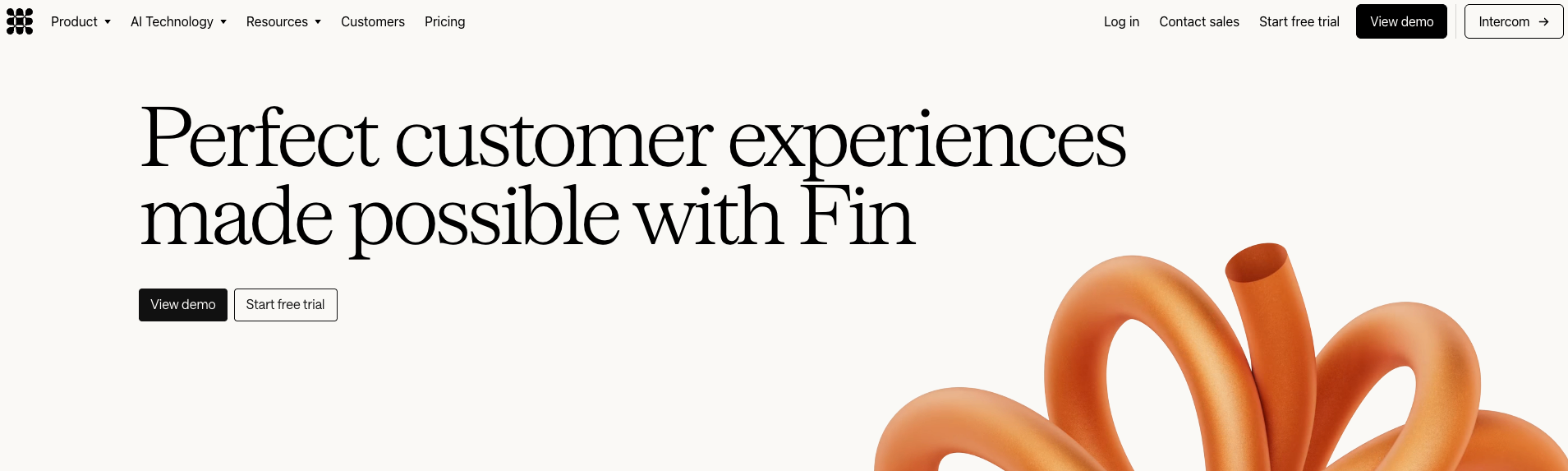
Best fit: teams running high-volume support across chat, email, SMS, and WhatsApp.
Fin AI is Intercom's AI agent and one of the most widely adopted agents in the market.
Its strength is breadth. It covers many channels, integrates with several help desks, including Zendesk and Salesforce, and can take actions via its Custom Actions feature. Its Procedures feature lets you define multi-step workflows in plain language. Fin learns from content recommendations drawn from past conversations and your help content.
Fin bills from $0.99 per outcome, with a 50-outcome monthly minimum on an existing helpdesk. Fin Copilot runs about $29 per user per month (verify), and Fin Voice is sales-gated.
Where Fin falls short?
Procedures and Custom Actions are powerful, but you build and maintain them by hand. For a B2B SaaS product with a long tail of edge cases, that upkeep grows over time and someone owns the ongoing cost.
3. Decagon: best for enterprise multi-channel automation
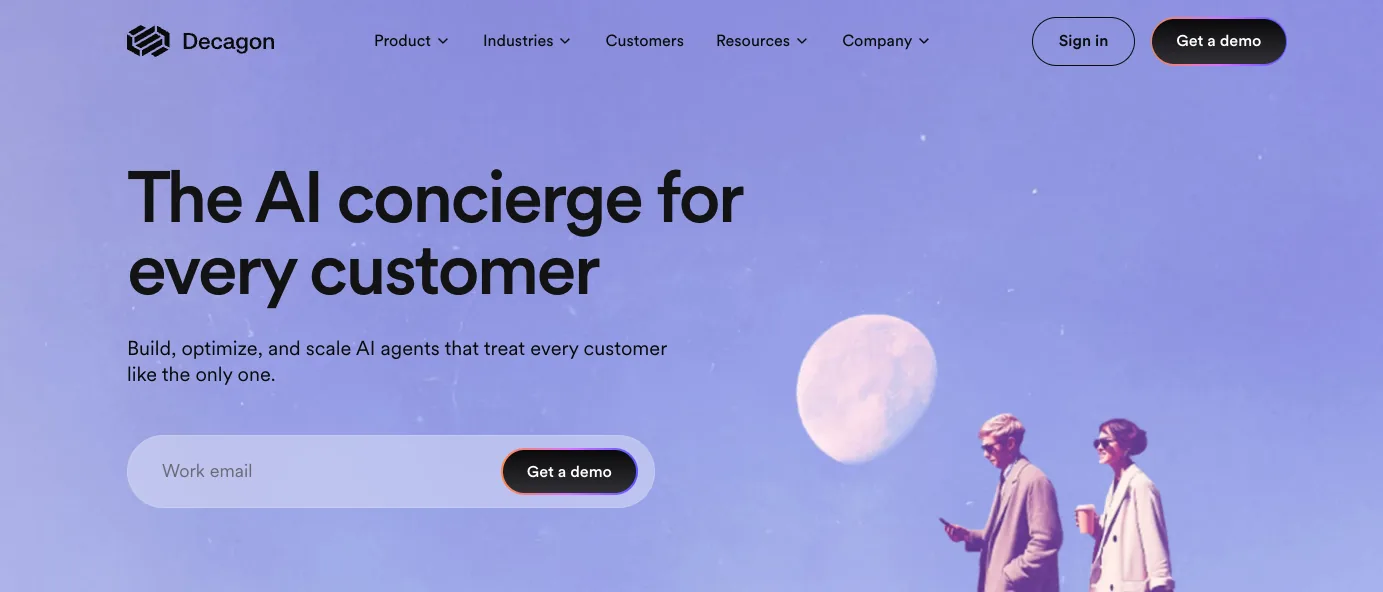
Best fit: large enterprises automating support across chat, voice, email, and SMS.
Decagon is an enterprise AI support platform that automates conversations across channels using Agent Operating Procedures, which are workflow definitions written in natural language. Its Voice 2.0 handles inbound and outbound calls with low latency, and the platform includes A/B testing and QA simulation tools. Decagon's customer list includes Notion, Rippling, Duolingo, and Chime, which signals strong enterprise adoption.
Decagon does not publish pricing. Third-party analyses describe a platform fee in the range of $50,000 per year before usage, with per-conversation and per-resolution options and total contracts that run well into six figures. Treat those as estimates and confirm in a quote.
Where Decagon falls short?
It is built for enterprise scale, so it is likely overkill for a small or mid-market team. There is no public pricing or self-serve path, so evaluation goes through sales. And while natural-language procedures are easier to write than decision trees, an enterprise deployment still takes setup and onboarding.
4. Sierra AI: best for Fortune 500 conversational CX\

Best fit: large enterprises that want branded, outcome-priced conversational agents.
Sierra is an enterprise AI agent platform co-founded by Bret Taylor, former co-CEO of Salesforce, and Clay Bavor. It builds branded customer-facing agents with strong guardrails, and it has grown quickly, reaching around $150 million in ARR and a $15.8 billion valuation in 2026 with more than 40% of the Fortune 50 as customers.
Sierra prices on outcomes. There is no public pricing page. Third-party estimates put contracts in the range of $150,000 to $350,000 or more per year, with some interactions billed per conversation and others per resolved outcome. The exact definition of an outcome varies by contract, so read the terms.
Where Sierra falls short?
The enterprise positioning and sales-led pricing put it out of reach for most SMB and mid-market teams. It is also a newer platform than some incumbents, and the blended billing model means you should model your likely mix of conversations and outcomes before signing.
5. Ada: best for enterprise automation with voice
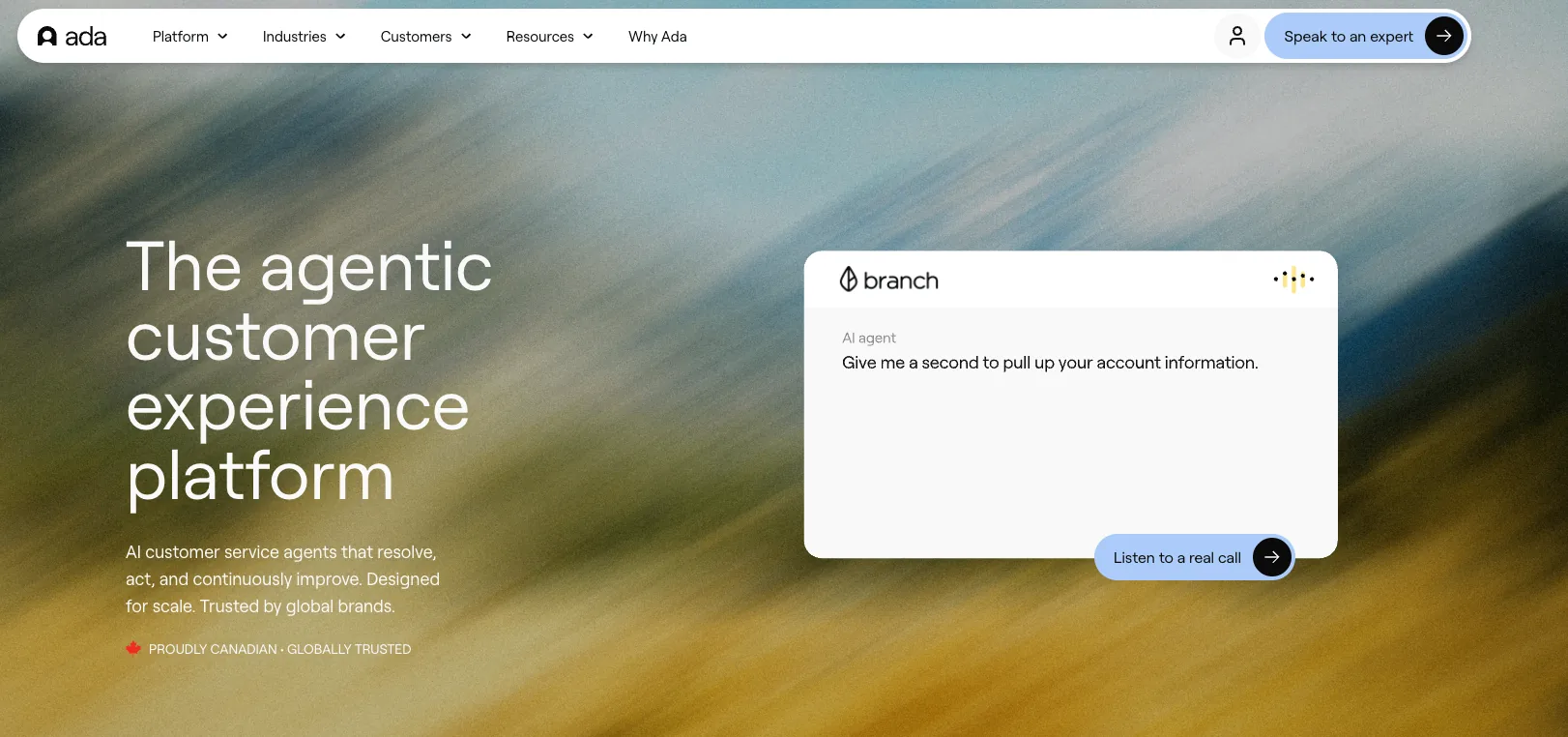
Best fit: enterprise teams automating high volume across web, mobile, social, and voice.
Ada is an established automation platform whose Reasoning Engine decides, per conversation, whether to answer from knowledge, take an action through an API, or escalate to a human. Its no-code Playbooks let non-technical teams build multi-step workflows, and voice is a core channel. Ada Glass is its handoff and agent-assist layer.
Ada draws on SOPs, Playbooks, APIs, customer context, and business logic beyond help-center content alone. Its pricing is unpublished and sales-led, and third-party estimates describe per-resolution or per-conversation billing that lands in the tens of thousands per year. Confirm in a quote.
Where Ada falls short?
Results depend heavily on the quality of the knowledge and workflows you feed it and on the coaching time you put in. Its answer model is not centered on resolved technical tickets, so for deeply technical B2B support you should test how it handles your hardest historical cases. Pricing is not public.
6. Zendesk AI: the native baseline for Zendesk teams
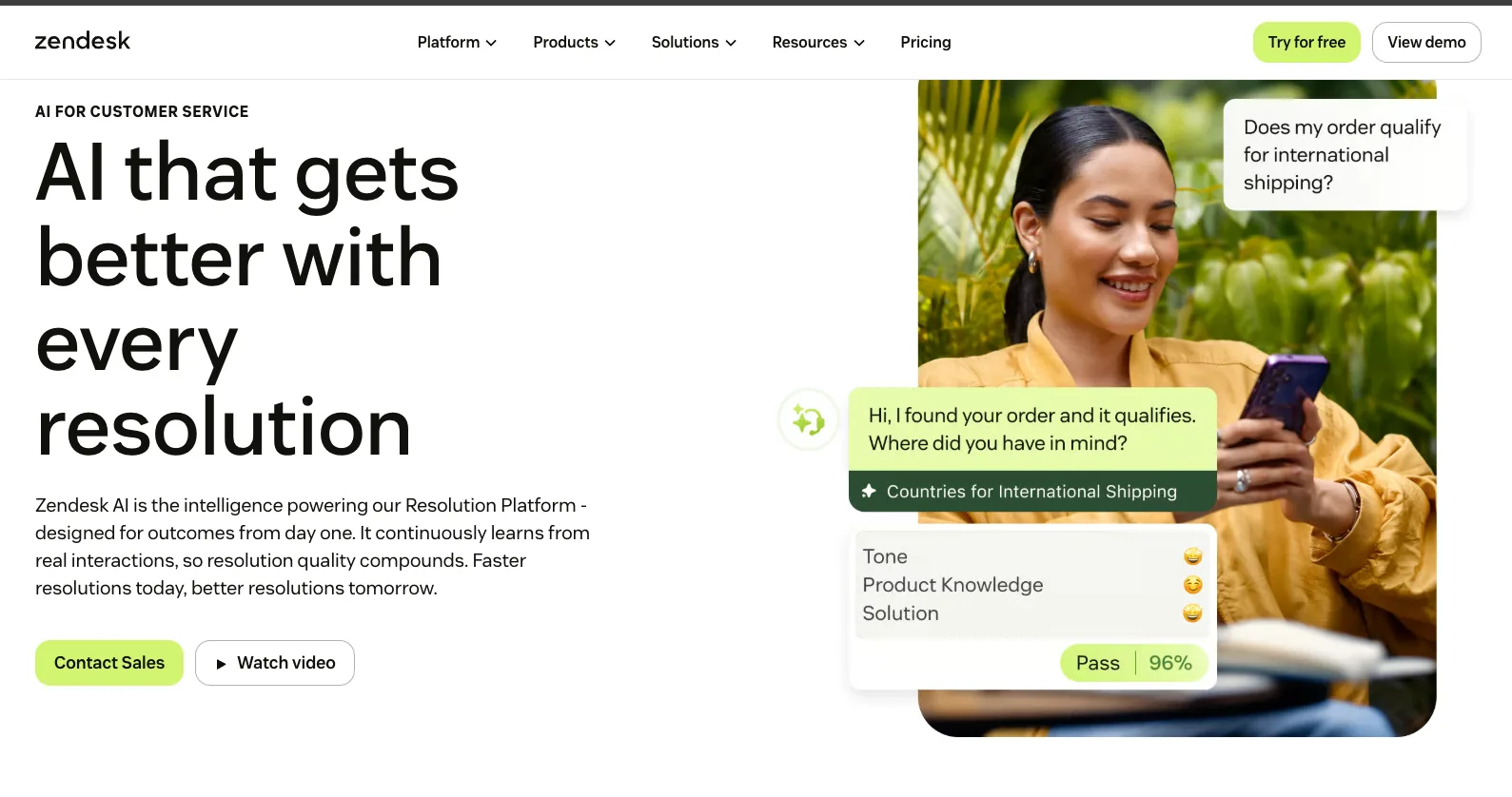
Best fit: teams already on Zendesk that want the built-in option.
Zendesk AI is the native AI layer inside Zendesk. Its AI Agents handle autonomous FAQ deflection, Agent Copilot assists human agents, and Intelligent Triage classifies intent, sentiment, and language and fills configurable fields. Zendesk AI connects to external knowledge sources, including Guru, Confluence, Google Drive, SharePoint, and Notion, and its Resolution Platform adds prebuilt connectors for Jira, Slack, and Salesforce. Zendesk also closed its Forethought acquisition, which adds more agent capabilities to the native stack.
Reported per-resolution pricing is $1.50 committed and $2.00 pay-as-you-go, with Agent Copilot around $50 per agent per month and Suite Enterprise sold through sales. Those resolution rates are reported figures instead of public seat-page pricing, so confirm them. Note that Relate 2026 removed the Essential and Advanced AI Agent split, and AI Agents Essential reaches end of life on December 10, 2026.
Where Zendesk AI falls short?
It handles documented, repetitive answers well, but it is less suited to tickets that need memory of resolved tickets, engineering context, logs, and cross-system escalation workflow. Because its AI Agents lean on help center and connected knowledge sources, the hardest technical tickets, where the answer was worked out in a past resolution, are where it more often escalates.
7. Salesforce Agentforce: best for Salesforce Service Cloud teams
Best fit: teams standardized on Salesforce Service Cloud and Data Cloud.
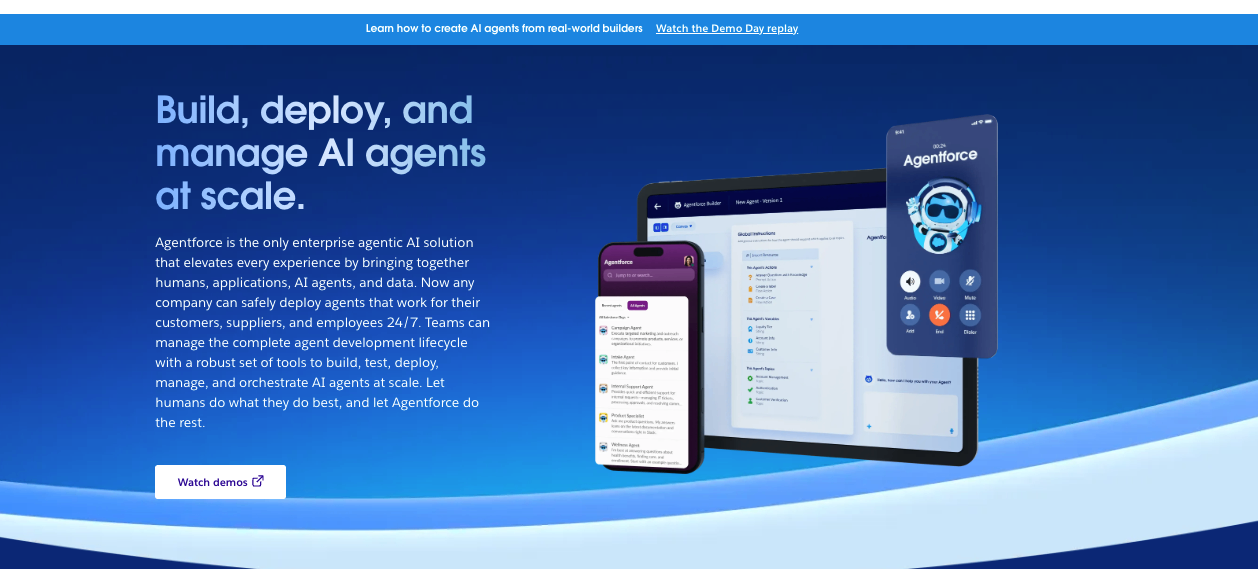
Agentforce is Salesforce's native AI agent layer. It builds customer-facing and employee-facing agents, includes Agentforce Voice, and takes actions through Salesforce flows with deep access to Salesforce data. For teams already running on Service Cloud, that native data access is the main draw.
Agentforce offers two pricing models. Conversations bills about $2 per conversation, where a conversation is a 24-hour session. Flex Credits sells at $500 per 100,000 credits, and each agent action costs about $0.10, so a typical support conversation of 8 to 15 actions works out to roughly $0.80 to $1.50. The two models cannot run in the same Salesforce org. A common hidden cost is Data Cloud, whose entry tier starts around $60,000 per year and often grows from there.
Where Agentforce falls short?
The value depends on being committed to the Salesforce ecosystem. The Data Cloud dependency adds real cost, and the choice between Conversations and Flex Credits adds pricing complexity. With Salesforce's pending Fin acquisition, it will soon own two AI agents, which is worth watching if you are betting on one roadmap.
How to choose the right AI support agent for your team
Start with ticket complexity and where your knowledge lives, because that decides more than any feature list.
-
If most of your tickets are simple, documented FAQs, the native option Zendesk AI (if your helpdesk software is already there) or a broad conversational agent (Fin) will clear the volume without extra spend.
-
If your tickets are complex, technical, and account-specific, and you run support on Zendesk or Intercom, choose an AI layer that learns from resolved support tickets, which is what Pluno is built for.
-
If you are a large enterprise that needs chat, voice, and email on a single platform, evaluate Decagon, Sierra, and Ada.
-
If your team runs on Salesforce Service Cloud, Agentforce is the native fit.
Frequently asked questions
What is the best AI agent for customer service? There is no single best. It depends on ticket complexity and your stack. For complex, technical B2B support on Zendesk or Intercom, an agent that learns from resolved support tickets like Pluno fits well. For high-volume conversational support, Fin is a common choice, and for enterprise multi-channel needs, Decagon, Sierra, and Ada are the main contenders.
Can AI agents resolve complex support tickets, or only FAQs? Deflection-focused agents handle documented, repetitive questions well. Resolving complex tickets requires an agent who draws on resolved support tickets, account context, and connected engineering systems, and escalates with full context when not confident. Test any tool on your hardest historical tickets to see which side of that line it falls on.
How much do AI customer support agents cost in 2026? Billing varies by model. Fin bills from $0.99 per outcome, Agentforce about $2 per conversation, and Zendesk AI a reported $1.50 to $2.00 per resolution. Decagon, Sierra, and Ada use custom enterprise pricing. Pluno's Deflection AI is EUR 0.90 per resolution with a custom platform fee. These units are defined differently, so confirm totals in your own quote.
Which AI agent is safest for customer service? Look for an agent that answers only when it has enough evidence, escalates to a human when confidence is low, and cross-checks its sources before replying. Pluno, for example, resolves autonomously when confident and escalates with full context when not, which reduces the risk of a wrong answer reaching a customer.
Do I need to switch helpdesks to use an AI support agent? Not always. Some agents work inside your existing stack, so Pluno works inside Zendesk and Intercom and Fin connects to several helpdesks. Others are native to one platform, like Zendesk AI or Agentforce. If avoiding a migration matters, confirm the integration before you buy.