Fin and Pluno look like the same product on paper. Both autonomous resolution, both copilot, both Zendesk integration, both usage-priced.
It's genuinely hard to figure out which one is the right fit for your team, so we wrote this to answer one question: Fin AI or Pluno for AI customer support on Zendesk?
This guide walks you through the differences between the two tools in how they learn from the past tickets, copilot scope, engineering escalations, pricing behavior at different volumes, and more.
Read on to see which AI support software is the best addition to your Zendesk operations.
TL;DR: When to pick each
- Pick Fin if you run consumer or transactional support. Ecommerce, fintech, marketplaces, gaming, and similar businesses where tickets cluster around common inquiries and a maintained knowledge base covers most of the volume. It's also the stronger choice when the AI needs to execute multi-step transactional workflows (refunds, account changes, order status checks) inside the conversation itself.
- Pick Pluno if you run B2B SaaS or technical support. Companies where tickets require diagnostic reasoning, context from past resolved tickets, lookups in Slack and Jira, calls to internal APIs, and clean handoffs to engineering when the AI cannot finish the job. Pluno was built for support teams whose real resolution knowledge lives in past tickets and engineering systems, not just in the help center.
Pluno vs Fin AI: Knowledge sources and Zendesk integration
Both products ingest your Zendesk help center, your past tickets, and any additional knowledge sources you connect. Both also operate across your Zendesk channels (email, Messaging, mobile, social). The past-ticket mechanic is where the two products diverge most. Help center ingestion and channel coverage are about even.
Help center and knowledge base
Both products ingest Zendesk Guide content. Fin syncs articles into the Fin workspace, and Zendesk metadata (labels, categories, tags) is converted into Fin tags so you can filter and scope which articles Fin uses for which customer segments. Pluno automatically scrapes the help center and refreshes it on a regular schedule, with manual retraining available from the dashboard.
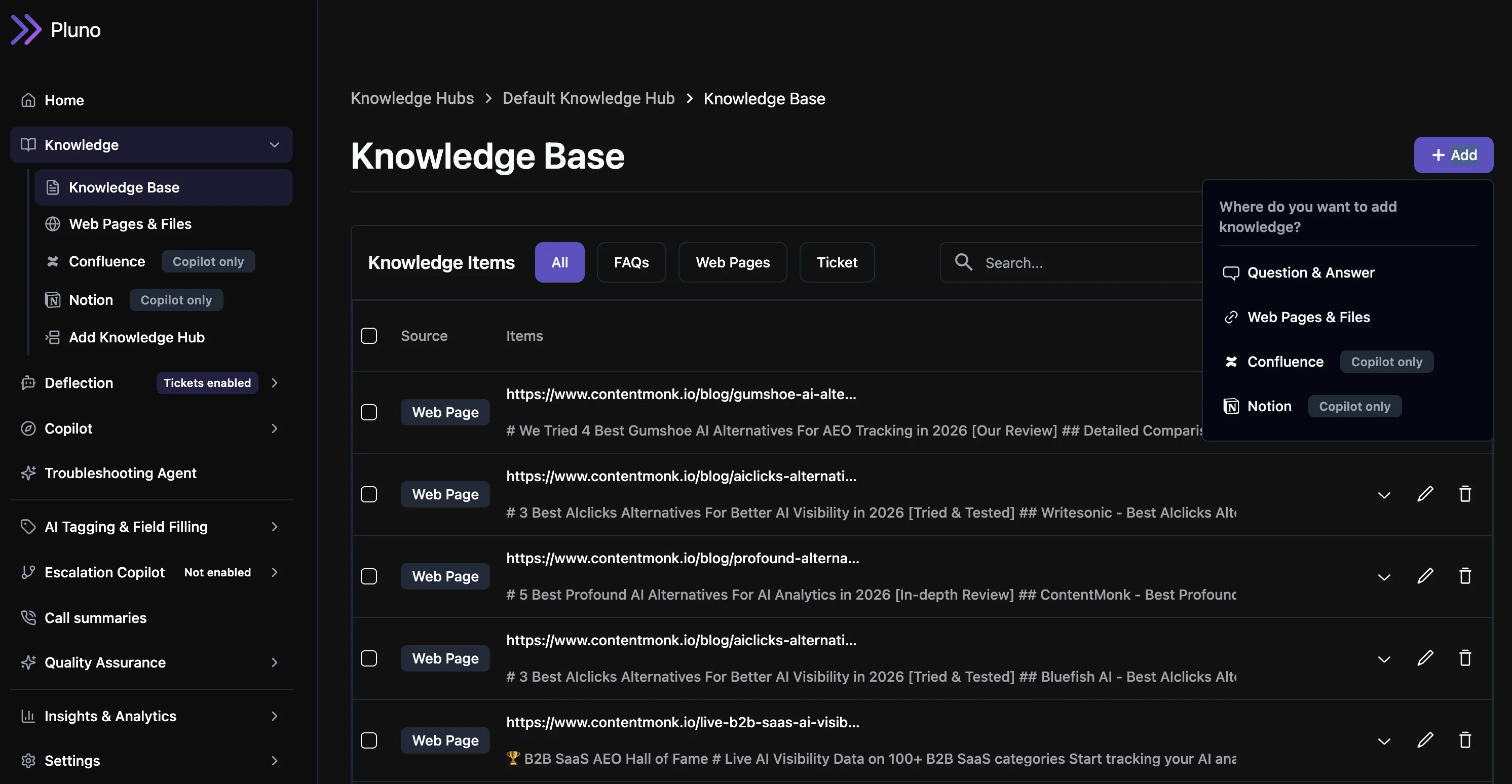
Both support internal-only Guide articles when toggled on. Both accept PDFs, URLs, and document uploads as additional sources. Both connect to Confluence or Notion as a native source, where you select specific pages or sync the full workspace. Fin Copilot also adds native connectors for Guru.
| Knowledge source | Pluno | Fin |
|---|---|---|
| Zendesk Guide articles (public and internal) | ✓ Auto-scrape with regular refresh and manual retrain | ✓ Synced, with Zendesk metadata mapped to Fin tags |
| Uploaded documents (PDFs, URLs, snippets) | ✓ | ✓ |
| Notion | ✓ Native, with page-level selection | ✓ Native (Fin Copilot) |
| Confluence | ✓ | ✓ |
| Guru | ✗ | ✓ Native (Fin Copilot) |
| Salesforce content | ✗ | ✓ Native (Fin Copilot) |
| Slack threads | ✓ | ✗ |
| Jira issues | ✓ | ✗ |
| Connected APIs (live data lookups) | ✓ | ✓ |
| Sentry (error tracking) | ✓ | ✗ Custom Data Connector only |
| DataDog (observability) | ✓ | ✗ Custom Data Connector only |
| Past tickets in autonomous answers | Direct, used in the answer pipeline | Indirect, via the KB-improvement suggestion pipeline |
Past tickets - the biggest difference between Pluno and Fin AI
The bottom line: Fin treats past tickets as feedback for your knowledge base. Pluno treats past tickets as primary evidence to the answer itself.
Per Intercom's help center article on syncing ticket history, dated March 6, 2026:
Fin AI Agent is currently designed to use your knowledge base as its source of truth for answering questions. However, it can learn from historical conversations through AI-powered suggestions. These suggestions help improve Fin's performance by identifying unresolved conversations, comparing them to human replies, and highlighting what needs to be fixed.
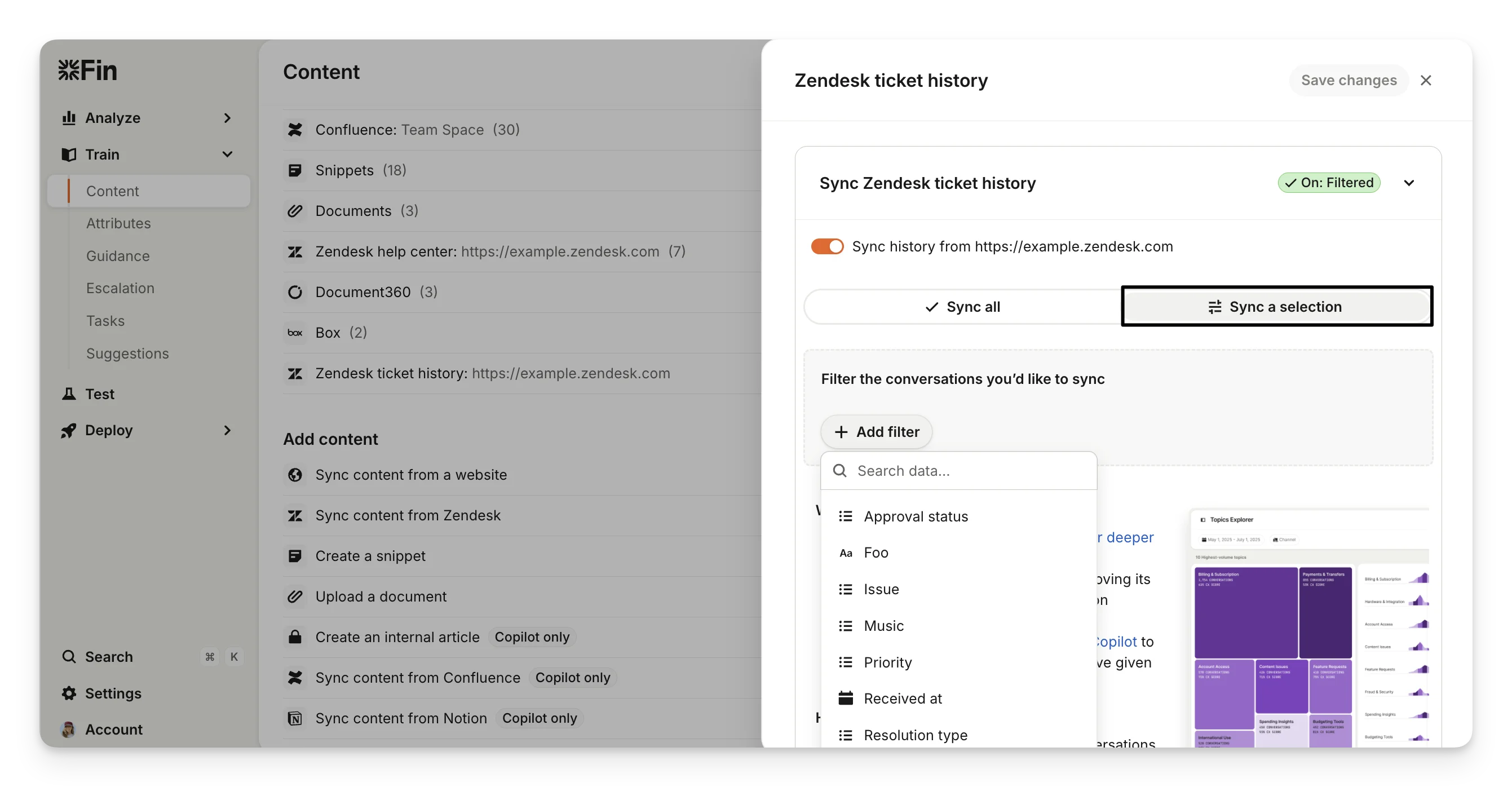
How Fin AI Agent uses past tickets:
- Customer asks a question
- Fin searches your knowledge base
- Fin generates an answer from the Knowledge Base content
- Separately, past tickets are scanned by a suggestion engine
- The engine surfaces gaps and proposes KB additions
- A human reviews each suggestion
- Approved suggestions are added to the KB
- The next similar question can use the new content
The design works well for teams whose resolution knowledge is meant to live in the help center. It is less helpful when your real answers live in past tickets that have not been written up as articles, a pattern common in B2B SaaS support, where product changes are frequent and the help center cannot keep up.
Fin Copilot works differently from Fin AI Agent. Copilot can use past conversation data directly when generating drafts for human agents. Per Fin's Copilot deployment docs, Copilot initially ingests the last 120 days of Zendesk tickets and syncs additional tickets daily afterward.
How Pluno's Deflection AI uses past tickets
- Customer asks a question
- Pluno searches across past resolved tickets, knowledge base, Slack threads, Jira issues, and connected APIs
- Pluno generates an answer using past tickets as direct evidence alongside everything else
- No suggestion queue, no human review required, no KB update needed first
This direct retrieval is the architecture around which Pluno was built. When the right answer was worked out over time in conversation and never written up as an article, Pluno can use the original conversation as evidence.
Both designs have a place:
- If your KB is well-maintained and your tickets are mostly common inquiries, Fin's suggestion-driven design keeps your KB tidy and your AI accurate
- If your team gets complex questions the KB doesn't cover, and the real resolution knowledge lives in past tickets and engineering threads, Pluno's direct learning from past conversations will be the better fit
Final comparison: Edge to Pluno for B2B SaaS technical support, where past tickets carry the real resolution knowledge. Edge to Fin for teams where the KB is the source of truth, and past tickets are mostly feedback used to keep it up-to-date.
Zendesk operational coverage: Pluno vs Fin AI
Both Pluno and Fin AI are roughly equal across most operational dimensions, with one meaningful asymmetry on multi-brand setups.
| Capability | Pluno | Fin |
|---|---|---|
| Email and form tickets | ✓ | ✓ |
| Zendesk Messaging (modern web widget) | ✓ | ✓ |
| WhatsApp, Facebook Messenger, Instagram | ✓ via Zendesk Messaging | ✓ via Zendesk Messaging |
| iOS and Android mobile SDKs | ✓ | ✓ |
| Legacy Web Widget (Classic) | ✗ | ✗ |
| Alternative web widget | ✗ | ✓ Fin Messenger, with ticket handoff to Zendesk |
| Zendesk macros as an answer source | ✓ | ✗ |
| Read and write Zendesk custom fields | ✓ | ✓ |
| Dedicated module for ticket categorization and field auto-fill | ✓ AI Tagging | ✓ via Procedures and workflows |
| Multi-brand Zendesk support | ✓ Per-brand workflows in a single workspace | ✓ Separate workspace required per brand personality |
On macros: Fin's documentation lists Copilot's knowledge sources as articles, internal resources, and past conversations, with macros absent from that list. Fin can coexist with existing Zendesk macros, triggers, and routing logic without breaking them. Pluno does not surface macros either, and in practice it makes them redundant. Because Pluno learns from past resolved tickets (which already carry the language, structure, and tone of your team's approved responses, including those originally based on macros), the AI generates answers that match your team's voice without needing a separate macro library. Teams can keep their existing Zendesk macros running for human agents, but Pluno's AI Copilot and Deflection AI do not need them as a knowledge source.
On multi-brand: Pluno supports per-brand tone, voice, and answer-scope configuration within a single Pluno workspace. Per Intercom's documentation, Fin supports a single Fin personality per workspace, so teams running multiple brands with different Fin behavior need to operate separate Fin workspaces, one per brand. Each separate workspace means a separate subscription, knowledge base configuration, procedure setup, analytics, and admin overhead. For a team running three or four brands on Zendesk, that turns into multiple parallel Fin deployments to maintain.
Final comparison: Roughly equal on channels and automatic ticket categorization (Pluno does this through its AI Tagging module, Fin through Procedures and workflows). Roughly equal on macro handling. Edge to Pluno on multi-brand setups, where Pluno supports per-brand configuration in a single workspace, and Fin requires separate workspaces per brand personality.
Autonomous resolution: Pluno's Deflection AI vs Fin AI Agent
Both products do autonomous resolution. The difference is what they're optimized to resolve. Pluno is built around answer generation that draws on past resolved tickets and engineering systems, enabling it to handle diagnostic reasoning on complex tickets. Fin is built around action-taking workflows that execute multi-step processes inside the conversation.
How each one generates answers
Fin AI Agent:
- Receives the customer question
- Searches synced help center articles, URLs, uploaded documents, and snippets
- If the answer requires more than one step, executes a configured Procedure (multi-step workflow)
- If the workflow needs to take action on backend systems, calls a Custom Action against your APIs (refunds, account changes, order lookups)
- Returns an answer to the customer
Pluno Deflection AI:
- Receives the customer question
- Searches across past resolved tickets, the help center, internal documentation, Slack threads, Jira issues, and connected APIs in a single query
- Generates an answer using evidence from all sources with citations attached
- Returns an answer to the customer with traceable sources
Escalation behavior when the AI isn't confident
The mechanics above describe the happy path. The reliability difference shows up when the AI is uncertain.
Fin is designed to resolve. When the AI can't confidently answer, it hands off to a human or routes through a procedure that ends in handoff.
The catch is that conversations also resolve automatically if the customer walks away without replying for 24 hours (Fin's "soft resolution" category), which counts as a billable resolution and as a successful deflection on the dashboard. A team can have a high reported resolution rate while frustrated customers churn quietly.
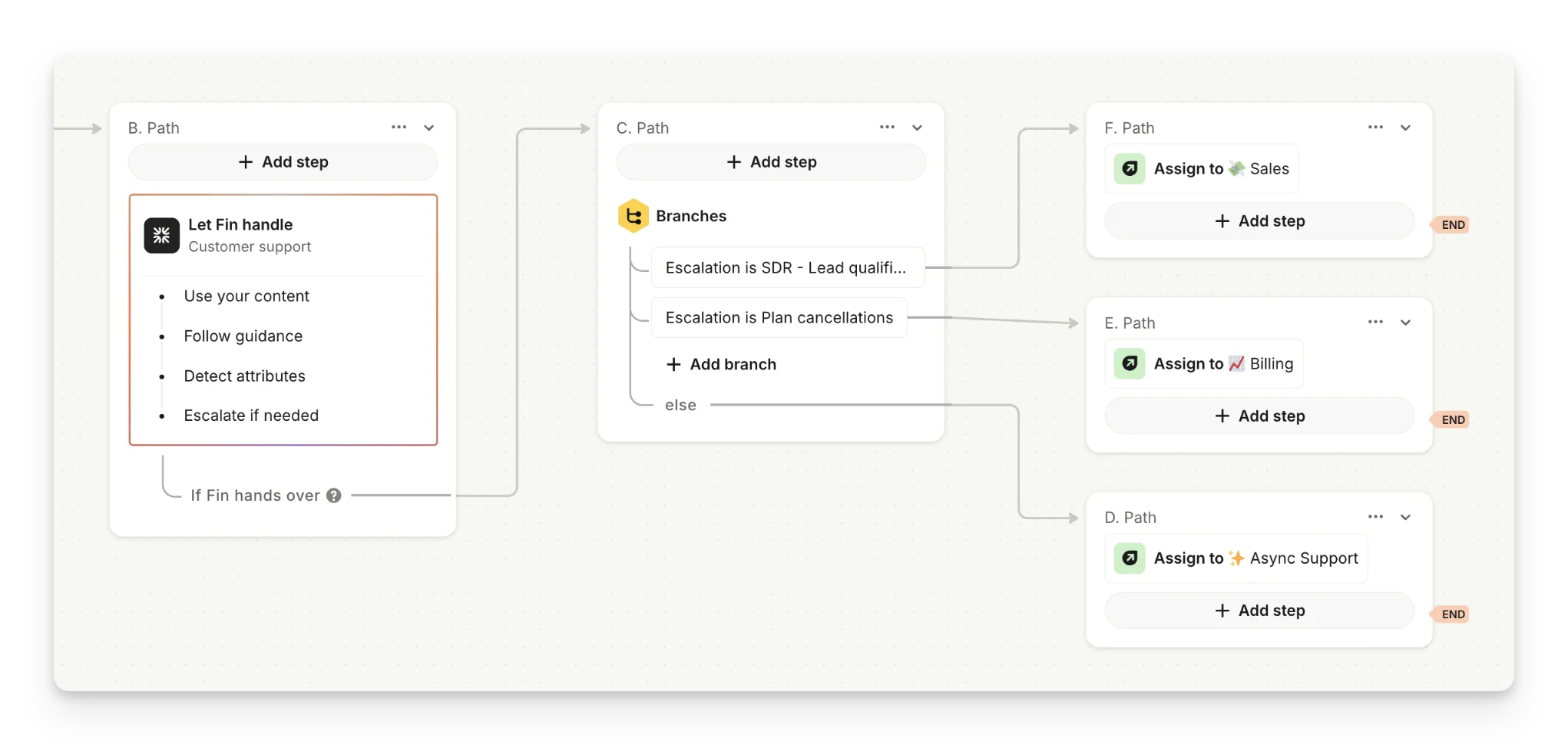
Pluno is designed to escalate to a human agent when uncertain. Deflection AI only marks a ticket resolved when its answer concludes the customer-facing conversation; it does not count silent walk-aways as resolutions, and escalations to humans are not billed. The escalation itself carries a summary, the evidence the AI considered, and suggested next steps written to the ticket as an internal note. The result is a smaller resolution count that better reflects actual resolution.
Final comparison: Edge to Fin for action-taking workflows that execute multi-step processes during the conversation. Edge to Pluno for breadth of evidence sources (especially past tickets and engineering systems) and for resolution reliability, where Pluno escalates cleanly when uncertain rather than absorbing walked-away conversations into the resolved count.
Diagnostic conversations
Both can ask clarifying questions. The difference lies in how each product treats diagnostic conversations as part of the default resolution flow.
Pluno's autonomous flow is built to gather information when a ticket is ambiguous. Diagnostic conversations (which Zendesk product version, what is the error code, when did it start, what is the exact reproduction path) are part of the standard resolution path. The AI asks follow-ups and pulls context across past tickets, internal docs, and connected systems as part of the same resolution flow.
Fin AI Agent can ask clarifying questions through Procedures, but these have to be written and maintained manually. Someone on the team writes the natural-language workflow for each scenario the AI needs to handle, defines the conditions, and updates it when the product or process changes. For a B2B SaaS team with hundreds of possible edge cases, that turns into ongoing maintenance work for the support manager or admin.
Fin's strength is on the action-taking side. Procedures support multi-step workflows that combine information lookups with backend operations, and Custom Actions can call your APIs to process refunds, update account settings, or check order status during the conversation.
Here's a concrete example of how both products would handle a specific task:
A customer writes: "My API is failing with a 403 error." Pluno's default response is to ask which environment, what the request was, and when it started, then check past tickets for similar 403 patterns and look for any recent Jira issues affecting the relevant service. Fin's default response, in a typical configuration, is to either answer from the KB if there's a matching article or hand off to a human. To get Fin to ask the same diagnostic questions Pluno asks by default, you would build a Procedure that includes those steps as configured workflow logic.
Final comparison: Edge to Pluno. Diagnostic reasoning is a core use case for Pluno, configured by default. For Fin, diagnostic conversations require building Procedures, which work but require more setup.
What happens when confidence is low
Fin AI Agent hands off to a human, or routes through a Procedure that ends in a handoff. However, a procedure that ends in a handoff counts as a billable resolution.
Pluno Deflection AI escalates with a summary, an evidence trail, and suggested next steps written to the ticket as an internal note. The escalation itself is not billed as a resolution (since, of course, the ticket is not resolved). The human agent picks up the ticket with context already in place, which keeps the support-to-engineering handoff fast on tickets that need it.
Final comparison: Edge to Pluno. Escalations include full context as internal notes and are not billed as resolutions. Fin's handoffs through Procedures count as billable resolutions.
Agent copilot: Pluno AI Copilot vs Fin Copilot
Both copilots live in the Zendesk sidebar, both draft answers, and both let teams customize tone and rules. The substantive differences are in what each one can read, the deployment path for Fin Copilot on Zendesk, and what each Copilot bundles with its seat fee (covered in the Pricing section).
Knowledge Sources
Both copilots read from Zendesk content and accept document uploads. The differences live in third-party connectors and operational sources.
| Source | Pluno AI Copilot | Fin Copilot |
|---|---|---|
| Zendesk help center (public articles) | ✓ | ✓ |
| Zendesk internal articles | ✓ | ✓ |
| Past tickets (chat channels) | ✓ | ✓ |
| Past tickets (email-originated) | ✓ | Ambiguous on Zendesk; verify with Fin |
| Webpages and URLs | ✓ | ✓ |
| PDFs and document uploads | ✓ | ✓ |
| Notion | ✓ | ✓ |
| Confluence | ✓ | ✓ |
| Guru | ✗ | ✓ |
| Slack threads | ✓ | ✗ |
| Jira issues | ✓ | ✗ |
| Connected APIs (live data lookups) | ✓ | ✓ for Fin AI Agent via Data Connectors; ✗ for Fin Copilot |
| Per-query source filtering | ✓ | ✓ |
For B2B SaaS support teams whose ticket history is mostly email, the email-originated tickets row is worth verifying directly with Fin during evaluation. Pluno reads email-originated tickets natively. Per Intercom's Copilot documentation, Fin Copilot's past-conversation access is limited to chat conversations and tickets, with Intercom's email channel explicitly excluded. How that exclusion applies to email-originated tickets in Zendesk is not clarified in the public docs.
Pluno AI Copilot also generates diagnostic walkthroughs alongside its drafted replies, mirroring how Deflection AI handles complex tickets on the autonomous side.
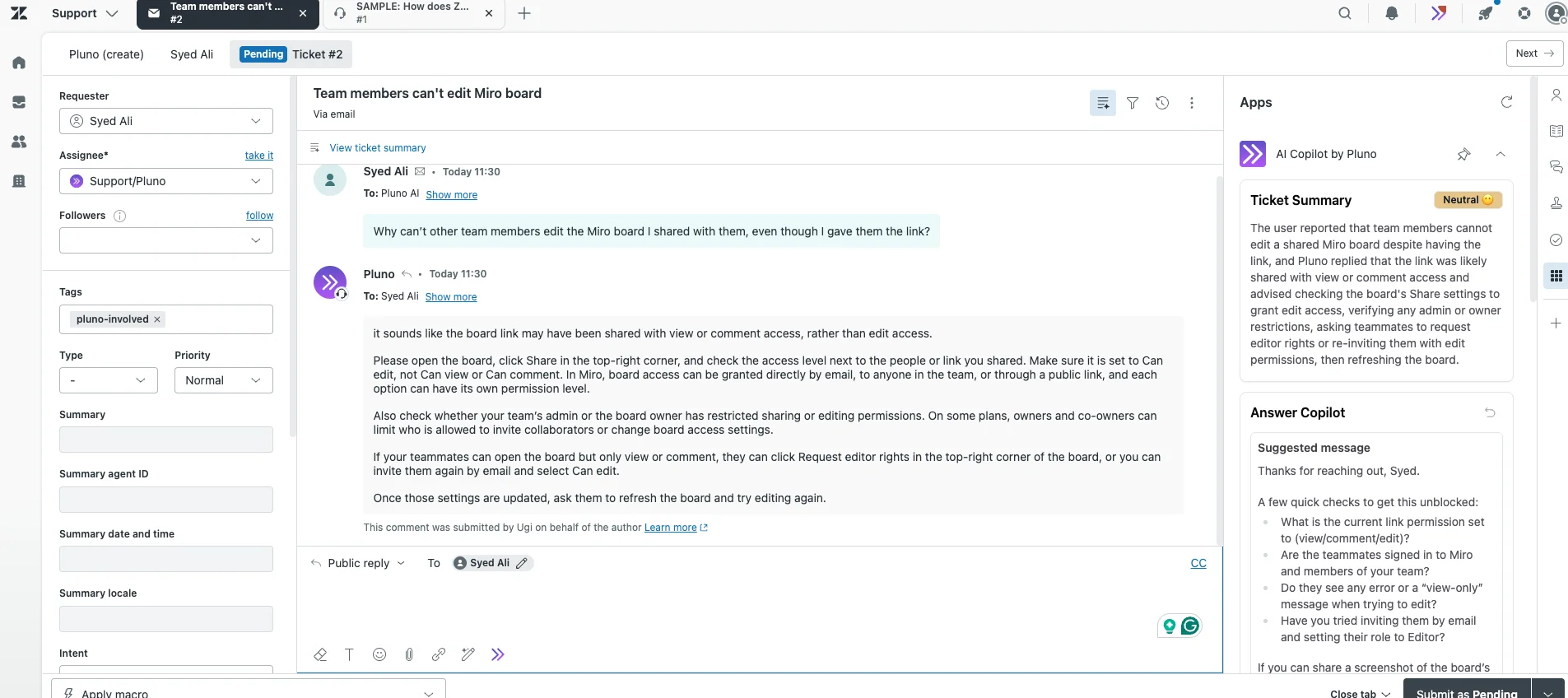
Fin Copilot's outputs are oriented toward drafting and answering; diagnostic walkthroughs are not a documented feature.
Final comparison: Edge to Pluno on operational sources (past tickets across all channels including email, Slack threads, Jira issues, and connected APIs) and on diagnostic walkthroughs. Edge to Fin on Guru as a native knowledge connector. Tie on source selection per query, with Pluno's AI handling it automatically and Fin offering manual agent control.
Customization and installation
- Customization. Both copilots use natural-language workflows for tone, brand voice, length constraints, and conditional rules. Both let agents chat with the copilot to refine or expand an answer. Pluno regenerates Copilot drafts automatically when new messages arrive in the thread. Fin Copilot's regeneration behavior on Zendesk is not documented publicly. Teams that need automatic regeneration should verify with Fin during evaluation.
- Install path. Pluno installs self-serve from the Zendesk Marketplace with a brief API connection step. Fin Copilot's install on Zendesk goes through Intercom's support team. The admin requests an installation link and assigns seats from the Fin workspace. Each teammate then accepts an email invite and signs into their Fin account.
Final comparison:
- Install: Edge to Pluno. Self-serve Marketplace versus Intercom-mediated deployment.
- Customization: Tie. Both use natural-language workflows.
- Note: Procedures and Data Connectors are Fin AI Agent features and do not apply to Fin Copilot.
Engineering escalations and other Pluno modules
The support-to-engineering loop is where B2B technical teams lose the most time. The two products treat it very differently, and Pluno's broader platform includes additional modules that go beyond what Fin covers today.
Engineering loop & escalations: Pluno vs Fin
Pluno's platform includes two modules built around the support-to-engineering loop. The Troubleshooting Agent investigates customer issues before they need engineering attention. The Escalation Copilot creates engineering issues and keeps them in sync with Zendesk. Together they handle the end-to-end workflow that's the biggest time sink for B2B technical support teams. Fin has no direct equivalent for either.
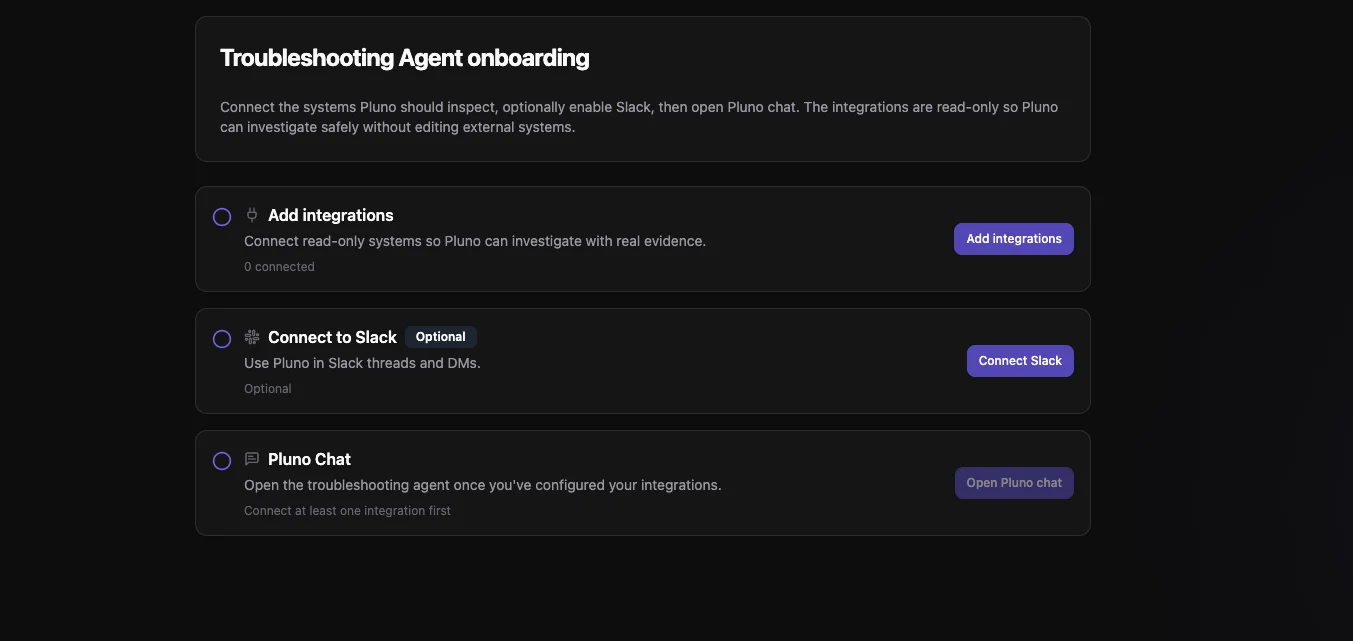
Troubleshooting Agent. Pluno's Troubleshooting Agent investigates customer issues across your code, logs, session recordings, and connected tools (Sentry, DataDog, Linear, and similar). It surfaces relevant system state for complex tickets, so the support agent has evidence to work from without manually digging through observability dashboards or code repos. For a B2B SaaS team where tier-1 agents would otherwise need an engineer's help just to understand what's happening, the Troubleshooting Agent compresses that loop.
Escalation Copilot. When an issue does need engineering attention, the Escalation Copilot creates Jira issues or Slack threads directly from the Zendesk ticket using a customizable template. The issue or thread carries reproduction details, customer impact, the relevant ticket history, and a generated summary. Updates flow in both directions. When engineering moves an issue, the Zendesk ticket reflects it. When the customer adds context in Zendesk, engineering sees it on the other side. Support stops chasing engineering for status.
Kojo, a Pluno customer in construction procurement, reports same-day Jira ticket creation on tickets that previously took days to reach engineering. That throughput comes from treating the support-to-engineering handoff as a productized two-way sync, with reproduction details and field mirroring built in.
"What really sets Pluno apart is that integration between Zendesk and Jira and Pluno… Having updates on your tickets automatically in Zendesk from the linked Jira tickets is a game changer. Your follow-ups become extremely on point."
Sarala Conlan, Sr. Customer Support Manager at Kojo
How Fin handles this work. Fin AI Agent supports Custom Actions that call APIs, and Procedures can route to a Jira workflow. There is no native two-way sync layer that packages reproduction details and mirrors updates across systems. There is no equivalent to the Troubleshooting Agent's code, logs, and session-recording investigation. Teams that want either behavior on Fin build it themselves through workflows and API calls, with the maintenance overhead that implies.
Final comparison: Edge to Pluno on both modules. The Troubleshooting Agent investigates issues across code, logs, session recordings, and engineering tools before they reach engineering. The Escalation Copilot productizes the two-way Zendesk-Jira and Zendesk-Slack sync with reproduction details and customer context. Fin requires teams to build either behavior through Custom Actions and Procedures, configured and maintained manually.
Other Pluno modules without a direct Fin equivalent
Two more Pluno modules cover ground Fin's product does not.
- Support Quality Assurance. Pluno's Support QA module scores every resolved ticket against criteria defined by the team (binary, five-level, or numerical). Coverage runs across 100% of resolved tickets, with no sampling. A QA module with team-defined scoring criteria, similar to Pluno's Support QA, is not documented in the Fin product on Zendesk today.
- Call Insights. When a Zendesk ticket includes a voice recording from a customer call, Pluno transcribes it and generates a summary using a template configured by the team. Fin has no equivalent call-transcription-and-summary module. Fin Voice handles voice conversations directly as an autonomous agent, which targets teams that want AI to take voice calls rather than summarize human-handled ones.
- Insights & Trends. Pluno groups tickets into recurring issue clusters, surfaces emerging product problems and feature friction, and lets the team query the data in natural language ("show me the most common payment-related issues in the last 30 days"). Intercom has equivalent analytics through CX Score and AI Topics, available as part of its Pro add-on rather than included in the core product.
Final comparison: Edge to Pluno on both, with caveats. Support QA gives teams direct control over what "good" looks like through custom scoring criteria. Call Insights and Fin Voice are different product categories addressing different use cases (post-call summarization of human-handled calls versus autonomous voice agent), so the comparison comes down to which capability the team actually needs.
Pricing - Fin AI vs Pluno for Zendesk teams
| Pluno | Fin | |
|---|---|---|
| Platform / base fee | Starting at 249€/mo for up to 500 tickets per month. | $49 per month, includes 50 AI Agent resolutions |
| Autonomous resolution charge | €0.90 per Deflection AI resolution | $0.99 per Fin AI Agent resolution above the first 50 |
| Per-seat fee | €49 per agent per month | $35 per user per month for Fin Copilot only |
| What does the base fee cover | Knowledge base and model training, AI tagging & field filling, Escalation Copilot, Deflection AI, and more. | Fin Copilot only |
| Per-seat for autonomous agent | No separate seat fee for Deflection AI | No per-seat for Fin AI Agent |
| Pay only for assigned agents | ✓ | ✓ (Copilot seats) |
| Trial | 14 days, all modules unlocked, no usage limits, self-serve from Zendesk Marketplace | 14 days, unlimited resolutions, per fin.ai/pricing |
How a resolution gets counted
This is the part of the pricing comparison most often misread, and it deserves its own attention. Both products bill on resolutions, and both count silence as a form of resolution. The differences are in the window length and what else counts.
Fin counts a resolution in three ways:
- Hard resolution: the customer confirms the answer helped or replies affirmatively.
- Soft resolution: 24 hours pass without further customer reply after Fin's answer.
- Procedure handoff: Fin successfully executes a Procedure configured to end with a handoff to a human or another workflow.
All three count as billable resolutions at $0.99 each.
The soft-resolution rule is the part that teams flag publicly. Across Reddit and Capterra discussions, the concern is that customers who give up on a conversation without explicitly escalating still count as resolved for billing purposes. For a frustrated customer who simply walks away, the bill increases even when the support outcome was poor. The customer experience can degrade without your dashboard reflecting it: resolution rate stays high while customers churn quietly.
Pluno's customer Smartness ran into this pattern with Fin AI before switching to Pluno:
The numbers of resolved tickets were high, but when you looked at the quality, it wasn't great. You could feel frustration building up in our customer base. - Joseph D'Appuzo, Customer Support Manager, Smartness
There is a mitigation on Fin's side. If a customer reopens within a billing window, the original resolution charge is reversed. But the underlying design choice (silence treated as agreement) is real, and at high volume, it can make monthly bills less predictable.
Pluno counts a resolution in two ways:
- Customer confirmation: the customer confirms the answer helped or replies affirmatively.
- 72-hour silence: Pluno sent the last public message and the customer has no replied within 72 hours.
Escalations to humans are not counted as resolutions in Pluno's billing.
Soft resolutions are documented on Fin's own pricing page, the reopen mechanic exists, and many teams find Fin's pricing predictable in practice. The point for a Zendesk buyer is to know which model fits your ticket pattern. If your customers tend to walk away from conversations without confirming, Fin's billing will run higher than the headline number suggests. If your customers reliably confirm or escalate, the difference largely disappears.
Two practical questions to ask any AI agent vendor before committing:
- What percentage of your "resolved" tickets are soft resolutions versus customer-confirmed resolutions?
- Can you share a sample of recent "resolved" tickets that we can review for resolution quality?
Pluno's product surfaces exactly this. The dashboard lists every ticket the AI resolved and billed for, with the underlying conversation, the evidence the AI used, and the final state of the customer interaction. Support managers can review the resolved-ticket queue, spot patterns in which the AI is closing the loop with customers who walked away frustrated, and adjust rules or escalation thresholds before the next billing cycle.
Comparison table
| Dimension | Pluno | Intercom Fin AI |
|---|---|---|
| Platform fit | Zendesk only | Zendesk (via API), Intercom (native), Salesforce |
| Install path | Zendesk Marketplace install with brief API connection step | Create Fin workspace and connect via Zendesk API; Fin Copilot install on Zendesk is mediated by Intercom support |
| Where the AI is managed | Pluno dashboard, sidebar in Zendesk | Fin workspace, sidebar in Zendesk |
| Autonomous resolution module | Deflection AI | Fin AI Agent |
| Past tickets in autonomous answers | Direct, automatic, no review | Indirect, via AI-powered KB-improvement suggestions |
| Agent copilot | AI Copilot, included in €49 per-agent seat per month. | Fin Copilot, $35 per user per month |
| Copilot reads email tickets | Yes | Ambiguous on Zendesk per public docs; verify with Fin |
| Engineering escalations (Jira, Slack) | Two-way sync built into Escalation Copilot | Via Procedures and custom actions |
| Pricing model | Base Platform Fee (based on average ticket volume) + €0.90 per resolution. Optional €49 per Copilot. | $49 per month base (includes 50 resolutions) + $0.99 per additional + optional $35 per Copilot seat |
| Resolution definition | Customer-confirmed or 72-hour silent; escalations to humans not billed | Customer-confirmed, 24-hour silent, or Procedure handoff |
| Trial | 14 days, all modules, no usage limits | 14 days, unlimited resolutions |
| Data residency | EU processing, Azure-hosted LLMs | Per trust.intercom.com |
| Voice support | Not in 2026 | Fin Voice, custom pricing |
How to choose between Fin AI vs Pluno for Zendesk?
Three questions usually decide it.
Where does the knowledge needed to resolve your tickets actually live? If it sits in a maintained knowledge base and your tickets are mostly common inquiries, Fin's KB-grounded design fits. If your real resolution knowledge lives in past tickets, internal Slack threads, and engineering systems, Pluno's direct-use design fits better.
Are engineering escalations a meaningful share of your weekly support work? If your team escalates to engineering through Jira or Slack regularly, Pluno's Escalation Copilot earns its money quickly. If escalations are rare or handled through a separate system already wired up, the gap matters less.
What is your platform commitment? Pluno is Zendesk only in 2026. Fin runs on Zendesk, Intercom, and Salesforce, with the deepest integration on Intercom. If you are not on Zendesk, the decision is made for you.
FAQ
Is Fin AI Agent on the Zendesk Marketplace?
No. Fin is managed from a separate Fin/Intercom workspace and connects to Zendesk through an API integration.
Do I need to pay for Intercom seats if I use Fin alongside Zendesk?
No. Intercom platform seats are only required when you run Fin inside Intercom's own helpdesk. Running Fin on top of Zendesk requires only the Fin resolution fee and, optionally, the Fin Copilot seat.
Does Pluno run on Intercom?
Not in 2026. Intercom support is on Pluno's roadmap, but not live yet.
Does Fin learn from my past Zendesk tickets?
Yes, but indirectly. Fin AI Agent grounds answers in the knowledge base. Past tickets trigger AI-powered suggestions that surface gaps and recommend KB updates, which a human reviews and accepts. Fin Copilot is separate and can use past conversation data directly for agent drafts, with the caveat that it reads chat conversations and tickets only; email conversations are out of scope. This comes from Intercom's help center.
Does Pluno learn from my past tickets?
Yes, directly and automatically. Pluno's Deflection AI uses past resolved tickets as part of the answer-generation pipeline. There is no suggestion review queue and no KB update prerequisite.
What resolution rate should I expect?
Neither average forecasts what your team will see. Run a simulation against your own ticket history before committing. Fin claims 67% on average across its customer base. Pluno reports an average of 65% across its customer base.
What does Fin count as a "resolution" for billing?
Customer confirms the answer helped, or 24 hours pass with no further customer reply, or a Procedure ends in handoff. The 24-hour silent rule is the part teams flag publicly for predictability concerns.
What does Pluno count as a "resolution" for billing?
A Pluno Deflection AI resolution is counted when Pluno has sent the last public message in the conversation, and the customer has not replied within 72 hours. Escalations to humans are not billed. The 72-hour window is longer than Fin's 24-hour equivalent, giving frustrated customers more time to return before the ticket is counted as resolved.
How does Pluno's pricing work?
Pluno's pricing has four paths:
- Platform fee. A flat monthly fee that scales with your monthly ticket volume across all channels. The platform fee includes Escalation Copilot, AI Tagging and Field Filling, Call Insights, Ticket Trends and Topic Insights, ticket summaries with sentiment detection, and continuous knowledge base management. Annual billing gets 15% off.
- AI Copilot seat fee. €49 per agent per month, charged only for teammates an admin designates to use the Copilot.
- Deflection AI resolution fee. €0.90 per autonomous resolution. A ticket counts as resolved when Pluno has sent the last public message and the customer has not replied within 72 hours. Escalations to humans are not billed.
- Optional add-ons. Quality Assurance at €35 per agent per month, and the Troubleshooting Agent at €99 per month for around 50 investigations.
Enterprise plans with custom terms, higher volume tiers, and SSO/SAML are available on request. A 14-day free trial with unlimited access to every module is available without a credit card.
Can I try both?
Yes. Both offer 14-day trials. The most useful test is to run the same historical Zendesk tickets through both products and compare answer quality, escalation behavior, and what each one does with your past-ticket history.