The best Freshdesk alternatives in 2026 are Zendesk, Zoho Desk, Help Scout, Intercom, HubSpot Service Hub, Front, Gorgias, Chatwoot and FreeScout, and which one is right depends almost entirely on why you are leaving.
Most lists on this topic say teams are switching away from Freshdesk. Few say what changed. Two things did, and both are documented on Freshworks' own properties. Freshworks cut the Freshdesk free plan from ten agent licences to two, effective 15 November 2024, and what remains is a six-month program. Freddy AI is also metered twice on top of per-agent seats, once per agent for Copilot and once per session for the AI Agent, and the 500 sessions everyone quotes are a one-time signup allowance instead of a monthly one.
Below are nine alternatives in three groups, each with its price, what it fixes and where it falls short, followed by what switching costs, the AI-layer decision, and five if-then rules for picking. Pluno is not in the list, because Pluno is not a helpdesk. Every price was read on the vendor's own pricing page on 16 August 2026, and pricing in this category moves quickly.
Key takeaways
-
Zoho Desk is best if you lost the free plan. Free forever for 3 agents with no clock, then $7 per user per month on annual billing, which is roughly a third of Freshdesk's entry price.
-
Help Scout is best for a small team that wants simplicity. A free tier for 5 users, then $25 per user per month, with no ticketing system to administer.
-
Zendesk is best for large teams that need the widest ecosystem. $55 per agent per month paid yearly, and the strongest multi-team routing here.
-
Intercom is best if the AI is why you are leaving. $29 per seat per month on annual billing, with Fin at a published $0.99 per outcome.
-
HubSpot Service Hub is best if you already run HubSpot. Free for 2 users and from $7 per seat, though Professional carries a mandatory $1,500 onboarding fee.
-
Front is best if your support is collaborative email. $25 per seat per month, built around shared threads instead of a ticket queue.
-
Gorgias is best for ecommerce, and for large teams on modest volume. From $10 a month by ticket count, with no per-agent charge at all.
-
Chatwoot is best if someone on your team runs infrastructure. Free to self-host under the MIT Expat licence, or $19 per agent per month on cloud.
-
FreeScout is best if you want a free shared mailbox you control. Free and open source, and the closest thing to what the old ten-agent Freshdesk plan gave a small team.
Why teams are leaving Freshdesk in 2026
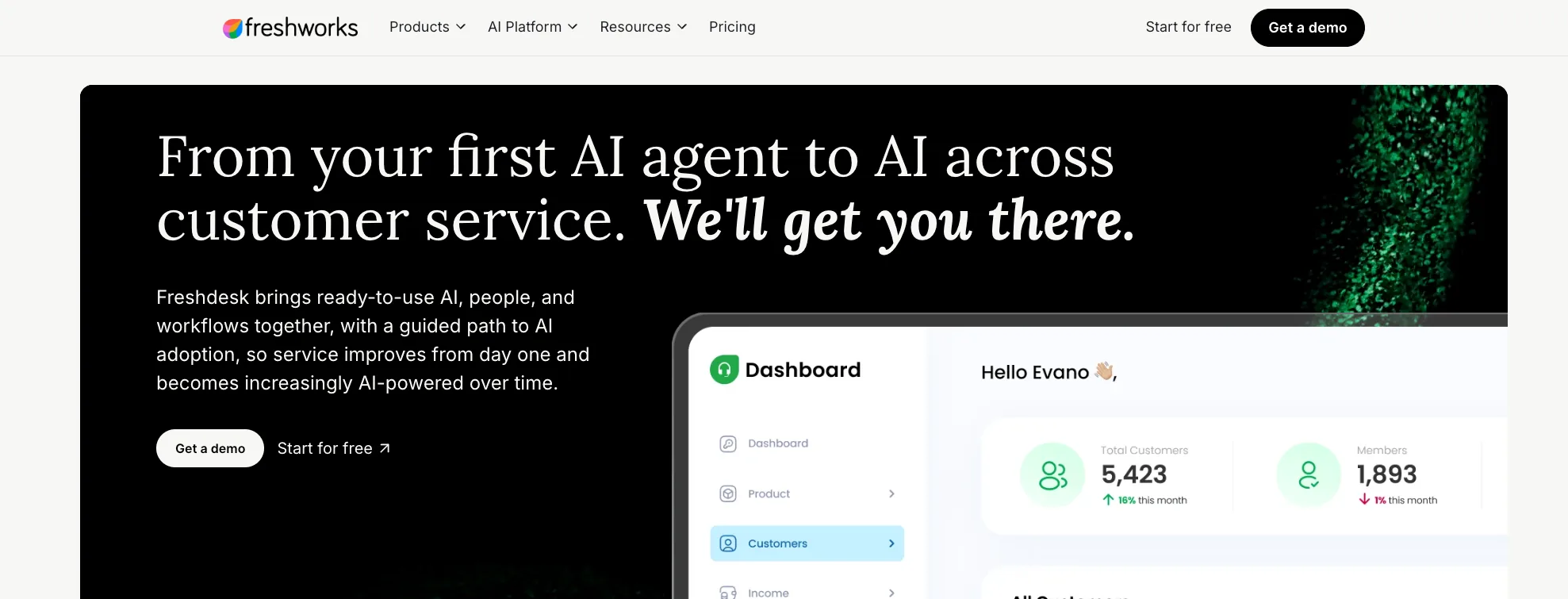
Two things changed at Freshworks, and one thing did not, and together they explain most of the switching.
The free plan went from ten agents to two
Freshworks notified customers that it would cut the agent licences included in the Freshdesk Free Plan "from ten to two," effective 15 November 2024.
Freshworks documents what remains on its own support site. The Free Plan runs for six months, caps at two agents, and applies only to Freshdesk customers. It does not run on Freshdesk Omni.
Inside those limits, you still get integrated ticketing across email and social, ticket dispatch, a knowledge base, a ticket trend report, out-of-the-box analytics, a choice of data center location, team collaboration and 24x5 email support. The features are intact. The headroom is what went.
The trial has a trap. If you trial a higher plan and add agents during it, Freshworks requires you to reduce back to the two-agent limit at the end unless you upgrade to a paid plan.
For a five-person team that built its support function on the old ten-agent tier, the arithmetic is straightforward. Two agents, six months, then at least $19 per agent per month.
Freddy AI is metered twice
Freshdesk charges for AI in two separate places on top of per-agent seats.
Freddy AI Copilot, the agent-facing assistant, costs $29 per agent per month. Freddy AI Agent, the customer-facing bot, costs $49 per pack of 100 sessions, which works out at $0.49 each.
Most published guides say the first 500 sessions are included. Freshworks' own add-on documentation is more specific. It describes them as "one-time complimentary 500 Freddy AI Agent sessions" granted with the purchase of a Growth, Pro or Enterprise plan. One time, on signup. A guide that presents it as a recurring monthly allowance understates your running cost by $245 a month.
A session has a published definition. Freshworks describes it as "all interactions between an end-user and the Freddy AI Agent or chatbot" inside a 24-hour window, and each session can last up to 24 hours.
Three details from the same documentation are worth knowing before you switch the bot on, and none of them appears on any of the pages currently ranking for this search:
-
Preview interactions consume sessions. Testing a bot while you build it burns paid allowance, whether the version is published or unpublished.
-
Unused sessions expire. They do not carry forward to the next billing period.
-
Auto-recharge is on by default, at one pack. The meter tops itself up unless you change the setting.
Third-party analyses report that Copilot is restricted to Pro and Enterprise and runs about $35 on monthly billing. Neither figure appears on a Freshworks page we could read, so treat both as reported.
Freshdesk and Freshdesk Omni are two different products
Freshworks sells two lines with similar names at different prices.
Freshdesk Support Desk runs $19, $55 and $89 per agent per month on annual billing across Growth, Pro and Enterprise. Freshdesk Omni runs $29, $79 and $119 across the same three tier names.
Neither page publishes a monthly rate. Third-party analyses put monthly billing at roughly 20% above annual, and that figure is not on a Freshworks page.
This matters when you compare. A price you read on another site may describe the other product, and the free program runs on Support Desk only.
While you are untangling names, Freshservice is a third thing again. It is Freshworks' IT service management product, and it is not what this article is about.
The complaints that show up more than once
These come from analyses published by competing vendors, so treat them as reported user sentiment.
The most specific one recurs independently in two of them: child tickets become standalone records and lose the parent conversation's context, breaking the thread and pushing teams into manual workarounds in Slack or Jira. If you run multi-team support on a technical product, this complaint is most likely what brought you here.
Two more recur. Performance degrades under high ticket volume, with slow loading and slow search. And features sit behind higher tiers, which is partly visible on the pricing page itself, since intelligent routing starts at Pro and skill-based routing at Enterprise.
Freshchat and Freshcaller are also sold as separate SKUs, so an omnichannel setup means more than one line on the invoice.
None of this makes Freshdesk a bad product. G2 rates it 4.4 out of 5 from 3,762 reviews, and reviewers consistently praise how easy it is to set up and use. The pattern is a tool people like that has become more expensive to run and harder to justify at the free end.
How this list was put together
Nine tools, chosen on two criteria.
The first is consensus. Zendesk, Zoho Desk, Help Scout, Intercom and HubSpot Service Hub appear on four of the five most substantial lists currently ranking, so leaving any of them out would make this list incomplete.
The second is the gap. Only one of those five lists includes a single open-source tool, while Chatwoot, osTicket, Zammad and FreeScout pull more than 33,000 searches a month between them. A team that just lost a free plan is exactly the team that would consider self-hosting, and almost nobody covers it.
We read every price on the vendor's own pricing page on 16 August 2026. Where a vendor does not publish a figure, this article says so instead of borrowing an estimate from somewhere else.
The 9 best Freshdesk alternatives at a glance
| Tool | Best for | Starting price | Free tier | AI pricing model |
|---|---|---|---|---|
| Zendesk | Large teams wanting the widest ecosystem | $55/agent/mo, paid yearly | No | Per automated resolution, rate not published |
| Zoho Desk | The closest like-for-like swap on price | $7/user/mo annual | 3 agents, forever | Included per tier |
| Help Scout | Small teams wanting simplicity | $25/user/mo | 5 users | $0.75 per resolution |
| Intercom | Messaging-first support with heavy AI | $29/seat/mo annual | No | $0.99 per outcome |
| HubSpot Service Hub | Teams already on HubSpot | From $7/seat/mo | 2 users | Credit-based |
| Front | Collaborative email over ticket queues | $25/seat/mo | No | Add-on below Enterprise |
| Gorgias | Ecommerce, and large teams on modest volume | $10/mo for 50 tickets | No | $0.90–$1.00 per interaction |
| Chatwoot | Teams that can self-host | Free self-hosted | 2 agents (cloud) | Credit-based |
| FreeScout | A free shared mailbox you control | Free, open source | Free | None built in |
AI rates in the last column are not directly comparable. Each vendor defines a resolution, an outcome, an interaction and a session differently, so compare the definitions before you compare the numbers.
The 9 best Freshdesk alternatives, reviewed
The mainstream replacements
1. Zendesk
Best for large support teams that want the widest third-party ecosystem.
Pricing. Suite Team $55 per agent per month paid yearly, Suite Professional $115. Suite Enterprise with Copilot is contact-sales with no public price.
Why it works as a Freshdesk alternative. It is the default destination for teams outgrowing a mid-market helpdesk, and it handles multi-team routing and threaded collaboration well enough that the child-ticket problem tends to go away. AI agents are included on every Suite and Support plan, billed per automated resolution, which Zendesk defines as a request resolved without escalation to a human.
Where it falls short. Zendesk does not publish a per-resolution rate anywhere on its pricing page, so you cannot forecast the AI line without a sales conversation. Figures of $1.50 committed and $2.00 pay-as-you-go circulate widely, and both are reported figures with no Zendesk page behind them. It is also the most expensive seat in the mainstream group after Intercom's top tier. What Zendesk's AI actually costs goes into the model in full.
Best for. Teams above roughly 20 agents with budget for the seat price and patience for a quote on the AI.
2. Zoho Desk
Best for teams that lost the Freshdesk free plan and want the closest like-for-like swap.
Pricing. Free forever for 3 agents. Express $7, Standard $14, Professional $23 and Enterprise $40 per user per month on annual billing.
Why it works as a Freshdesk alternative. This is the profile that matters most if the free plan is why you are here. Zoho Desk's free tier carries three agents with no six-month clock, and the paid entry point at $7 is roughly a third of Freshdesk's $19. The product is close enough in shape that the migration is conceptually simple.
Where it falls short. Express carries a hard five-seat ceiling, so a growing team hits an upgrade sooner than the headline price suggests. Monthly billing is reported to run 30 to 50% above annual, which is a wide range and is not published. The pricing page also renders in Indian rupees by default, so switch the currency before you quote yourself a number.
Best for. Small and mid-sized teams whose main complaint about Freshdesk is cost.
3. Help Scout
Best for small teams that want a shared inbox and a knowledge base without a ticketing system on top.
Pricing. Standard $25, Plus $45 and Pro $75 per user per month. A free plan covers 5 users, 1 inbox and 1 Docs site. AI Answers is a pay-as-you-go add-on at $0.75 per resolution, with a three-month free trial.
Why it works as a Freshdesk alternative. Its free tier allows five users against Freshdesk's two, and it has no six-month clock, which makes it the most generous hosted free option in this list. The product is deliberately simpler than Freshdesk, so teams that felt they were administering a helpdesk instead of using one tend to prefer it.
Where it falls short. The free tier caps at one inbox, one Docs site, one saved reply, 10 tags and 10 knowledge base articles, so it suits a simple setup and runs out on a multi-team one. The simplicity that appeals to small teams becomes a ceiling as you add queues and SLAs.
Best for. Teams under about ten people whose support is conversational.
4. Intercom
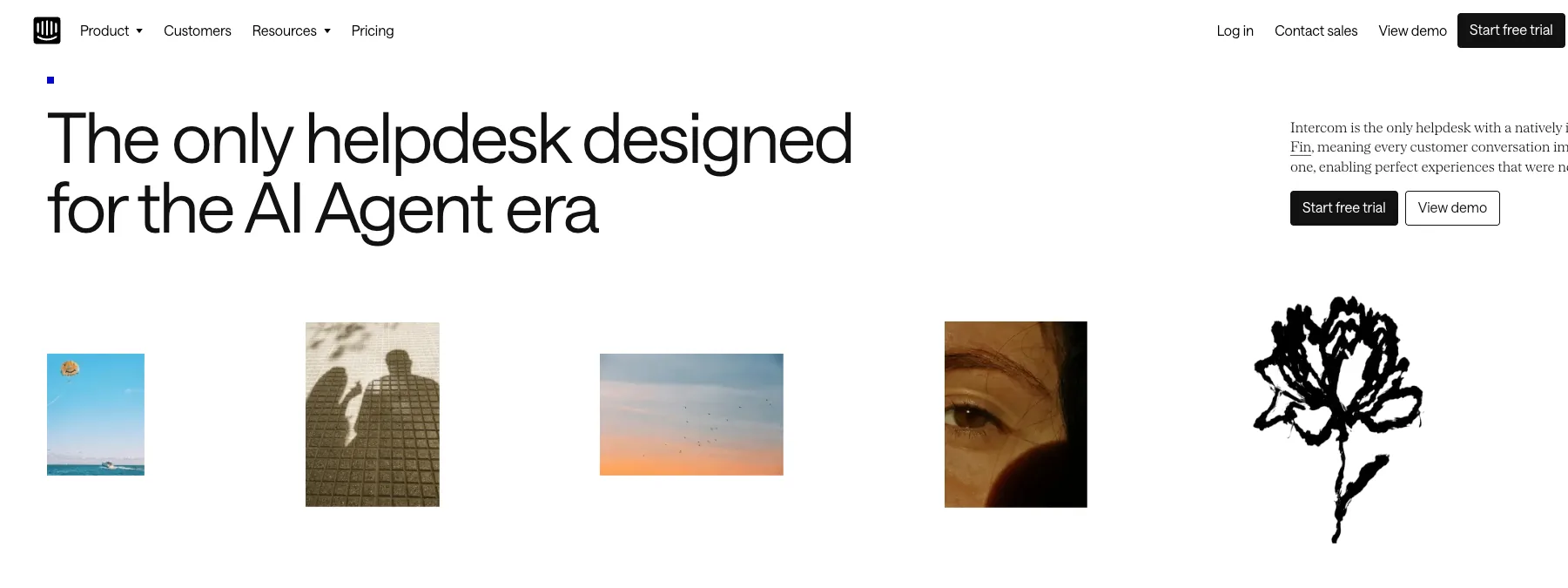
Best for messaging-first support teams that want the heaviest AI automation available.
Pricing. Essential $29, Advanced $85 and Expert $132 per seat per month on annual billing, or $39, $99 and $139 monthly. Fin AI Agent costs $0.99 per outcome and $9.99 per qualification. Advanced includes 20 free Lite seats, Expert 50, and Essential none.
Why it works as a Freshdesk alternative. Fin is one of the most widely adopted autonomous agents in this category and its per-outcome rate is published, which is more than Zendesk offers. If Freddy not resolving enough is why you are leaving, this is the most direct upgrade path.
Where it falls short. Two things. The AI meter is separate from seats and scales with your ticket volume, so a busy month costs money even if nobody joins the team. And Intercom renamed itself Fin, then signed a definitive agreement to be acquired by Salesforce for approximately $3.6 billion on 15 June 2026, expected to close in the fourth quarter of Salesforce's fiscal year 2027. The deal is signed and not closed, which is worth raising before you commit to a multi-year term. Intercom Fin's per-outcome pricing covers the model in detail.
Best for. Teams whose support is chat-led and whose ticket volume justifies an automation-first bill.
5. HubSpot Service Hub
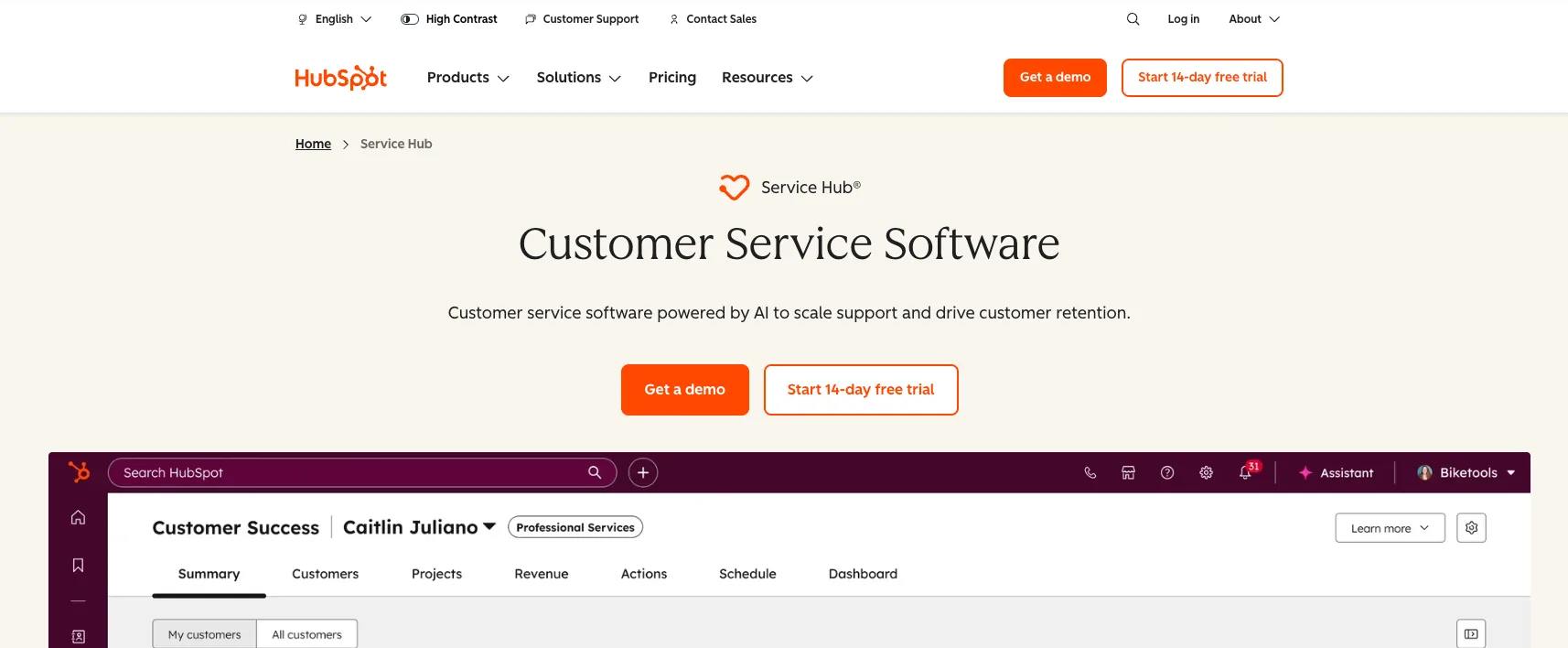
Best for teams already running HubSpot for sales or marketing.
Pricing. A free tier covers up to 2 users with no credit card. Starter runs from $7 per seat per month and Professional from $90.
Why it works as a Freshdesk alternative. If your CRM is already HubSpot, support tickets sitting beside the customer record removes a whole class of context-switching, and the free tier gives you somewhere to start.
Where it falls short. Professional and Enterprise carry mandatory one-time onboarding fees of $1,500 and $3,500. No other list covering this topic mentions them, and they change first-year cost materially: a five-seat Professional deployment is $5,400 in seats plus $1,500 before anyone logs in. HubSpot Credits also reset monthly with no rollover, and extra credits cost $0.010 each on annual billing.
Best for. Existing HubSpot customers, where the shared customer record is worth the premium. For anyone else the mandatory onboarding fee is hard to justify against Zoho Desk's $7 entry point and free tier.
The specialists
6. Front
Best for teams whose support work is collaborative email instead of a ticket queue.
Pricing. Starter $25 per seat per month for up to 10 seats, Professional $65 for up to 50, Enterprise $105 with no seat limit. Annual billing carries a stated 24% discount.
Why it works as a Freshdesk alternative. Front models conversations as shared email threads with internal comments attached, which is a better fit than tickets for teams where several people contribute to one customer relationship. If the child-ticket problem is what drove you out of Freshdesk, this is the most structurally different answer in the list.
Where it falls short. The seat ceilings on Starter and Professional are hard limits and rarely mentioned, so a team of 12 cannot stay on Starter regardless of budget. AI features sit behind add-ons below the Enterprise tier, where Copilot, QA and CSAT are included.
Best for. Account-managed support, agencies, and teams where support and customer success share the same inbox and the same customers.
7. Gorgias
Best for ecommerce brands, and for large teams handling modest ticket volume.
Pricing. Priced per ticket with no per-agent charge. The helpdesk runs $10, $60, $360 and $900 per month on monthly billing for 50, 300, 2,000 and 5,000 tickets. AI Agent is metered separately at $1.00 per automated interaction monthly and $0.90 annual, with $1.50 past your allowance. Ticket overage is $0.40 on the lower two tiers and $0.36 on the upper two.
Why it works as a Freshdesk alternative. It is the only tool here with no per-seat charge, which inverts the economics. A team of twelve pays what a team of three pays at the same ticket volume.
Where it falls short. It is ecommerce-first. Gorgias says it powers 40% of Shopify brands, and its AI Agent's documented actions are order cancellations, returns and shipping address updates. For a B2B software product that shape does not fit. Its pricing page is also JavaScript-rendered, so figures quoted on other sites are often stale.
Best for. Shopify and DTC brands, and anyone whose headcount is high relative to their ticket count.
The free and open-source route
8. Chatwoot
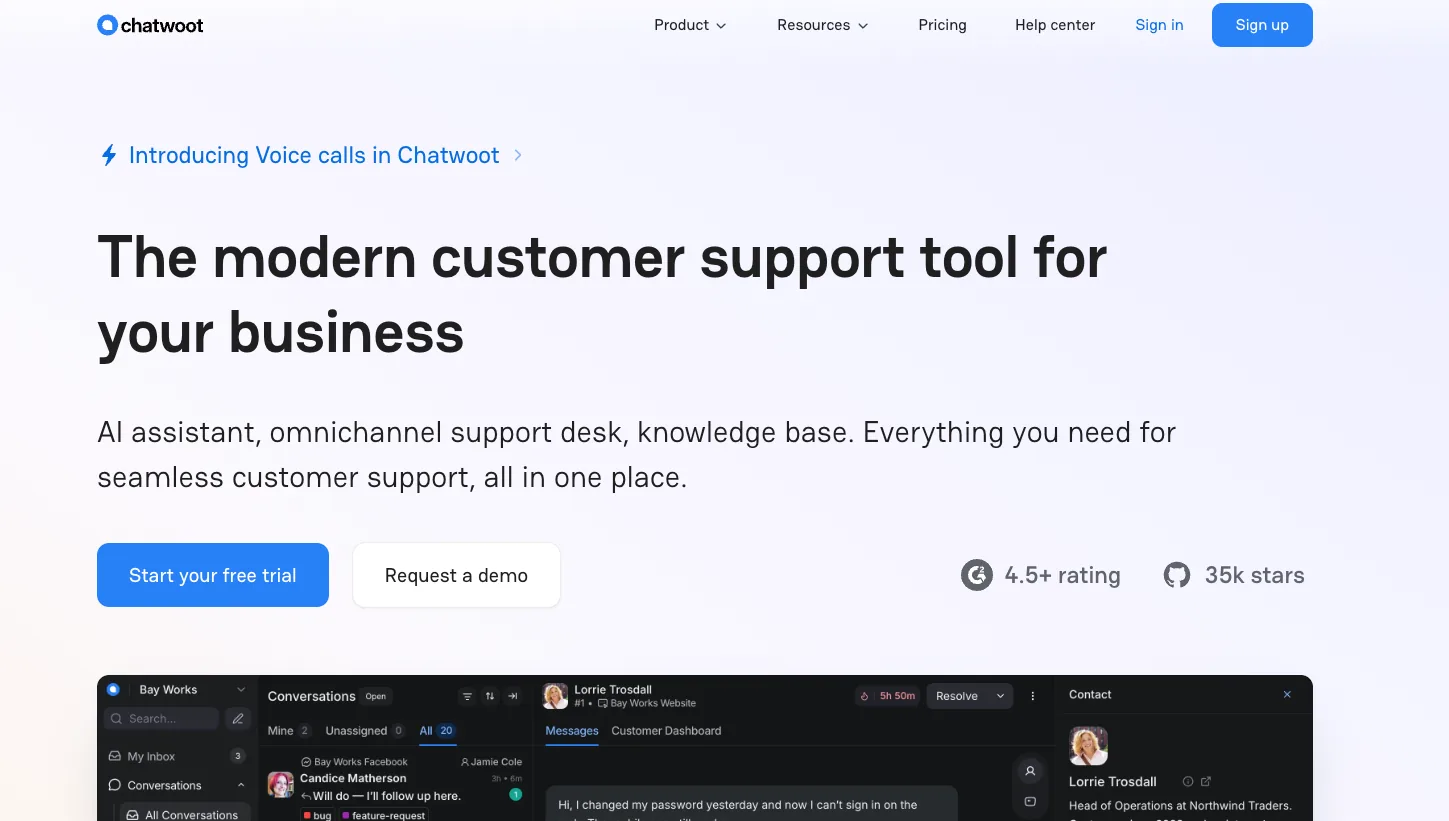
Best for teams with someone who can run infrastructure.
Pricing. Free to self-host. Cloud tiers billed annually are Hacker free for up to 2 agents with 500 conversations a month, Startups $19, Business $39 and Enterprise $99 per agent per month. Captain AI credits come with each tier and extra credits cost $20 per 1,000.
Why it works as a Freshdesk alternative. It is the most actively developed open-source option in this category and it covers live chat, email and social in one inbox. Released under the MIT Expat licence, with content in the enterprise/ directory licensed separately, so read both before you build on it commercially.
Where it falls short. Self-hosting means you own the server, the updates, the backups and email deliverability. The cloud Hacker tier caps at two agents and 500 conversations a month, which makes it a demo tier.
Best for. Technical teams that already run their own infrastructure and want to keep support data in it.
9. FreeScout
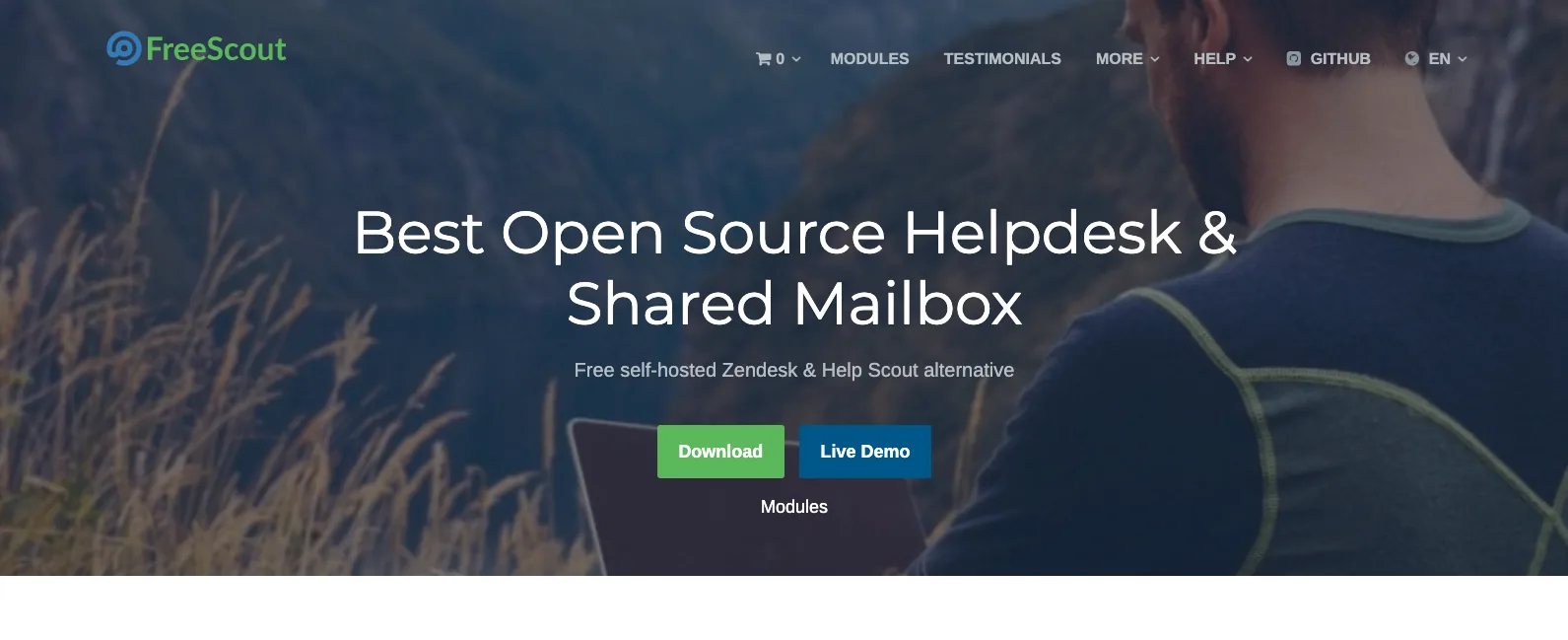
Best for a small team that wants a free shared mailbox it fully controls.
Pricing. The core application is free and open source, built on PHP and MySQL. One-click installs are available through Pikapods, Zenith, Softaculous, Docker and Cloudron.
Why it works as a Freshdesk alternative. It is the closest free equivalent to what the old ten-agent Freshdesk plan gave a small team: a shared mailbox with assignment, notes and a knowledge base, at no licence cost and with no agent cap.
Where it falls short. Paid modules are sold through a marketplace and no module prices were published on the pages we read, so you may be budgeting for extensions you cannot price in advance. The core product is deliberately minimal, so expect to add modules for things Freshdesk included.
Best for. Small teams with technical capacity and a strong preference for owning their data. If you want other open-source options, osTicket and Zammad are the two other mature projects in this space, both self-hosted and both with the same trade.
What the free and open-source route actually costs
Self-hosting an open-source helpdesk trades a licence fee for engineering time.
The bill you avoid is the licence. The bill you take on is a server, an upgrade path, backups, email deliverability, and a named person who owns all four. Deliverability is the one that surprises people, because a self-hosted helpdesk sending from your domain needs SPF, DKIM and a reputation you now manage yourself.
It works well when you already run infrastructure and adding one more service is a small marginal cost. It fails predictably when the person who set it up leaves and nobody inherits it.
For most teams that have just lost a free plan, the hosted free tiers are the lower-effort answer. Zoho Desk gives three agents, Help Scout five users, HubSpot two users and Chatwoot's Hacker tier two agents, and none of them asks you to run anything.
What switching actually costs
Leaving a helpdesk has three costs, and only one of them shows up on an invoice.
The first is the new subscription, which the profiles above cover.
The second is the migration. Tickets and contacts usually move with vendor tooling or a migration service. Automations, SLA policies, macros, custom fields and integrations get rebuilt, because they do not map cleanly between platforms. Migration effort therefore scales with how much you automated, which means a heavily-configured Freshdesk instance is a bigger project than a heavily-trafficked one.
The third is the productivity dip while your team relearns where everything is. It is temporary and it is not zero.
One Freshdesk-specific check before you commit. If child tickets losing their parent context is part of why you are leaving, test how your shortlist models ticket relationships during the trial. That behaviour differs meaningfully between these platforms, and it is the thing you are trying to fix, so it deserves a deliberate test instead of an assumption.
The AI layer is a separate decision
On every platform in this list the AI layer is priced separately from seats, and no two vendors bill it the same way.
Zendesk bills per automated resolution and publishes no rate. Intercom bills $0.99 per outcome. Help Scout bills $0.75 per resolution. Gorgias bills $1.00 per automated interaction on top of the ticket fee. Freshdesk bills per session, plus $29 per agent per month for Copilot.
Those five numbers are not comparable. A resolution, an outcome, an interaction and a session are four different units with four different definitions, and the definition decides how often you get charged. Read the definition before you compare the price.
A second decision sits underneath the first. Once you pick a platform, the AI that runs on it doesn't have to be the platform's own. On Zendesk and Intercom, you can run the native AI or a third-party layer, and that choice is independent of which helpdesk you just bought.
Pluno is one of those layers. It is an AI support agent for complex technical tickets that works inside Zendesk and Intercom, and it ingests your resolved support tickets, which is what lets it handle issues that no help center article documents. That matters if part of why you are leaving Freshdesk is that your tickets stopped being simple: the answers to integration failures and account-specific problems live in tickets your agents already worked out, and nobody wrote them up afterward.
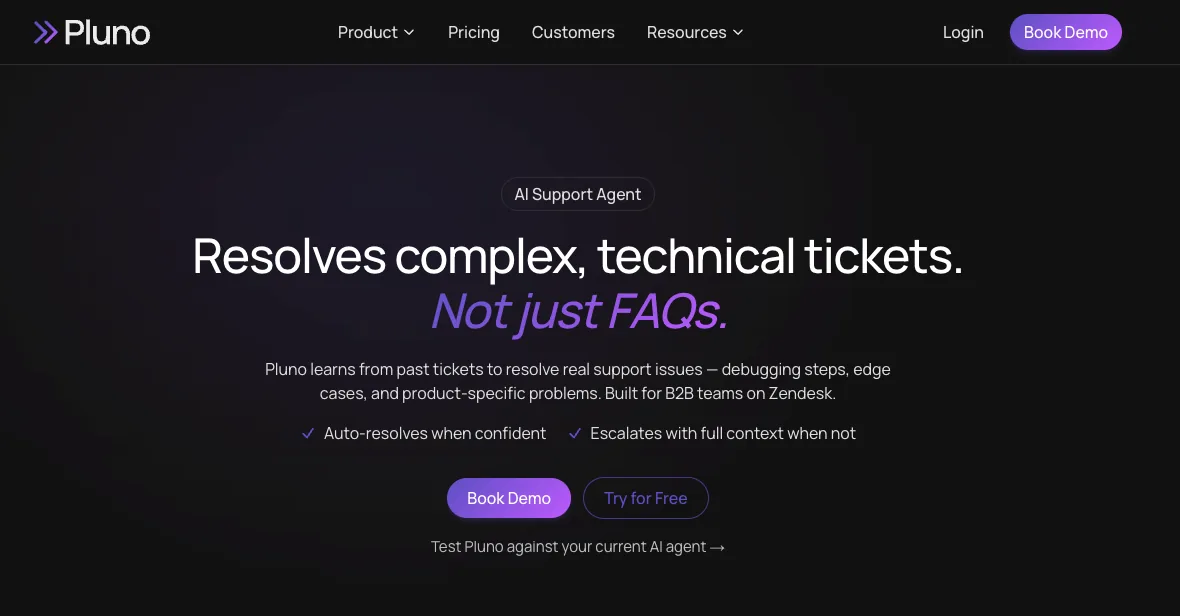
On pricing, Pluno charges €0.90 per resolution, roughly $1 for US readers, and its pricing page defines a resolution as a ticket resolved without human involvement. Escalations aren't counted, so partial work isn't billed. AI Copilot is €49 per agent per month, and the base fee is custom, based on your average ticket volume.
Two limits worth stating. Pluno needs a body of resolved support tickets to learn from, so a team with a short support history gets less from it than a team with years of history. And autonomous deflection on Intercom is arranged case by case per company instead of published, so don't assume it.
If you want the wider set of options on that platform, AI agents that run on Intercom covers the alternatives.
How to pick, in five rules
The reason you are leaving Freshdesk predicts the right destination better than any feature table.
-
If you left because the free plan disappeared, start with Zoho Desk's three-agent tier or Help Scout's five-user tier. Both are hosted, neither has a clock, and both are running in an afternoon.
-
If you left because of cost at scale, look at Zoho Desk on the paid side at $7 to $23 per user, or at Gorgias if your ticket volume is modest relative to your headcount, since it charges nothing per seat.
-
If you left because of the AI bill, compare the AI models instead of the seat prices. Help Scout at $0.75 per resolution and Intercom at $0.99 per outcome are the only two here that publish a unit rate you can forecast against.
-
If you left because child tickets broke your workflow, weight Front and Zendesk highest, and test ticket relationships during the trial before you migrate anything.
-
If you left because your support got technical, the helpdesk matters less than the AI layer you put on it. Zendesk and Intercom have the widest third-party AI ecosystem, which keeps that decision open.