Siena AI has become a fixture on e-commerce shortlists, and its $17M Series A in October 2026 put it in front of even more support leaders. So I went through everything Siena publishes: its pricing page, integrations, product updates, customer stories and its reviews on G2.
Siena has no free trial, so this isn't a hands-on test. It's what Siena promises, what its customers report, and what I'd tell a friend who runs support.
My verdict: Siena AI is a capable AI agent for Shopify brands with order, return and subscription tickets, but it isn't built for complex or technical tickets. For teams whose answers live in a deep history of resolved tickets, Pluno is the stronger fit. It covers the same e-commerce work, learns from those past tickets and runs on Zendesk, Intercom, Salesforce Service Cloud, HubSpot and Jira Service Management.
On top of a monthly platform fee, its AI usage charge applies only to tickets it fully resolves.
Siena still makes sense if you run Gorgias, Kustomer, Gladly or Dixa, or want one vendor to moderate your social comments as well.
To keep the comparison fair, I scored Siena and every alternative on the same six yardsticks:
- Helpdesk fit: where the AI agent runs, and whether you have to change helpdesks.
- Actions: what it can actually do in your other systems, beyond answering.
- Knowledge sources: what it learns from.
- Handoff: what happens when it can't answer.
- Pricing: how you're billed and what it costs to start.
- Setup: who does the work and how long it takes.
TL;DR: Is Siena AI worth it for your support team?
- For teams with complex tickets and a deep ticket history, Pluno is the stronger pick. It covers Siena's order, return and subscription jobs and learns from your past tickets. Beyond its monthly platform fee, it charges 0.90€ only for tickets it fully resolves.
- The bottom-line number: Siena charges a $750 monthly platform fee plus $0.90 per automated ticket. Implementation and support are priced on request.
- Get Siena's billing unit in writing. Its own pages describe what it bills for in three different ways, from "per automated ticket" to "per conversation, regardless of outcome".
- Siena's main limits: no native Salesforce Service Cloud or HubSpot integration listed, no free trial and no public help center. Setup is vendor-led and planned over six weeks.
- Where Siena still wins: Shopify brands on Gorgias, Kustomer, Gladly or Dixa, and teams that want social comment moderation from the same vendor.
- Test before you decide: Pluno runs your last 50 tickets for free and shows its answers next to your team's.
What is Siena AI?
Siena AI is an AI agent for consumer brands. It sits on top of your existing helpdesk, answers customers in your brand's voice, and takes actions in Shopify and subscription apps, like refunds and order changes.
The company behind it is Siena Labs Inc., founded in 2022. Its founders spent more than a decade as Shopify merchants, and it shows. Every customer story on the Siena customers page is a consumer brand, from beauty and fashion to pet food.
Siena calls itself "AI-native" and argues that AI bolted onto a helpdesk falls short (its own comparison). Its site now lists a family of agents that share one customer memory:
- Customer Service Agent: answers tickets and runs post-purchase jobs like returns and refunds.
- Shopping Agent: recommends products and adds them to the cart in chat.
- Social Agent: replies to and moderates Instagram and Facebook comments and DMs.
- Reviews Agent: moderates and replies to product reviews.
- QA Agent and Topics Explorer: score tickets and spot trends.
- Ask Siena and Memory: answer questions about your data and remember each customer.
For the bigger picture beyond e-commerce, I compare the leading tools in AI agents for customer support.
Siena AI features: how it scores on 6 yardsticks
Siena scores highest on actions and lowest on helpdesk fit and pricing clarity. Here's how it holds up on each yardstick, with the source for every claim.
Helpdesk fit: six helpdesks, and Salesforce and HubSpot aren't among them
Siena runs on top of Zendesk, Gorgias, Intercom, Kustomer, Gladly and Dixa. Salesforce Service Cloud, HubSpot and Freshdesk are not on the list as of October 2026.
Siena's FAQ says it "sits on top of your existing helpdesk", so your helpdesk subscription stays a separate bill. One customer, Comfrt, found its existing CRM was "incompatible with Siena" and rolled out Zendesk alongside it. The Series A post adds that "the help desk is included", but Siena doesn't explain publicly what that covers.
What this means for you: if your team works in Salesforce Service Cloud or HubSpot, Siena lists no native integration for it. Siena does advertise custom API integrations, so ask Siena to confirm compatibility before you plan around it. My guide to AI agents for Salesforce Service Cloud covers tools with native Salesforce support.
Actions: Siena's strongest yardstick
Siena can do real work in your e-commerce stack, not just answer questions. On Shopify, it can cancel orders, process refunds, send replacements, edit orders, update shipping addresses and change a customer's email.
It goes further than most AI agents in three places:
- Subscriptions: through Recharge, it can skip shipments, swap products, change frequency and cancel or restart a subscription.
- Order tracking: its order tracking covers 2,000+ carriers and reaches out first when a delivery is late.
- Custom actions: you can connect any API in three steps, and Siena also handles price matching and discount codes.
For a brand where "Where is my order?" and "Can I skip next month?" make up most of the queue, this list covers a lot of tickets. For a B2B SaaS team, almost none of it applies, because your tickets look like "Why did my sync fail?". If you want to see which tickets are worth automating first, start with my guide to customer support automation.
Knowledge sources: documents and store data, not past tickets
Siena learns from documents and store data. Its knowledge sources announcement lists Shopify, Zendesk articles, Yotpo Q&A, Google Docs, Google Sheets, PDFs, text files and websites. It can also import Gorgias macros and host your help center through Siena Docs.
What I couldn't find on any official Siena page is past tickets listed as a knowledge source. That gap matters more than it sounds. In most support teams, the fix for a tricky issue lives in a resolved ticket from last month, not in an article anyone wrote down.
If your help center is thin, you'll spend Siena's setup writing documentation first. Pluno takes the other route and treats past tickets as the primary source, which I cover in the alternatives below.
Handoff: a handoff note on every ticket, and mixed reviews
When Siena can't answer, it routes the ticket to your team with a handoff note. Siena calls this "Collaborative AI Routing", and it adds the note to every handoff. You also get a playground to test each automation with step-by-step reasoning before customers see it.
Reviews tell a more mixed story. Siena holds 4.8 out of 5 from 28 reviews on G2, but the complaints cluster around handoff:
- The AI agent sometimes drags a ticket out instead of routing it to a human.
- It sometimes closes tickets it can't answer.
- After a handoff, it sometimes keeps replying as if the ticket were new.
- It needs ongoing tuning. As one reviewer put it, it's "not set it and forget it".
A caveat on this evidence: 28 reviews is a small sample, and the visible ones date from August 2024 to February 2025. Siena ships updates often, so some of these issues may be fixed.
Still, I'd test handoff first in any trial. My piece on autonomous customer service explains how to measure where autonomy should stop.
Setup: vendor-led, planned over six weeks
Siena sets the AI agent up for you, rather than handing you a self-serve trial. Its implementation blueprint runs over six weeks in three phases and targets 30% or more of customer interactions handled by week six.
Real timelines vary. Comfrt went live in two weeks while moving to Zendesk, and G2 reviewers report an average of one month to implement.
The upside is a hands-on team and a dedicated Slack channel. The downside is that you can't watch Siena answer your own tickets before a sales process. There's no free trial, and its help center needs a login.
For contrast, Velotric switched Pluno on in Zendesk with almost no implementation work.
Siena AI scorecard
| Yardstick | What Siena offers | Score for e-commerce brands | Score for B2B SaaS teams |
|---|---|---|---|
| Helpdesk fit | Zendesk, Gorgias, Intercom, Kustomer, Gladly, Dixa | Good | Weak (no native Salesforce or HubSpot listed) |
| Actions | Shopify orders and refunds, subscriptions, tracking, custom APIs | Excellent | Limited (commerce-only actions) |
| Knowledge sources | Store data, docs, PDFs, websites, macros | Good | Weak (no past tickets listed) |
| Handoff | Handoff note on every ticket, playground | Mixed reviews | Mixed reviews |
| Pricing | $750/month + $0.90 per automated ticket, implementation on request | Fair | Fair |
| Setup | Vendor-led, six-week plan, no free trial | Slow | Slow |
Siena AI pricing: what you'll actually pay
Siena's pricing page lists a $750 monthly platform fee plus $0.90 per automated ticket. The platform fee covers the "core AI engine" and an unlimited sandbox.
Support and implementation are a separate line with no price. To get a quote, you fill in a form with your monthly tickets and helpdesk.
The billing unit changes depending on the page you read
Siena describes what it charges for in three different ways:
- The pricing page: "$0.90 per automated ticket".
- A 2025 blog post and the Gorgias comparison page: a flat rate "for each customer conversation our AI handles, regardless of outcome".
- The October 2026 Series A post: "You pay for outcomes and for intelligence."
Those are very different bills. Paying per conversation "regardless of outcome" means you pay for tickets the AI agent hands back to your team, while paying for outcomes means you don't.
Before you sign, ask Siena three questions and get the answers in your contract:
- Is a ticket the AI agent hands off to a human billable?
- Is a ticket billed once, or once per conversation if the customer writes back later?
- What do implementation and support cost, and is there a minimum term?
What Siena costs at three ticket volumes
Here's a worked example, so you can see the logic and swap in your own numbers. Because Siena's billing unit is unclear, I priced it both ways its own pages describe.
My assumptions: the AI agent handles 70% of tickets and fully resolves 50%, the other 20% being handoffs to your team. Pluno is shown on its monthly and annual prices, converted to US dollars at the ECB reference rate for October 14, 2026 (1 EUR = 1.1195 USD).
| Monthly tickets | Siena, per resolved ticket | Siena, per conversation | Pluno, monthly | Pluno, annual |
|---|---|---|---|---|
| 400 | $930 + support and implementation | $1,002 + support and implementation | about $480 | about $437 |
| 900 | $1,155 + support and implementation | $1,317 + support and implementation | about $1,012 | about $929 |
| 2,500 | $1,875 + support and implementation | $2,325 + support and implementation | about $2,378 | about $2,211 |
Which one costs less depends on how Siena bills you, so get its billing unit in writing. If Siena charges per conversation, as its blog and Gorgias comparison page say, Pluno's annual plan comes in lower at every volume in this table. Pluno's usage charge never applies to handoffs, so its bill doesn't grow when the AI agent passes a ticket to your team.
What the Siena columns leave out:
- Support and implementation: listed on Siena's pricing page with no price, so ask for the amount in writing. Every Pluno customer gets dedicated onboarding with the Pluno team.
- Siena's other agents: the QA Agent, Topics Explorer and Social Agent are separate products with no published prices. Pluno's platform fee already includes AI Copilot, AI Tagging, Escalation Copilot, call summaries and topic trends, with AI Copilot seats at 49€ each on top.
- The scope of the platform fee: Siena's $750 covers its core AI engine and a sandbox, so compare what each fee includes, not just the total.
For a deeper look at how per-resolution billing plays out, see my breakdowns of Zendesk AI pricing and Fin pricing.
Siena AI pros and cons
Siena's pros are depth in e-commerce. Its cons are everything outside it.
Pros
- Deep Shopify and subscription actions, including refunds, order edits and subscription swaps.
- A full e-commerce suite: social, shopping, reviews, QA and analytics agents on one customer memory.
- Brand-voice personas, with channel-specific tone.
- Strong published results, all reported by Siena: Spanx says Siena handles 50% of conversations and halved handle time, and HexClad reports over 65% automation.
- A hands-on implementation team.
Cons
- Built only for e-commerce, with no B2B or SaaS use cases on its site.
- Six native helpdesk integrations, with no Salesforce Service Cloud, HubSpot or Freshdesk listed.
- A $750 monthly minimum before any tickets, plus an unpublished implementation fee.
- No free trial, no public help center and no published list of supported languages.
- A billing unit that changes from page to page.
- Recurring G2 complaints about handoff.
If those cons rule Siena out but you want to stay with an e-commerce-first tool, my Gorgias alternatives roundup covers more options.
Who should choose Siena AI (and who shouldn't)
Choose Siena if you're a Shopify brand on Gorgias, Kustomer, Gladly or Dixa and most of your tickets are about orders, returns and subscriptions. It suits teams that want Siena's staff to build the setup for them. It also fits if you want the same vendor to moderate your Instagram and Facebook comments, which Pluno doesn't do.
Look elsewhere if your tickets need troubleshooting or your team runs Salesforce Service Cloud or HubSpot. The same goes if you want to see an AI agent answer your real tickets before a sales call. Siena says it's "trained exclusively on e-commerce support scenarios", and a SaaS support queue isn't one of them.
If you're on Zendesk, Intercom, Salesforce Service Cloud, HubSpot or Jira Service Management, Pluno covers the same e-commerce work and is stronger on the yardsticks where Siena is weakest. Here's how it compares with the other alternatives.
5 best Siena AI alternatives compared
For teams with complex or technical tickets and a deep history of resolved tickets, the best Siena AI alternative is Pluno. The other four each fit a different case:
- Gorgias AI Agent for brands already on Gorgias.
- Yuma AI for the closest match to Siena's e-commerce focus.
- Fin for teams on Intercom.
- Zendesk AI agents for simple flows and a strong help center inside Zendesk.
Each tool below gets the same six yardsticks Siena did. Every price below comes from the vendor's own pricing page, checked on October 14, 2026.
1. Pluno: best for complex tickets and a deep ticket history
Pluno adds AI to the helpdesk your team already works in. It resolves tickets on its own, drafts replies for your human agents, and hands issues to engineering with the research already done. It covers Siena's order, return and subscription work, and it was built for the complex tickets Siena isn't trained on.
- Helpdesk fit: runs inside Zendesk, Intercom, Salesforce Service Cloud, HubSpot and Jira Service Management as a native app. There's no new inbox and no ticket migration.
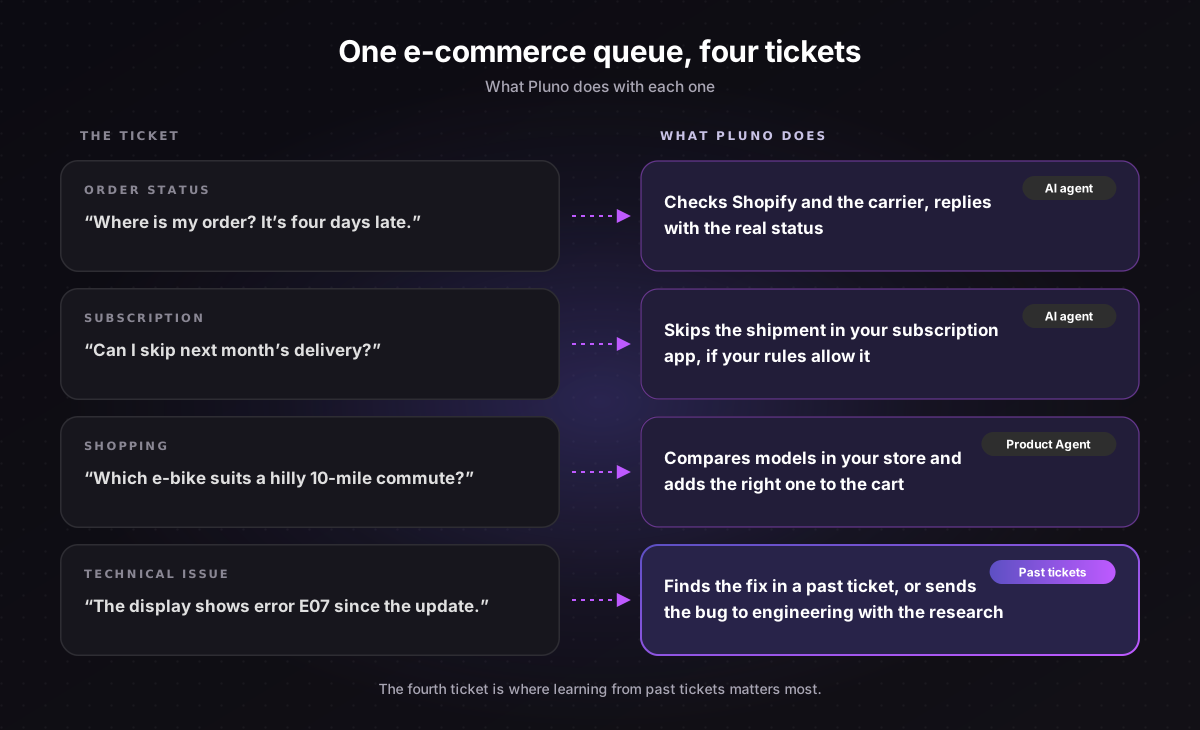
- Actions: Pluno can carry out refunds, order edits, address updates and replacements in Shopify, and subscription changes through apps such as Recharge or Skio. It does these on its own only where your AI Workflow rules allow it, and anything that needs a business decision goes to your team. It also messages customers first when a delivery is late and can call your own APIs to read or write live data.
- Knowledge sources: your past tickets come first. Pluno rebuilds the troubleshooting steps and fixes your agents actually used, favoring the latest successful ones. It adds your help center, docs, uploaded files and the places your team works, such as Slack, Jira, Confluence or Notion.
- Handoff: Pluno replies only when its sources agree. When they don't, it hands off with a research summary, the tickets it checked and suggested next steps. Escalation forms can collect required details from the customer first.
- Pricing: a monthly platform fee from 249€ for up to 500 tickets. On top of that, the AI usage charge is 0.90€ per ticket it fully resolves, and escalations are never billed. AI Copilot is 49€ per seat. See Pluno pricing.
- Setup: Pluno connects to your helpdesk and starts learning from your ticket history right away, and most teams see useful results within days. Every customer gets dedicated onboarding, and there's a 14-day free trial.
Beyond the AI agent, Pluno covers several jobs Siena sells as separate agents, and adds one Siena doesn't list:
- Quality checks, like Siena's QA Agent: Quality Assurance scores every ticket against your own rubric.
- Trend spotting, like Topics Explorer: topic insights track what customers write in about and how that changes.
- Shopping help, like the Shopping Agent: Pluno's Product Agent works inside your store as a shopping assistant. Shoppers ask it questions, it researches products for them and it can take actions like adding items to the cart.
- Engineering escalations, which Siena doesn't list: Escalation Copilot sends bugs to the tool your engineering team already uses, such as Slack, Jira, Linear, Microsoft Teams or incident.io. Updates sync back to the ticket.
Social comment moderation and review management are not on this list. If you need those, Siena covers them and Pluno doesn't.
The proof that matters most for Siena shoppers comes from Velotric, a direct-to-consumer e-bike brand on Zendesk. Its AI agent handles 58% of routed tickets and answers simple questions in about 10 seconds. On harder tickets, agent research time fell from 20 minutes to under 5, and Velotric's team said there was almost nothing to implement.
"Pluno helped us turn repetitive questions into scalable AI-assisted support while allowing us to focus our time and expertise where human involvement matters most."
Cristina Mercado, Reputation and Trust Manager in Customer Support at Velotric
Where Pluno beats Siena:
- Native apps for Salesforce Service Cloud and HubSpot, which Siena doesn't list, alongside Zendesk and Intercom.
- Past tickets as the main knowledge source.
- Engineering escalations with the research done.
- A usage charge only for full resolutions on top of the platform fee, plus a free trial.
Limits to know: Pluno doesn't moderate Instagram or Facebook post comments, and it doesn't run on Gorgias, Kustomer, Gladly or Dixa. It also doesn't answer phone calls, though it summarizes them from the recording.
For a closer look at how Pluno handles complex tickets, see how Deflection AI works.
2. Gorgias AI Agent: best for brands already on Gorgias
Gorgias AI Agent is the AI agent built into the Gorgias helpdesk, which focuses on Shopify brands. If your team already lives in Gorgias, it's the simplest Siena alternative to switch on.
- Helpdesk fit: works only inside Gorgias, and needs a Shopify store connected.
- Actions: refunds, cancellations, order edits, address changes, returns with a prepaid label and discounts, from a library of 130+ actions. Through Recharge it can skip, pause or cancel subscriptions.
- Knowledge sources: your guidance, help center, store website, public pages and uploaded documents. Gorgias says the AI agent doesn't use your macros, and its documentation doesn't list past tickets as a source.
- Handoff: it always hands off on anger, a request for a human or sensitive topics, and you can add your own handover topics.
- Pricing: $1.00 per automated interaction on monthly plans or $0.90 on annual, on top of a Gorgias plan from $10 to $900 a month. Each interaction also counts as a billable helpdesk ticket.
- Setup: self-serve, "live in under an hour" according to Gorgias, with a 7-day free trial.
Best for: Shopify brands that already use Gorgias and want one bill. Watch out for: the double count, since every AI interaction also uses a helpdesk ticket. My Gorgias pricing breakdown shows how that adds up.
3. Yuma AI: the closest match to Siena
Yuma AI is an AI agent built for e-commerce brands, like Siena, and it sits on top of your helpdesk. It's the alternative to shortlist if you want Siena's e-commerce depth with a different billing model.
- Helpdesk fit: its integrations page lists ten helpdesks, including Gorgias, Zendesk, Kustomer, Gladly, HubSpot and Salesforce Service Cloud.
- Actions: Shopify order edits, refunds, discounts and tracking, Recharge subscription changes, and 100+ pre-built actions. It can also drive a browser for tools with no API.
- Knowledge sources: past tickets, your help center and product catalog. Yuma says it builds its handbook from past tickets.
- Handoff: hands off on low confidence, frustration or out-of-scope topics with the full thread, and you can set rules by topic, sentiment or VIP status (Yuma FAQ).
- Pricing: billed per full resolution and sold as annual bundles from $14,400 a year. That works out to about $1.20 per resolution, falling to about $0.75 on larger plans.
- Setup: vendor-led, with no do-it-yourself option, and a 30-day free trial on live tickets.
Best for: e-commerce brands that want resolution-based billing and can commit to a year upfront. Watch out for: the 12-month commitment and the $14,400 entry point. My customer support automation guide helps you size the resolutions you'd actually need.
4. Fin: best for teams on Intercom
Fin is the AI agent from the company formerly called Intercom, which Salesforce finished acquiring in September 2026. It's a general-purpose AI agent, not an e-commerce specialist.
- Helpdesk fit: native to Intercom, and supported on Zendesk, Salesforce Service Cloud, Freshdesk and HubSpot, or any helpdesk through its API.
- Actions: refunds, cancellations and account changes through Procedures, its natural-language workflows, using data from systems like Shopify and Stripe (Fin Procedures). I found no Recharge integration.
- Knowledge sources: your help center, website, PDFs and tools like Notion or Confluence. Its help article lists past Intercom conversations among approved sources.
- Handoff: you set handoff rules on customer data or in plain language, and your agents get the full thread (Fin training).
- Pricing: $0.99 per outcome. On your existing helpdesk there's a $49 monthly minimum that includes 50 outcomes, and on Intercom you add seats from $29 per month, billed annually. Fin counts an outcome when the customer confirms the issue is solved or doesn't ask for more help after Fin replies. A completed Procedure also counts, including some handoffs.
- Setup: self-managed, and Fin says most teams go live the same day, with a 14-day free trial.
Best for: teams that run Intercom and want broad channel coverage, including voice.
Watch out for: Procedure handoffs. Both Fin and Pluno treat a customer who doesn't write back as resolved (Pluno waits 72 hours after its last reply). The difference is that Pluno never bills a ticket it escalates, while Fin can charge for a configured Procedure that ends in a handoff.
My Fin pricing guide walks through it.
5. Zendesk AI agents: best for simple flows inside Zendesk
Zendesk AI agents are Zendesk's own AI agents, included in every Suite and Support plan. They're the native choice if you run Zendesk and your answers already live in your help center.
- Helpdesk fit: inside Zendesk only, except Forethought AI agents by Zendesk, which are sold separately and can run on other platforms.
- Actions: action flows and custom actions that call outside systems through an API. Zendesk's public Shopify refund recipe uses Copilot with an agent's approval, so check autonomous refunds in a demo.
- Knowledge sources: your help center plus up to 50 external sources, like Confluence, Google Drive or Notion (Zendesk docs). Past tickets aren't a direct answer source, though Knowledge Builder can draft articles from them.
- Handoff: routes to the right team with the ticket context, and messaging AI agents can create a ticket for later follow-up.
- Pricing: Zendesk's pricing page lists automated resolutions at $1.50 committed or $2.00 pay-as-you-go, on top of plans from $19 per agent per month, billed annually. Its help center describes a newer tiered model with a dollar allowance per seat, so confirm which applies to you.
- Setup: self-serve, with a 14-day free trial.
Best for: Zendesk teams with a strong help center and simple, repeatable requests. Watch out for: pricing that's in transition. My Zendesk AI pricing breakdown explains both models.
Siena AI vs the alternatives side by side
| AI agent | Helpdesk fit | Actions | Learns from past tickets | Pricing (October 2026) | Setup | Best for |
|---|---|---|---|---|---|---|
| Pluno | Zendesk, Intercom, Salesforce Service Cloud, HubSpot | Shopify orders and refunds within your rules, subscriptions, delivery alerts, custom APIs | Yes, as the main source | From 249€/month platform fee + 0.90€ per resolution | Days, onboarding included, 14-day trial | Teams with complex tickets and a deep ticket history |
| Siena AI | Zendesk, Gorgias, Intercom, Kustomer, Gladly, Dixa | Shopify orders and refunds, subscriptions, tracking, custom APIs | Not listed | $750/month + $0.90 per automated ticket + implementation | Vendor-led, six-week plan | Shopify brands on its six helpdesks |
| Gorgias AI Agent | Gorgias only, with Shopify | 130+ actions, Recharge | Not in its docs | $0.90 to $1.00 per interaction + Gorgias plan | Self-serve, 7-day trial | Brands already on Gorgias |
| Yuma AI | Ten helpdesks, including Gorgias and Zendesk | 100+ actions, Recharge, browser actions | Yes | From $14,400/year (~$1.20 per resolution) | Vendor-led, 30-day trial | E-commerce brands ready for an annual plan |
| Fin | Intercom, Zendesk, Salesforce Service Cloud, Freshdesk, HubSpot | Procedures with Shopify and Stripe data | Yes, past Intercom conversations | $0.99 per outcome + seats or $49/month minimum | Same day, 14-day trial | Intercom teams |
| Zendesk AI agents | Zendesk | Action flows and custom API actions | Drafts articles from them | $1.50 to $2.00 per resolution + Zendesk plan | Self-serve, 14-day trial | Simple flows in Zendesk |
How to test Siena AI against an alternative on your own tickets
The only comparison that counts is one on your own tickets. Here's the process I'd run, and it fits into about two weeks.
- Sort a sample. Export your last 200 tickets and tag each one as an order or subscription request, a how-to question or a technical issue. The mix tells you which yardstick matters most.
- Check helpdesk fit first. If your helpdesk isn't on a vendor's list, cross it off before you book a demo.
- Get pricing at your volume. Send each vendor your monthly ticket count, and ask Siena the three billing questions from the pricing section.
- Run the same tickets through each AI agent. Pluno will run your last 50 tickets for free and show its answers next to your team's. Use the free trials for Gorgias, Yuma, Fin and Zendesk, and Siena's playground during the sales process.
- Grade every answer. Mark each one correct, wrong or handed off, and count wrong answers on their own, because a wrong refund costs more than a slow one.
- Read ten handoff notes per vendor. Ask one question: could your agent act on this without rereading the whole thread?
- Work out cost per resolution. Divide each vendor's monthly total, including platform fees, by the tickets it would have fully resolved.
- Pilot on one channel. Turn the winner on for email or chat only for two weeks, then expand.
If you want a wider field for step 4, my list of the best AI agents for Zendesk applies the same kind of test.
The bottom line
Siena AI is a capable AI agent for Shopify brands with transactional tickets, and its actions are among the deepest in e-commerce. Its limits are the helpdesks it supports, the unclear billing unit and a setup you can't try before a sales call.
If your tickets are complex or technical and your team has a deep history of resolved tickets, Pluno is the stronger choice. It covers the same order, return and subscription work and learns from those past tickets. It runs on Zendesk, Intercom, Salesforce Service Cloud, HubSpot and Jira Service Management, and on top of its platform fee it charges only for tickets it fully resolves.
Pick Siena if you run Gorgias, Kustomer, Gladly or Dixa, or want social comment moderation from the same vendor. Otherwise, start with a free Pluno simulation on your last 50 tickets and compare the answers yourself.
FAQ
How much does Siena AI cost?
Siena's pricing page lists a $750 monthly platform fee plus $0.90 per automated ticket, as of October 2026. Support and implementation are a separate line with no published price, and Siena sends a quote after you share your ticket volume and helpdesk. Its blog and comparison pages describe billing per conversation instead, so confirm what counts as billable before you sign.
Is it Siena AI or Sienna AI?
It's Siena AI, with one "n". The official site is siena.cx, and the company behind it is Siena Labs Inc. "Sienna AI" is a common misspelling.
Does Siena AI replace my helpdesk?
No, not for email and chat support. Siena's FAQ says it sits on top of your existing helpdesk, and it supports Zendesk, Gorgias, Intercom, Kustomer, Gladly and Dixa. Its October 2026 Series A post says "the help desk is included", but Siena hasn't published what that covers.
Does Siena AI work with Shopify, Zendesk and Gorgias?
Yes. Shopify is Siena's main e-commerce integration, with actions like refunds, cancellations and order edits. It also runs on top of Zendesk and Gorgias, along with Intercom, Kustomer, Gladly and Dixa.
Can I use Siena AI with Salesforce Service Cloud or HubSpot?
Siena lists no native integration for either as of October 2026. It does offer custom API integrations, so ask Siena whether your setup can be connected. Pluno, Fin and Yuma all list native support for Salesforce Service Cloud and HubSpot.
What are Siena AI's most common complaints?
On G2, reviewers mention occasional wrong answers, slow or missed handoffs to a human, tickets closed without an answer and the need for ongoing tuning. Siena still averages 4.8 out of 5 from 28 reviews. Most visible reviews date from 2024 and early 2025, so some issues may be fixed.
Does Siena AI have a free trial?
Siena doesn't advertise a free trial, and its help center requires a login. You can test automations in its playground during the sales process. Pluno, Gorgias, Fin, Zendesk and Yuma all offer free trials.
What is the best Siena AI alternative?
For teams with complex tickets and a deep ticket history, Pluno. It covers Siena's e-commerce actions, learns from past tickets and runs natively on Salesforce Service Cloud and HubSpot as well as Zendesk and Intercom.
Its usage charge applies only to full resolutions, on top of a monthly platform fee. If you're already on Gorgias, its built-in AI agent is the simplest switch, and Yuma is the closest e-commerce match to Siena.
Who is behind Siena AI?
Siena AI is made by Siena Labs Inc., founded in 2022 by a team that spent over a decade as Shopify merchants. It raised a $17M Series A in October 2026, led by York IE.