Gorgias pricing starts at $10 a month for 50 tickets and goes up to $900 a month for 5,000, billed by ticket volume instead of per seat, with the AI Agent charged separately at $0.90 to $1.00 per resolution.
That covers what Gorgias publishes clearly. What it doesn't spell out is what happens once you cross an allowance, and for most brands, crossing an allowance is the normal condition.
Gorgias is the only major helpdesk that prices a conversation instead of a person, so your bill tracks how many customers write in and team size doesn't change anything. Two meters run at once: one counts tickets, and one counts automated interactions, each with its own allowance and overage rate.
This article covers every line that can appear on a Gorgias invoice: the four published plans and Enterprise, what makes a ticket billable, how the AI Agent is charged, the add-ons, and the overage arithmetic that no published guide has done. Then it works two examples so you can drop in your own numbers and get a figure before you talk to anyone.
All figures were read on Gorgias's live pricing page on 16 August 2026. That page is JavaScript-rendered, which means it returns nothing to an automated fetch, so several figures circulating on other sites are stale. Check the live page in a browser before you build a business case on any of this.
Key takeaways
-
Four published plans plus Enterprise. The helpdesk costs $10, $60, $360 or $900 a month on monthly billing, covering 50, 300, 2,000 or 5,000 tickets.
-
Nobody is billed per agent. Gorgias's pricing page states the helpdesk is "never priced per agent," so headcount does not change the price.
-
AI Agent is a separate meter at $1.00 per automated interaction on monthly billing and $0.90 on annual, with $1.50 for anything past your included allowance.
-
Overage costs exactly double the included rate on every tier. Basic's 300 tickets work out at $0.20 each and overage is $0.40. Pro's 2,000 work out at $0.18 and overage is $0.36.
-
Included AI covers about 10% of your included tickets on every plan above Starter, so a brand automating more than a tenth of its volume pays overage from the first month.
-
Annual billing saves 16.7% on the helpdesk and 10% on the AI Agent, which blends to roughly 14.3% on the bundle. Starter is monthly-billing only.
Gorgias pricing at a glance
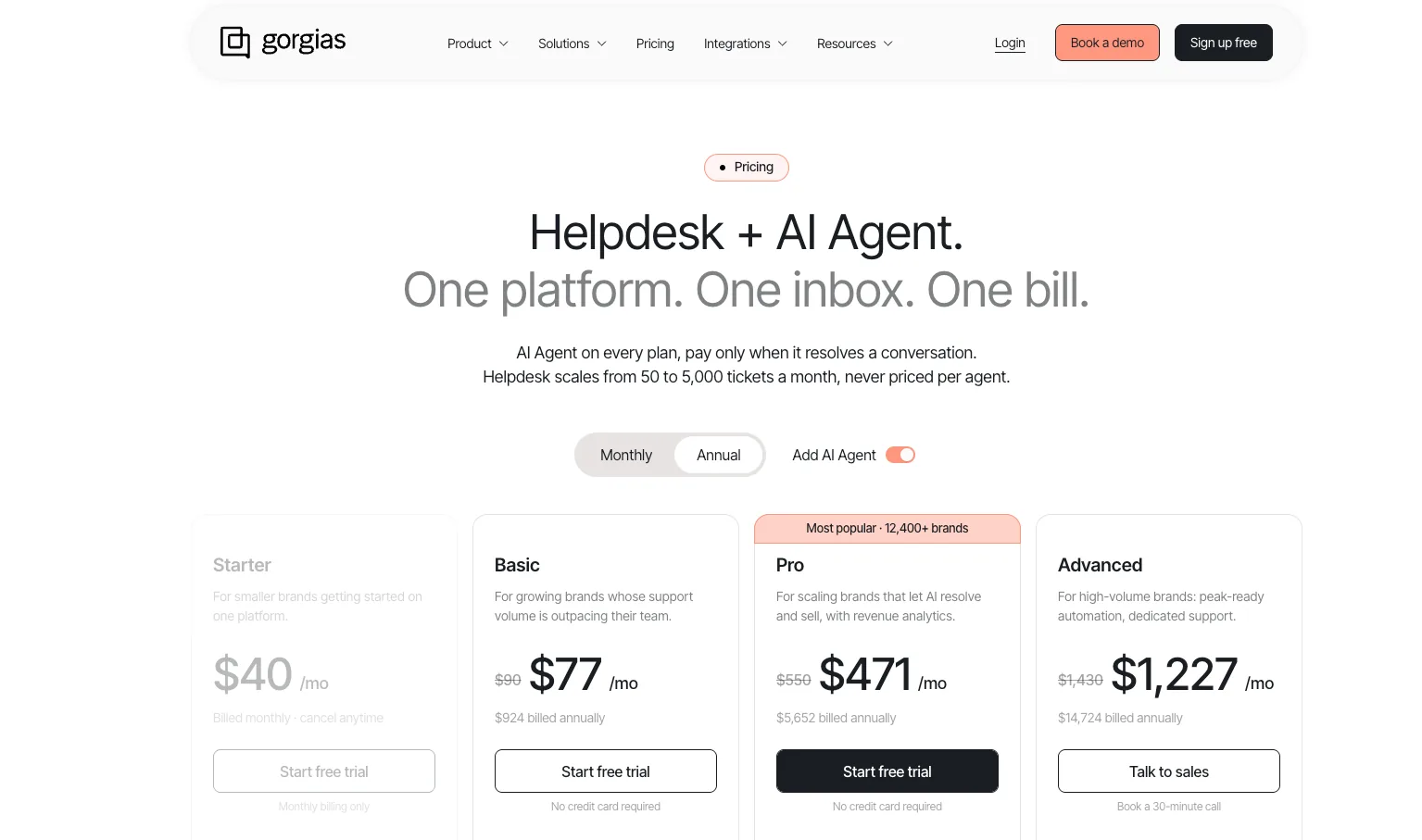
Gorgias has four published plans and one custom tier, and every price splits into a helpdesk fee and an AI Agent fee.
Monthly billing
| Plan | Total /mo | Helpdesk | AI Agent | Tickets included | Automated interactions | Ticket overage | AI overage |
|---|---|---|---|---|---|---|---|
| Starter | $40 | $10 | $30 | 50 | 30 | $0.40 | $1.50 |
| Basic | $90 | $60 | $30 | 300 | 30 | $0.40 | $1.50 |
| Pro | $550 | $360 | $190 | 2,000 | 190 | $0.36 | $1.50 |
| Advanced | $1,430 | $900 | $530 | 5,000 | 530 | $0.36 | $1.50 |
| Enterprise | Custom | Custom | Custom | 5,000+ | Custom | Not published | Not published |
That split is the most useful thing on this page, and it explains a contradiction you have probably already run into. Some articles say Basic costs $60 and others say $90. Both are reading Gorgias's own card correctly. The $60 is the helpdesk on its own and the $90 is the helpdesk with the AI Agent switched on. Gorgias sells them as one bill and shows them as two line items.
Annual billing
| Plan | Total /mo | Billed annually | Helpdesk | AI Agent |
|---|---|---|---|---|
| Basic | $77 | $924 | $50 | $27 |
| Pro | $471 | $5,652 | $300 | $171 |
| Advanced | $1,227 | $14,724 | $750 | $477 |
Starter does not appear here. Gorgias marks Starter as billed monthly with cancellation any time, and greys it out under the annual toggle, so annual billing is unavailable on the entry plan.
Enterprise sits above all of it, aimed at teams over 5,000 conversations a month with security, compliance or integration requirements. It adds SSO through SAML, audit logs, SCIM provisioning, unlimited Help Centers, API access at four requests per second, a custom DPA or MSA with security review support, and a dedicated CSM and solutions architect. Gorgias publishes no price and no overage rate for it.
How Gorgias pricing works: you pay per ticket
Gorgias bills you for conversations instead of for the people answering them.
Every other major helpdesk starts from a seat. You count your agents, multiply, and the number stays the same until you hire. Gorgias starts from a conversation, and its pricing page says the helpdesk is "never priced per agent."
The consequence runs both ways, and a fair reading has to hold both. A team of twelve handling 2,000 tickets a month pays exactly what a team of three handling 2,000 tickets pays, which on a seat model would cost the larger team nine extra licenses. And a Black Friday spike costs money in a way a seat model never does, because the meter is your customers, not your staff.
Two meters run at the same time. Tickets have an allowance and an overage rate, and automated interactions have their own allowance and overage rate. Most bill surprises come from someone tracking the first and forgetting the second.
Going over does not stop anything. Gorgias describes a soft cap and says on its own blog that you "never get cut off from receiving customer messages" past your monthly limit. That is good service design, and it also means the bill has no ceiling of its own. Nothing intervenes between a busy month and an invoice.
What counts as a billable ticket
A Gorgias ticket becomes billable the moment you send anything from your helpdesk, including an automatic reply.
Gorgias's billing documentation puts it precisely. A ticket counts when at least one message is sent from your helpdesk, whether that message comes from a human agent, the AI Agent or an automatic reply from a Rule.
One conversation is one billable ticket no matter how long it runs. A customer who sends nine follow-ups costs the same as a customer who sends one, which favors brands whose support threads run long.
Several things do not count:
-
Inbound tickets you never answer.
-
Internal-only changes, including assignee changes, tags and internal notes.
-
Replies made directly inside a third-party platform such as Facebook instead of through the helpdesk.
One practical read follows from the Rules clause. An automatic reply makes a ticket billable, so an aggressive auto-responder turns unanswered inbound into paid volume. If you have a Rule that acknowledges everything on arrival, it is worth auditing what share of those tickets a human would ever have touched.
The Gorgias plans in detail
Gorgias has four published tiers, and what separates them is ticket allowance more than features.
Starter: $10/month helpdesk, 50 tickets
Starter includes 30 automated interactions, charges $0.40 per extra ticket and $1.50 per extra automated interaction.
It is monthly-billing only. Gorgias greys it out under the annual toggle and marks it "billed monthly, cancel anytime," which no other published guide mentions.
One oddity is worth noticing. Starter bundles 30 AI interactions against 50 tickets, which is 60% coverage. Proportionally that is far more generous than any tier above it, and it makes Starter the only plan where the AI allowance is not the binding constraint.
Basic: $60/month helpdesk, 300 tickets
Basic includes 30 automated interactions and charges $0.40 per extra ticket. Gorgias's guidance is to start here if you handle 200 to 300 tickets a month.
The catch sits in that AI number. Basic carries the same 30 interactions as Starter but at six times the tickets, so AI coverage drops from 60% to 10% at exactly the point most brands land.
Pro: $360/month helpdesk, 2,000 tickets
Pro includes 190 automated interactions and charges $0.36 per extra ticket. It is the largest step in the range, six times Basic's helpdesk fee for 6.7 times the tickets, and the point where the ticket overage rate improves.
Gorgias marks it as most popular and claims 12,400+ brands on it.
Advanced: $900/month helpdesk, 5,000 tickets
Advanced includes 530 automated interactions and charges the same $0.36 per extra ticket as Pro. The step from Pro buys allowance while the marginal rate stays flat, which matters if you are choosing between upgrading and absorbing overage.
Enterprise: custom
Enterprise covers teams over 5,000 conversations a month. It adds the security and scale items listed earlier.
Gorgias publishes no Enterprise price and no Enterprise overage rate. One competing guide states $7,000 a month and a $0.32 ticket overage. Neither figure appears on any Gorgias page we could read, so neither is repeated here as fact.
Gorgias AI Agent pricing (formerly Automate)
Gorgias AI Agent costs $1.00 per automated interaction on monthly billing and $0.90 on annual, charged on top of the ticket fee.
The product was called Automate before it was called AI Agent, which is why older guides use both names for the same meter.
Past your included allowance, every additional automated interaction costs $1.50 regardless of plan or billing term.
The double billing, and the part that favors Gorgias
When the AI Agent fully resolves a conversation with no human involved, Gorgias charges you twice on the same conversation, once as a ticket and once as an automated interaction. Its billing documentation states this directly, and it is the single most misunderstood thing about Gorgias pricing.
The other half of the rule is less known, and it works in Gorgias's favor. When the AI hands the conversation to a human, you pay only the ticket fee. Gorgias's blog says the conversation "becomes a standard resolved ticket," and you are not billed on both meters. Several vendors in this category charge on both sides of a handoff, so this is a point in Gorgias's favor, and it belongs in any fair comparison.
The AI meter also runs wider than the chatbot. Flows, Order Management and Article Recommendations each incur an automation fee when they resolve something on their own, so automation you set up months ago and forgot about is still counting.
What the AI Agent works from
Gorgias documents the AI Agent as drawing on your help center articles, website content, documents, guidance and Shopify data. It runs on email, chat and SMS, supports over 80 languages, and can cancel an order, process a return or update a shipping address in connected tools. It hands over when it cannot answer confidently, hits a sensitive topic or detects frustration.
Rates across this category aren't directly comparable because Gorgias bills a ticket and an interaction, while other vendors bill a resolution or a conversation. Compare the definitions before you compare the numbers. For the nearest per-resolution model, see how Intercom Fin's per-resolution pricing compares.
The overage maths nobody does
On every Gorgias plan, an extra ticket costs exactly twice what a ticket inside your allowance costs.
Gorgias publishes both numbers on the same card. Nobody divides one by the other.
| Plan | Included rate | Overage rate | Multiple |
|---|---|---|---|
| Starter | $10 ÷ 50 = $0.20 | $0.40 | 2× |
| Basic | $60 ÷ 300 = $0.20 | $0.40 | 2× |
| Pro | $360 ÷ 2,000 = $0.18 | $0.36 | 2× |
| Advanced | $900 ÷ 5,000 = $0.18 | $0.36 | 2× |
It holds to the cent on all four published tiers. The AI meter works the same way with a different ratio. Basic's 30 interactions cost $30, or $1.00 each, with a $1.50 overage. That is 1.5 times. On annual billing, the included rate drops to $0.90 while overage stays at $1.50, so annual customers face a 1.67 times multiple on anything past the allowance.
The number that actually drives your bill
Divide the included AI interactions by the included tickets, and the picture gets sharper.
| Plan | Interactions | Tickets | Coverage |
|---|---|---|---|
| Starter | 30 | 50 | 60% |
| Basic | 30 | 300 | 10% |
| Pro | 190 | 2,000 | 9.5% |
| Advanced | 530 | 5,000 | 10.6% |
Every tier above Starter bundles enough AI for roughly a tenth of your volume. Automation rates well above that are the whole point of buying an AI agent, so a brand resolving 30% of its tickets automatically is paying $1.50 each on two-thirds of them.
The practical conclusion is short. Buy the plan whose allowance covers your peak month, because the moment you cross it every unit costs twice what it did inside.
None of this is a trick. Volume pricing with published overage rates is more transparent than most of this category, and charging more at the margin than inside a committed block is ordinary commercial structure. The problem is that nobody tells buyers the multiple is there, and it is one division away on a page Gorgias publishes.
Add-ons: Voice, SMS and Convert
Voice and SMS are add-ons available on any Gorgias plan, and Gorgias does not publish per-unit rates for either.
Its pricing page says only that pricing scales with your call and text volume, and offers tiers matched to usage without naming them.
You will find per-ticket figures for both quoted on other pricing guides. None cite a Gorgias source, so they don't appear here.
Convert is a separate Gorgias product and isn't priced on the helpdesk pricing page.
If voice or SMS carries meaningful volume for you, get the rates in writing in your quote before you sign. An unpublished rate is one you cannot forecast and cannot hold anyone to.
What Gorgias actually costs: two worked examples
A brand on Basic doing 700 tickets a month with 140 AI resolutions pays about $415, against a $90 plan price.
Published estimates for Gorgias vary widely and most of them do not show their working. Both examples below show every line so you can substitute your own volumes.
Example 1: a DTC brand on Basic, monthly billing
-
Helpdesk base, 300 tickets included = $60/mo
-
Actual volume 700 tickets, so 400 over × $0.40 = $160/mo
-
AI Agent base, 30 interactions included = $30/mo
-
AI resolves 140 conversations, so 110 over × $1.50 = $165/mo
-
Total: $415/mo
The plan costs $90 and the bill is $415. Overage across the two meters comes to $325, which is 3.6 times the plan price.
There is a trap worth spotting here. This brand pays $415 a month, while Pro's bundled monthly price is $550 and includes 2,000 tickets and 190 interactions. Once overage runs this hot, the next tier up is close to break-even, and on annual billing Pro's bundle drops to $471.
Example 2: a scaling brand on Pro, annual billing
-
Helpdesk base, 2,000 tickets included = $300/mo
-
Actual volume 3,000 tickets, so 1,000 over × $0.36 = $360/mo
-
AI Agent base, 190 interactions included = $171/mo
-
AI resolves 900 conversations, so 710 over × $1.50 = $1,065/mo
-
Total: $1,896/mo, or $22,752 a year
The published plan price is $471, and the bill is four times that. The AI overage alone, at $1,065, is larger than every other line combined.
That is what the 10% coverage figure looks like in money. This brand automates 30% of its tickets, which is a good outcome operationally, and the plan was built to include a third of that.
How to keep the Gorgias bill predictable
Five habits keep a Gorgias bill predictable, and the first one has to happen before you pick a plan.
-
Size the plan to your peak month. Overage costs double inside every tier, so a plan sized to your average is a plan that charges you twice for every busy week.
-
Audit your Rules before you tune them. An automatic reply makes a ticket billable, so an auto-responder on unanswered inbound converts free volume into paid volume.
-
Track the two meters separately. Tickets and automated interactions have different allowances and different overage rates, and the AI allowance is the smaller of the two on every plan above Starter.
-
Work out your automation rate as a share of ticket volume and compare it with the 10% or so your plan includes. If yours is higher, price the excess at $1.50 before you switch anything else on.
-
Recheck the tier maths quarterly. When combined overage approaches the next plan's price, moving up buys allowance at half the marginal rate.
Free trial, the startup program and discounts
Gorgias offers a 7-day free trial with no credit card, capped at 10 email ticket messages.
The trial covers both products, Helpdesk and AI Agent, and Gorgias's signup page confirms you don't need a card to start.
The message cap deserves attention. Gorgias states on its own blog that you can send a maximum of 10 email ticket messages during the trial. Ten messages will show you the interface and setup flow, but they won't show you the volume behavior that drives the entire bill. Treat the trial as a product demo and forecast your cost from the arithmetic above.
Annual billing
Annual is the discount available to everyone. It takes 16.7% off the helpdesk and 10% off the AI Agent, blending to roughly 14.3% on the bundle, and it drops the AI unit rate from $1.00 to $0.90. Starter is excluded because it bills monthly only.
The startup program
Gorgias runs a startup program, and its own startups page returns a 404, so the terms below come from a third-party founder's guide instead of from Gorgias.
That guide reports that the second and third months of any paid plan are free, that you must be a brand-new Gorgias customer and an early-stage startup, and that you have to sign up through a recognized partner portal such as an accelerator, a VC firm, or a startup deal platform.
None of that is verifiable on a Gorgias page. If you qualify, confirm the terms through your accelerator or directly with Gorgias before you plan around them.
When Gorgias is the right buy, and when it isn't
Gorgias is worth it when your tickets are about orders, returns, and shipping.
Buy it when:
-
You run an ecommerce brand, especially on Shopify, where the AI Agent's order, return, and shipping actions map onto your actual ticket mix.
-
You have a large team on modest ticket volume, since you pay nothing per seat and a seat model would punish you for the headcount.
-
Your volume is steady enough to size a plan against with confidence.
-
You want one vendor and one bill for the helpdesk and the AI, which saves the coordination overhead of running two contracts.
Think harder when:
-
Your volume is seasonal, and your peak sits far above your average, because per-ticket pricing punishes that shape.
-
You plan to automate well past a tenth of your tickets, which is where the second meter takes over your bill.
-
Voice or SMS is a primary channel, and you cannot get rates in writing.
-
Your support has stopped being transactional.
It is worth being fair about the transparency here. Gorgias publishes its plan prices, its included allowances, its overage rates for both meters and its AI unit rate on one page, and defines a billable ticket in its documentation. Several vendors in this category publish none of that.
The last bullet is the one worth expanding. Gorgias's AI Agent works from help center articles, website content, documents, and Shopify data, and its documented actions are order cancellations, returns, and shipping updates. For a brand answering questions about orders, that is exactly the right knowledge model. A seller whose tickets have turned into integration failures, API errors, and account-specific configuration problems has a different problem, and those sellers usually end up evaluating Zendesk or Intercom instead.
Pluno is an AI support agent for complex technical tickets that works inside Zendesk and Intercom. It ingests your resolved support tickets, which is where the answers to those issues already live, because an agent worked each one out and nobody wrote it up afterwards. It needs a body of resolved tickets to learn from, so a team with a short support history gets less out of it than a team with years of history.
If you are weighing the AI layer on either of those platforms, what Zendesk's AI costs covers the other side of that decision.
Frequently asked questions
How much does Gorgias cost per month? The helpdesk costs $10, $60, $360 or $900 a month on monthly billing, covering 50, 300, 2,000 or 5,000 tickets. The AI Agent is billed separately. Annual billing takes 16.7% off the helpdesk and 10% off the AI Agent.
Does Gorgias charge per agent? No. Gorgias bills on ticket volume and its pricing page states the helpdesk is never priced per agent, so adding people to your team does not change what you pay. This makes it unusually cheap for a large team handling modest volume.
What happens if I go over my Gorgias ticket limit? Nothing stops. Gorgias uses a soft cap and keeps receiving customer messages, then charges $0.40 per extra ticket on Starter and Basic and $0.36 on Pro and Advanced. Both rates are exactly double the effective rate of a ticket inside your allowance.
How much does Gorgias AI Agent cost? $1.00 per automated interaction on monthly billing, $0.90 on annual, and $1.50 for anything past your included allowance. A conversation the AI resolves entirely is billed twice, once as a ticket and once as an interaction. A conversation it hands to a human is billed once, as a ticket only.
Does Gorgias have a free trial? Yes, 7 days with no credit card required, covering both Helpdesk and AI Agent. It is capped at 10 email ticket messages, so it will show you the product without showing you what your volume will cost.