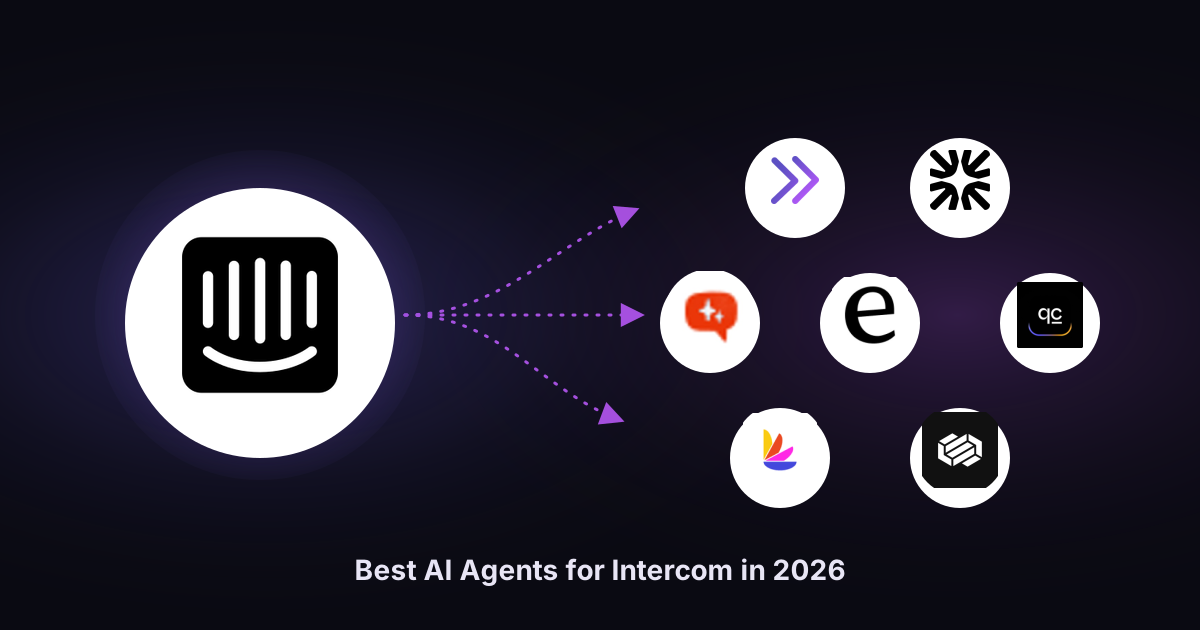
Running support on Intercom used to mean running Fin, Intercom's own AI agent. That is no longer the only option. The helpdesk and the AI agent are now two separate decisions: you can keep Intercom's inbox, Messenger, and workflows, and plug in a third-party AI agent that fits your tickets better or bills more predictably. This post compares the best Intercom AI agents and AI chatbots in 2026 using the same criteria for every option, so you can match the right agent to your ticket mix, your stack, and your budget.
Our pick: Pluno is the best AI agent for Intercom. It integrates directly with Intercom, learns from the conversations your team has already resolved, pulls answers from Slack, Jira, and engineering tools that Fin never sees, and never bills an escalation. It is strongest where other agents fail: complex B2B and technical support. The rest of the list covers the native option, cheaper entry points, and voice-first platforms.
Quick summary
For B2B teams with complex, technical tickets whose answers live in past conversations, Slack, Jira, and internal tools, Pluno is the best AI agent for Intercom, and the clear pick for complex B2B and technical tickets. Fin, the native Intercom AI agent, is the option if you would rather not add a vendor and your answers live in a maintained help center. My AskAI and eesel AI are the low-cost alternatives for simpler, help-center-style questions that run inside the Intercom inbox. Quickchat AI is the cheapest way to start. Lorikeet and Decagon are worth a look mainly if you need voice in the same agent.
What an Intercom AI agent is (and how it differs from an Intercom chatbot)
An AI agent reads a conversation, gathers context, decides what to do, and either replies, takes an action, or hands off to a human. That is the difference between an Intercom AI agent and the classic Intercom chatbot: the chatbot follows the fixed flows you build, while the agent reasons about each conversation. On Intercom, a third-party agent connects to your workspace, reads conversations in the inbox, and replies in Messenger or email as a teammate, or drafts replies for your agents to approve.
Three kinds of products sit under the "AI agent" label on Intercom, and it pays to keep them apart:
-
Autonomous AI agents reply directly to customers in Messenger and email. This is what deflection means in 2026.
-
AI copilots draft answers and surface context inside the agent's inbox. Fin Copilot and Pluno's AI Copilot are examples.
-
Routing, tagging, and QA layers work on the conversation pipeline without replying to customers.
The best AI agents for Intercom combine the first two, so the conversations the AI cannot finish reach a human with the work already done.
Comparison table: Best Intercom AI agents in 2026
| AI agent | Best for | How it works in Intercom | Learns from | Pricing (October 2026) | What you pay for |
|---|---|---|---|---|---|
| Pluno | Best overall; strongest on complex B2B and technical tickets | Direct integration: replies to customers, assists agents, escalates to Slack and Jira | Past resolved conversations (primary), help center, Slack, Jira, Confluence, custom external APIs | Platform fee from €249/mo + €0.90 per resolution; Copilot €49/agent/mo | Volume-based platform fee + resolutions |
| Fin | Teams that want no extra vendor and have a strong help center | Built into Intercom | Help center, URLs, uploaded docs, custom Actions | Intercom seat plan $29 to $132/seat/mo (annual) + $0.99 per outcome | Seats + every outcome, including resolutions counted after 24 hours with no reply and some Procedure handoffs |
| My AskAI | Low-cost Fin replacement for documentation-based answers | Intercom app: replies to customers or writes internal notes for agents | Help center, Notion, Confluence, Google Drive, websites | From $199/mo for 1,000 tickets, then ~$0.10 to $0.12 per extra ticket | Every ticket the AI handles, resolved or not |
| eesel AI | General-purpose AI across many tools | Connects to your Intercom account: replies to customers or drafts for agents | Past Intercom conversations, help center, macros, docs | From $299/mo for 500 tickets, up to $1,749/mo for 5,000; $0.80 per extra ticket | Every conversation the AI handles, resolved or not |
| Quickchat AI | Cheapest way to start | Connects to your Intercom account: replies as its own teammate | Help center, websites, files | Free plan; paid from $9/mo, billed in AI credits per message | Every AI message, from a monthly credit allowance |
| Lorikeet | Teams that need voice in the same agent | Resolves conversations inside Intercom | Policies, workflows, connected systems | From $2,100/mo + $0.99 per resolution | $2,100/mo minimum fee + resolutions |
| Decagon | Consumer brands that want A/B testing and voice | Syncs Intercom tickets and customer data | Agent Operating Procedures, connected systems | Custom enterprise | Custom enterprise contract |
Why Pluno is the best AI agent for Intercom
Every agent on this list can answer a question that is already in your help center. Pluno pulls ahead on everything after that:
- It learns from how your team actually solves problems. Pluno's primary source is your past resolved conversations, plus Slack, Jira, Confluence, and your custom external APIs. Fin answers from your help center and only uses past conversations to suggest new articles.
- You pay for conversations it actually resolves. Beyond a platform fee set by your ticket volume, Pluno's usage charge is €0.90 per conversation it actually resolves. Escalations are never billed, so you never pay for the hard conversations it hands to your team. My AskAI and eesel bill every ticket they touch, whether the AI solved it or not, Quickchat bills every message, and Fin can bill some Procedure handoffs.
- It hands off like a senior teammate. When Pluno is unsure, it escalates with a summary, the evidence it found, and next steps, and can turn the conversation into a Slack post or Jira issue in one click, then sync the answer back to Intercom.
- It does the whole job, not one slice. Autonomous replies, an agent copilot inside Intercom, routing, auto-tagging and field filling, actions through custom APIs, QA scoring, and reporting, in one product.
- It is proven against Fin. Smartness compared the two head to head and called Pluno "miles ahead".
- It is built for enterprise. SSO/SAML, SOC 2 Type II, GDPR, data processed in Europe with no training on your data, multi-brand setups, dedicated onboarding, and teams of 100+ agents.
How we evaluated the options
We applied the same criteria to every option and pulled facts from vendor pages in October 2026: fit, what it does, how it works, key features, pricing, setup, main limitation, standout strength, and buyer profile. Three factors carried the most weight: whether the agent resolves complex tickets or only common questions, how it behaves when it is not confident, and how deeply it works inside Intercom, so conversations, notes, and escalations stay in one place.
We left out agents that no longer integrate with Intercom. Ada, for example, is a strong enterprise agent, but it does not list an Intercom integration today. If Ada is on your shortlist, our Zendesk AI agents comparison covers it.
The 7 best AI agents for Intercom in 2026
1. Pluno (best overall AI agent for Intercom)
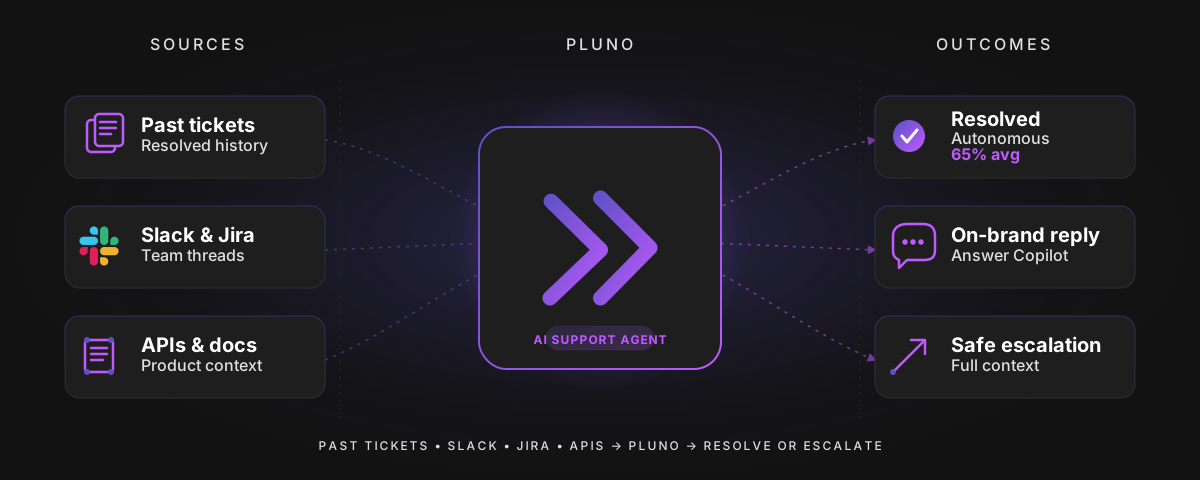
Best for: Intercom teams of any size that want an AI agent which resolves the hard conversations, not just the FAQs. It is strongest for B2B and technical products, where resolving a conversation takes troubleshooting.
What it does: Pluno is an AI agent built for complex support. It integrates directly with Intercom. Deflection AI resolves conversations on its own when it is confident, across every channel you run through Intercom and in your customers' languages. AI Copilot gives your agents summaries, suggested answers, and next steps inside the conversation. Escalation Copilot turns a conversation into a Slack post or a Jira issue in one click, then syncs the answer back to Intercom.
How it works: Most agents on Intercom start from your help center. Pluno starts from the conversations your team has already resolved, because that is where the real fixes live. It reconstructs how your team troubleshoots, then searches past conversations, help center articles, Slack threads, Jira issues, Confluence, and your custom external APIs at the same time. Every answer is grounded in evidence. When confidence is low, Pluno does not guess. It escalates with a summary, the evidence it found, and the next steps, so your agents never start from zero.
Key features: learning from past resolved conversations; troubleshooting with diagnostic questions; one search across conversations, help center, Slack, Jira, Confluence, and custom external APIs; actions through custom APIs, such as lookups, refunds, and account changes; simulation on your past Intercom conversations before going live; multilingual, on-brand replies across all Intercom channels; routing and assignment; auto-tagging and field filling; one-click escalation to Slack and Jira with answers synced back as internal notes; proactive follow-up on stale Jira issues; QA scoring; reporting with ticket trends and topic insights; multi-brand support.
Pricing: A platform fee that scales with ticket volume, from €249 per month for under 500 tickets, plus €0.90 per autonomous resolution and €49 per agent per month for AI Copilot, billed only for the teammates you choose. Escalations are never billed. A 14-day free trial includes every module. See pricing.
Setup or integration complexity: Low. Setup takes minutes to a day: connect Intercom, Slack, Jira, and your knowledge sources, and Pluno learns from your historical conversations from day one. Enterprise teams get dedicated onboarding, SSO/SAML, SOC 2 Type II and GDPR compliance, and data processed in Europe, with no model training on customer data.
Main limitation: No voice channel. If phone support is your main channel, pair Pluno with a voice tool or look at Lorikeet or Decagon.
Why it stands out: Most AI agents stall when the answer is not in the help center. Pluno was built for exactly that case. Teams running it report 67% of chat tickets resolved by AI at Innovorder, 50% deflection at Kojo, and 58% of routed tickets handled by the AI Agent at Velotric. And when Smartness put Pluno side by side with Fin, the comparison was not close:
"I compared Pluno with Fin by Intercom, and Pluno was miles ahead!"
Joseph D'Appuzo, Customer Support Manager at Smartness
After switching from Fin, Smartness reached over 40% real deflection and cut first response time from hours to 22 minutes. For a closer look at the two products, read our Fin vs Pluno comparison.
Who should choose it: Any Intercom team that wants the AI to resolve real problems, from growing startups to enterprises with 100+ agents. It is the obvious choice for B2B SaaS, hardware, fintech, and other technical products, and for teams that have tried a help-center-based agent and watched it fail on the hard conversations.
2. Fin (the native Intercom AI agent)
Best for: Intercom teams whose questions are mostly answered by a maintained help center.
What it does: Fin is Intercom's own AI agent, and what most people mean by Intercom AI. The company renamed itself Fin in May 2026, and Salesforce signed an agreement to acquire it in June 2026, a deal expected to close in Salesforce's fiscal 2027. Fin answers customers in Messenger, email, and other channels around the clock, follows Procedures (natural-language workflows), and takes actions through custom Actions that call your systems.
How it works: Fin grounds its answers in content sources: help center articles, URLs, and uploaded documents. Past conversations feed suggestions for new help center content, which a human reviews, rather than being used directly to answer. Fin Copilot, a separate product, drafts replies for agents.
Key features: native to Intercom; Procedures for multi-step workflows; custom Actions; brand voice controls; multilingual answers; Fin Copilot for agents; reporting on resolutions and topics.
Pricing: Fin has no separate platform fee, but you cannot run it inside Intercom without a seat plan, so the seats work as your base fee: $29 (Essential), $85 (Advanced), or $132 (Expert) per seat per month on annual billing, or $39, $99, and $139 on monthly billing. Fin then costs $0.99 per outcome on top, and qualification outcomes cost $9.99. Fin Copilot for agents is another $29 per agent per month on annual billing, or $35 monthly. A conversation can count as resolved when the customer does not reply, which is the part teams most often question. Our Fin pricing guide breaks it down.
Setup or integration complexity: Low. It is built into the platform.
Main limitation: Fin is only as good as your help center. If the answer lives in a Slack thread, a Jira issue, or an engineer's head, Fin escalates or guesses, and per-outcome billing can climb with volume.
Why it stands out: It ships with Intercom, so there is no separate vendor to add.
Who should choose it: Teams with a strong help center and mostly common questions that prefer to stay with a single vendor.
3. My AskAI
Best for: Teams that want a lower-cost alternative to Fin without leaving Intercom.
What it does: My AskAI is an AI agent that works inside your existing helpdesk, including Intercom, Zendesk, and Freshdesk. In Intercom, it replies directly to customers in chats, tickets, and email, or writes internal notes only, so agents can review its answers first.
How it works: It answers from your help center plus connected sources such as Notion, Confluence, Google Drive, SharePoint, and websites. You can mark a source as copilot-only, so agents see it but customers do not.
Key features: an approved Intercom app; direct replies or internal-note mode; auto-tagging; live translation; a copilot for agents delivered through a Chrome extension.
Pricing: My AskAI bills per ticket the AI handles, whether it resolves it or not. Pro is $199 per month with 1,000 tickets included, then about $0.12 per extra ticket. Scale is $499 per month with 2,000 tickets, then about $0.10 per extra ticket. Enterprise starts at $999 per month with volume discounts, and annual billing saves 33%. At a 60% resolution rate, $0.10 per ticket works out to roughly $0.17 per resolved ticket. My AskAI also offers a 60% AI resolution guarantee or your money back, and a 30-day free trial.
Setup or integration complexity: Low. Install the app and connect your sources.
Main limitation: Built around documentation. The agent copilot runs in a browser extension rather than natively in Intercom, and live data actions need custom setup.
Why it stands out: A low entry price for documentation-based answers.
Who should choose it: Small and mid-sized Intercom teams with good documentation that want to cut AI costs.
4. eesel AI
Best for: Teams with mostly simple questions that want one general-purpose AI across support and their other tools.
What it does: eesel AI works natively inside Intercom Messenger and the inbox. In autonomous mode it sends replies, adds internal notes, updates fields, and routes escalations. In draft mode it suggests replies for agents to approve.
How it works: It learns from past Intercom conversations, help center articles, saved replies, and macros, plus connected tools like Google Drive, Notion, and Confluence. You can simulate it on past conversations before going live.
Key features: autonomous and draft modes; field updates and routing; simulation on historical conversations; connections across 100+ apps.
Pricing: eesel sells monthly bundles of credits, where one ticket or chat the AI works on is one credit, resolved or not. Plans run from $299 per month for 500 credits (about $0.60 per ticket) to $1,749 per month for 5,000 (about $0.35), with extra credits at $0.80 each. Slack questions and reports also use credits. There is no platform or seat fee, annual billing gives two months free, and 100 free credits let you test it. eesel's Intercom page advertises $0.40 per conversation, but its plans start at the prices above. SSO costs extra from $199 per month, and SOC 2 Type II is still in progress.
Setup or integration complexity: Low. You connect your Intercom account from eesel.
Main limitation: Designed for breadth rather than deep technical troubleshooting. For products that need reproduction steps, internal APIs, and engineering escalations, a purpose-built agent like Pluno goes further.
Why it stands out: Breadth. It connects to 100+ apps, so the same AI can work beyond the support inbox.
Who should choose it: Lean teams whose questions are mostly simple and whose knowledge is spread across general workplace tools.
5. Quickchat AI
Best for: Small teams that want the cheapest possible start with an Intercom AI chatbot.
What it does: Quickchat AI positions itself as an affordable alternative to Fin. In Intercom, it joins as a dedicated teammate and replies directly to the conversations assigned to it, or to every conversation if you switch that on.
How it works: It answers from text, websites, files, Intercom help center articles, and videos. Handoff to human teammates is optional and configured through Intercom workflows.
Key features: direct replies as an Intercom teammate; assignment-based routing; channels beyond Intercom, including WhatsApp, Messenger, Instagram, and a web widget.
Pricing: A free plan, then paid plans from $9 to $999 per month, each with a monthly allowance of AI credits. A credit is one AI message, not one conversation, and each reply costs 1, 2, or 4 credits depending on the model. The $9 Starter plan's 150 credits cover at most 150 replies a month, and the $299 Professional plan includes 9,000. When credits run out, the agent stops replying until the allowance resets. Enterprise is priced from $0.50 per resolution with a 2,000-resolution monthly minimum.
Setup or integration complexity: Low. Connect through Intercom's external apps.
Main limitation: No draft or copilot mode in Intercom, and handoff to humans is off by default, so it needs careful setup to avoid the AI answering conversations it should not.
Why it stands out: The lowest entry price on this list.
Who should choose it: Startups and small teams with simple questions and a tight budget.
6. Lorikeet
Best for: Teams that need voice handled by the same AI agent as chat and email.
What it does: Lorikeet is an AI agent for consumer businesses in areas like fintech and insurance. It resolves conversations inside Intercom and also covers voice, SMS, and WhatsApp.
How it works: It follows your policies and workflows and connects to your systems to take real actions, not just answer questions.
Key features: workflow execution; voice and messaging channels.
Pricing: Start is $2,100 per month for under 5,000 tickets, plus $0.99 per chat or email resolution. Scale is $5,100 per month for 5,000 to 20,000 tickets, plus $0.90 per resolution. Larger plans are custom. Billing is annual, with a 30-day free trial.
Setup or integration complexity: Medium. Workflows take time to configure.
Main limitation: A $2,100 monthly fee before any resolutions, with annual billing, which rules it out for most teams.
Why it stands out: Voice in the same agent as chat.
Who should choose it: Consumer businesses where phone support is a major channel and the budget covers a high monthly minimum.
7. Decagon
Best for: Consumer brands that want built-in A/B testing on their AI agent and need voice.
What it does: Decagon is an enterprise AI agent platform used by brands like Duolingo and Chime. It connects to Intercom to sync support tickets and customer data and to handle conversations with handoffs.
How it works: Teams write Agent Operating Procedures in plain language instead of building flows, then use experiments and quality monitoring to improve the agent over time.
Key features: Agent Operating Procedures; voice, chat, and email; A/B experiments; always-on quality monitoring.
Pricing: Custom enterprise contracts, not public.
Setup or integration complexity: Medium to high. Implementation is part of the contract and takes weeks.
Main limitation: Enterprise-only in practice, with no self-serve option or documented Intercom app.
Why it stands out: Built-in A/B experiments on agent behavior.
Who should choose it: Consumer brands that need voice and A/B testing and can commit to a custom platform contract with a weeks-long implementation.
How to choose the right AI agent for your Intercom workspace
Start with three questions.
Where does the knowledge needed to resolve your conversations live? If it sits in a tidy help center, Fin, My AskAI, or Quickchat will handle most of it. If the real answers live in past conversations, Slack, Jira, and engineering tools, you need an agent that reads all of them. That is the strongest signal to choose Pluno.
What is your ticket mix? If most conversations are order status, password resets, and how-to questions, a documentation-based agent is enough. If a large share is diagnostic, you need an agent built to ask the right questions, troubleshoot, and escalate with context.
What are you actually paying for? Per-conversation and per-message pricing (eesel, My AskAI, Quickchat) bills whether or not the AI resolves anything. Fin counts a resolution after 24 hours without a reply, and some Procedure handoffs are billable. Pluno pairs a platform fee set by your ticket volume with €0.90 per resolution, counted only after 72 hours without a reply, and never bills escalations, without the $2,100 monthly floor of Lorikeet or the custom contracts of Decagon.
One rule holds across every option: do not pick an agent that cannot tell you how it behaves when it is unsure. Escalating with full context is what separates agents that protect your customer experience from agents that quietly damage it.
The bottom line
Pluno is the best AI agent for Intercom. It resolves the conversations other agents escalate, learns from how your team actually solves problems, and never bills an escalation. Fin is the option if you would rather not add a vendor, and the cheaper tools fit simple, documentation-based questions.
Comparison tables only get you so far. The real test is how an AI agent performs on your own conversations, your stack, and your edge cases. Try Pluno yourself and see where it would resolve, draft, or escalate on your Intercom data.
Continue reading: 4 Best Intercom Fin AI Alternatives For Your Use Case →
FAQ
What is the best AI agent for Intercom?
Pluno is the best AI agent for Intercom. It integrates directly with Intercom, learns from your past resolved conversations, pulls context from Slack, Jira, and engineering tools that help-center-based agents never see, and never bills an escalation. It is the clear choice for B2B and technical support. Fin is the native option if you prefer not to add a vendor.
Does Pluno integrate with Intercom?
Yes. Pluno integrates directly with Intercom as well as Zendesk. It resolves conversations, assists agents inside the conversation, and escalates to Slack and Jira in one click, with answers synced back to Intercom.
What is Intercom AI?
Intercom AI usually means Fin, the AI agent built into Intercom, plus Fin Copilot for agents. You do not have to use it. You can keep Intercom as your helpdesk and run a third-party Intercom AI agent such as Pluno instead.
Can I replace Fin with a different AI agent on Intercom?
Yes. Third-party AI agents connect to your Intercom workspace and reply in Messenger and email, draft for your agents, or both. You keep Intercom as your helpdesk and choose the AI agent separately.
What are the best Fin AI alternatives?
Pluno for complex B2B tickets, My AskAI and eesel AI for lower-cost help-center automation, Quickchat AI for the cheapest start, and Lorikeet or Decagon if you need voice. If you are open to leaving Intercom altogether, our guide to Fin AI alternatives also covers options that replace the helpdesk.
What is the best Intercom AI chatbot?
It depends on how hard your questions are. For complex B2B and technical support, Pluno goes beyond a chatbot: it troubleshoots from past conversations and escalates with context. For simple FAQs on a small budget, Quickchat AI and My AskAI are the low-cost options, and Fin is the native choice.
Is there a cheaper alternative to Fin?
Quickchat AI has a free plan and paid plans from $9 per month, though its credits are spent per AI message, so real volume costs more. My AskAI starts at $199 per month for 1,000 tickets, and eesel AI from $299 per month for 500 tickets. Compare the unit carefully: Fin and Pluno bill per resolution or outcome, My AskAI and eesel bill for every ticket the AI handles, and Quickchat bills for every AI message.
How does Fin count a resolution?
A Fin resolution is billed when the customer confirms the answer helped, or when the customer does not reply for 24 hours after Fin's answer. That short window is why some teams find Fin's resolution numbers higher than the problems it actually solved. Pluno uses a 72-hour window after its last message, three times longer, and never bills escalations.
How do I avoid hallucinations?
Choose an agent that grounds every answer in evidence and has an explicit confidence threshold. Ask each vendor what happens when the agent is unsure. The right answer is a clean escalation with context, not a confident guess.
Will an AI agent replace my support team?
No. It takes the repetitive conversations so your team can focus on the complex ones that need judgment. Most teams reallocate time rather than cut headcount.