A business case for AI usually starts with a message like this one, which we see in sales calls at Pluno every week: "I love it. Now I need to convince my boss. Can you send me something with pricing I can forward?"
That champion doesn't need a pitch deck. They need one page that answers what it costs, what it gives back, what could go wrong and when it pays off. This guide shows you how to write that page for AI in customer support, with a worked example, a calculator and a template you can copy.
Where Pluno fits: Pluno is the AI agent for complex support that runs inside Zendesk, Intercom, Salesforce Service Cloud, HubSpot, Jira Service Management and Freshdesk. It publishes its prices and charges no setup fee, so every number in the example below is one you can check on the pricing page.
This guide is for the Head of Support or support ops lead who has found the tool and now has to win the budget. Every option in your case gets measured against the same five yardsticks:
- Monthly cost: platform fee, seats and usage charges at your ticket volume.
- Agent hours freed: tickets nobody has to handle, plus minutes saved on the tickets people still handle.
- Payback: how many months until the gains cover your one-time costs.
- Risk controls: what stops wrong answers, data exposure and lock-in.
- Proof before purchase: how you can test the numbers before you sign.
Disclosure: I work at Pluno, and I run many of the demo calls where this question comes up.
TL;DR
- The winner in most support business cases is agent time, not license savings. Count the hours AI frees, value them at your loaded hourly cost, and subtract the full monthly bill.
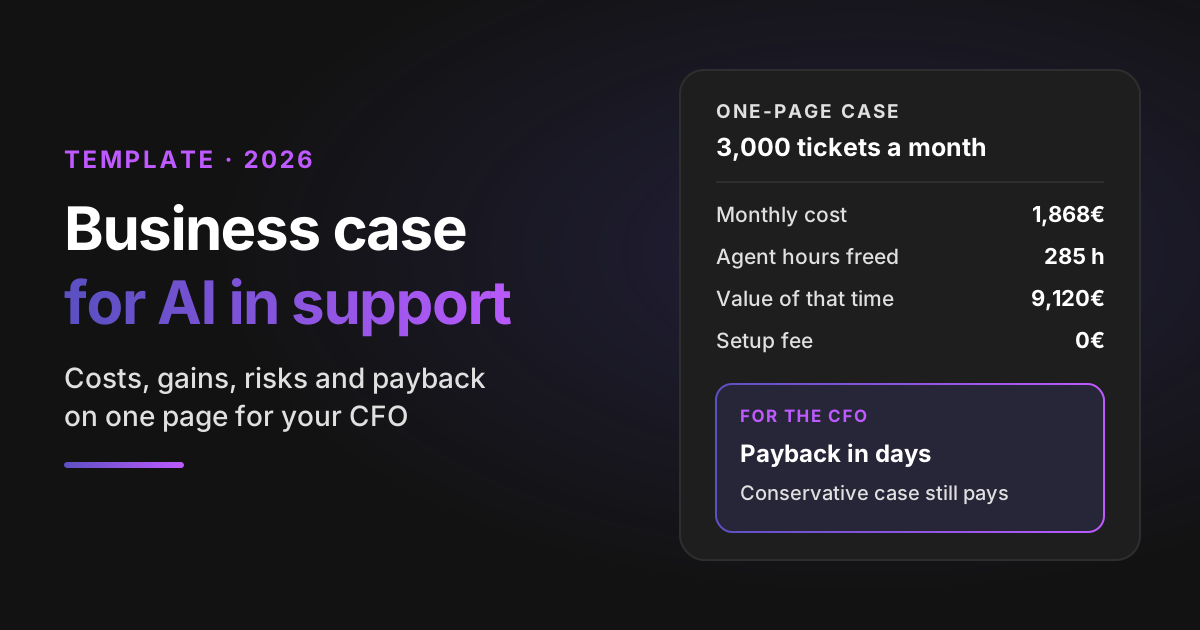
- Worked example: a five-agent team with 3,000 tickets a month pays about 1,868€ a month for Pluno on annual billing and frees about 285 agent hours, worth about 9,120€ at 32€ an hour.
- Payback is fast when there's no setup fee. Your team's own setup time is the one-time cost. In the example, 40 hours are repaid in about five days, and first-year ROI is about 360%.
- Show two cases. A conservative case (20% resolution, 1.5 minutes saved) still returns about 210% in year one. CFOs trust the low case more than the high one.
- Name the controls. Pluno answers only the tickets you send it, escalates with a research summary when it can't resolve, and bills only verified resolutions. Escalations are never billed.
- Key data point: in a Gartner survey of 275 service and support leaders, just 4% said they had achieved the ROI they expected from AI. That's why this case rests on your own tickets, not a vendor benchmark.
- Bottom-line advice: run a free simulation on your last 50 tickets, put its resolution rate in the calculator, and paste the result into the template.
What a business case for AI in customer support has to prove
A business case for AI in customer support has to prove one thing: that the time the AI frees is worth more than the full bill, soon enough to matter. Everything else on the page supports that claim or shows it's safe.
Most generic AI business case guides stop at strategy: pick a use case, align stakeholders, measure value. Support is easier to model than most functions, because you already track the inputs. You know your monthly tickets, your handle time and roughly what an agent hour costs.
That's also why finance is skeptical. AI spending by customer service leaders rose 38% while service budgets rose just 2%, according to Gartner. Your CFO has seen AI line items grow, and wants to know which ones pay back.
So a strong AI business case does four things:
- Counts every cost, including your team's own time.
- Counts gains in hours, then converts them to money with your own payroll numbers.
- Names each risk next to the control that handles it.
- Rests on your tickets, not on a vendor's benchmark.
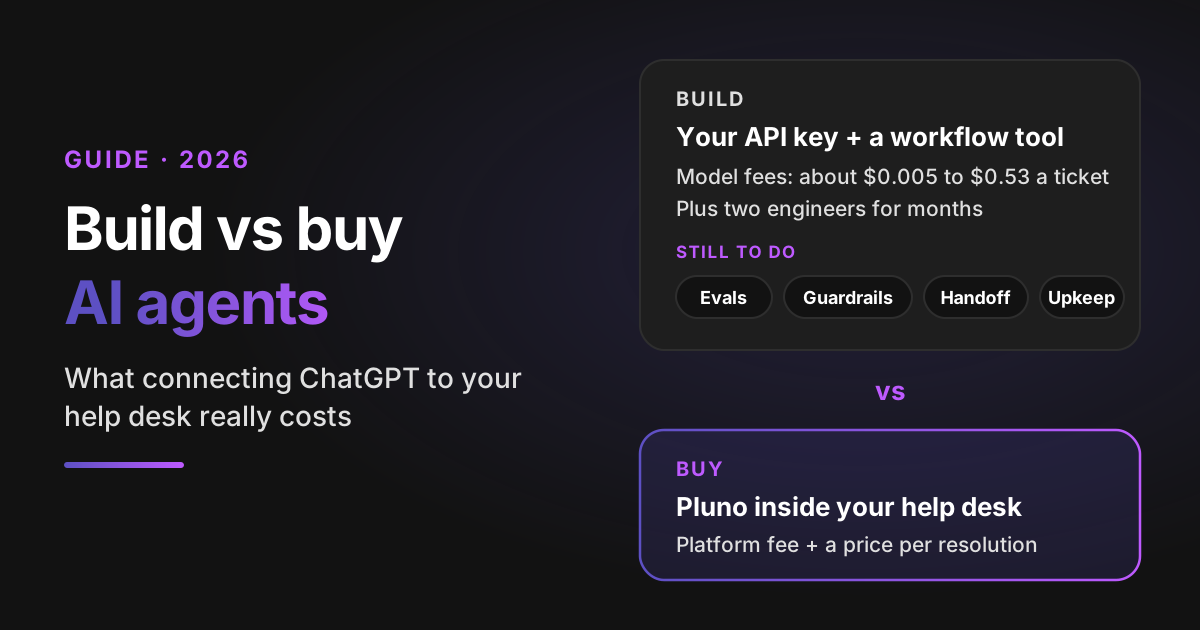
This post assumes you're buying a tool. If your engineers want to build one instead, my build vs buy guide prices that path.
Step 1: count every cost
The cost side of an AI business case has three parts: what the vendor bills each month, what you pay once, and what your team spends in time. Leave any of them out and finance will add it back for you, usually at a higher number.
What the vendor bills each month
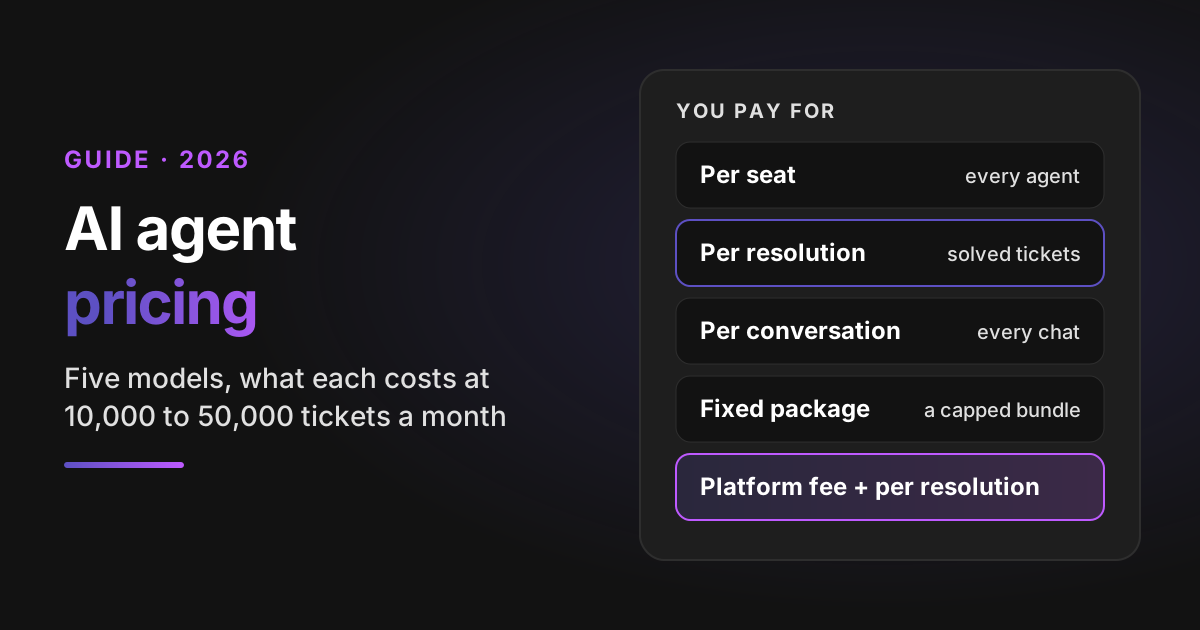
AI support tools price in a few common ways. My AI agent pricing guide compares the models in depth. For a business case, list each line separately:
- Platform fee: a fixed monthly charge, often tied to ticket volume.
- Seats: a price per agent for drafting tools such as a copilot.
- Usage: a price per resolution, per conversation or per credit.
Pluno uses all three, and publishes each one.
The platform fee runs from 249€ a month (210€ a month, billed annually) for up to 500 tickets, to 4,649€ a month (3,950€ billed annually) for up to 30,000 tickets. AI Copilot costs 49€ per seat a month, or 41.65€ billed annually, and you choose how many agents get a seat. Deflection AI adds 0.90€ per resolved ticket.
The platform fee already includes Escalation Copilot, AI Tagging & Field Filling, ticket and call summaries, and topic trends. Those count as gains you don't pay extra for, so mention them in the proposal.
What you pay once
Many vendors charge setup or implementation fees. Pluno doesn't: there's no setup fee, and every customer gets onboarding with the Pluno team. So your one-time cost is mostly your own people's time.
What your team spends in time
This is the line most business cases forget. Budget hours for:
- Setup: connecting the help desk and knowledge sources, and writing the first AI Workflows.
- Testing: reviewing sample answers before you widen the scope.
- Upkeep: a weekly look at escalations and answer gaps after go-live.
I use 40 hours of setup and testing in the example below. Adjust it to your team. A larger knowledge base or several brands take longer.
Step 2: count the gains in agent hours
The gain side of an AI business case is agent time, measured in hours and then valued in money. Count two sources, because AI in support does two different jobs.
Gain 1: tickets nobody has to handle
When an AI agent fully resolves a ticket, your team saves that ticket's whole handle time. The math is simple:
AI-resolved tickets × handle time per ticket = hours freed
Pluno learns from your past tickets and connected tools as well as your help center, so it can take on the longer, harder tickets where each resolution frees the most agent time. That's where its complex-support focus turns into money in this model.
Use a resolution rate you can defend. Across Deflection AI customers, the average resolution rate is 65% (Pluno-reported average, November 2026). Individual results vary by ticket mix: Velotric reports that the AI agent handles 58% of the tickets routed to it, and Kojo went from 0% to 50% ticket deflection.
For your own case, start lower than those numbers and let your simulation results move it up. I use 30% in the main example and 20% in the conservative one.
Gain 2: minutes saved on the tickets people still handle
Tickets the AI doesn't resolve still go to an agent. A copilot saves minutes on each one by researching the case and drafting the reply. The math:
Tickets handled by seat holders × minutes saved per ticket = hours freed
Pluno customers report real ranges here.
Waste Vision saves 2 to 5 minutes on every ticket. At Velotric, AI Copilot cut agent research time from 20 minutes to under 5. Across Deflection AI customers, the average agent time saved is 48%.
I use 3 minutes in the main example, inside Waste Vision's range, and 1.5 minutes in the conservative case.
Turning hours into money
Value each hour at your loaded agent cost: wage plus benefits, payroll taxes and overhead. Your HR or finance team has this number.
If you need a reference point, the US median wage for customer service representatives was $21.53 an hour in May 2025. Wages made up 70.0% of private-industry employer costs in June 2026, so a loaded hour comes to about $31. I use 32€ an hour to keep the example in euros.
Capacity or cash?
Be honest with your CFO about one distinction. Freed hours are capacity. They turn into cash only when they avoid a hire, overtime or an outsourcing contract.
Most growing support teams do have a planned hire, a backlog or an SLA they keep missing. Name it in the case. "This lets us absorb 20% ticket growth next year without the two hires in the plan" is a sentence finance can book.
The softer gains belong in the case too, as a short list: faster first replies, 24/7 coverage and CSAT on AI-handled tickets. Innovorder reports replies in under one minute and a 15-point CSAT gain, and Kojo reports a 40% faster ramp for new hires.
Step 3: work the example with Pluno's prices
Here's a full AI business case for a typical team: 3,000 tickets a month, five agents, all five on AI Copilot, and AI resolving 30% of tickets. Every price comes from Pluno's pricing page.
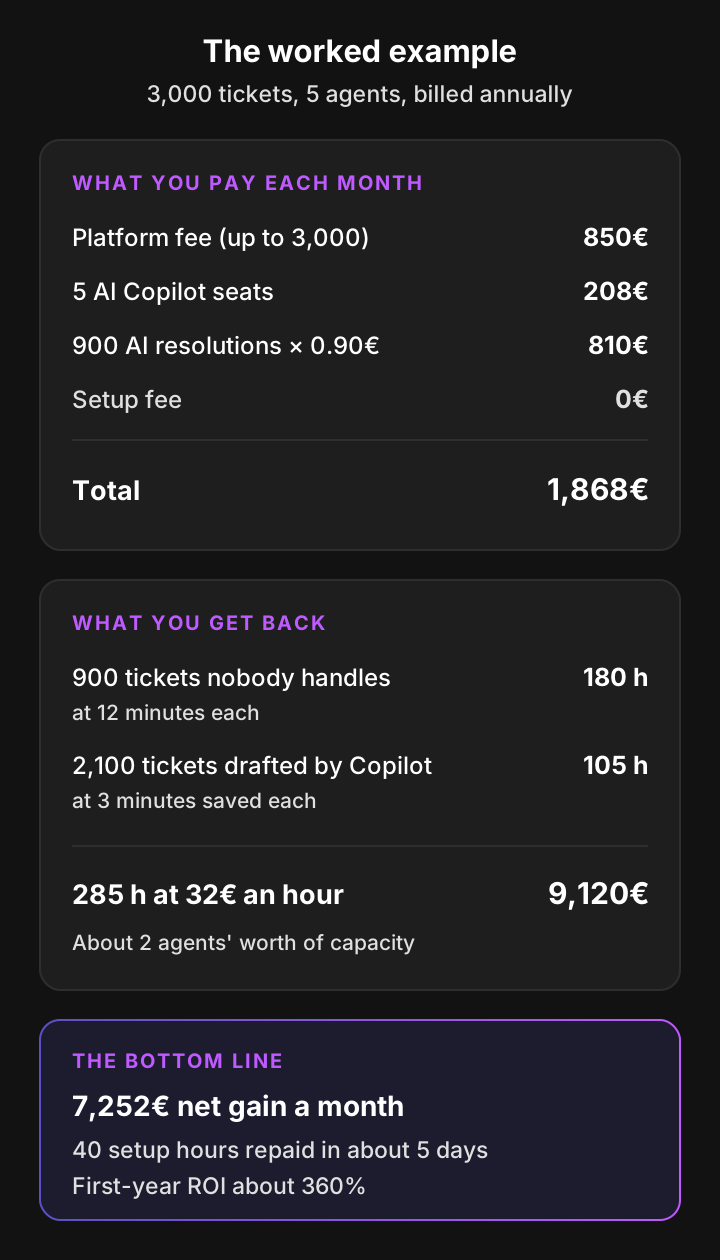
Monthly cost
On annual billing:
- Platform fee for up to 3,000 tickets: 850€.
- Five AI Copilot seats at 41.65€: about 208€.
- 900 AI resolutions (30% of 3,000) at 0.90€: 810€.
- Total: about 1,868€ a month.
On monthly billing, the same team pays about 2,054€: 999€, 245€ and 810€. Monthly plans can be cancelled anytime. Annual billing is a 12-month commitment.
Monthly gains
At a 12-minute handle time and 32€ an hour:
- 900 AI-resolved tickets × 12 minutes = 180 hours.
- 2,100 human-handled tickets × 3 minutes saved = 105 hours.
- Total: 285 hours, worth about 9,120.€
That's about two agents' worth of capacity, at 140 productive hours per agent a month (160 paid hours, about 140 of them productive).
Payback and ROI
- Net monthly gain: 9,120€ minus 1,868€ = about 7,252.€
- One-time cost: 40 hours of your team's time at 32€ = 1,280.€ No setup fee.
- Payback: 1,280€ ÷ 7,252€ = about five days.
- First-year ROI: about 85,700€ net on about 23,700€ spent, or about 360%.
Even if month one runs at half the conservative case below while you widen the scope, its net gain still covers the 40 setup hours within the first month.
The conservative case
Now cut the inputs: AI resolves 20% of tickets, only three agents get a Copilot seat, and Copilot saves 1.5 minutes per ticket.
| Line | Target case | Conservative case |
|---|---|---|
| AI resolution rate | 30% | 20% |
| AI Copilot seats | 5 | 3 |
| Copilot minutes saved per ticket | 3 | 1.5 |
| Monthly cost (annual billing) | about 1,868€ | about 1,515€ |
| Agent hours freed a month | 285 | 156 |
| Value of that time | about 9,120€ | about 4,992€ |
| Net monthly gain | about 7,252€ | about 3,477€ |
| Payback on 40 setup hours | about 5 days | about 11 days |
| First-year ROI | about 360% | about 210% |
The conservative case is the one I'd lead with. It still pays back within two weeks, and its resolution rate and Copilot minutes sit well below what Pluno customers report.
Compare the options on the same yardsticks
Your CFO will ask what else you looked at. Here are the four options most support teams weigh, at the worked example's volume of 900 AI resolutions a month. Competitor prices are list prices from their pricing pages, checked on November 19, 2026.
| Yardstick | Pluno | Help desk built-in AI | Build in-house | Hire an agent |
|---|---|---|---|---|
| Monthly cost | About 1,868€ all in: platform fee, 5 Copilot seats and 900 resolutions at 0.90€ | Zendesk: $1.50 (committed) or $2.00 per automated resolution past the plan allowance, plus $50 per agent for Copilot, billed annually. Intercom Fin: $0.99 per outcome with a minimum monthly commitment, plus Intercom seats | Engineers, model fees and upkeep. See the build vs buy guide | About 5,100€ a month per agent at 32€ an hour |
| Agent hours freed | 285 in the example: resolutions plus Copilot drafts | Depends on the resolution rate on your tickets | Only once the build is live | 140 productive hours per hire |
| Payback | About five days on 40 setup hours. No setup fee | Depends on plan, add-ons and resolution rate | Months of engineering before the first resolution | Never: the cost recurs every month |
| Risk controls | Escalations never billed, reopens not billed again, resolutions verified and tagged | Check each vendor's definition of a billable outcome | Your team builds evaluation, guardrails and handoff | No new risk, no new capacity |
| Proof before purchase | Free simulation on your last 50 tickets, plus a 14-day free trial | Ask for a test on your own tickets | A prototype your team builds first | Not applicable |
For the full bills, see my guides to Zendesk AI pricing and Intercom Fin pricing.
AI business case calculator: payback and ROI
Put in your own volume, handle time and loaded cost. The calculator uses Pluno's list prices for your ticket tier and shows the monthly cost, the value of the time freed, payback on your setup hours and first-year ROI.
AI business case calculator: payback and first-year ROI
Costs use Pluno's list prices: the platform fee for your ticket tier, AI Copilot at 49€ per seat a month (41.65€ billed annually) and 0.90€ per resolved ticket. Escalations are never billed. Gains value agent time at your loaded hourly cost (wage plus benefits). AI-resolved tickets free their full handle time, and Copilot saves minutes only on tickets handled by agents with a seat. Setup hours are your own team's time for onboarding and testing; Pluno charges no setup fee. Agent equivalents assume 140 productive hours a month. Freed time becomes a cash saving only when it avoids a hire, overtime or outsourcing.
Monthly cost
€1,868
€850 platform fee, €208 for 5 seats, €810 for 900 resolutions
Monthly value of time freed
€9,120
285 agent hours, about 2.0 agent equivalents
Payback on setup time
5 days
€1,280 of your team's time, repaid from the monthly net
First-year ROI
362%
€85,741 net in year one on €23,699 spent
At these numbers, Pluno frees 285 agent hours a month for €1,868. Put the conservative version in your business case: lower the resolution rate and Copilot minutes until you'd defend every number to your CFO.
Two tips for using it in a real case.
First, set the resolution rate from your simulation, not from a headline number. Second, take handle time from your help desk reports for the ticket types the AI will take first. Password resets and order-status questions take less time than the average ticket.
For a broader savings estimate across your whole support operation, use the Pluno ROI calculator.
Step 4: name the risks and how they're controlled
A business case for AI that skips risk reads like a sales brochure, and finance will treat it as one. List each risk your boss will think of, then the control that handles it.
| Risk | What could happen | How it's controlled with Pluno |
|---|---|---|
| Wrong answers | The AI tells a customer something false | Pluno answers only the tickets you send it. AI Workflows tell Pluno which topics or customers always go to your team, and it escalates with a research summary when it can't resolve |
| Paying for non-results | You're billed for handoffs or tickets that come back | Escalations are never billed, a reopened ticket isn't billed again and resolutions are verified before billing. Every AI-resolved ticket is tagged in your help desk |
| Agent adoption | The team ignores the tool | AI Copilot works in the help desk sidebar your agents already use, so there's no new tool to learn |
| Data and security | Ticket data leaves your control | SOC 2 Type 2 certified and GDPR compliant, with a DPA. No AI models are trained on customer data |
| Lock-in | You're stuck if it doesn't work | No setup fee, and monthly plans can be cancelled anytime |
| A bad start | The rollout hurts CSAT | Start with one topic or one group, then widen the scope as the results hold |
Add one more line that only you can write: what happens if you do nothing. If tickets grow 20% next year, the cost of doing nothing is the hires you'll need to absorb them.
The questions a CFO asks about an AI business case
These are the questions champions tell us they got back from finance. Answer them in the case before anyone asks.
"Is this a cash saving or a capacity gain?" Say which. If it avoids a planned hire, name the hire and its loaded cost. At 32€ an hour and 160 paid hours, one agent costs about 5,100€ a month.
"What if the resolution rate is half what you expect?" Show the conservative case. If it still pays back, the downside is small.
"What's the total cost in year one, all in?" Twelve months of the monthly bill plus your team's setup hours. In the example, that's about 23,700.€
"Is there a setup fee or a minimum term?" With Pluno, there's no setup fee. Monthly plans cancel anytime, and annual billing is a 12-month commitment at a lower price.
"Why not use the AI built into our help desk?" Compare the full cost at your volume and what each tool does on your hard tickets, using the options table above. Smartness compared Pluno with Fin by Intercom, switched to Pluno and reached 40%+ real ticket deflection. Pluno researches each ticket across past tickets, your help center and connected tools, and escalates to engineering through Slack, Jira, Linear, Microsoft Teams or incident.io with a report attached.
"How will we know it worked?" Agree on three numbers now and review them at 90 days: AI-resolved tickets per month, hours freed, and CSAT on AI-handled tickets.
One-page business case template for AI in customer support
Copy this template, fill in the brackets and send it. It follows the order a finance reader works through: problem, proposal, money, risk, decision.
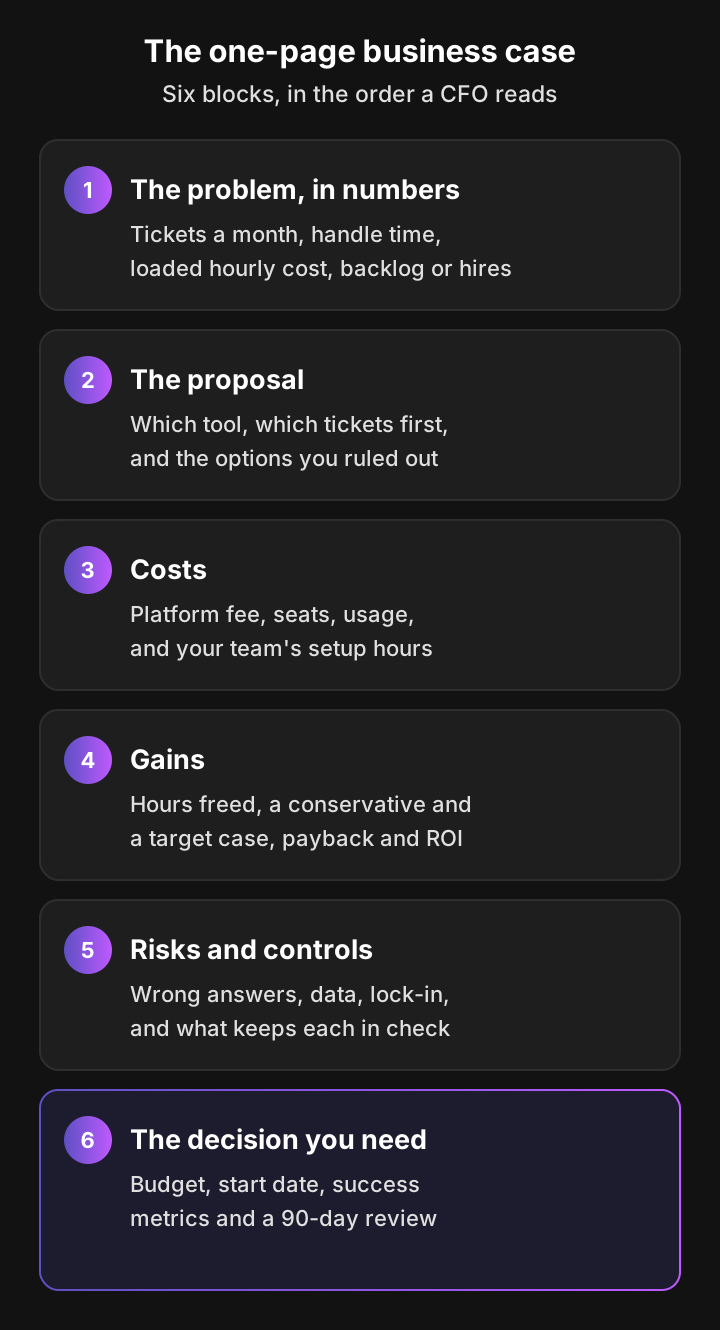
BUSINESS CASE: AI IN CUSTOMER SUPPORT
Prepared by: [name, role]        Date: [date]

1. THE PROBLEM
- We handle [tickets] tickets a month at [minutes] minutes each.
- That is [hours] agent hours a month at [€ per hour] loaded cost.
- Without a change we need [number] more hires by [date] to keep [SLA].

2. THE PROPOSAL
- Tool: [tool name], running inside [help desk].
- First scope: [ticket types or groups], then widen as results hold.
- Options considered: hire, our help desk's built-in AI, build in-house.
  Why this one: [one line per option].

3. COSTS
- Monthly: platform fee [€] + [seats] seats at [€] + [resolutions] at [€].
- Total per month: [€]. Total in year one: [€].
- One-time: [hours] hours of our team's time. Setup fee: [€].

4. GAINS (conservative / target)
- AI-resolved tickets a month: [n] / [n]
- Agent hours freed a month: [h] / [h]
- Value at [€] an hour: [€] / [€]
- Payback: [days or months]. First-year ROI: [%] / [%]
- Other gains: [faster first reply, 24/7 coverage, CSAT].

5. RISKS AND CONTROLS
- Wrong answers: [control].
- Billing for non-results: [control].
- Data and security: [certifications, DPA].
- Exit: [contract term, cancellation].

6. THE DECISION
- Approve [€ per month] from [start date].
- Success metrics: [AI resolutions], [hours freed], [CSAT on AI tickets].
- Review on [date, 90 days after go-live].
- Evidence: simulation on our last 50 tickets, attached.
Keep it to one page. Attach the simulation results and the calculator screenshot, and leave the vendor's brochure out.
What support teams say about AI customer service ROI
The most useful comments about AI customer service ROI come from people who had to explain their results to executives. These quotes are from Hacker News, verbatim.
“At the start we had calculated the total time and human cost per support ticket going back a few years. After a few months of running the AI agent, we found that both our time and cost per ticket had increased - but then digging in, the issue was that our overall cost and time had decreased and it was just that the more complicated issues the agent wasn't able to answer were the ones now going to the humans, skewing our per ticket cost up.”
“If you can even route 30% away from the central triage with 90+% accuracy and drop everything else back to the central triage... you suddenly safe 2 FTEs in that spot in some places. And increase customer satisfaction for most of those tickets because they get resolved faster.”
“More interesting to support team managers are things like deflection rate (didn’t get to an agent) involvement rate (needed an agent) and eventually resolution rate (resolved issue). The last one in the absence of feedback is only a very weak proxy for a resolved issue.”
“We implemented an AI-powered customer support triage system that initially looked promising in testing. In production, it actually increased our support costs by ~30% because: ... Support agents spent more time correcting AI mistakes than they saved”
The lesson: define your metrics before go-live, track total hours rather than cost per ticket, and test on real tickets before you trust a demo. Each of those is already in the template above.
How to prove the numbers before you ask for budget
The weakest input in any business case for AI is the resolution rate, because it's a guess until you test. So test it before you send the case.
Request a free simulation. The Pluno team runs your 50 most recent tickets and shows you, side by side, how Pluno would have answered each one. It answers each ticket using only the knowledge that existed before that ticket was created.
You see the quality of its answers, any gaps in its knowledge and when it would hand off, all before anything goes live.
Then turn the simulation into business case inputs:
- Count the tickets Pluno would have resolved correctly. That's your evidence for the resolution rate.
- Note the tickets it would have escalated, and check that a person should have taken them.
- Use the 14-day free trial to time a sample of live tickets with and without AI Copilot drafts. That's your evidence for minutes saved.
- Put both numbers in the calculator and paste the results into section 4 of the template.
The 14-day free trial gives full access to every module, with no credit card. A case with your own tickets behind it is much harder for a CFO to turn down.
The bottom line on a business case for AI
A business case for AI in customer support wins on hours, not hype. Price the tool at your volume, value the time it frees at your own loaded cost, and show a conservative case that still pays back.
With Pluno, the numbers are easy to check: published prices, no setup fee, escalations never billed, and every resolution tagged in your help desk. In the worked example, a five-agent team pays about 1,868€ a month and frees about 285 agent hours.
Start with your own tickets. The simulation gives you the evidence, the calculator gives you the numbers, and the template gives your boss one page to sign.
Prefer to walk through your business case with us? Book a demo.
FAQ
What is a business case for AI?
A business case for AI is a short document that justifies an AI investment: what it costs, what it returns, what could go wrong and when it pays back. In customer support, the return is mostly agent hours, from tickets the AI resolves and from minutes saved on tickets agents still handle.
What should an AI business case include?
An AI business case should include the problem in numbers, the proposal and the options you ruled out, every cost including your team's time, gains in a conservative and a target case, risks with their controls, and the decision you need with success metrics and a review date.
How do you calculate the ROI of AI in customer service?
To calculate the ROI of AI in customer service, add the hours freed by AI-resolved tickets and by copilot drafts, and multiply by your loaded hourly cost. Subtract the yearly bill and your setup time, then divide by the total spent. The calculator above does it at Pluno's list prices.
What's the ROI timeline for AI agents?
With no setup fee, the payback timeline mostly depends on your own setup time and your resolution rate. In the worked example, 40 setup hours are repaid in about five days, and in the conservative case in about 11 days. Tools with implementation fees take longer.
How do I justify the cost of AI to my boss?
Justify it with your own numbers: ticket volume, handle time and loaded cost. Show what the tool costs each month, how many agent hours it frees, and a conservative case that still pays back. Attach a simulation on your own tickets as evidence, and use the one-page template in this post.
Is AI customer service ROI real?
AI customer service ROI is real when you measure it on resolved tickets and hours freed. Gartner found that just 4% of service leaders achieved the ROI they expected, which is why a case built on your own tickets matters more than a vendor benchmark.
How do you measure AI ROI after go-live?
Track three numbers from day one: AI-resolved tickets per month, agent hours freed, and CSAT on AI-handled tickets. With Pluno, every AI-resolved ticket is tagged in your help desk, so you can count them and check reopens. Review the numbers at 90 days.
What does Pluno cost for a typical team?
For a team with up to 3,000 tickets a month, five agents on AI Copilot and AI resolving 30% of tickets, Pluno costs about 1,868€ a month on annual billing, or about 2,054€ on monthly billing. There's no setup fee, and the pricing page has an estimate for your own volume.