AI agent pricing is one of the first hard questions in the AI buying calls we join at Pluno, and it often comes from finance, not support. "Can you tell me what this will cost next quarter?" sounds simple. With most AI agents for customer service, the honest answer is "it depends on how well it works", which is exactly what a CFO doesn't want to hear.
This guide is for teams buying an AI agent for customer service. If you're weighing whether to build one instead, start with our build vs buy guide.
This guide fixes that. I'll walk through the five ways vendors bill for an AI agent, what each one costs at 10,000, 25,000 and 50,000 tickets a month, and which model gives you a predictable bill. Every vendor price comes from the vendor's own pricing page, help center or announcement, checked on November 17, 2026.
Where Pluno fits: Pluno charges a platform fee for your ticket volume plus 0.90€ per resolved ticket. Escalations of any kind are never billed, a reopened ticket isn't billed again, and every AI-resolved ticket is tagged in your help desk, so you can check each invoice line by line.
This post is for support leaders at B2B SaaS companies who need a number they can defend. To keep the comparison fair, I hold every pricing model to the same four yardsticks:
- Predictability: how much the monthly bill moves when ticket volume or the resolution rate changes.
- Cost per resolved ticket: the total bill divided by the tickets the AI agent fully resolves.
- Billing rule: what exactly the vendor counts as billable, and what it never bills.
- Hidden extras: minimums, overage rates, credits that expire and seats you still need.
TL;DR
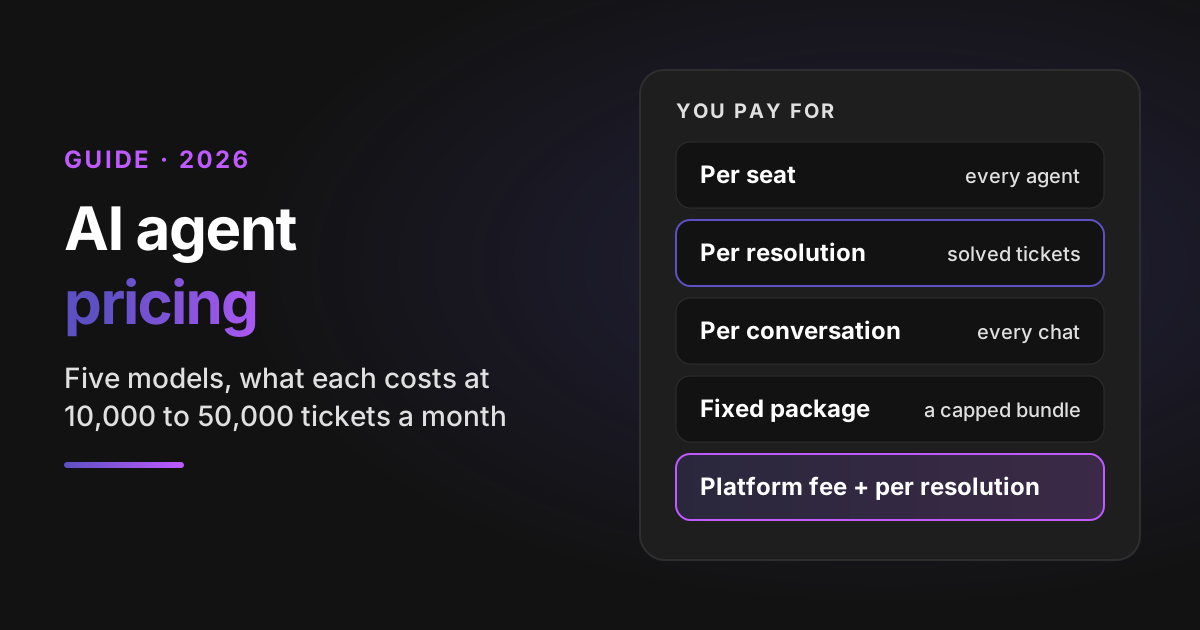
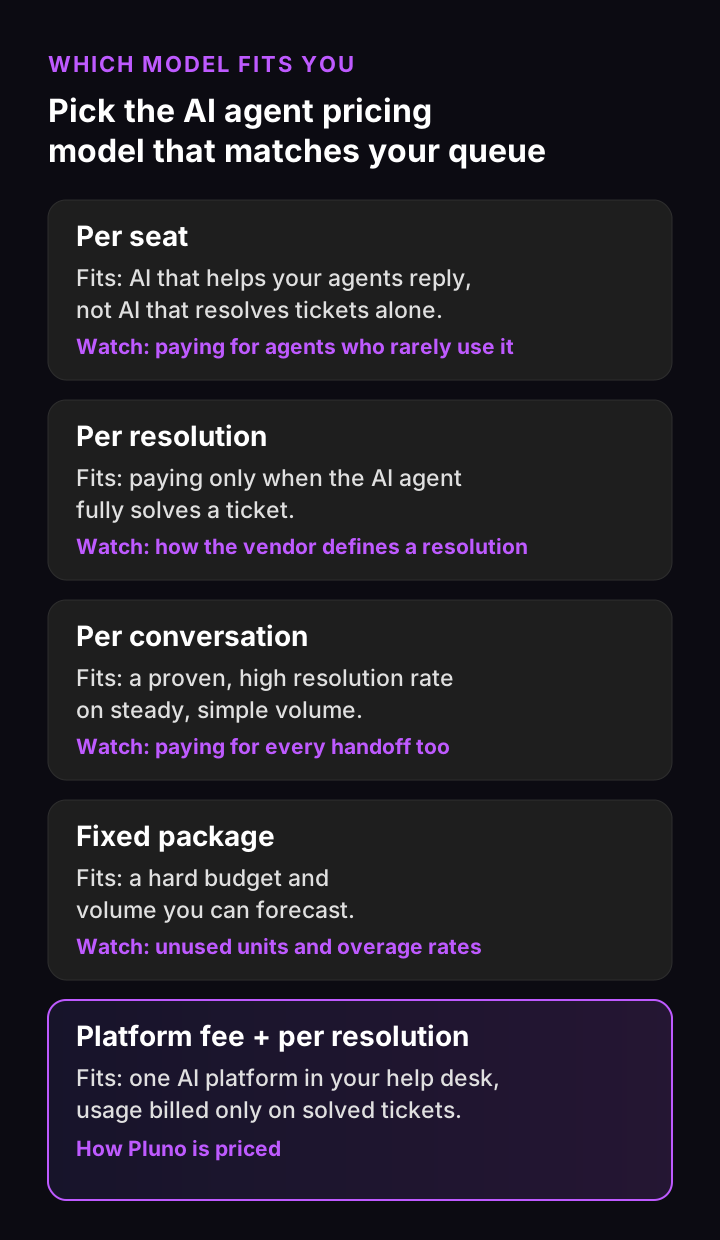
- There are five AI agent pricing models: per seat, per resolution, per conversation, a fixed package, and a platform fee plus a price per resolution. Outcome-based pricing is the family that per resolution belongs to.
- Per resolution is the most common model for support today. List prices run from $0.50 (HubSpot Customer Agent) through $0.99 (Fin) to $1.50 or $2.00 (Zendesk, past the included allowance).
- The bottom-line number: at 25,000 tickets a month and a 40% resolution rate, the same queue costs about $5,000 with HubSpot, $9,900 with Fin, $12,250 on Freddy sessions and $50,000 on Agentforce's $2 conversations. Pluno's usage is 9,000€, plus a platform fee that also covers tagging, escalations and insights.
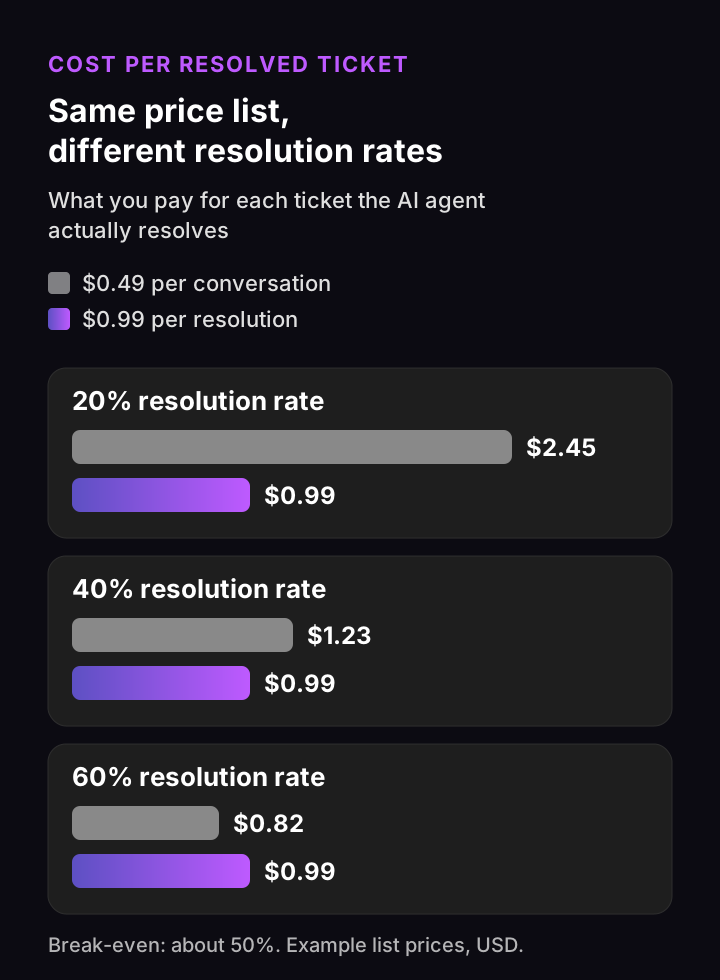
- The rule that matters most: per conversation pricing gets more expensive per solved ticket as your resolution rate drops. At $0.49 a conversation and a 20% resolution rate, each real resolution costs you $2.45.
- For a predictable bill: pick a model where usage is billed only on resolved tickets, ask for the billing definition in writing and test the AI agent on your own tickets before you forecast.
- Pluno's answer: a platform fee for your ticket volume plus 0.90€ per resolved ticket. Escalations are never billed and every billed resolution is tagged in your help desk.
How does AI agent pricing work?
AI agent pricing charges you for one of three things: the people who use the AI, the work it handles or the results it delivers. Every model you'll see on a pricing page is one of those, or a mix of two.
That choice decides who carries the risk. When you pay per seat, you carry all of it: the bill is the same whether the AI agent solves 10 tickets or 10,000. When you pay per resolution, the vendor carries more of it, because a ticket the AI agent hands back to your team usually costs you nothing.
The shift since 2024 has been clear. Zendesk now states that its AI agents are "included in every Suite and Support plan, with pricing based on the successful outcomes they deliver" (Zendesk pricing). HubSpot moved its Customer Agent from $1.00 per conversation to $0.50 per resolved conversation in April 2026 (HubSpot news). Paying for results is becoming the default, and the fine print is where vendors now differ.
The 5 AI agent pricing models explained
Here are the five models, what each one bills and who it suits. The decision map after this section sums them up.
1. Per seat pricing
You pay a fixed monthly price for every agent who uses the AI. Zendesk Copilot is $50 per agent a month on annual billing, and Freddy AI Copilot is $29 per agent a month (Zendesk pricing, Freshdesk pricing).
Per seat is the easiest bill to forecast. It also fits a different job: seat-priced AI usually drafts replies for your agents rather than resolving tickets on its own. The cost doesn't fall when the AI does more work, and you pay for agents who barely open it.
2. Per resolution pricing
You pay only when the AI agent fully resolves a ticket without a human. Fin (formerly Intercom) charges $0.99 per outcome, HubSpot Customer Agent $0.50 per resolution and Gorgias $0.90 to $1.00 per automated interaction (Fin pricing, HubSpot Customer Agent, Gorgias pricing).
This is the model most closely tied to value, because every dollar on the invoice maps to a solved ticket. The risk sits in the definition of "resolved", which differs by vendor. More on that in the overages section.
3. Per conversation or per ticket pricing
You pay for every conversation the AI agent handles, solved or not. Salesforce lists $2 per conversation for Agentforce, and Freshdesk sells Freddy AI Agent sessions at $49 per 100, or $0.49 each (Agentforce pricing, Freshdesk pricing).
The unit price looks lower than per resolution. The catch is that you also pay for every conversation the AI agent hands back to your team. Decagon, which offers both, describes per conversation as "a fixed rate for every incoming conversation" and per resolution as "a higher fixed rate for each fully resolved conversation, with no charge for escalations" (Decagon).
4. Fixed package pricing
You pay one monthly or yearly fee for a set number of conversations, credits or resolutions. Salesforce Flex Credits are a prepaid version: $500 buys 100,000 credits, and a standard Agentforce action uses 20 of them, about $0.10 each (Agentforce pricing).
Packages suit a team with a hard budget and volume it can forecast. Read two lines before you sign: what happens to units you don't use (Salesforce says unused Flex Credits "do not roll over"), and the price of each unit above the cap.
5. Platform fee plus per resolution
You pay a fixed fee for the platform and a price for each resolved ticket. The fee covers what runs on every ticket, such as tagging, summaries and escalations. Usage is billed only on tickets the AI agent solves.
This hybrid is how Pluno is priced: a platform fee scaled to your monthly tickets plus 0.90€ per resolved ticket. You get the predictability of a fixed base and the fairness of paying for results, without a second bill for every handoff.
What is outcome-based pricing?
Outcome-based pricing means you pay for a business result instead of access or activity. In customer support, the result is almost always a resolved ticket, so per resolution pricing is the most common form of it.
Sierra, which popularized the term for AI agents, gives wider examples: "a resolved support conversation, a saved cancellation, an upsell, a cross-sell". It adds that "if the conversation is unresolved, in most cases, there's no charge" (Sierra). Sierra and Decagon don't publish prices, so you'll only see their numbers in a quote.
AI customer service pricing: what vendors charge in 2026
AI customer service pricing in 2026 ranges from $0.49 a session to $2 a conversation, and most vendors now bill per resolution. Here is what each vendor lists today (prices checked November 17, 2026). Help desk seats, where you need them, come on top.
| Vendor | Pricing model | List price (USD) | Minimum or allowance | What counts as billable |
|---|---|---|---|---|
| Fin (formerly Intercom) | Per outcome | $0.99 per outcome; qualifications $9.99 | 50 outcomes a month with your current help desk | Resolutions (customer confirms or asks for no more help) and Procedures that end in a handoff; one charge per conversation |
| Zendesk AI agents | Per automated resolution | $1.50 committed, $2.00 pay-as-you-go past the allowance | 5 resolutions per agent a month on Team plans, 10 on Suite Professional | Requests "successfully resolved by an AI agent" |
| HubSpot Customer Agent | Per resolution, paid in credits | $0.50 per resolution (50 credits); voice $0.50 per minute | Needs a Professional or Enterprise edition | No handoff to a human rep for 72 hours, or the agent qualifies a lead |
| Gorgias AI Agent | Per automated interaction | $0.90 annual, $1.00 monthly | Allowance included in each help desk plan | Requests "fully resolved without a human agent"; billed as a help desk ticket if an agent replies within 72 hours |
| Freshdesk Freddy AI Agent | Per session | $49 per 100 sessions | 500 free sessions, once per account | Every session, resolved or not |
| Salesforce Agentforce | Per conversation or Flex Credits | $2 per conversation, or $500 per 100,000 credits | None stated | Every conversation, or every action |
| Ada | Per conversation (per resolution for some enterprises) | Quote only | Not published | Every conversation |
| Sierra | Outcome-based | Quote only | Not published | Agreed outcomes; "in most cases" no charge if unresolved |
| Decagon | Per conversation or per resolution | Quote only | Not published | Every conversation, or resolutions with no charge for escalations |
Fin is now part of Salesforce: Salesforce completed its acquisition of Fin on September 10, 2026. Fin's list prices haven't changed since, but if you sign a multi-year deal, ask for price protection in writing.
Three patterns stand out. Resolution prices vary by four times between vendors. The allowances are small: 10 resolutions for each of 25 Zendesk agents covers 250 tickets, a few hours of volume for a mid-size team. And several vendors still bill every conversation, which matters a lot once you look at cost per resolution.
For the full plan-by-plan detail, see our guides to Fin pricing, Zendesk AI pricing, Agentforce pricing, Freshdesk pricing, Gorgias pricing, Ada pricing and our HubSpot Breeze AI review.
What AI agent pricing costs at 10,000 to 50,000 tickets a month
At 25,000 tickets a month and a 40% resolution rate, AI agent usage costs between about $5,000 and $50,000 a month, depending only on the pricing model. That spread is why the model matters more than the list price.
Here's how I built the table, so you can check it:
- Volume: 10,000, 25,000 and 50,000 tickets a month, all handled first by the AI agent.
- Resolution rate: 40%, so 4,000, 10,000 and 20,000 resolutions.
- Team: 25 agents on Zendesk Suite Professional (10 included resolutions each, so 250), which only matters for Zendesk's allowance.
- Left out: help desk seats, Copilot seats and implementation. This is AI agent usage only.
| Vendor and meter | 10,000 tickets | 25,000 tickets | 50,000 tickets |
|---|---|---|---|
| HubSpot Customer Agent, $0.50 per resolution | $2,000 | $5,000 | $10,000 |
| Fin, $0.99 per outcome | $3,960 | $9,900 | $19,800 |
| Freddy AI Agent, $0.49 per session | $4,900 | $12,250 | $24,500 |
| Zendesk, $1.50 per resolution past 250 included | $5,625 | $14,625 | $29,625 |
| Zendesk, $2.00 pay-as-you-go past 250 included | $7,500 | $19,500 | $39,500 |
| Agentforce, $2 per conversation | $20,000 | $50,000 | $100,000 |
| Pluno Deflection AI, 0.90€ per resolution | 3,600€ | 9,000€ | 18,000€ |
A few caveats keep this honest. Pluno's row is in euros, net of VAT, and its platform fee (2,499€ a month at 10,000 tickets, 4,649€ at up to 30,000, custom above) also covers tagging, escalations and insights that no other row includes. HubSpot's price needs a Professional or Enterprise edition. Fin with your current help desk has a 50-outcome monthly minimum, and Fin with its own help desk adds help desk seats, so the cheapest row isn't the cheapest total for every team. And Agentforce's Flex Credits can cost far less than $2 a conversation if your AI agent takes few actions; our Agentforce pricing guide works through that math.
Cost per resolution: the number that compares every model
Cost per resolution is your total AI agent bill divided by the tickets the AI agent fully resolved. It's the only number that lets you compare a per seat quote with a per conversation quote on equal terms.
For per resolution pricing, the math is short: your cost per resolution is the list price. For every other model, it depends on your resolution rate. Take Freddy's $0.49 session:
- At a 60% resolution rate, each resolved ticket costs $0.82.
- At 40%, it costs $1.23, already more than Fin's $0.99.
- At 20%, it costs $2.45, because you pay for four handoffs for every ticket solved.
The break-even with a $0.99 per resolution price sits at about 50%. Below that, the "cheaper" per conversation price is the more expensive one.
With a platform fee plus per resolution, split the bill in two. Compare the per resolution line with other vendors' resolution prices, and compare the platform fee with the tools it replaces, such as tagging, escalation and reporting add-ons.
This is the practitioner lesson I'd stress most. The resolution rate in your first months is usually lower than the one in a vendor's case study, because the AI agent is still learning your product and your help center has gaps. A per conversation contract charges you full price during exactly that period.
AI vs human cost per resolution
To judge any AI price, compare it with what a human resolution costs you. The formula is your fully loaded agent cost per hour times the handle time in minutes, divided by 60. For example, at an assumed $40 an hour and 12 minutes per ticket, a human resolution costs $8. Your numbers will differ, so plug them into the Pluno ROI calculator.
Overages, minimums and other costs not on the pricing page
The costs that surprise teams are rarely the headline price. They sit in allowances, minimums and billing definitions. Check these six before you sign.
- Overage rates. Zendesk bills each resolution past the included allowance at $1.50 on committed volume or $2.00 pay-as-you-go. Commit too low and you pay a third more on every extra ticket.
- Monthly minimums. Fin with your current help desk has a 50-outcome minimum, billed at $49 a month, and Fin's help article says unused resolutions "will not be carried over" (Fin help center).
- Credits that expire. HubSpot credits expire at the end of each month, and Salesforce Flex Credits don't roll over (HubSpot credits, Agentforce pricing).
- One-time allowances. Freshdesk's 500 free sessions are a single allowance per account, not a monthly one.
- The billing definition. Ask what turns a conversation into a billable resolution, and whether a handoff, a reopened ticket or a second message in the same conversation is billed again.
- Seats you still need. Zendesk Copilot ($50 per agent) and Freddy AI Copilot ($29 per agent) are separate from the AI agent. HubSpot's Customer Agent needs a Professional or Enterprise edition.
How Pluno answers these checks:
- Overage: one price, 0.90€ per resolved ticket, with no separate overage rate.
- Credits: no credits to expire. Pluno bills resolved tickets.
- Trial: a 14-day free trial of every module, with no credit card.
- Billing definition: escalations are never billed, a reopened ticket isn't billed again and resolutions are verified before billing. Every AI-resolved ticket is tagged and can be exported.
- Seats: Deflection AI needs none. AI Copilot seats are optional, for only the agents you choose, and the number can change month to month.
- Help desk: Pluno runs inside Zendesk, Intercom, Salesforce Service Cloud, HubSpot, Jira Service Management and Freshdesk, so you don't need a new help desk edition.
A simple test: ask each vendor for one month of sample invoices for a customer your size, with the list of tickets behind each billed resolution. A vendor that can show you that list is one you can audit later.
What resolution rate should you expect?
Your queue decides your resolution rate more than the vendor does, so test the AI agent on your own tickets before you forecast. As a reference point, an AI agent that answers from your help center and past tickets typically climbs over its first months as gaps get filled.
Pluno's average resolution rate is 65% across Deflection AI customers, as of November 2026. Customer stories show the range by queue type:
- Smartness switched from Fin to Pluno and reached 40%+ real ticket deflection, with first response time down from hours to 22 minutes.
- Innovorder resolves 67% of chat tickets with AI.
- Velotric has 58% of routed tickets handled by the AI agent.
- Kojo reached 50% ticket deflection, up from 0%.
Be careful when you compare published averages between vendors. Each one measures resolutions by its own billing definition, on its own customer mix, so a higher headline number doesn't mean a higher number on your tickets. Three factors move your rate most: how much of your queue is how-to questions versus account-specific problems, whether the AI agent can read your past resolved tickets and not only your help center, and whether it can take actions such as checking an order or a subscription.
For forecasting, use two rates: a conservative one for months one to three and a target for month six. If the bill only works at the target rate, the pricing model is the problem.
AI agent pricing calculator
Enter your monthly tickets, your expected resolution rate and your number of agents, then set each model's price to the quotes you have. The calculator shows the monthly bill and the cost per resolution for all five models side by side.
AI agent pricing calculator: five pricing models at your volume
Enter your monthly tickets, the share you expect the AI agent to fully resolve and the agents who would need a seat. Then set each model's price to the quotes you have. The defaults are example list prices in USD, not quotes, and the calculator does not convert currencies. Per conversation assumes the AI agent handles every ticket; the fixed package counts every conversation against its cap. Help desk seats, setup and implementation are left out. Your own numbers, not benchmarks.
Your team
Prices to compare
Per seat (assists agents, resolves nothing)
$1,250
25 seats × $50
Per resolution
$7,920
8,000 resolutions × $0.99 · $0.99 per resolved ticket
Per conversation
$9,800
20,000 conversations × $0.49 · $1.23 per resolved ticket
Fixed package
$11,000
$5,000 + 10,000 over the cap × $0.60 · $1.38 per resolved ticket
Platform fee + per resolution
$9,200
$2,000 fee + 8,000 × $0.90 · $1.15 per resolved ticket
Among the models that resolve tickets, at 20,000 tickets and a 40% resolution rate, per resolution pricing is the cheapest at $7,920 a month, and fixed package pricing costs $3,080more. Move the resolution rate: models that bill every conversation or every seat don't change when it drops, so each real resolution gets more expensive.
The defaults are example prices in USD, not quotes: $50 per seat, $0.99 per resolution, $0.49 per conversation, a $5,000 package for 10,000 conversations with $0.60 per conversation over the cap, and a $2,000 platform fee plus $0.90 per resolution. The last model has an extra input for the tools its platform fee replaces. Replace them with your quotes. Then drag the resolution rate down to 20% and watch which totals stay flat while your cost per resolution climbs.
If you want to model what the AI saves on agent time as well, the Pluno ROI calculator covers that side.
Which AI agent pricing model gives you a predictable bill?
The most predictable bill comes from a model that bills usage only on resolved tickets and gives you the list of those tickets every month. A flat seat or package price is predictable too, but it's predictable whether the AI agent works or not.
Here is how each model scores on the four yardsticks:
| Pricing model | Predictability | Cost per resolution | Billing rule to check | Hidden extras |
|---|---|---|---|---|
| Per seat | High: fixed per agent | Falls as the AI does more, rises if it does less | Who counts as a seat | Agents who rarely use it |
| Per resolution | Moves with resolved tickets | Fixed: the list price | Definition of "resolved" | Minimums, overage rates |
| Per conversation | Moves with all volume | Rises as the resolution rate drops | Session length, repeats | Paying for handoffs |
| Fixed package | High until the cap | Depends on how many units you use | Rollover of unused units | Overage above the cap |
| Platform fee + per resolution | Fixed base by volume tier, usage on solved tickets only | Fixed at the unit price for the AI agent; the fee buys modules that work on every ticket | Definition of "resolved" | Few: escalations unbilled |
Platform fee plus per resolution is the model that scores well on all four: the base is fixed, usage tracks solved tickets, handoffs cost nothing and every billed ticket can be checked.
To make a per resolution bill predictable, do three things:
- Forecast a range, not a point. Multiply your monthly volume by your conservative and target resolution rates. Budget at the high end of the range: a higher bill there means more tickets solved.
- Get the billing definition in writing. Ask whether escalations, reopened tickets and repeat messages are billed.
- Audit the first invoices. Pull the tagged list of AI-resolved tickets and spot-check 20 of them against the help desk.
What people say about paying per resolution
Buyers and builders on Hacker News are split on paying per resolution. These comments come from a June 2026 thread about Salesforce's deal to acquire Fin, plus one from a November 2026 thread on help desk pricing.
“These outcomes also skew heavily towards the easy stuff for LLMs to get. So tickets that take a human 1 min to respond to now cost you $0.99 ($60+/hour) and you are stuck only doing the hard tickets.”
“I also think the trend will be to bill per solved ticket ... But I also have a hard time with pricing that isn’t clear, such as “~XXX Resolutions/month.” ... If there’s one area where I’m not a fan of approximations, it’s definitely pricing.”
“This is also demonstrated in the pricing of these systems at a per "open cases resolved"- they're putting their money where their mouth is.”
The takeaway: people like paying for results, but they dislike vague estimates and AI agents that only take the easy tickets. A clear billing rule and a forecast built on your own tickets answer the first. The second is why Pluno researches technical tickets across your past resolutions and connected systems, and escalates with its findings at no charge when a person is needed.
How Pluno prices its AI agent
Pluno is an AI platform for support teams that runs inside the help desk you already use: Zendesk, Intercom, Salesforce Service Cloud, HubSpot, Jira Service Management and Freshdesk. Its pricing follows the fifth model, a platform fee plus a price per resolved ticket.
The platform fee scales with your monthly tickets, from 249€ a month (210€ a month, billed annually) for up to 500 tickets to 4,649€ a month (3,950€ a month, billed annually) for up to 30,000 tickets. Above 30,000 tickets the fee is custom. It already includes:
- AI Tagging & Field Filling on new tickets
- Escalation Copilot, with reports to the tools where your engineering team works, such as Slack, Jira, Linear, Microsoft Teams or incident.io
- Ticket trends and topic insights
- Call summaries and transcriptions, and ticket summaries with sentiment detection
Deflection AI costs 0.90€ per resolved ticket. It answers from your past resolved tickets, your help center and live data, and it never bills an escalation of any kind. A reopened ticket isn't billed again, resolutions are verified before billing, and every AI-resolved ticket is tagged in your help desk, so you can export the list behind each invoice.
AI Copilot is optional, at 49€ per seat a month (41.65€ billed annually). You can buy seats for only some agents and change the number month to month.
Here's a worked example at 10,000 tickets a month and a 40% resolution rate, on monthly billing:
| Line | Monthly cost |
|---|---|
| Platform fee, up to 10,000 tickets | 2,499€ |
| Deflection AI, 4,000 resolutions × 0.90€ | 3,600€ |
| Total | 6,099€ |
On annual billing the platform fee drops to 2,125€, for 5,725€ a month. That covers the AI agent, tagging, escalations and insights in one bill, with usage charged only on tickets the AI agent solved. There's no setup fee, monthly plans can be cancelled anytime, and the 14-day free trial includes every module without a credit card.
Two pricing problems come up often in our calls. Either a per conversation bill grew faster than their resolutions, or a per resolution vendor answered the easy questions while the technical tickets still landed on their agents. Pluno works through both: it researches each ticket across your past resolutions and connected systems, and when a human is needed it escalates with its findings, at no charge.
The Deflection AI page explains how resolutions work in more detail, and the pricing page has an estimate for your exact volume.
The bottom line on AI agent pricing
AI agent pricing is easiest to judge by one number: what you pay for each ticket the AI agent really resolves. Per conversation and per seat prices look low until your resolution rate is low. Per resolution pricing, alone or on top of a platform fee, keeps the AI agent's cost per resolution fixed, as long as the vendor's definition of a resolution is clear and auditable.
My advice for a defensible budget: price two scenarios with the calculator above, ask each vendor for its billing definition in writing, and test the AI agent on your own tickets before you sign. Pluno's free simulation runs your 50 most recent tickets, so you see the quality of its answers, any gaps in its knowledge and when it would hand off, all before anything goes live.
FAQ
How much does an AI agent cost for customer service?
AI agent pricing for customer service in 2026 runs from about $0.50 to $2.00 per resolution or conversation. At 10,000 tickets a month and a 40% resolution rate, that's roughly $2,000 to $20,000 a month in usage, before help desk seats. Pluno charges 0.90€ per resolved ticket plus a platform fee from 249€ a month that also covers tagging, escalations and insights, and never bills escalations.
What are the main AI agent pricing models?
The five models are per seat, per resolution, per conversation, a fixed package, and a platform fee plus a price per resolution. Most support AI agents now bill per resolution or per conversation.
What is outcome-based pricing for AI agents?
Outcome-based pricing means you pay for a result, such as a resolved ticket, a saved cancellation or an upsell, instead of for seats or activity. In support, it usually means paying per resolved ticket, with no charge when the AI agent hands a conversation to a human.
Is per resolution or per conversation pricing cheaper?
Per conversation pricing is cheaper only at high resolution rates. With $0.49 per conversation and $0.99 per resolution, the break-even is a resolution rate of about 50%. Below it, per resolution pricing costs less for every ticket solved.
What is cost per resolution?
Cost per resolution is your total AI agent bill divided by the number of tickets the AI agent fully resolved. It's the fairest way to compare AI customer service pricing across models, because it includes every handoff you paid for.
Do AI agents charge for escalations?
It depends on the pricing model. Per conversation and per session models bill every conversation, escalated or not. Per resolution models don't bill most escalations, but definitions differ: Fin bills a Procedure that ends in a handoff, and HubSpot counts a lead its agent qualifies. Pluno never bills an escalation of any kind.
How is Pluno's AI agent priced?
Pluno charges a platform fee for your monthly ticket volume, from 249€ a month for up to 500 tickets, plus 0.90€ per resolved ticket for Deflection AI. Escalations are never billed, and every AI-resolved ticket is tagged so you can check each invoice.
How do I budget for an AI agent?
Multiply your monthly tickets by a conservative and a target resolution rate, then price both with each vendor's per resolution or per conversation rate. Add any platform fee, minimum and seats, and budget at the high end of the range.