Fin and Ada show up on the same shortlist when you shop for AI support. They are different kinds of products.
Fin is an AI agent from Intercom, which renamed itself Fin in 2026. In June 2026, Salesforce signed a definitive agreement to acquire Fin for about $3.6 billion. The deal is expected to close in early 2027 pending regulatory approval, and Fin's product and pricing are unchanged for now.
Ada is an AI customer service platform that deploys its own AI agent across your channels. They still compare directly, because both put an autonomous agent in front of your customers as a layer on top of Zendesk, Salesforce, Intercom, or another helpdesk you already run. You often weigh them against each other for the same seat.
This comparison covers how Fin and Ada differ on knowledge sources, channels, setup, pricing, and billing, all checked against official documentation in June 2026, so you can match the right one to your team.
TL;DR: Intercom Fin vs Ada vs Pluno
-
Pick Intercom Fin if your support is high-volume and transactional, and you want self-serve setup with pricing you can read on a page.
-
Pick Ada if you're an enterprise covering chat, email, SMS, and voice, with a budget for a guided rollout and a quote that third-party listings put near $30,000 a year
-
Pick Pluno if you run complex B2B SaaS support on Zendesk. It learns from your resolved tickets to answer the hard cases, and it carries the ones that need engineering into Jira and Slack with full context.
[Pluno Free Trial CTA]
What is Intercom Fin AI?
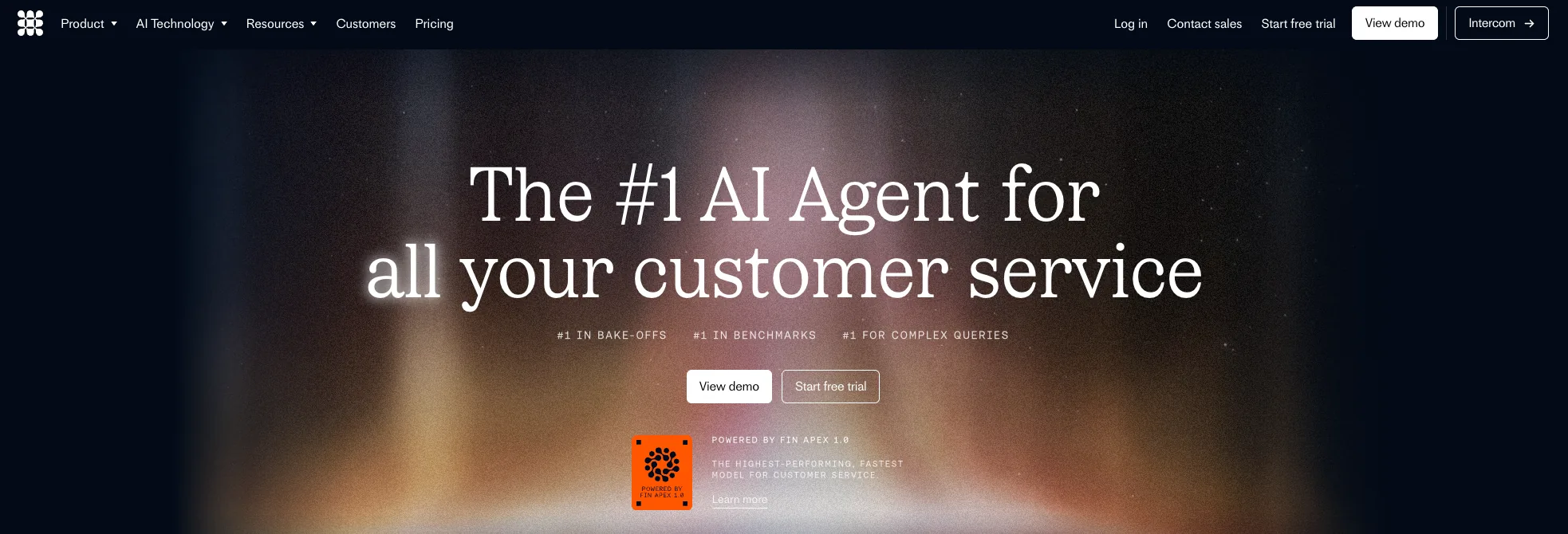
Fin is Intercom's AI agent, and it's good at its job. It resolves chat, email, and messaging conversations on its own, and Fin now reports an average resolution rate of about 76%, a vendor-measured figure.
Resolution rates aren't comparable across vendors because each vendor defines a resolved conversation differently, so treat any headline number as a starting point and benchmark against your own tickets.
Its review base on G2 skews small business (about 58%), which matches its high-volume, transactional sweet spot.
Two parts matter most:
-
Procedures. Your team writes multi-step instructions in plain language (verify the account, check the order, trigger a refund via the API) and Fin runs them, including actions in external systems.
-
Fin Copilot. A separate product that drafts replies for human agents from your content and past conversations.
Deployment:
-
Runs inside Intercom's own helpdesk, where it's deepest, or as a layer on Zendesk, Salesforce, and other helpdesks.
-
On Zendesk, it connects by API and resolves tickets in your existing workspace.
-
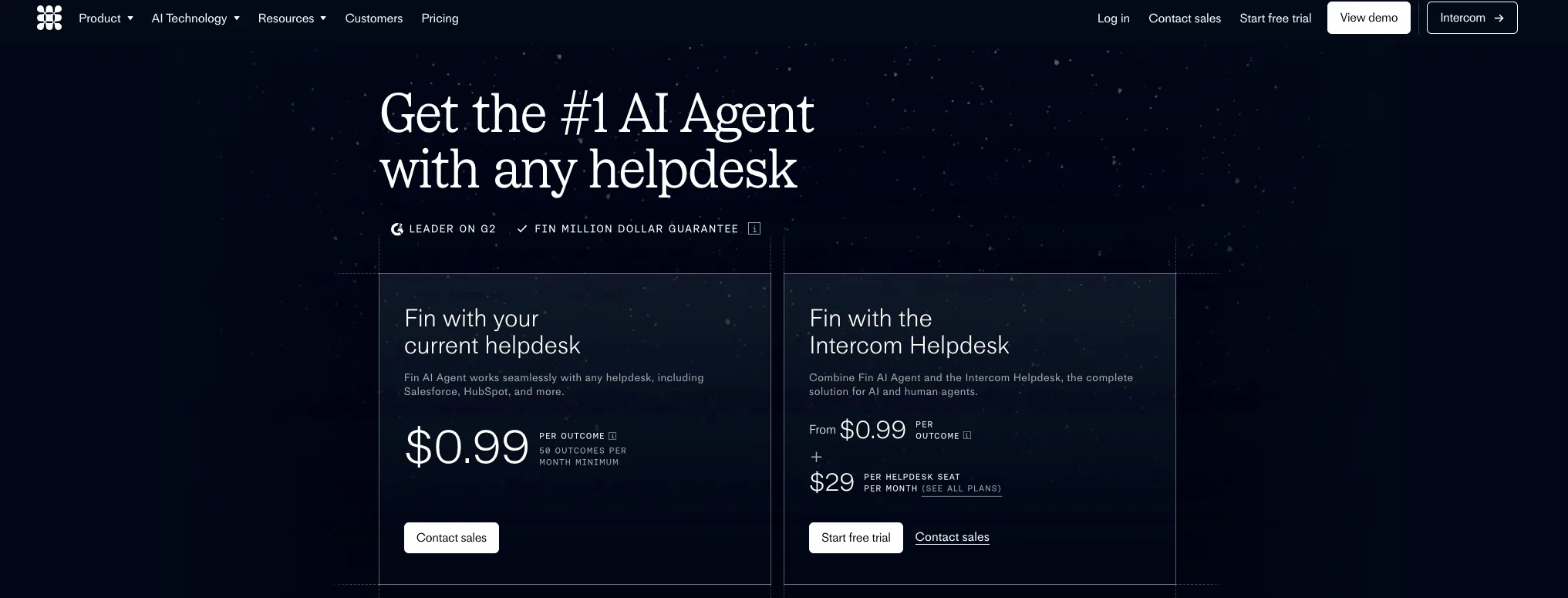
Fin is priced at $0.99 per outcome. An outcome is a resolution or a Procedure handoff.
What is Ada?
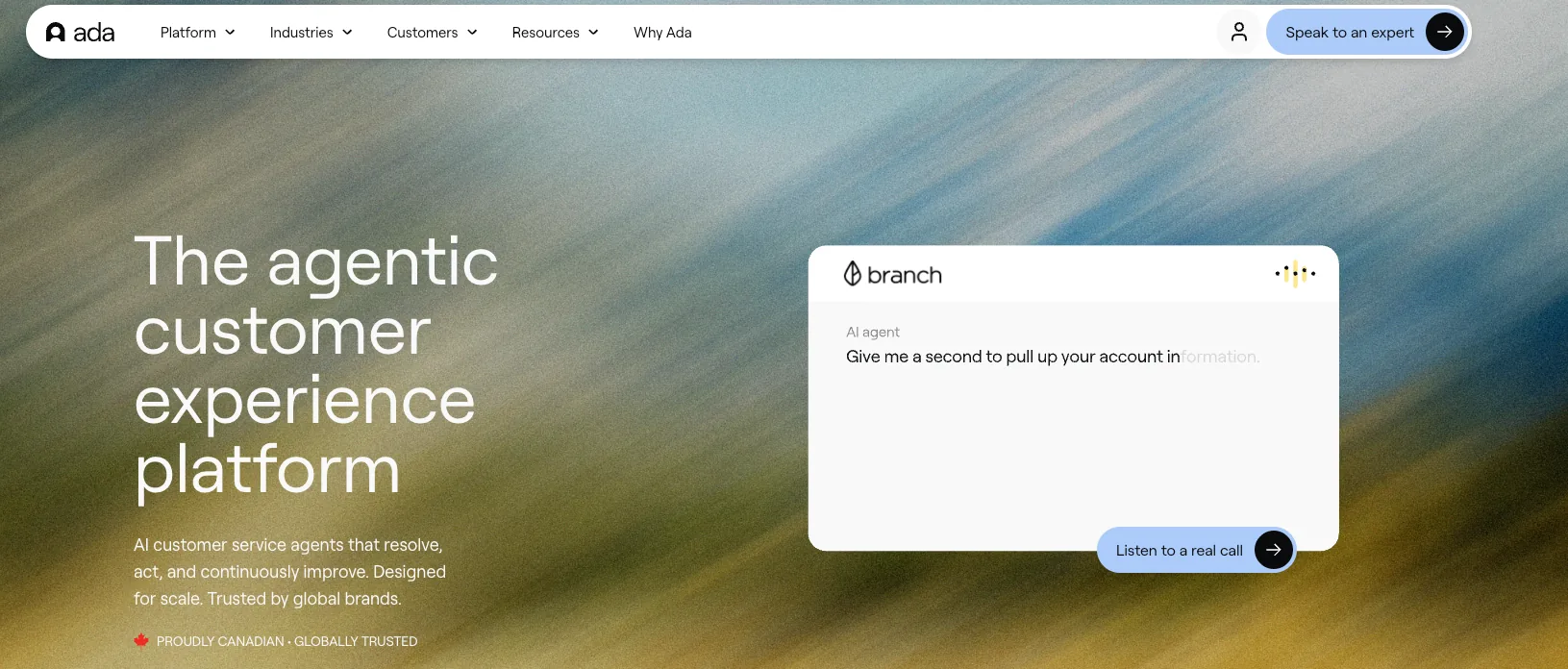
Ada is a standalone AI customer service platform. Founded in 2016, it automates support conversations across chat, email, messaging, and voice, and its homepage claims it resolves up to 83% of issues on its own, measured by Ada. Its review base on G2 skews mid-market (about 63%), larger accounts than Fin's base, which fits its enterprise positioning.
Three parts matter most:
-
Reasoning Engine. A multi-model engine that orchestrates several LLMs, with built-in safeguards that monitor for accuracy and hallucinations.
-
Playbooks. Written SOP-style instructions that guide the engine through tasks like troubleshooting and identity checks.
-
Channels. Chat, email, SMS, social, and voice, with voice offered as part of the platform and built to deflect call-center volume.
Deployment and pricing:
-
Layers on Zendesk, Salesforce, Freshworks, Genesys, and can run on Intercom too. It has no helpdesk of its own.
-
Contracts are quote-based, and rollouts are vendor-guided.
Intercom Fin vs Ada: main differences
This table skips the rows where all three look the same (they all hold SOC 2 and escalate to humans) and covers the dimensions that decide the purchase.
| Dimension | Intercom Fin | Ada | Pluno |
|---|---|---|---|
| Best fit | Transactional, high-volume support | Enterprise omnichannel, voice included | Complex B2B tickets on Zendesk |
| How it learns | Help center, docs, and URLs. Past conversations feed answers only after a human turns them into approved content | Synced knowledge bases and a Knowledge API; resolved tickets aren't a documented native source | Past resolved Zendesk tickets, third-party tools, knowledge base, APIs, and internal documentation |
| Autonomous resolution | Procedures you write by hand | Playbooks you write by hand, with built-in guardrails | Deflection AI trained on how your team already solved tickets |
| Agent copilot | Fin Copilot, on Intercom, Zendesk, and Salesforce | Built around autonomous resolution; agent assist is a newer, secondary add-on | AI Copilot with reply drafts and diagnostic walkthroughs |
| Voice | Native (Fin Voice), but a sales-gated add-on with custom pricing | Part of the platform | None; Call Insights only summarizes calls |
| Setup | Self-serve, change it yourself the same day | Vendor-guided rollout over weeks, services sold on top | Self-serve, Marketplace install in about 10 minutes |
| Pricing model | Per outcome, published | Quote-based, usually per conversation | Platform fee plus €0.90 per resolution, published |
| Biggest weakness | Costs come from several separate charges; strongest on Intercom's own helpdesk | Opaque pricing; agent assist is secondary | No autonomous voice; built for B2B, not transactional |
The sections below unpack the rows that move the decision most.
Intercom Fin vs Ada: what each AI learns from
Fin can draw on past conversations, but only content a human has reviewed and approved. It doesn't learn from every resolved ticket on its own. Ada's documented sources don't include resolved tickets, though a custom Knowledge API integration can change what it ingests. Both answer mainly from the content you've already published.
Fin's knowledge sources:
-
Help center and internal articles, synced from Confluence, Guru, and Notion
-
PDFs, snippets, and approved URLs
-
Past conversations, through a review step. Fin can suggest content drawn from earlier replies, and a human approves it before Fin uses it.
Ada's knowledge sources:
-
Synced knowledge bases (Zendesk Guide, Salesforce, Contentful)
-
A Knowledge API for custom sources, refreshed automatically
-
Resolved tickets aren't a documented native source, though the Knowledge API can feed custom data
This gap hits B2B SaaS hardest. The product ships weekly, the help center lags by months, and the best answer to a hard ticket usually lives in how an agent fixed the same issue three weeks ago. With both Fin and Ada, someone has to turn that fix into content first: write the article, approve the snippet, or author the Playbook. That someone is your support manager or Zendesk admin, and the work grows with every edge case your product creates.
Pluno learns from your resolved Zendesk tickets directly. The fix an agent shipped last week already shapes how Pluno answers today, with no article to write and no snippet to approve. Edge cases stay covered as fast as your team solves them.
Intercom Fin vs Ada: autonomous resolution
Both rely on workflows your team writes and maintains (Fin Procedures, Ada Playbooks). The difference is who controls them and how the output is checked.
-
Fin Procedures are plain-language workflows with branching and API calls. Fin can verify eligibility, change a subscription, or process a refund in an outside system. The no-code editor makes them quick to write and test. Fin doesn't pull from your Zendesk macros for its AI answers, so the canned responses your team built over the years don't feed Fin's replies. Confirm current macro behavior with Fin before relying on this.
-
Ada Playbooks do the same job. A written SOP guides the Reasoning Engine through the steps, with built-in guardrails that monitor for accuracy before answers reach customers. That matters for teams worried about wrong answers going out.
Neither wins outright. Fin gives you more self-serve control over the workflows. Ada wraps more guardrails around the output.
The cost is the same for both. Someone writes a Procedure or Playbook for every workflow, keeps each one up to date as the product changes, and adds new ones as edge cases arise. In B2B SaaS, edge cases pile up faster than anyone writes instructions for them, and the tickets that escalate are usually the workflows nobody had time to write.
Intercom Fin vs Ada: channels and voice
Both are omnichannel. Ada has the edge on voice.
| Channel | Intercom Fin | Ada |
|---|---|---|
| Chat and email | Yes | Yes |
| Messaging apps (WhatsApp, Facebook, Instagram) | Yes | Yes |
| Voice / phone | Native, but a sales-gated add-on with custom pricing | Part of the platform |
Both cover the standard text channels. Voice is where Ada pulls ahead. Ada offers voice as part of its platform, with phone support that aims to skip IVR menus and resolve calls the same way its chat agent handles web and messaging. Confirm voice scope and any tier limits with Ada before you count on it. Fin Voice is also native and real-time, but Intercom offers it as a newer add-on, gated behind sales and priced case by case, so fewer teams can turn it on today. If phone is most of your volume, Ada is the safer pick.
Intercom Fin vs Ada: agent assist
Fin's agent copilot is a mature, separately sold product. Ada is built around autonomous resolution.
-
Fin Copilot drafts replies in the inbox from your content and past conversations. It works on Intercom, Zendesk, and Salesforce, at $35 per seat per month.
-
Ada centers on customer-facing automation. Its tuning tools (Coaching, Custom Instructions) shape the AI agent rather than draft for human agents.
The difference shapes how you roll out. Teams often start with AI assisting humans, then move to autonomous resolution once they trust the quality. Fin Copilot supports that path. Ada points you toward putting AI in front of customers sooner.
Intercom Fin vs Ada: setup and ownership
Fin is self-serve. Ada is vendor-guided.
| Intercom Fin | Ada | |
|---|---|---|
| Who configures it | Your team, no-code | Vendor-guided |
| Time to live | Under an hour on an existing helpdesk | 4 to 16 weeks (third-party estimates) |
| Changing an answer | Same day, yourself | Larger changes typically go through the vendor |
| Contract | Monthly available | Usually annual or multi-year |
| Leaving | No migration needed, low floor | Pay for two layers mid-contract; Playbook logic generally rebuilt elsewhere |
Some enterprises prefer the guided model, since the vendor carries setup work your team would otherwise do. The tradeoff is speed, since larger changes typically depend on the vendor's rollout. The switching cost is the bigger risk on the Ada side. Ada's Playbooks are built inside Ada, so moving to another platform generally means rebuilding that workflow logic. Confirm export options with Ada.
How Intercom Fin and Ada count a billable resolution
Fin bills per outcome. Ada usually bills per conversation, escalations included.
| What triggers a charge | |
|---|---|
| Intercom Fin | An outcome. The main outcome is a resolution: the customer confirms the answer helped, or stops replying without asking for more help. A Procedure you set to end in a handoff can also count, so some handoffs bill too. |
| Ada | Commonly per conversation, including conversations that escalate. Ada measures "Automated Resolutions" as a metric, but its pricing blog argues for per-conversation billing. Confirm which model your quote uses. |
Because Ada can bill for conversations it didn't resolve, two vendors quoting similar headline rates can still produce very different invoices. The reliable number is the one you measure on your own tickets.
Intercom Fin vs Ada pricing
Fin's numbers below come from Fin's official pricing documentation. Ada publishes no public pricing, so the Ada figures are third-party estimates.
Intercom Fin pricing
| What | Price |
|---|---|
| Fin outcomes | $0.99 per outcome |
| Standalone on your helpdesk | 50-outcome monthly minimum, unlimited teammates, no platform or integration fees |
| On any existing helpdesk (Zendesk, Salesforce, and others) | $49/month base plan that includes 50 outcomes, then $0.99 per additional outcome. No platform, seat, or integration fees. |
| Intercom helpdesk seats | Monthly billing: $39 Essential / $99 Advanced / $139 Expert per seat per month. Annual billing: $29 / $85 / $132 per seat per month. These apply only if you run Fin inside Intercom's own helpdesk, not when Fin runs standalone on Zendesk. |
| Fin Copilot | $35 per user per month, or $29 on annual billing |
| Fin Voice | Custom pricing, through sales |
| Free trial | 14 days, unlimited outcomes |
Ada pricing
Ada publishes no pricing. The numbers below come from third-party sources, the Salesforce AppExchange listing and Vendr's procurement data, since a real figure only comes through a demo and a custom quote based on conversation volume and team size. Treat these as estimates only. Confirm the actual billing model and rate in your own Ada quote, because Ada's contracts vary and its own pricing content discusses per-conversation billing.
| What | Detail |
|---|---|
| AppExchange reported starting price | $30,000 per company per year |
| Vendr median (about 100 tracked purchases) | around $70,000 per year, ranging from roughly $34,000 to $274,000 |
| Services | Implementation and optimization cost extra |
| Billing model | Commonly per conversation, the structure Ada advocates publicly |
A worked example
Take 2,000 AI-eligible conversations a month at a 60% resolution rate. Every assumption is labeled, because Ada's rates are illustrative.
| Scenario | What bills | Monthly cost |
|---|---|---|
| Fin on your helpdesk | $49 base plan (includes 50 outcomes) plus 1,150 additional outcomes at $0.99 | ~$1,188, plus your Zendesk costs |
| Ada at $0.50 / conversation | All 2,000 conversations, including the 800 that escalated | $1,000 |
| Ada at $1.00 / conversation | All 2,000 conversations | $2,000 |
Ada's annual floor applies on top of these figures, and your real rate comes from the quote.
Where Intercom Fin and Ada fall short
Where Intercom Fin falls short
-
Knowledge from past conversations passes through a review queue capped at 100 pending snippets, with 4-week auto-rejection, so it needs weekly attention or the knowledge expires unused.
-
The bill comes from several separate charges: $0.99 per outcome, $35 per Copilot seat, and Intercom seat fees if you use their helpdesk.
-
A Procedure that ends in a handoff counts as a billable outcome, so conversations your humans finished can still bill.
-
Voice needs a sales conversation and custom pricing, while Ada treats voice as a core channel in its platform.
-
The economics and the deepest integration both assume Intercom as your helpdesk, which weakens the case if you run Fin on Zendesk.
Where Ada falls short
-
Pricing stays invisible until you've finished a sales cycle, which blocks the quick bake-offs most teams want to run first.
-
Implementations run for weeks and lean on vendor services, so iteration speed depends on someone else's calendar.
-
Ada centers on autonomous resolution rather than agent assist, so teams that want to start with an AI that drafts for human agents will find Fin's Copilot more established.
-
Documented knowledge sources center on published content, and resolved tickets aren't among them, so answer coverage tracks how current your help center is.
-
Per-conversation billing can include escalated conversations, so the bill grows with traffic even when resolution quality dips.
For complex B2B support on Zendesk: Pluno
Fin and Ada both run as a layer on the Zendesk helpdesk you own, and both lean on content someone has to write and keep current. For the hardest B2B SaaS tickets, the answer usually lives in how your team already solved the issue and in the engineering systems where the bug sits.
Pluno is built for that case. It integrates with Zendesk and Intercom, and installs from the Zendesk Marketplace in about 10 minutes.
Pluno's edge for B2B SaaS is twofold: it reads your resolved tickets directly, and it carries a hard ticket all the way into engineering. Help center articles, URLs, and drag-and-drop documents feed the same knowledge pool. Your macros stay useful for human agents, and Pluno doesn't need them for AI answers, because the phrasing they standardized already lives in your resolved tickets.
The modules:
-
Deflection AI resolves tickets autonomously, trained on how your team already solved them, and escalates when it isn't sure.
-
AI Copilot drafts replies and diagnostic walkthroughs for agents who want a human-in-the-loop first.
-
The Troubleshooting Agent investigates across Sentry, Linear, databases, and session recordings to diagnose a bug rather than guessing at it. Support and engineering both use it.
-
Escalation Copilot syncs Zendesk with Jira, Slack, and Linear in both directions and automatically generates the escalation report (summary, repro steps, impact), so engineers can act without a round of clarifying questions.
Billing:
| What | Detail |
|---|---|
| Deflection AI | €0.90 per resolution, charged only when Pluno sent the last public message and the customer stayed silent for 72 hours |
| Escalations to humans | Never billed |
| Verification | Every AI-resolved ticket is tagged so an admin can check it |
| Platform fee | Scales with ticket volume; covers Escalation Copilot, AI Tagging, Call Insights, Ticket Trends, and ticket summaries with sentiment |
| AI Copilot | €49 per agent per month for the seats you choose |
| Troubleshooting Agent | €99 per month for about 50 investigations, as an add-on |
| Annual billing | 15% off |
Where Pluno falls short:
-
No autonomous voice channel. Call Insights transcribes and summarizes Zendesk calls, but the AI doesn't answer phones, so voice-heavy contact centers fit Ada better.
-
The platform fee sits on top of usage fees.
-
Built for complex B2B support, so a transactional consumer brand with simple, repetitive tickets will get more from Fin's model.
The bottom line: Fin, Ada, or Pluno?
-
Intercom Fin fits transactional, high-volume teams that want published pricing and same-day, self-serve control, with the deepest experience inside Intercom's own helpdesk.
-
Ada fits enterprises that want one vendor-managed AI across chat, email, SMS, and voice, and can absorb a quoted contract and a rollout measured in weeks.
-
Pluno fits B2B SaaS teams on Zendesk whose hardest tickets get solved from past resolutions and engineering systems. If that is your support profile, it reads your resolved tickets directly and carries the engineering cases end to end.
-
Whatever you shortlist, benchmark on your own tickets. The published rates use different definitions on different customer bases, so vendor numbers can't be compared directly.
FAQ: Intercom Fin vs Ada
Can I use Intercom Fin or Ada with Zendesk?
Yes, both deploy as an AI layer on top of Zendesk. Fin connects by API with a $49/month base plan that includes 50 outcomes, then $0.99 per additional outcome, and no platform or seat fees. Ada integrates with Zendesk under a quote-based annual contract. Pluno installs from the Zendesk Marketplace and serves the same slot for B2B SaaS teams.
Is Ada cheaper than Intercom Fin?
It depends on the billing structure in your quote. Fin charges $0.99 per outcome, so escalated conversations without a Procedure cost nothing. Ada commonly bills per conversation under contracts that start around $30,000 a year, so escalated conversations can appear on the bill. At low volumes Fin is usually cheaper. At enterprise volumes, negotiated Ada rates can flip the math.
Does Ada learn from past support tickets?
Ada's documented knowledge sources are synced knowledge bases like Zendesk Guide, Salesforce, and Contentful, plus a Knowledge API. Resolved tickets aren't a documented native source, so out of the box Ada's answers track your published content. A custom Knowledge API integration can extend what it ingests.
Fin can draw on past conversations only through human-reviewed content, so it reflects what your team has approved. Pluno ingests resolved Zendesk tickets directly into answer generation.
What counts as a billable resolution for Intercom Fin and Ada?
Fin bills per outcome. A resolution counts when the customer confirms the answer helped or stops replying without asking for more help, and some Procedures that end in a handoff also count. Ada measures Automated Resolutions as a metric while commonly billing per conversation, including conversations that escalate. Confirm the structure in writing before comparing quotes, because the definitions move the math more than the rates do.
What's a good Intercom Fin and Ada alternative for B2B SaaS teams on Zendesk?
Pluno is built for that profile. It learns from your resolved Zendesk tickets automatically, connects support to engineering through Jira and Slack sync plus a Troubleshooting Agent, and bills €0.90 per resolution only when the customer stays silent for 72 hours after Pluno's last message. Escalations to humans are never billed. You can simulate it against your own historical tickets before paying anything.