You're on Zendesk, ticket volume keeps climbing, and you want AI to take the first pass at support. An AI agent that resolves tickets on its own cuts the volume your team touches by hand. The question is which AI layer does that best on Zendesk.
Two options sit in front of you. Use the AI available natively inside Zendesk, or add a dedicated AI agent for Zendesk and point it at the same tickets. Ada is the dedicated agent most Zendesk teams shortlist because it installs on top of Zendesk and appears in almost every search in this category. So this comparison puts Zendesk AI against Ada.
A third option fits one specific profile. Pluno is an AI layer for B2B SaaS teams on Zendesk whose hardest tickets get answered from resolved support tickets, a Jira thread, or a log. We bring Pluno in at each point where it changes the decision.
Which layer fits comes down to what each AI learns from, how it resolves and acts on a ticket, what it costs as volume grows, and how fast it goes live. Each section below ends with a verdict.
TL;DR
- Pick Zendesk AI if you're on Zendesk Suite and want autonomous resolution live in days. The AI agent turns on inside the admin, and reporting lands in Explore where your team already looks. Copilot, the agent-assist side, is a separate paid add-on.
- Pick Ada if you're an enterprise running support across chat, email, voice, SMS, and social. Plan for a multi-week, vendor-guided rollout on a quote-based annual contract. Third-party estimates put the floor around $30,000 a year.
- Pick Pluno if you're a B2B SaaS team on Zendesk and your hardest tickets get answered from resolved support tickets, a Jira thread, or a log. Pluno learns from how your team resolved past tickets. Neither Zendesk AI nor Ada uses resolved support tickets as a documented knowledge source today.
Cost works differently for each. Zendesk bills per automated resolution, tiered by each resolution's value, with a baseline allowance in your plan. You choose whether to allow paid overages or pause the AI at your limit. Ada is quote-based. Confirm how each one counts a resolution before comparing a single number.
What is Zendesk AI?
Zendesk's AI is available natively inside Zendesk, and it splits into two products:
- AI agents handle autonomous resolution across messaging, email, and voice, with voice still in early access.
- Copilot sits in the agent sidebar and assists a human with drafts, suggestions, actions, and summaries.
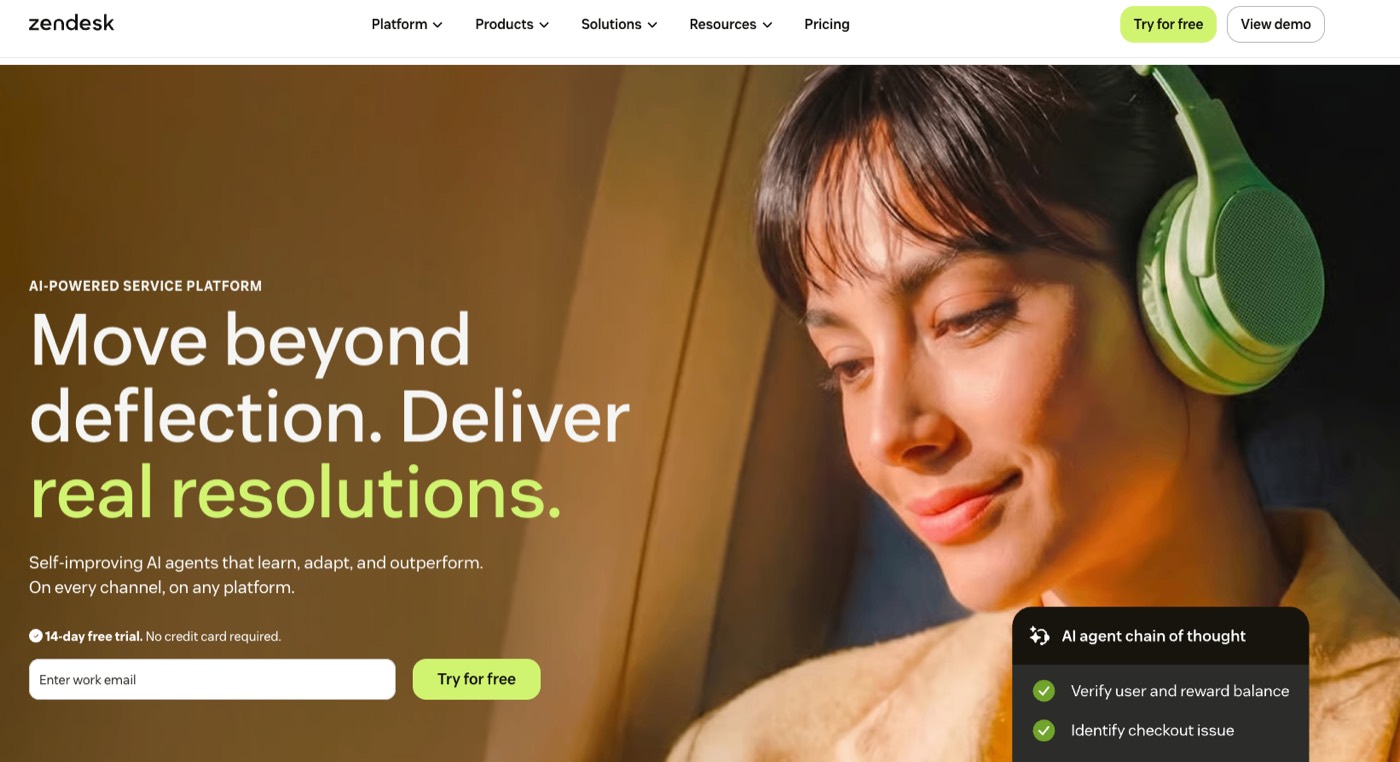
Because the AI agent is Zendesk's own, you turn it on in the admin with a few clicks, and reporting shows up in Explore where your team already looks. A basic deployment can be live in days. Copilot is a separate paid add-on, so turning on agent assist is its own line item.
Zendesk reshuffled its AI agent packaging in mid-2026. As of the rollout between May and June 2026, the old split between Essential and Advanced AI agents is gone. The agentic capabilities that previously required an add-on (multi-step reasoning, procedures, external API actions) are now included across Zendesk Suite and Support plans. Copilot stays a separate add-on.
What is Ada?
Ada is an enterprise AI agent platform founded in Toronto, with no helpdesk of its own. It deploys as an AI layer on top of Zendesk, Salesforce, Freshworks, and other platforms, so teams keep their existing helpdesk and route resolution through Ada.
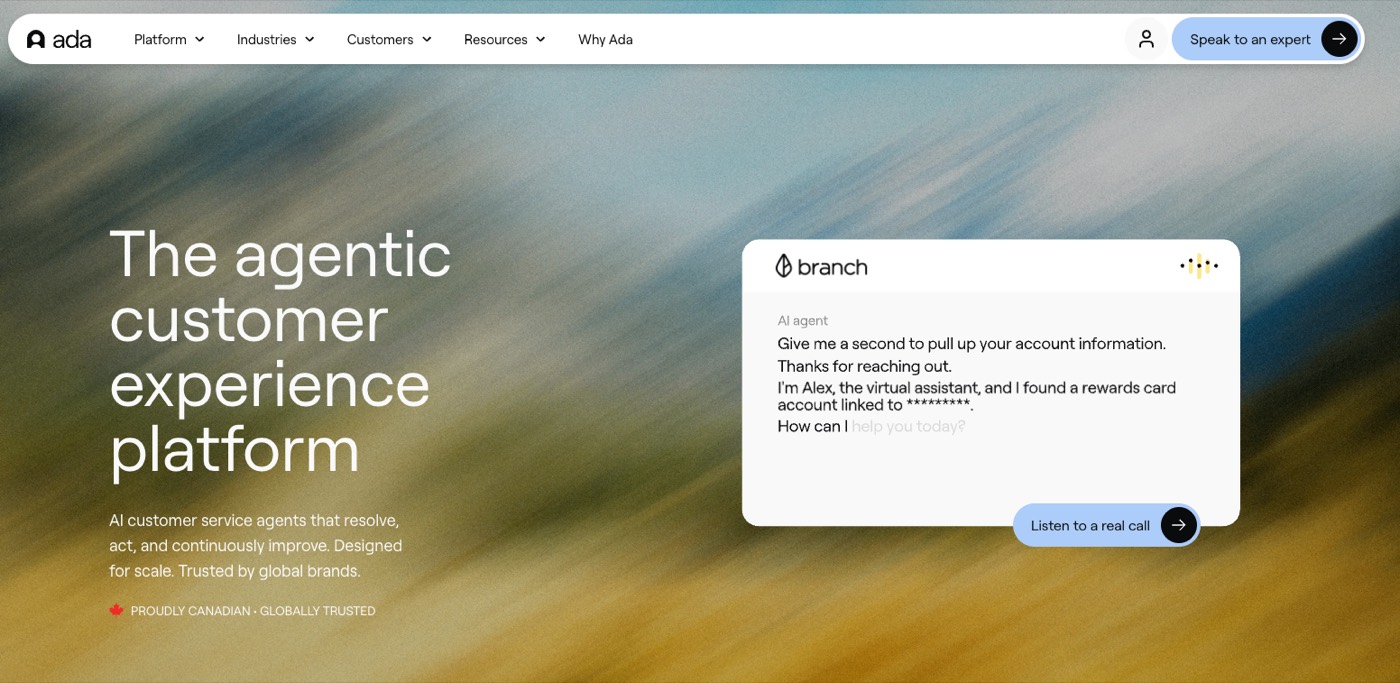
Ada targets larger support organizations that run high volume across many channels and want structured automation that they can configure themselves.
- Unified Reasoning Engine, launched February 2026, orchestrates multiple LLMs as one decision layer across every channel.
- Playbooks are structured multi-step workflows you build in a no-code editor.
- Channel range is wide: chat, email, voice, SMS, WhatsApp, Instagram, and social from one platform.
Ada answers from your knowledge base, pulls live data through Actions and API calls, and uses conversation context to decide a reply. When it can't resolve a case, it hands it off to a human.
Zendesk AI vs Ada: side-by-side comparison
This table draws the contrasts on each factor. Read it to see how the three tools differ, and where one does something better.
| Decision factor | Zendesk AI | Ada | Pluno |
|---|---|---|---|
| Best-fit buyer | Existing Zendesk teams wanting AI fast | Enterprises wanting broad channels and structured workflows | B2B SaaS teams on Zendesk with complex, technical tickets |
| Deployment | Available natively inside Zendesk, turned on in admin | Third-party layer on Zendesk, Salesforce, Freshworks | Third-party layer on Zendesk, built for B2B SaaS |
| What the AI reads | Help center plus imported sources (web crawler, Confluence, CSV) | Knowledge base plus business systems via Actions and API | Resolved support tickets, plus help center and connected systems |
| Autonomous engine | Generative replies inside conversation flows | Unified Reasoning Engine plus Playbooks | Deflection AI, iterative retrieval across sources |
| Agent assist | Copilot, a dedicated sidebar product | Focused on autonomous resolution, no documented standalone copilot | Answer Copilot in the sidebar |
| Channels | Messaging, email, voice (voice in EAP) | Chat, email, voice, SMS, WhatsApp, social | The channels you connect to Zendesk |
| Setup and ownership | Fast, self-serve, configured by the support team | Multi-week, vendor-guided implementation | Install from the Marketplace, learns from resolved support tickets automatically |
| Pricing model | Per automated resolution (tiered), Copilot add-on separate | Quote-based annual contract | Per resolution plus a platform fee |
| Security | SOC 2, GDPR | SOC 2, GDPR, HIPAA, AIUC-1 | Confirm current certifications |
| G2 skew | Broad install base across segments | Mid-market and enterprise | B2B SaaS |
Where Zendesk AI and Ada look for answers
For teams with a lot of technical tickets, what each AI reads decides fit, and most comparisons skip it.
Here's what each one draws on, per its own documentation:
| Tool | Documented knowledge sources | Main knowledge source |
|---|---|---|
| Zendesk AI | Help center, plus web crawler, Confluence, and CSV imports | Published help-center content. Zendesk's FAQ states ticket volume doesn't affect answers. |
| Ada | Knowledge base, business systems via Actions and API, conversation context | Curated knowledge base, with live data pulled through Actions. |
| Pluno | Resolved support tickets, plus help center and connected systems | Resolved support tickets, how your team solved the same issue before. |
A few details that matter:
- Zendesk searches your help center live and syncs external sources on a schedule. Its answers are only as good as a comprehensive, well-maintained knowledge base.
- Ada's agent-logic docs describe its Reasoning Engine answering from the knowledge base, business-system Actions, and conversation context, then handing off to a human when it can't resolve.
- Pluno's primary source is your resolved support tickets, so the diagnostic steps and fixes your team already worked out become what it answers from.
The consequence lands hardest on B2B SaaS teams. Product changes are frequent, and the help center can't keep up. The answer to a hard ticket often isn't written in an article. It lives in how an agent solved the same issue three weeks ago, in a Jira thread, or in a log.
Zendesk AI and Ada both route knowledge through a content step a human maintains: writing the article, building the Playbook, keeping the help center current. The support manager or admin owns that upkeep, and it grows with the product. Pluno reads your resolved support tickets directly, so that upkeep shifts from writing content to letting solved tickets accumulate.
How Zendesk AI and Ada resolve tickets and take action
Verdict: Edge to Ada on workflow depth, edge to Zendesk AI on speed to value.
| Zendesk AI agents | Ada | |
|---|---|---|
| Engine | Generative replies inside conversation flows, scripted plus generative | Unified Reasoning Engine plus Playbooks |
| Actions | API calls for standard cases: refunds, lookups, account updates | Multi-step API workflows with branching |
| Strongest at | Common cases, fast | Deep, multi-step processes across systems |
| Weaker at | Deep custom workflows spanning several systems | Speed and simplicity of a quick rollout |
Why Ada wins on depth: Playbooks chain multi-step API workflows with branching, so Ada handles processes that touch several systems in one run. Why Zendesk AI wins on speed: the generative agent answers common cases out of the box, with no workflow to build first.
Where both fall short: Playbooks and conversation flows are configured and maintained by hand. In a fast-moving B2B SaaS product, edge cases multiply faster than anyone writes flows for them, and the admin or support manager carries that work. The same applies to engineering handoffs. With both tools, the escalation to Jira, the reproduction steps, the impact, and the customer context are filled in manually.
What that means for the buyer: if your team wants to own deep, controlled workflows and has the staff to maintain them, Ada rewards that. If you want resolution live fast on common cases, Zendesk AI gets there sooner. For the manual-escalation gap, see how Pluno's Escalation Copilot auto-generates the report below.
Zendesk AI vs Ada: agent assist
Verdict: Edge to Zendesk AI.
Agent assist keeps a person on every reply. The AI drafts a response and surfaces context, the agent reviews it, edits if needed, and sends. Nothing reaches the customer without a human. Handle time per ticket drops, but a person still touches each ticket, so agent assist doesn't cut volume the way autonomous deflection does. Teams not ready to let AI answer customers directly usually start here.
| Copilot | What it does | What it draws on | Pricing |
|---|---|---|---|
| Zendesk Copilot | Suggests first replies, follows admin-written procedures, takes approved actions in connected systems, summarizes tickets, prompts agents during voice calls | Macros, help center articles, admin-written procedures, similar solved tickets | Paid add-on on Professional plans and above, reported around $50 per agent per month |
| Ada Glass | Hands a conversation to a live agent with the transcript, an AI summary, and the customer record. A handoff layer that stops at the transfer. | The conversation up to the point of handoff | Part of Ada's quote-based contract |
| Pluno Answer Copilot | Drafts a reply the moment a ticket opens, shows its reasoning and sources, and lets the agent refine it in chat | Resolved support tickets, help center, and connected systems | €49 per agent per month |
Why Zendesk AI wins: Copilot is the deepest of the three for working a ticket from open to close. It drafts replies, follows the procedures your admins define, and executes approved actions across connected systems, all within the Agent Workspace.
Where it falls short: its suggestions come from macros, help center articles, and procedures you maintain. A thin or stale help center produces generic drafts that agents stop accepting.
How Ada compares: Ada Glass is a handoff layer. When the AI agent can't resolve a conversation, it passes the customer to a human with the transcript, an AI summary, and the customer record. It does not draft and refine replies alongside the agent for the rest of the ticket, the way Zendesk Copilot does.
How Pluno compares: Answer Copilot grounds its drafts in resolved support tickets, the help center, and connected systems. For a complex ticket, the suggested reply reflects how your team solved the same issue before, with reasoning and sources shown so the agent can verify at a glance. The agent can ask it to adjust the draft, and it regenerates as new messages arrive. Nothing goes out without the agent.
What that means for the buyer: if you want one assistant to carry a ticket end-to-end, Zendesk Copilot is the deepest, as long as your help center is strong. If your hardest answers live in resolved support tickets, Pluno's drafts start from there.
Zendesk AI vs Ada: supported channels
Verdict: Edge to Ada.
Why Ada wins: it handles chat, email, voice, SMS, WhatsApp, Instagram, and social from one platform. For an enterprise running support across many channels, that breadth cuts real complexity.
Where Zendesk AI falls short: it covers messaging, email, and voice, with voice in early access. Fewer channels than Ada today.
What that means for the buyer: if customers reach you on five or six channels and you want one AI agent across all of them, Ada has the wider net. Pluno answers on the channels you connect to Zendesk, so channel range follows your Zendesk setup.
Zendesk AI vs Ada: setup and time to value
Verdict: Edge to Zendesk AI.
Why Zendesk AI wins: it's self-serve. You connect knowledge sources, configure behavior, and a basic agent answers within days. Reporting flows into Explore.
Where Ada falls short on speed: it's a vendor-guided project. Third-party estimates put a full deployment at roughly 8 to 16 weeks, with lighter pilots faster. The trade buys deeper workflows and broader channels.
What that means for the buyer: if you want AI answering this month, Zendesk AI gets there. If you need Ada's depth and channels, budget for the rollout. Pluno installs from the Zendesk Marketplace and starts learning from your resolved support tickets automatically, so it lands closer to the Zendesk end of this range.
If you're switching from one AI layer to another, plan for the full cost of the move: data risk, contract timing, rebuilding integrations, and retraining your team. A timeline estimate alone hides most of that.
Zendesk AI vs Ada: pricing
Verdict: Lower commitment with Zendesk AI at low to moderate volume; Ada's fixed contract can win at high volume.
| Zendesk AI | Ada | |
|---|---|---|
| Model | Per automated resolution, grouped into value tiers | Quote-based annual contract with volume commitment |
| Rate | Zendesk doesn't publish a flat rate. Third-party breakdowns cite roughly $1.50 to $2.00 per resolution. | No public rate. Third-party estimates put the floor around $30,000 a year. |
| Allowance | Baseline included in your plan, capped at 10,000 resolutions per year | Negotiated in the contract |
| Agent assist | Copilot add-on, reported around $50 per agent per month | No separate copilot product |
| When you hit the limit | Allow paid overages, or pause the AI until the next cycle | Defined by your contract terms |
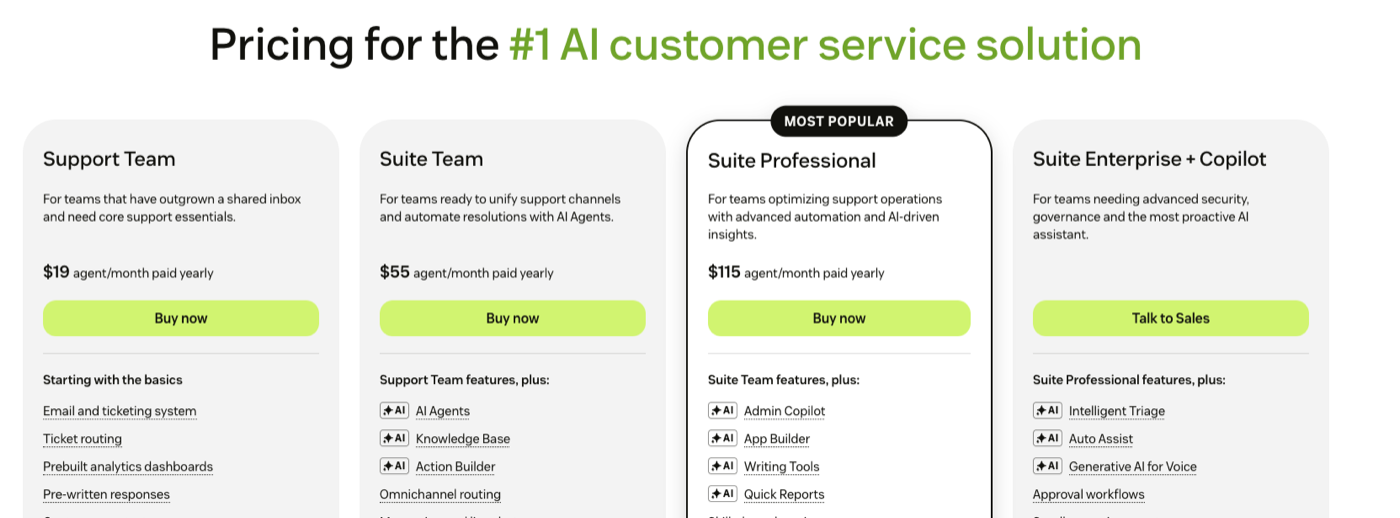
How Zendesk counts and bills a resolution:
- A resolution counts when an AI agent resolves a request without a human, verified by a second LLM check before billing.
- Committed volume costs less per resolution than pay-as-you-go.
- Cost climbs as the AI resolves more, the trade in any outcome-based model.
On Ada, the market disagrees on the unit. Some sources cite per-resolution rates, while Ada's own writing argues for conversation-based pricing, so the unit likely depends on your contract. Treat the $30,000 figure as a third-party market estimate. Ada doesn't publish a price.
Across the industry, per-resolution native pricing tends to be competitive at low to moderate volume and gets expensive as resolution counts climb, where a fixed enterprise contract can come out ahead. The crossover point varies with your negotiated rate, so model it on your own numbers.
Pluno: the AI layer for complex B2B SaaS tickets on Zendesk
Zendesk AI and Ada are strongest where the answer already lives in maintained, published content. For many teams, most tickets fit that shape, and either one serves well.
B2B SaaS support works differently. The tickets that pile up are the ones where the answer was never written into an article. Pluno is built for that profile. It runs as the primary AI layer for these teams, the same role Zendesk AI or Ada plays for content-heavy support.
Pluno installs from the Zendesk Marketplace and learns from your resolved support tickets. The answer to a hard ticket comes from how your team solved it before, with the help center and connected systems as additional sources. Pluno runs an iterative process, several knowledge searches and tool calls per ticket, to ground its answer. It answers on the channels you connect to Zendesk.
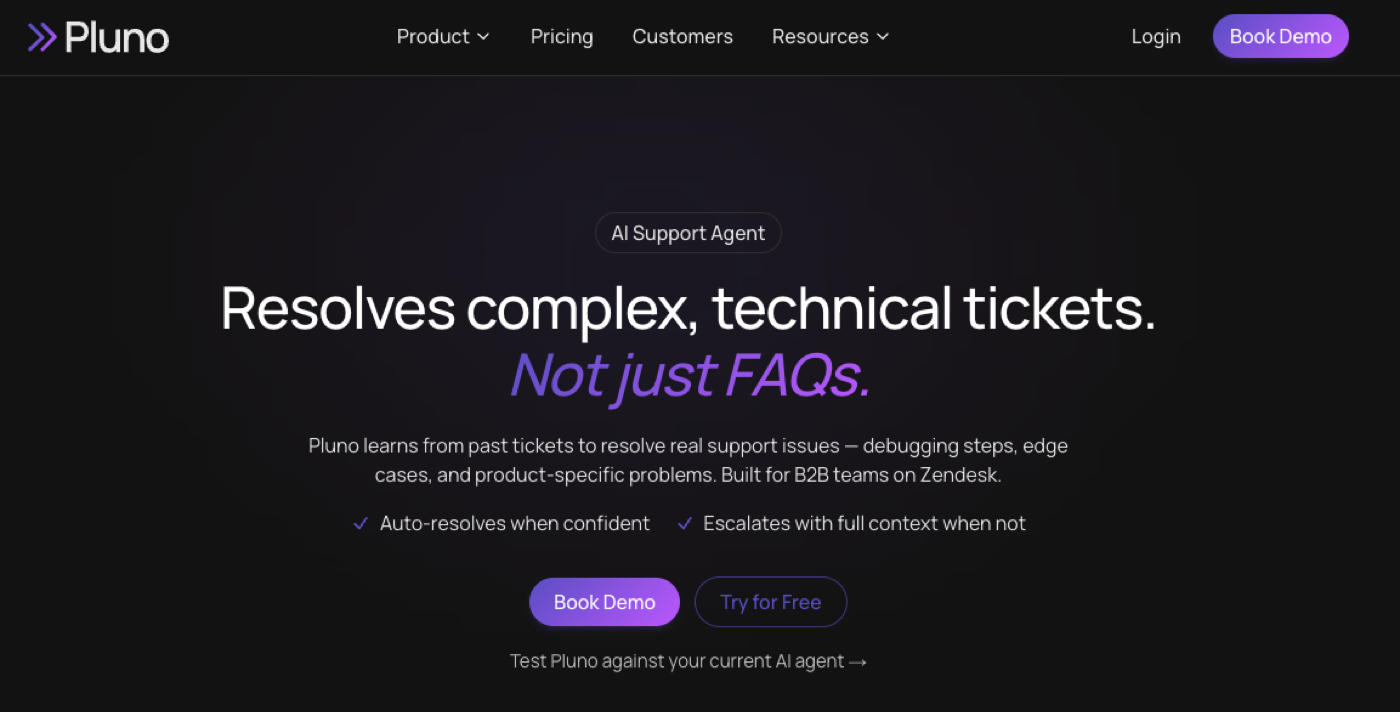
Pluno answers only when it has enough evidence to be confident. When it doesn't, it escalates to a human with the full context it gathered, so a low-confidence ticket reaches an agent with a summary and a trail to work from.
"Pluno knows when something needs to be escalated… and I know that if something hasn't come to me, it's not urgent and doesn't need to get fixed by a human person."
Joseph D'Appuzo, Customer Support Manager at Smartness
What it adds for technical products:
- Troubleshooting Agent investigates across code, logs, recordings, Sentry, Linear, and databases. Support uses it to confirm a customer-side fix and avoid an unnecessary engineering escalation. Engineering uses it to debug and get a recommended fix when a ticket is a real bug.
- Escalation Copilot keeps a two-way sync between Zendesk and Jira or Slack, and writes the escalation report for you, with a summary, reproduction steps, and impact. The report Zendesk and Ada leave you to fill in by hand.
- Answer Copilot drafts replies for the agents you choose, grounded in resolved support tickets, the help center, and connected systems.
How Pluno's pricing works:
- Deflection AI: €0.90 per resolution. Pluno counts a resolution the way most autonomous AI does, when it sent the last public message and the customer stayed silent for 72 hours. The difference is what isn't billed and how you check it. Escalations to a human are never billed, and every AI-resolved ticket gets tagged in Zendesk so an admin can verify it before it appears on an invoice.
- Answer Copilot: €49 per agent per month, for the agents you choose.
- Troubleshooting Agent: €99 per month for roughly 50 investigations.
- Platform fee: custom, based on your average ticket volume.
Where it falls short: Pluno is built for Zendesk today, with Intercom on the roadmap, so non-Zendesk teams wait. It's focused on complex, technical support, so a high-volume consumer queue full of "where is my order" questions isn't where it's strongest.
Which AI support layer should you choose?
- Zendesk AI: your tickets are mostly answered by your help center, and you want autonomous resolution live in days.
- Ada: you need broad channel coverage and structured Playbooks for multi-step, regulated workflows across systems.
- Pluno: your answers live in resolved support tickets, engineering context from Jira and Slack, customer context, and logs more than in articles.
One closing thought. Zendesk AI and Ada both do their best work where your support knowledge is written down and maintained.
Product and pricing facts were verified against official Zendesk and Ada documentation in June 2026. AI agent pricing and packaging change often, so re-check the current vendor pages before a purchase decision.
FAQ
Can I use Ada with Zendesk, or should I use Zendesk's own AI?
Both run on Zendesk. Zendesk AI is native and the fastest to deploy, with billing and reporting built in. Ada is a third-party layer you'd add for broader channels and structured workflows under an enterprise contract. Pluno is a third-party layer built for B2B SaaS teams on Zendesk. Zendesk doesn't lock you into its own AI, so a dedicated layer is a real option.
Does Zendesk AI or Ada learn from past support tickets?
Per their public documentation, neither uses resolved support tickets as a primary knowledge source today. Zendesk's generative replies answer from your help center and imported sources, and Zendesk states ticket volume doesn't affect those answers. Ada answers from your knowledge base and business systems. Zendesk announced a Resolution Learning Loop at Relate 2026 that it says improves agents over time, though the ingestion details aren't published yet. Pluno learns from your resolved support tickets directly, which we cover in our Zendesk AI vs Pluno comparison.
How much does Zendesk AI cost compared to Ada?
Zendesk bills per automated resolution, grouped into value tiers since May 2026 and drawn from a baseline allowance in your plan, with committed volume cheaper than pay-as-you-go. It doesn't publish a flat rate; third-party breakdowns cite roughly $1.50 to $2.00 per resolution. Copilot is a separate add-on reported around $50 per agent per month. Ada is quote-based with no public rate; third-party estimates put the floor around $30,000 a year. Confirm how each one counts a resolution before comparing.
Which resolves more tickets, Zendesk AI or Ada?
Their published claims use different definitions on different customer bases, so the numbers don't compare directly. Ada advertises up to 83% while assuming 40% in its own ROI calculator. The reliable way to compare is to simulate each tool against your own historical tickets.
What's a good alternative to Zendesk AI and Ada for B2B SaaS teams?
Pluno is the AI layer built for that profile. It learns from your resolved support tickets, connects support to engineering via Jira and Slack with an auto-generated escalation report, and bills €0.90 per resolution if the customer remains silent for 72 hours after Pluno's last message; escalations are never billed. For the wider field, see our guides to the best AI agents for Zendesk and Zendesk AI alternatives.