A technical support engineer fixes the hard technical issues that help desks can't. They own software bugs, hardware failures, and networking problems for customers or internal teams. The work means reproducing bugs, reading logs, and tracing issues across systems that were never designed to talk to each other.
The job got harder in the last five years. A "login is broken" ticket might be an expired SSO certificate, a permissions change, or yesterday's bad deploy. Most teams still triage these with a ticketing system, scattered runbooks, and Slack pings to engineering.
This guide covers what the role does today, the skills it demands, where common approaches break, and where AI troubleshooting agents like Pluno actually help.
Key insights
If you only have a few minutes, here are the things that matter most.
- A technical support engineer is a mid-level position that owns the complex hardware, software, networking, and cloud-services issues a help desk cannot resolve alone.
- The 2024 U.S. median wage is $61,550 for computer support specialists per the Bureau of Labor Statistics, with about 50,500 openings projected each year through 2034.
- Specialized software-company roles pay more. Glassdoor estimates median U.S. total pay around $105K, most-likely range $82K–$136K.
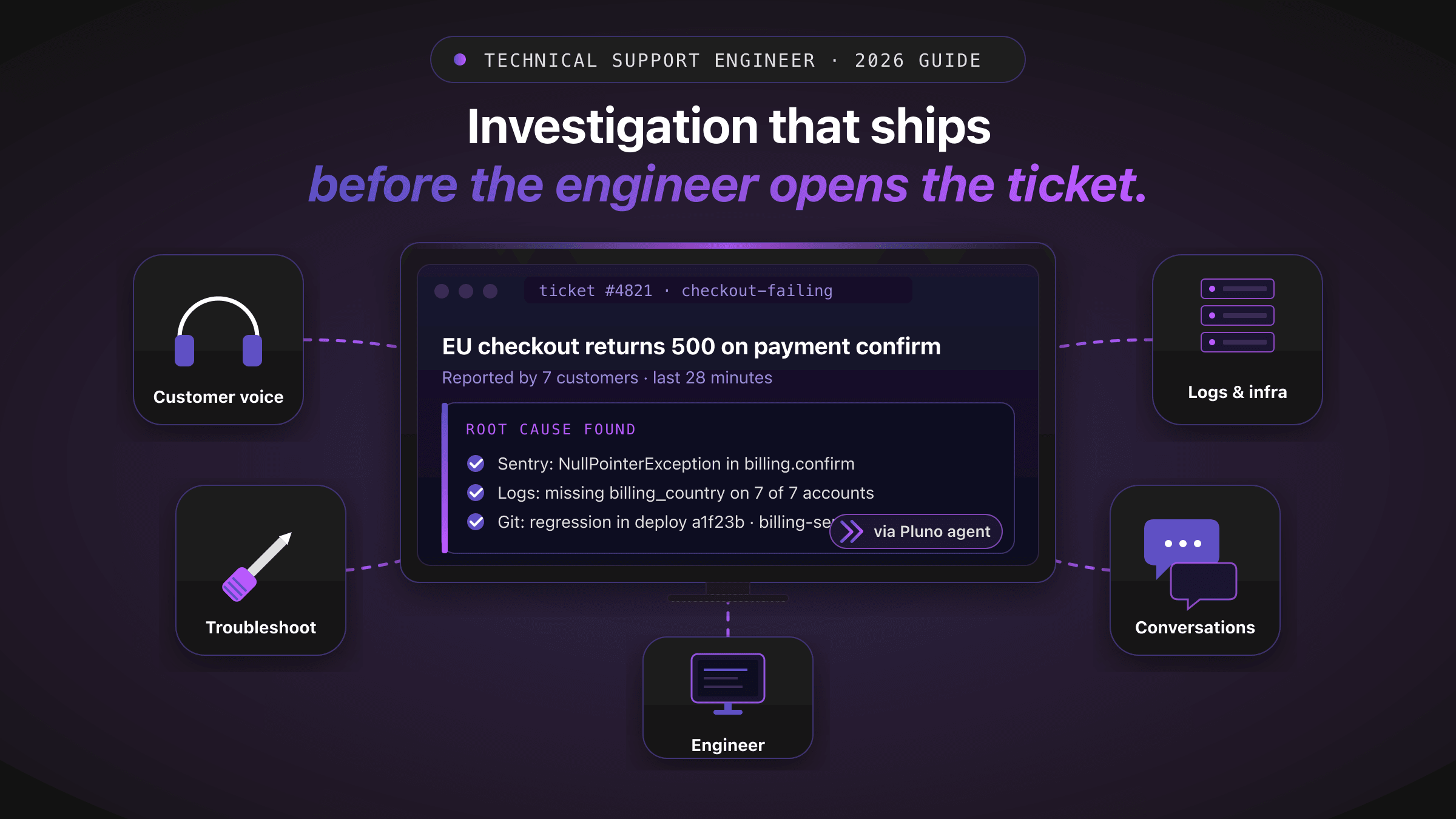
- The 2026 shift is investigation, not answering. Hard tickets now span APIs, identity providers, deploys, logs, and customer config. The slow part is gathering evidence.
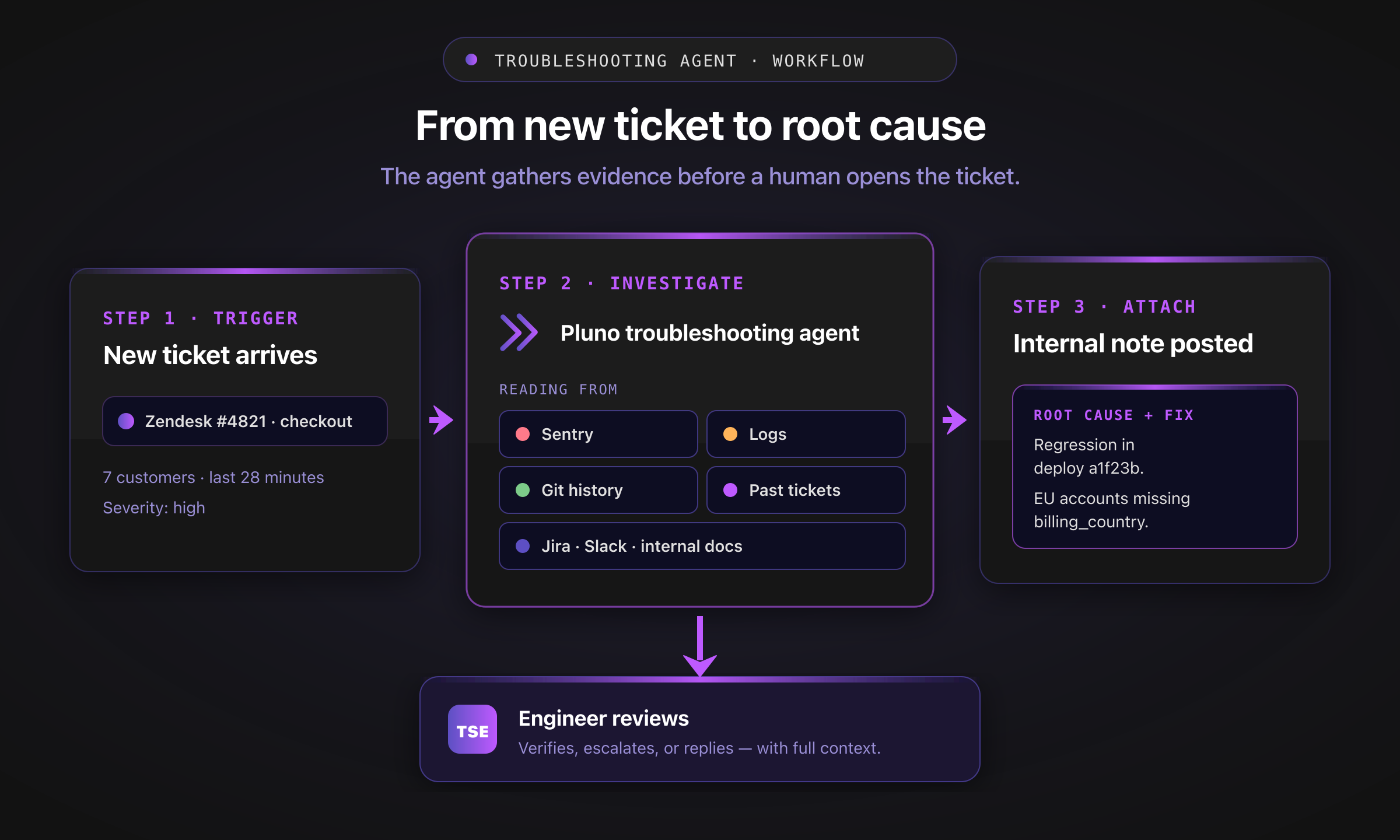
- AI troubleshooting agents like Pluno's troubleshooting agent sit on that investigation step. They pull context from Zendesk, Slack, Jira, Sentry, logs, and internal docs before a human engineer opens the ticket.
What is a technical support engineer?
A technical support engineer investigates customer-reported issues that desk support and help desk teams can't resolve alone. Think reproducing a bug across browsers, parsing a 4MB log file, or tracing a 502 that turns out to be DNS.
The role sits between end users, developers, QA, and infrastructure teams inside the broader information technology organization. The BLS describes the broader category as professionals who maintain computer networks and resolve hardware, software, and connectivity issues.
The position lives at SaaS companies, MSPs, and internal IT teams. Real-world postings like Plaid's product support openings ask for ticket ownership, SQL, REST API debugging, and clean engineering escalations. Titles vary. The core job doesn't.
Why the position matters more in 2026
Most support tickets now touch three or four interconnected computer systems. A failed checkout might involve a payment processor, a recent deploy, or a customer-specific config flag. None of that is in the help center.
That complexity hits the whole industry. Customers expect instant answers. Management wants leaner teams. Engineering pushes back on every interruption.
Technical support engineers absorb the difference. The position has shifted from "first responder" to "force multiplier." Reduce ticket volume. Write durable docs. Prevent escalations that didn't need to be escalations. Tools that automate the investigation step, including Pluno's troubleshooting agent, are increasingly part of that toolkit.
For B2B SaaS teams, the hardest part is often not answering the customer. It is gathering the evidence before anyone can answer: logs, past tickets, customer configuration, recent deploys, internal docs, and engineering context. That is where troubleshooting agents like Pluno fit. They help investigate the ticket before it becomes another vague Slack escalation to engineering.
Core responsibilities
The work is triage, diagnosis, documentation, and cross-team collaboration. Day-to-day, that usually means:
- Triaging support tickets by severity and SLA in a ticketing system.
- Answering technical questions through email, chat, phone, and video.
- Providing technical assistance for login failures, slow system performance, and connectivity problems.
- Helping users install software, run system updates, and improve system performance.
- Performing routine maintenance on internal services and computer networks.
- Reproducing bugs and collecting logs for engineering when issues get harder.
- Documenting customer interactions and step-by-step solutions to build internal knowledge bases.
- Escalating unresolved bugs with reproduction steps, evidence, and business impact.
Real postings echo this shape. Plaid's technical support engineer description calls out REST API debugging and engineering escalations as core to the role. Senior roles add incident response and problem management. Caterpillar's Lead Technical Support Engineer posting lists incident management, root cause analysis, and corrective actions.
That investigation step is where Pluno fits. More on the workflow below.
Types of technical support engineers
The job title varies by industry, company size, and product type. The common variants:
| Variant | Focus |
|---|---|
| Applications Support Engineer (ASE) | Customer-facing software applications. Works with product teams, databases, APIs, and cloud services. |
| Field Support Engineer | A customer-facing position handling onsite hardware or network infrastructure issues. Often involves travel and on site repair. |
| Customer Support Engineer | Phone, email, and chat support in SaaS help desks. Heavy focus on troubleshooting and onboarding. |
| Internal Support Engineer | Maintains the organization's IT infrastructure for employees. Ensures staff have the tools, services, and access they need. |
| Senior Technical Support Engineer | Owns Tier 3 and Tier 4 escalations and mentors junior team members. A senior technical support engineer also drives incident and problem management. |
The backbone is the same across all five. Structured diagnosis. Clean documentation. Translating complex technical concepts for people who don't have the same context.
Essential skills and technical knowledge
The role blends technical skills, problem solving skills, and interpersonal skills. Most engineers need working knowledge of IT terminology and computer systems. The goal is to resolve issues without making the interaction feel frustrating or condescending.
Core technical skills
- Operating systems. Proficiency in operating systems like Windows, Linux, or macOS. Two of the three are common.
- Networking fundamentals. Network configuration, firewalls, DNS, and TCP/IP. Familiarity with WANs, LANs, and computer networks underpins most connectivity debugging.
- Data and scripting. SQL for queries. Python or bash for automation. Coursera's skills overview lists SQL, Linux, and scripting as core technical knowledge.
- Cloud and enterprise services. Hands-on with enterprise software and AWS or Azure is table stakes.
- Hardware and infrastructure. Computer hardware, peripherals, and network infrastructure.
Core people and process skills
- Communication. Translating technical concepts for non-technical stakeholders quietly decides who advances. The BLS lists customer-service and listening as important qualities.
- Interpersonal skills. Support engineers spend a lot of time with frustrated users. Empathy and active listening matter as much as technical depth.
- Organizational ability. Tracking and prioritizing multiple customer issues at once.
- Root cause analysis. Problem solving skills for deconstructing complex technical data flows.
AI sharpens the technical layer. Judgment and empathy still belong to people.
A day in the life
Mid-level support engineers in 2026 mostly work remote or hybrid. Field and internal IT roles see more onsite work. Mornings start with dashboards, overnight alerts, and a triaged queue.
Mornings lean live: screen sharing with customers, reviewing logs, and chasing bugs that crossed into engineering. If the team uses an automated technical support troubleshooting workflow, overnight tickets already have first-pass investigation attached.
Afternoons split between reactive and proactive work. Reactive: incoming incidents and escalations from clients. Proactive: patching, runbook updates, testing fixes in staging, and writing docs that pay forward.
With Pluno, the engineer often opens a Zendesk ticket and finds an internal note already there. When the evidence is clear, they verify and reply. When it isn't, they still own the call.
Joseph D'Appuzo at Smartness describes the same routine:
"Honestly, when I jump on a ticket right now, I don't even look at what the customer said because I have the summary from Pluno, and Pluno tells me, 'Cool, you have to enable that.' I go there, I enable it… Ticket is resolved."
Joseph D'Appuzo, Customer Support Manager at Smartness
Where common support approaches fall short
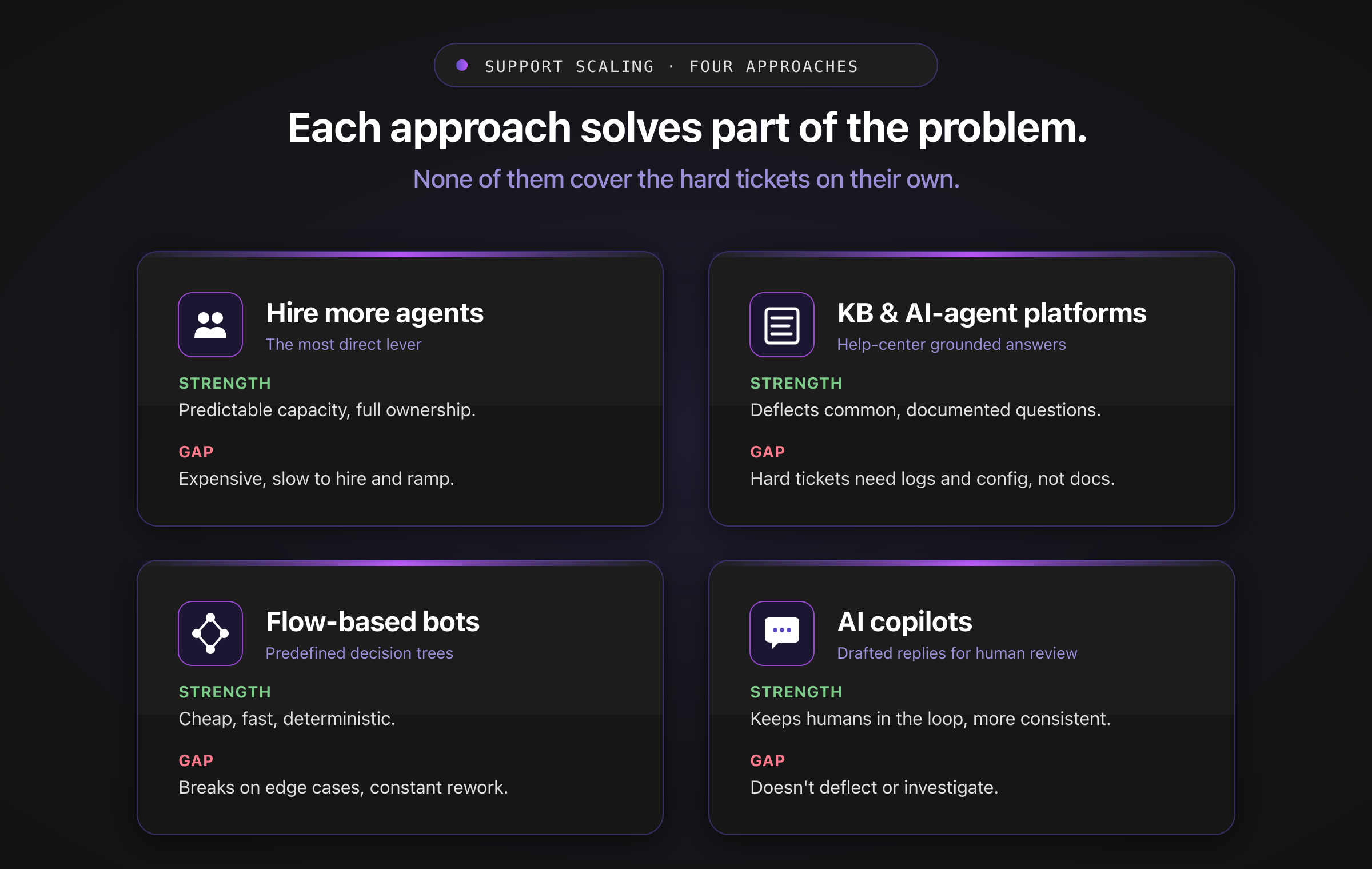
Teams typically respond to ticket growth in four ways. None of them fully solve hard technical tickets.
Hiring more agents. The direct approach. Also slow, expensive, and dependent on a hiring pipeline for qualified technical support engineers. Linear scaling hurts at companies running complex software.
Knowledge-base and AI-agent platforms. Tools like Zendesk AI agents and Intercom's Fin AI Agent start with help-center content, procedures, and connected knowledge. They handle common questions well. (For a side-by-side, see our comparison of the best AI agents for Zendesk.) The challenge for complex technical support is access to the evidence engineers actually use: past tickets, internal docs, Jira, and logs. Without those, hard tickets still escalate with thin context.
Flow-based bots. Keyword matching down predefined paths. Cheap. Every product change forces another round of flow updates. Edge cases break them.
AI copilots. Draft replies for human agents. Keeps a human in the loop and improves consistency. Doesn't deflect tickets. Doesn't reduce engineering escalations. (For a deeper walkthrough of one example, see our Zendesk AI Copilot setup guide.)
What to look for in modern support tooling
Focus on the job, not the category. Five questions cover most evaluations.
- Where does it get knowledge? Help center only, or also past tickets, internal docs, and Jira?
- Can it actually investigate? Summarizing a ticket is helpful. Pulling evidence from connected systems before answering is a different class.
- How does it handle uncertainty? Confidence-aware tools answer with evidence and escalate safely without it. That matters more than headline resolution rate.
- Does it integrate where engineers work? Slack, Zendesk, Intercom, and Jira are the usual surfaces. New UIs lose political fights.
- What does the audit trail look like? Every action reviewable, with sources attached. Trust comes from transparency.
Score honest tools against these. Most lose at least one category.
Where a troubleshooting agent fits
A troubleshooting agent investigates the ticket. It doesn't write the reply. That's the difference from help-center-first AI agents, which try to answer questions from documentation.
Pluno positions its product as an AI support agent for complex products that learns from past tickets. It connects to internal tools like Slack, Jira, and APIs. What it can read depends on what you connect.
Three example workflows show the pattern. They're illustrative scenarios, not guaranteed outcomes.
Example 1: Confirming a likely bug. A Zendesk ticket arrives about checkout failing. The agent posts a summary in the team's Slack channel:
A new Zendesk ticket came in about checkout failing. Based on what I can see, this looks like a real issue, not a one-off. The latest billing deploy seems to have introduced a regression where some EU accounts hit the payment flow without a
billing_countryvalue. Full report attached with a recommended fix.
The support engineer routes the issue. Engineering gets context instead of a panic.
Example 2: Resolving the ticket without engineering. Another ticket asks why a customer's CSV export looks broken. The agent posts an internal note:
Troubleshooting complete: customer-side fix available, no engineering escalation needed. Root cause looks like unescaped commas in a CSV field that Excel auto-splits on open. Logs are clean. Suggested fix: change the export delimiter, or open the file via Excel's Data > From Text/CSV flow.
The engineer reviews and replies. No engineering time burned.
Example 3: Catching an emerging incident. When several tickets cluster around the same symptom, the agent flags a likely incident and notifies on-call with the evidence. Faster detection. Smaller blast radius.
A help-center bot is a better FAQ. A troubleshooting agent is closer to a teammate doing the diagnostic work that used to land on an engineer's desk.
Rolling out an AI-assisted support workflow
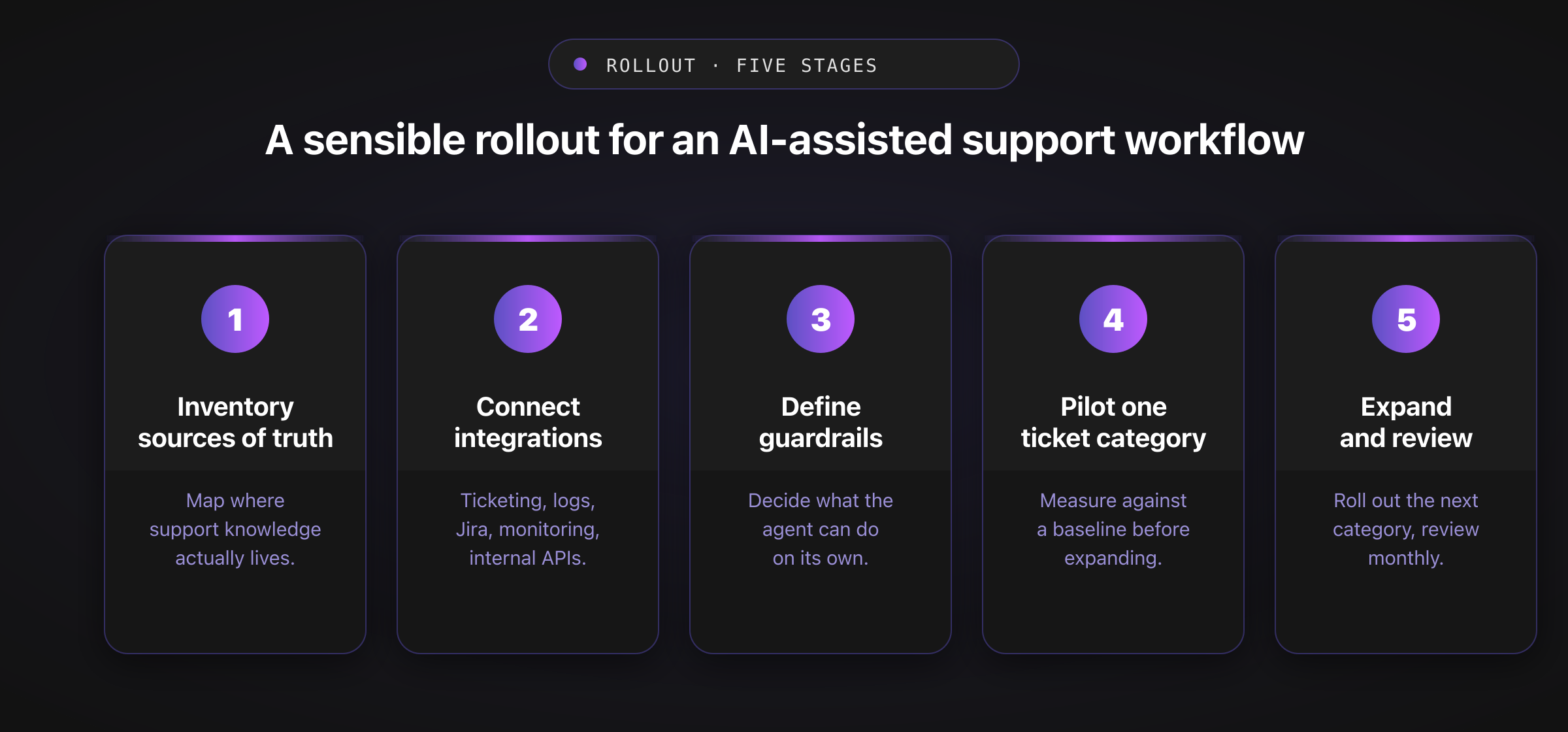
A sensible rollout has five stages. Skipping stages is the most common reason these projects underperform.
Stage 1: Inventory your sources of truth. Map where support knowledge actually lives. Most teams find the help center holds a fraction of what's needed for hard tickets.
Stage 2: Connect the integrations that matter. Start with ticketing and monitoring. Add error tracking and the APIs engineers open during triage. (If Jira is one of those systems, see how a native Zendesk–Jira integration compares to running it through Pluno.)
Stage 3: Define guardrails. Auto-posting an internal note is usually safe. Auto-replying to customers should start narrow and expand only when accuracy proves itself.
Stage 4: Pilot one ticket category. Pick something painful: billing failures, integration errors, or performance complaints. Measure resolution time, escalation rate, and CSAT against a baseline.
Stage 5: Expand and review. Once one category is solid, roll out the next. Monthly review of agent decisions, missed cases, and customer feedback.
Time-to-value depends on how clean your historical tickets are and how many of your internal systems the agent can see.
Outcomes worth measuring
Track the same KPIs your support team already uses.
| Metric | What to watch | Why it matters |
|---|---|---|
| Escalation rate to engineering | Tickets escalated per week before vs after | Direct measure of engineering time reclaimed |
| First response time | Median time to first human reply | Customers notice speed first |
| Time to resolution | End-to-end ticket time | The KPI leadership cares about |
| Tickets resolved per agent | Per-engineer throughput | Capacity gain without hiring |
| CSAT and reopen rate | Quality alongside speed | Catches false "wins" |
| Engineering hours on customer issues | Hours per week per engineer | The most strategic metric for VP Engineering |
Set baselines first. Without one, every "improvement" is anecdote.
Salary, career path, and growth
Pay varies by region, industry, and seniority. The U.S. Bureau of Labor Statistics reports a 2024 median annual wage of $61,550 for computer support specialists overall. Computer user support specialists are at $60,340. Computer network support specialists earn $73,340. Employment is projected to decline about 3% from 2024 to 2034. Roughly 50,500 openings per year are still expected.
Specialized technical support engineer jobs in software companies pay more. Glassdoor estimates median total pay at about $105K, with a most-likely range of $82K to $136K. That includes base salary and additional compensation.
A technical support engineer is usually a mid-level position requiring three to five years of relevant experience. Entry level roles include system administrator, technical support specialist, and help desk technician. Typical advancement: senior or lead support engineer, IT manager, or network engineer. Some move into SRE, solutions architecture, or support operations leadership. Coursera's career overview covers similar paths.
Familiarity with AI tools like Pluno's troubleshooting agent and light automation is increasingly a resume differentiator.
Education, certifications, and getting started
There's no single path in. According to BLS, requirements vary. User-support roles often skip the college degree. Network support typically expects at least an associate degree. Larger software companies and more technical positions often prefer or require a bachelor's degree in computer science or a related field.
Useful certifications: CompTIA A+ and Network+ for fundamentals. Linux+, AWS, and Azure if you're going technical. These prove baseline knowledge in operating systems, hardware, networking, and cloud services.
A practical learning plan for someone targeting a technical support engineer position:
- Build a home lab with Windows, Linux, and a small cloud trial.
- Practice reading logs, querying with SQL, and writing simple scripts.
- Hit APIs with Postman or curl until the response codes feel natural.
- Volunteer for small companies or open-source projects to solve real technical issues.
- Learn a ticketing system and remote support tools end to end.
Reading live job postings and reverse-engineering the listed requirements is the fastest way to spot gaps.
FAQ
What does a technical support engineer do?
Diagnose and resolve technical issues reported by customers or internal teams. The work covers software, hardware, computer networks, and cloud services.
Is a technical support engineer the same as a help desk technician?
No. A help desk technician handles password resets, basic desk support, and routine maintenance. A technical support engineer handles deeper technical problems and complex escalations across systems and services.
What skills do I need for a technical support engineer position?
Solid technical skills across operating systems, networking, and at least one scripting language. Plus problem solving skills, communication, and interpersonal skills. SQL, Linux, AWS or Azure, and a ticketing system are usually expected at mid-level.
How much does a technical support engineer make?
Per the BLS, the 2024 median annual wage for computer support specialists was $61,550. Computer user support specialists came in at $60,340. Glassdoor estimates median total pay for U.S. technical support engineers at about $105K, with a most-likely range of $82K to $136K.
Are technical support engineer jobs a good career in 2026?
For people who like mixing customer work with technical depth, yes. BLS projects a slight decline through 2034, but about 50,500 openings remain each year through replacement demand. Engineers who layer in AI tools, automation, and cloud expertise are best positioned.
Do I need a bachelor's degree to become a technical support engineer?
Not always. BLS notes that requirements vary. User-support roles often don't strictly require a college degree. Larger software companies and more technical positions usually prefer or require a bachelor's degree in computer science or a related field.
How can AI tools help technical support engineers?
They handle the slowest part of most tickets: pulling logs, checking error trackers, replaying sessions, and reading internal docs. Pluno's troubleshooting agent, for example, can post an internal note with a likely root cause and a suggested fix.
What's the difference between a technical support engineer and a software engineer?
A software engineer builds the product. A technical support engineer keeps customers unblocked when something in that product goes wrong.