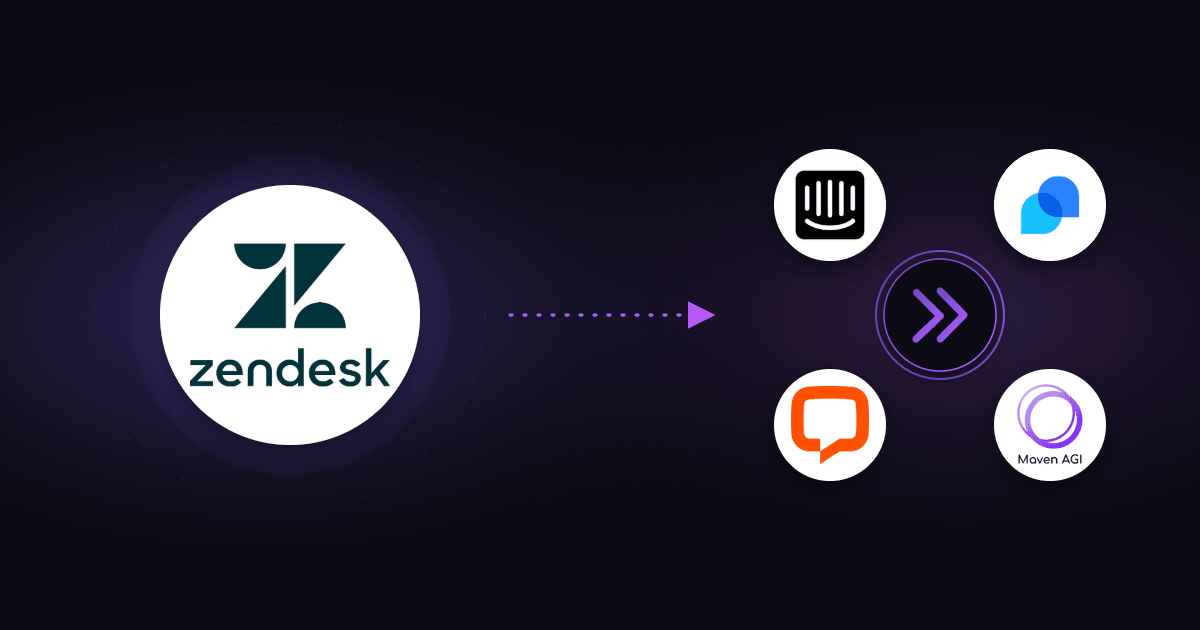
Most articles about "Zendesk Chat alternatives" assume you want to replace Zendesk with Tidio, Intercom, or LiveChat. That works if the chat tool itself is the problem, but the product itself is very solid, and not too much different than other Chat products on the market.
However, what slows most teams down with Zendesk Chat is what surrounds it: an AI chatbot that can't answer much beyond FAQs, knowledge scattered across your internal tools and knowledge databases (e.g., Notion, Jira, Confluence, past tickets, etc.) that Zendesk can't access, and unnecessary ticket escalation to your team.
So the real question is: should you fix the existing Zendesk Chat and make it 3x more powerful, or switch platforms entirely and move to another Zendesk chat alternative?
This guide covers both paths:
- Path A: Stay on Zendesk and make your chat and AI customer support operations more efficient and powerful.
- Path B: Your use case makes Zendesk the wrong fit, so replace it entirely with helpdesk software built for your needs.
TL;DR: Which Zendesk Chat alternative fits your use case?
- Choose Pluno as your Zendesk Chat alternative if → You're a B2B SaaS company on Zendesk with a technical product, your chat tickets need diagnostic reasoning, and the real answers live in past resolved tickets, Slack threads, Jira, Notion, Confluence, and other internal products. Pluno auto-resolves complex chats by learning from how your team has actually solved similar problems before, and escalates with full context (summary, evidence, next steps) when confidence is low, rather than guessing.
- Choose Maven AGI as your Zendesk alternative if → You're an enterprise CX team running chat alongside voice, your AI needs to take real actions (refunds, account changes, dispute resolution) across dozens of internal systems, and compliance posture (HIPAA, PCI-DSS, ISO 27001) is non-negotiable.
- Choose Intercom as your Zendesk Chat alternative if → You want a chat-first conversational platform rather than a ticketing system, your support overlaps with onboarding and proactive in-app messaging, and the chat widget is part of the product experience itself.
- Choose Tidio as your Zendesk Chat alternative if → You're an SMB ecommerce shop on Shopify or WooCommerce, your tickets are dominated by order tracking, returns, and product questions, and you want a tool where ecommerce automations like abandoned cart recovery and product recommendations come built in alongside chat.
- Choose LiveChat as your Zendesk Chat alternative if → You're a sales-focused team using chat primarily for pre-purchase conversion, your support is mostly human-led with mature canned responses and visitor tracking, and AI deflection isn't the primary driver.
At-a-glance comparison
| Criteria | Pluno | Maven AGI | Intercom | Tidio | LiveChat |
|---|---|---|---|---|---|
| Path | A (stays on Zendesk) | A (stays on Zendesk) | B (replaces Zendesk) | B (replaces Zendesk) | B (replaces Zendesk) |
| Best for | Complex B2B SaaS technical tickets | Enterprise multichannel + voice | Chat-first SaaS conversational platform | SMB ecommerce | Human-led sales chat |
| Where it runs | Native Zendesk Marketplace app | Native Zendesk, Salesforce, Freshdesk, Intercom | Standalone platform | Standalone platform | Standalone platform |
| Primary knowledge | Past resolved tickets + Knowledge Base + Slack + Jira + Confluence + APIs | 100+ native integrations including KB + CRM + product DBs | Help center + URLs + uploaded docs + custom Actions | Website content + help center | Help center |
| Setup time | Hours | Days to weeks | Weeks | Under an hour | Under an hour |
| Voice support | No | Yes | Yes (in early beta) | No | No |
| Pricing entry | Custom base fee (based on ticket volume) + €0.90/resolution. AI copilot is €49/seat | Custom enterprise only | $29/seat/mo + $0.99/outcome + $35/seat Copilot | Free plan available; Starter from $29/mo + Lyro add-on | $20/agent/mo + ChatBot separate |
Path A: How to Make Zendesk Chat Smarter & Better?
Replacing your help desk carries real costs that are easy to underestimate. Migration takes weeks, integrations need rebuilding, ticket history gets messy, and your team has to relearn everything. If the chat layer works and the AI layer doesn't, that's an AI problem, not a platform problem.
There are two Zendesk-native products you can use on top of Zendesk to empower your support reps to resolve tickets faster with high-quality AI ticket resolving, deflection, and copilot.
1. Pluno: Best for handling complex B2B SaaS technical tickets
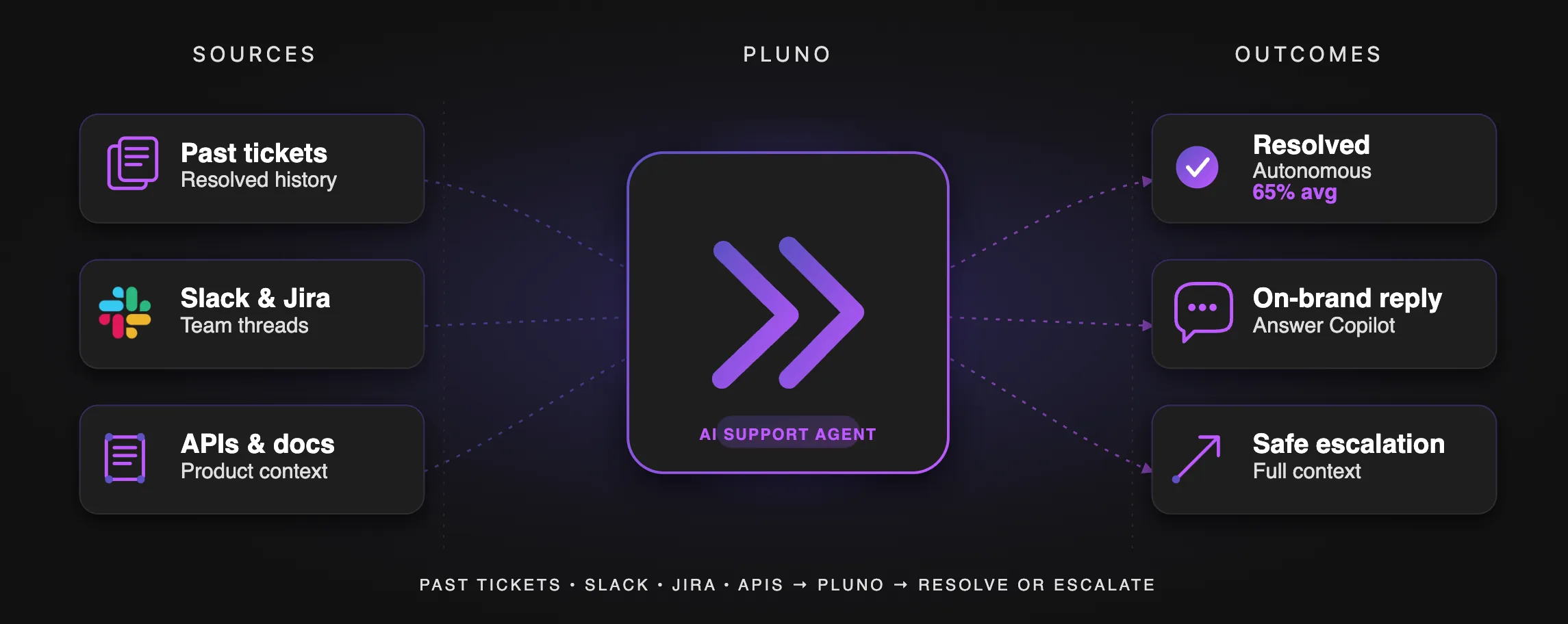
What it is: A native Zendesk Marketplace app that auto-resolves chat conversations across your web widget, WhatsApp, and Zendesk Messaging channels. Pluno's AI learns directly from your resolved tickets and connects to Slack, Jira, Sentry, DataDog, and APIs to pull the full context needed to answer complex questions.
Where it wins: Pluno's wedge is past-ticket learning. For B2B SaaS products where the same edge cases recur but the help center never quite covers them, Pluno's AI knows how your team has actually solved similar problems before. When evidence is thin, it escalates with a summary, supporting evidence, and suggested next steps, rather than guessing or producing a forced "resolution."
The chat-relevant modules are Deflection AI (which auto-resolves on Zendesk Messaging channels, including the web widget, WhatsApp, and other supported integrations) and AI Copilot (which drafts replies for human agents in real time).
When a chat ticket escalates to engineering, Pluno's two-way integration with Jira and Slack automatically creates an issue with the full reproduction context already attached, and any updates flow back to the ticket thread.
Innovorder, a B2B restaurant tech SaaS, reports a 67% deflection rate on chat and WhatsApp across a product with 20+ modules, with response times dropping from 20 minutes to under 1 minute and zero customer complaints about the AI.
Where it falls short:
- Zendesk-only today. Intercom integration is on the roadmap, but not live yet.
- Not built for transactional B2C chat (refund processing, order edits).
- No native voice support. If voice is a primary channel, then Pluno is not the right Zendesk chat alternative for you.
Pricing: Platform fee scales with ticket volume, roughly €250/mo for sub-1,000 tickets up to ~€1,000/mo at 3,000+ tickets. Copilot is €40 per agent per month, billed only for the seats you need them for (you're not required to buy it for all Zendesk seats included in the plan, just as Zendesk doesn't require it). Deflection AI is €0.90 per resolution. There's a 14-day free trial with all modules included.
Best for: B2B SaaS teams already on Zendesk, handling complex technical products, with 1,000+ tickets per month, and scattered 'knowledge' that lives in different internal tools.
Not for: Teams not on Zendesk yet, pure transactional ecommerce chat, voice-first contact centers, brand-new Zendesk accounts.
2. Zendesk Chat Alternative #2: Maven AGI for enterprise multichannel chat with voice and action-taking
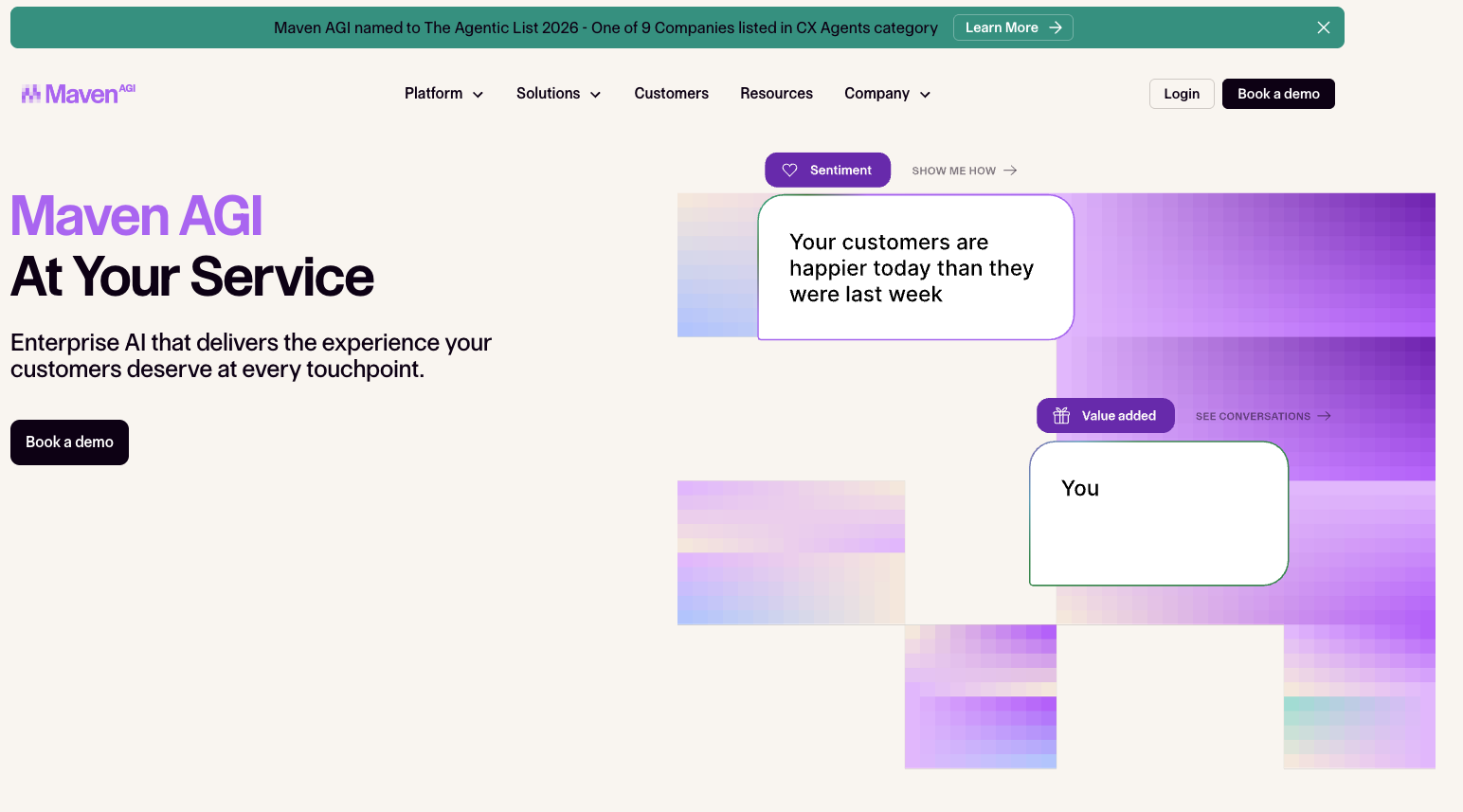
What it is: An enterprise AI agent platform with native integrations across Zendesk, Salesforce, Freshdesk, Intercom, and 100+ other systems. One reasoning engine across chat, voice, email, SMS, and social.
Where it wins: Voice and chat on a single platform is rare, and Maven Voice is one of the few production voice-to-voice agents built for enterprise CX. Action-taking depth is the other strength: Maven calls APIs to process refunds, update accounts, and resolve disputes end-to-end. Papaya Pay reports 90% autonomous resolution by integrating Maven with its payment, account, and dispute systems. Compliance posture includes SOC 2 Type II, ISO 27001, HIPAA, PCI DSS, and GDPR.
Where Maven AGI falls short:
- Custom enterprise pricing only. No public rates, no self-serve trial, multi-week procurement cycle.
- Heavier than most teams need. If your support is mostly text-based and your tickets aren't transaction-heavy, Maven might be "too much" for you.
- Implementation is days to weeks with their team. You're getting a managed deployment, not a self-serve product.
- Doesn't market past-ticket learning the way Pluno does. Knowledge is engineered through integrations, not learned from resolution history.
Pricing: Custom enterprise pricing. Maven hasn't published rates publicly as of April 2026.
Best for: Enterprise CX teams (Fortune 1000, regulated industries), multichannel operations (including voice), and heavy action-taking use cases.
Not for: SMB or mid-market teams, teams that want self-serve setup, teams whose primary need is FAQ deflection.
Path B: Best Zendesk Chat Alternatives to Replace Zendesk Entirely
For some teams, Zendesk really is the wrong platform. There are two common scenarios that apply:
- You've outgrown ticketing-style support and want a chat-first conversational model. Intercom is built for this.
- You shouldn't have been on Zendesk in the first place. SMB ecommerce shops and small sales teams paying $55–$115/agent/month for enterprise features they never use are usually better served by SMB-specific Zendesk alternatives such as Tidio or LiveChat.
However, keep in mind that switching carries real costs beyond the timeline. Plan for 4-12 weeks of migration work, depending on team size and custom automation, but also factor in data migration risks (ticket history integrity, broken references), contract and renewal timing on your current Zendesk agreement, integration rebuilding, and team retraining.
3. Best Zendesk Chat Alternative #3: Intercom for SaaS teams moving to a chat-first conversational platform
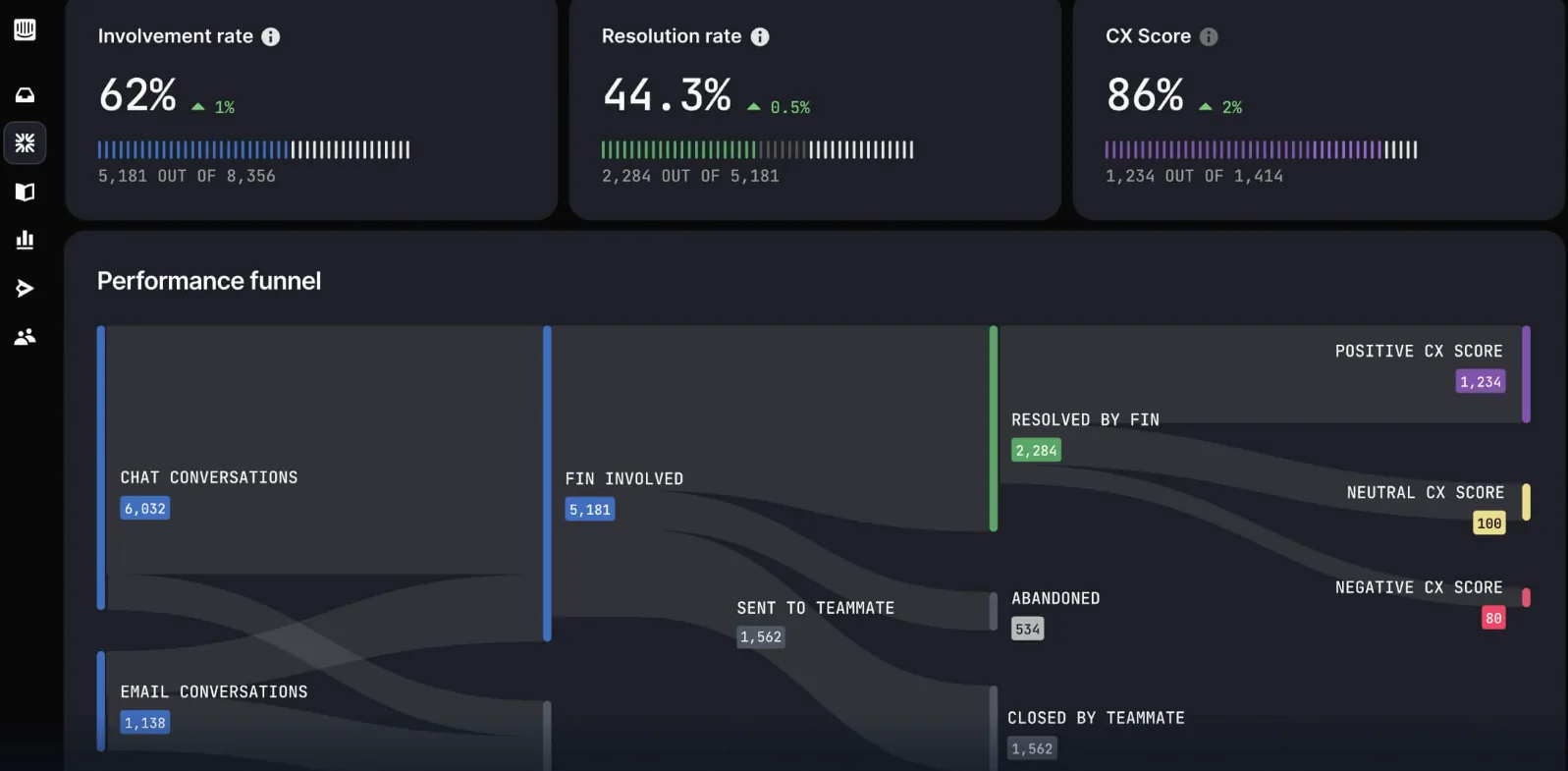
What it is: A customer service platform built around real-time chat, in-app messaging, and proactive customer engagement. Comes with Fin AI built in, plus product tours, onboarding sequences, and lead qualification in the same tool as the inbox. Channels include chat, email, SMS, WhatsApp, and voice (early access).
Where it wins: Setup speed and AI out of the box. Most teams are running Fin within hours rather than the 1-2 weeks Zendesk admin work typically takes. The messenger itself is more polished than Zendesk's chat widget, which matters for consumer-facing SaaS where the widget is part of the product experience. And because Intercom natively handles in-app onboarding, product tours, and lifecycle messaging, support and product growth share one tool instead of two.
Where it falls short:
- Real bills are typically 3–4x the headline seat price. Stack of seat fees, Fin per-resolution, and Copilot add-on add up fast.
- Limited past-ticket learning. Fin is strong on help-center deflection, weaker on "look at how we solved this last time" reasoning.
- "Resolution" includes implicit resolutions where the customer doesn't reply within 24 hours. That inflates billed numbers without confirming the customer was actually helped.
- Migration from Zendesk takes weeks.
Pricing: Essential $29/seat/mo, Advanced $85/seat/mo, Expert $132/seat/mo (annual billing). Fin: $0.99 per outcome with a 50-outcome monthly minimum. Copilot: $35 per user per month. SMS, WhatsApp, voice, and email campaigns are billed separately.
Worth knowing: You can deploy Fin standalone on Zendesk at $0.99 per outcome without migrating. If it's specifically Fin you want, you don't need to switch platforms.
Best for: Companies that need a chat-first conversational platform rather than a ticketing system, your support overlaps with onboarding and proactive in-app messaging, and the chat widget is part of the product experience itself.
Not for: Teams that need predictable monthly costs, B2B SaaS where chat answers live in past tickets rather than the help center, cost-sensitive SMBs, and technical B2B software companies that often get technical tickets that require custom troubleshooting.
4. Best Zendesk Chat Alternative #4: Tidio for SMB ecommerce with plug-and-play AI
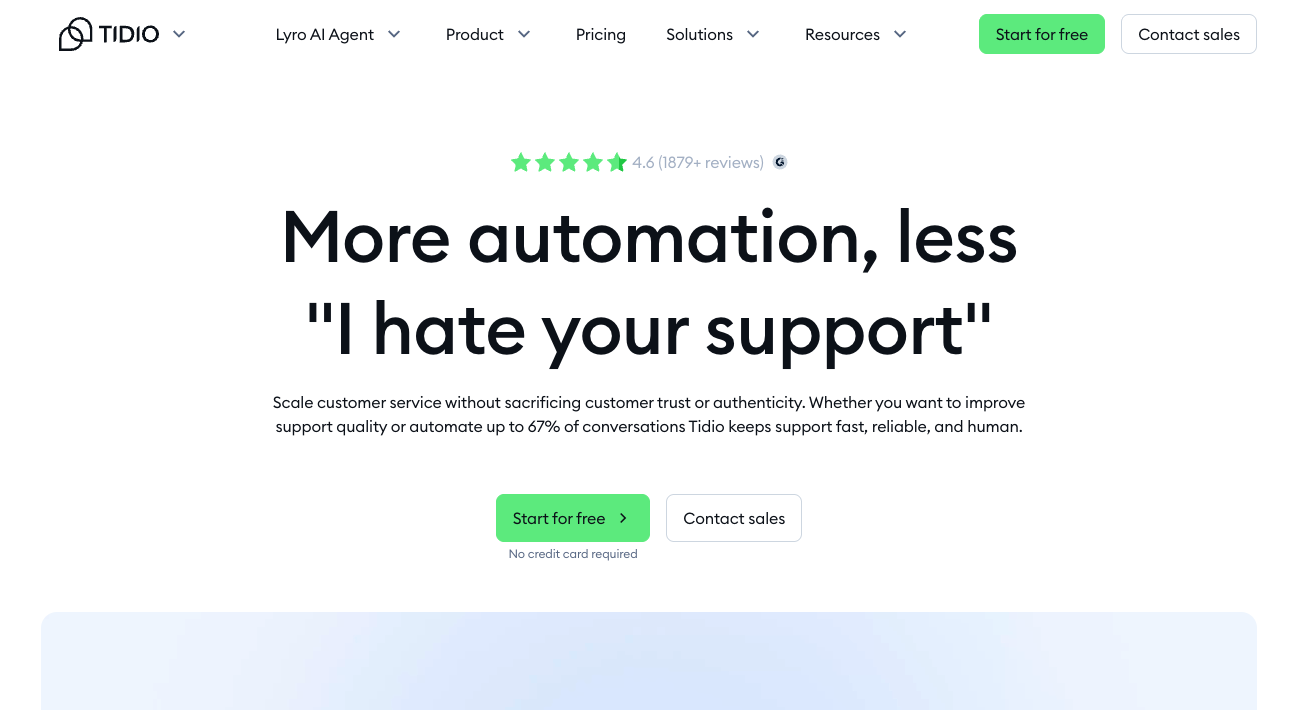
What it is: A live chat and AI chatbot platform built for SMB e-commerce companies. Lyro AI is included on most plans, and Tidio claims a 67% resolution guarantee on the Premium tier. It supports native Shopify and WooCommerce integrations.
Where it wins: Speed and simplicity. Setup takes under an hour, and AI starts working without a decision-tree configuration. Ecommerce features like order status lookups, abandoned cart recovery, and product recommendations work out of the box.
Where it falls short:
- Lyro AI is a separate billing pool from human conversations. Real costs typically run 2–3x the advertised price once you add Lyro and Flows.
- Lower plans cap Lyro conversations fast. Top-ups run roughly $39/month for an additional 50 conversations.
- Not designed for complex B2B technical support. Lyro learns from website content, not from your team's resolution patterns.
Pricing: Starter from $29/month. Growth from $59/month. Plus from $749/month. Lyro AI add-on starts at $39/month for 50 conversations on top of base plans.
Best for: SMB ecommerce shops on Shopify or WooCommerce with use cases dominated by order tracking, returns, and product questions.
Not for: B2B SaaS, mid-market and enterprise teams, complex technical support, and bigger teams.
5. Best Zendesk Chat Alternative #5: LiveChat for sales-focused, human-led chat
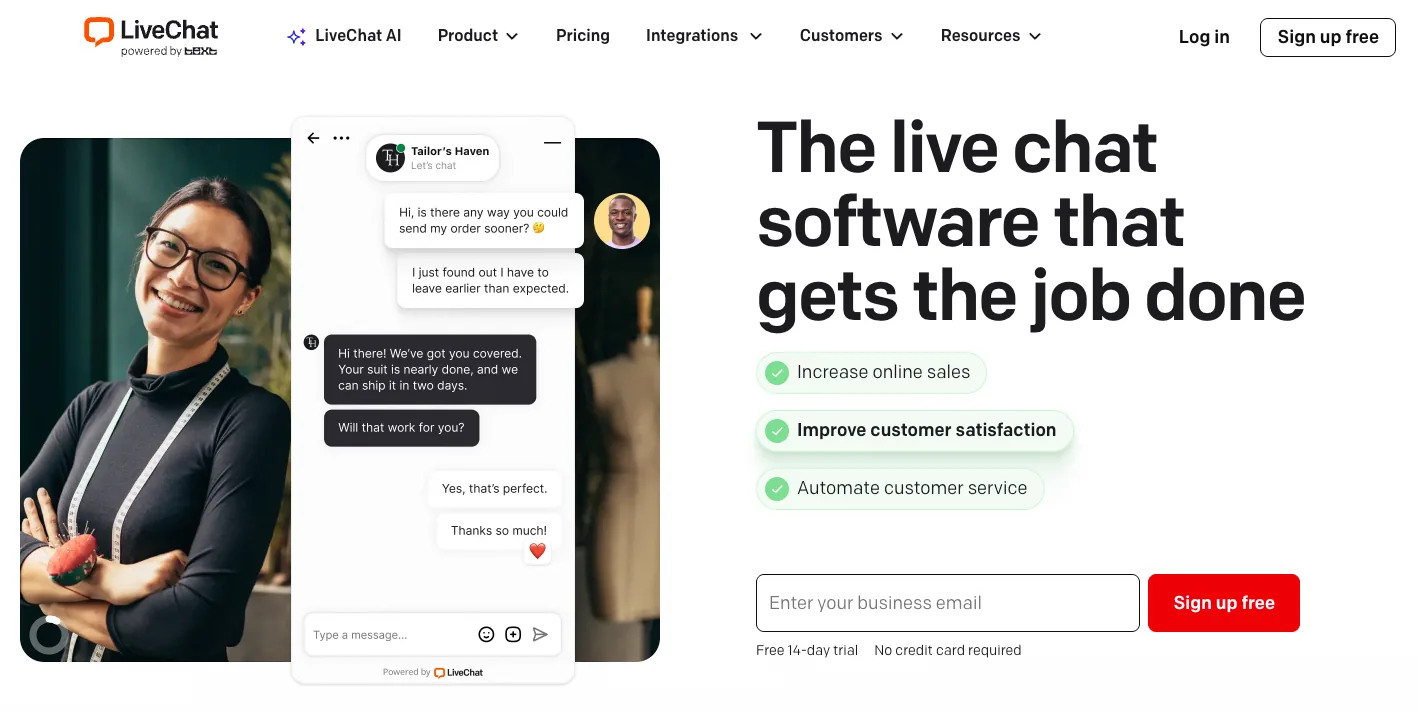
What it is: A mature live chat product (founded 2002) focused on human-agent efficiency. Strong on canned responses, file sharing, rich messages, and conversion analytics. AI is sold separately as ChatBot, a companion product.
Where it wins: Best-in-class agent experience for human-led chat. Sales-conversion features are mature: visitor tracking, proactive messaging triggers, and conversion analytics. The widget is light and customizable. 200+ integrations with CRMs and ecommerce platforms.
Where it falls short:
- AI is not built in. ChatBot is a separate paid product. If you want AI deflection, you're stacking two SKUs and paying for both.
- Pricing scales with headcount. Teams with 20+ agents pay heavily for what's still primarily a human-led product.
- Less modern than other alternatives on persistent messaging. Sessions feel more like classic live chat than ongoing threads.
- Knowledge integration is shallow compared to AI-first tools.
Pricing: Starts at $20/agent/month. ChatBot is sold separately. No free plan.
Best for: Sales-focused teams using chat for pre-purchase conversion, mid-market companies with established human support teams that don't need AI as the primary driver.
Not for: Teams that want AI to handle volume, B2B SaaS with technical chat, SMB teams on tight budgets, teams expecting all-in-one AI plus chat.
The Final Comparison of The Best Zendesk Chat Alternatives
| Pluno | Maven AGI | Intercom | Tidio | LiveChat | |
|---|---|---|---|---|---|
| Path | A (Stay on Zendesk) | A (Stay on Zendesk) | B (Move away from Zendesk) | B (Move away from Zendesk) | B (Move away from Zendesk) |
| Best for | Complex B2B SaaS technical tickets | Enterprise multichannel + voice | Chat-first SaaS conversational | SMB ecommerce | Human-led sales chat |
| Primary knowledge | Past tickets + KB + Slack + Jira + APIs | 100+ native integrations | Help center + URLs + custom Actions | Website + help center | Help center (ChatBot separate) |
| Pricing entry | ~€250/mo + €40/seat + €0.90/resolution | Custom enterprise only | $29/seat + $0.99/outcome + $35/seat Copilot | Free; $29/mo Starter + Lyro add-on | $20/agent/mo + ChatBot separate |
| Setup | Hours | Days to weeks | Hours (Fin) to weeks (migration) | Under an hour | Under an hour |
| Voice | No | Yes | Yes (early access) | No | No |
| Past-ticket learning | Core methodology | Engineered through integrations | Limited | None | None |
| Confidence-based escalation | Yes | Yes | No (deflection-style) | No | No |
How to choose the best fit for you?
Ask yourself these three questions to choose the best Zendesk Chat alternative for your specific use case:
- Where does the knowledge needed to resolve your chats actually live? If it's tidy and lives in the help center, Zendesk's native AI Agents Essential handles most of the work. If it lives in past resolved tickets, Slack threads, Jira issues, and engineering tools, that's Pluno's lane. If it spans 100+ enterprise systems, including CRM, billing, and product databases, then Maven AGI might be the best fit.
- How important is staying on your current platform? Already on Zendesk and not migrating? Then go down path A: Pluno or Maven AGI. Open to leaving? Then path B is for you. If it's specifically Fin you want, deploy Fin on Zendesk at $0.99 per outcome instead of switching platforms.
- What's your channel mix? Chat, email, Slack, and Jira (B2B SaaS) point to Pluno. Chat, voice, SMS, and WhatsApp point to Maven AGI or Intercom. Chat plus ecommerce points to Tidio or Intercom. Chat as a sales tool points to LiveChat.
The best test for any of these is to install it and run it on your real tickets. Since you're already on Zendesk, Pluno offers a 14-day free trial with all modules included and a free simulation against your last 50 Zendesk tickets, which shows exactly which conversations the AI would resolve, draft, or escalate before you commit.
FAQ
Is Zendesk Chat still available as a standalone product?
No. The legacy Zopim-based Chat was folded into Zendesk Messaging inside the Zendesk Suite. Zendesk is actively migrating remaining legacy Chat customers to Messaging.
Can I run multiple Zendesk Marketplace AI add-ons together?
Technically yes, but most teams pick one and let it own the AI layer. Stacking creates conflicting suggestions and pricing overhead.
What's the difference between Zendesk's own AI Agents and these third-party tools?
Zendesk's AI Agents (Essential and Advanced) are help-center-focused. Third-party tools like Pluno pull from broader knowledge sources, including past tickets, Slack, Jira, and internal docs.
Can I use Intercom's Fin AI without migrating off Zendesk?
Yes. Fin can be deployed on Zendesk at $0.99 per outcome with the same 50-outcome minimum. No platform switch required.
How long does it actually take to migrate from Zendesk to Intercom, Tidio, or LiveChat?
Vendors say weeks. Real teams report 4–12 weeks, depending on team size, integration complexity, and how much custom automation needs to be rebuilt.