
From Tribal Knowledge to Team-Wide Intelligence: How Waste Vision Made Expert Support Scalable with Pluno
A conversation with

Ruben Martin


About
Waste Vision provides access control systems and radar sensors for underground waste containers, plus integrated software for waste management organizations. Learn More
Industry
Waste Management Tech / IoT
Company Size
51-200
Support Tool
Zendesk
Key Features
Deflection AI
AI Copilot for Agents
🚧 Core Challenges
Critical knowledge locked inside the heads of a few experienced employees
Agents frequently dependent on specific experts to resolve complex issues
New employees faced long onboarding times before becoming productive
Significant time spent searching through documentation and historical tickets
Previous AI tools provided generic, inaccurate answers with no understanding of Waste Vision's specialized systems
✅ Solutions
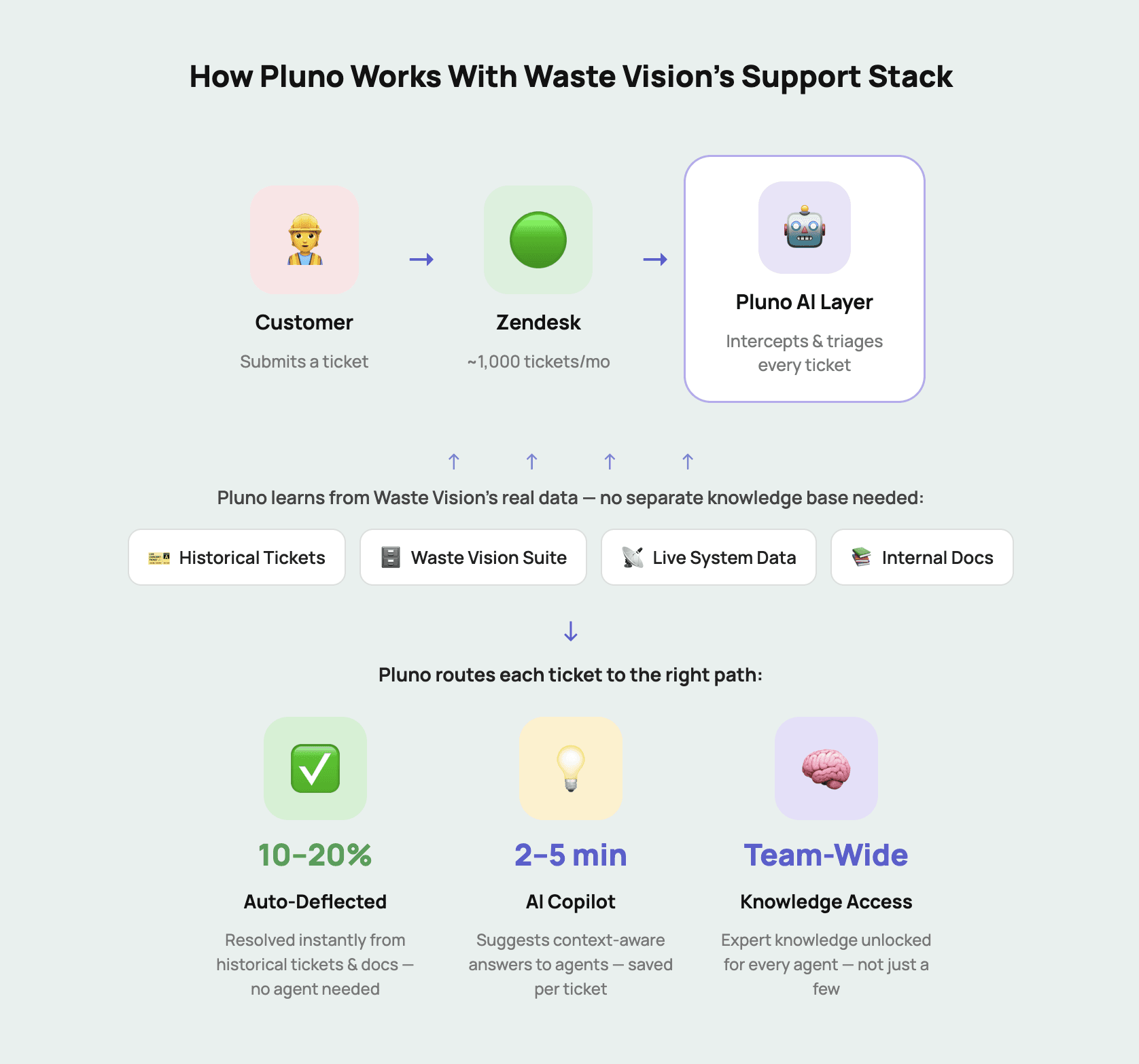
Pluno learns from years of real Zendesk tickets, not just static documentation, to deliver context-aware answers
Deflection AI auto-resolves 10–20% of incoming tickets without agent involvement
AI Copilot provides relevant answer suggestions for every ticket agents handle
Institutional knowledge is now accessible to the entire team, not just a few individuals
Implementation completed in days, configured directly by the Waste Vision support team
Waste Vision builds access control systems and radar sensors for underground waste containers, paired with software that helps municipalities and waste companies optimize collection routes, reduce costs, and improve service reliability. It's a specialized, technically complex product, and the support team behind it needs to match that complexity every day.
The service organization includes 6 servicedesk agents, 8 field service technicians, and 3 consultants, handling around 1,000 support tickets per month. Roughly half of those are simple requests. Another 30% sit in the medium-complexity range. The remaining 20% are complex technical issues that require deep system knowledge and often cross-team coordination.
THE CHALLENGE
When the Knowledge Lives in People, Not Systems
Waste Vision's core operational challenge wasn't response time, they already maintained a strong first response time of 1–2 hours. The real problem was more structural: critical knowledge was stored in the minds of specific employees.
When an agent encountered a complex issue involving a specific sensor configuration or an edge case in the access control system, the path to resolution often ran through a single experienced colleague. If that person was unavailable, the ticket waited. If they were on leave, the team worked around the gap as best they could. Knowledge wasn't documented in a way that made it easily transferable, and years of accumulated expertise existed as institutional memory rather than institutional infrastructure.
This created several compounding problems. Agents spent significant time searching through documentation and historical tickets before even beginning to formulate a response. New employees faced long ramp-up periods, unable to operate independently until they'd absorbed enough context from colleagues. And resolution of the hardest issues depended entirely on who happened to be available that day.
AI That Didn't Understand the Business
Waste Vision recognized the problem and explored AI solutions before finding Pluno. But the tools they evaluated fell short in ways that mattered. The AI couldn't effectively leverage their historical ticket data, the single richest source of institutional knowledge the team had. Instead, it produced generic responses that lacked understanding of Waste Vision's specialized hardware and software environment. Configuration was cumbersome, accuracy was insufficient for technical support, and the gap between what the AI suggested and what an experienced agent would actually say was too wide to be useful.
What Waste Vision needed was an AI solution that could genuinely understand their environment, not just repeat documentation back, but reason across years of real support interactions the way a senior team member would.
THE SOLUTION
Historical Tickets as a Living Knowledge Base
Waste Vision selected Pluno primarily for one capability that set it apart: the ability to use historical Zendesk tickets as a knowledge base.
This was the critical differentiator. Instead of relying solely on static documentation, which was always incomplete and often outdated, Pluno could learn from years of real support interactions. Every resolved ticket, every workaround, every edge-case diagnosis that an experienced agent had worked through became available to the entire team through Pluno's AI. Institutional knowledge that had been locked inside people's heads was suddenly operationalized and scalable.
Up and Running in Days
The implementation was fast and hands-on, in the right way. Pluno was operational within just a few days, configured directly by the Waste Vision service team without a lengthy onboarding process or external consultants. When questions came up during setup, the Pluno team responded quickly, ensuring nothing stalled. The collaborative, feedback-driven approach meant the solution was shaped to fit Waste Vision's actual workflows from the start.
Ticket Deflection: Handling the Predictable Automatically
Pluno now directly resolves approximately 10–20% of incoming tickets automatically. These are the requests where the answer exists clearly in the knowledge base, the kinds of questions that previously required an agent to look up the same information they'd looked up dozens of times before. By deflecting this layer of volume, Pluno frees agents to spend their time where it actually matters: on the complex, technical issues that require human judgment and system expertise.
AI Copilot: The Expert That's Always Available with Deep Integration
For the tickets that do reach agents, Pluno serves as an AI Copilot, providing highly relevant, context-aware answer suggestions drawn from historical tickets and system knowledge. Instead of spending minutes searching through old tickets or consulting a colleague, an agent can review Pluno's suggestion, validate it against their own understanding, and send a faster, more complete response.
This has been especially valuable for newer team members. Rather than waiting weeks or months to build up enough experience to handle complex cases independently, new agents have Pluno surfacing the same solutions that a veteran would draw from memory. The learning curve hasn't disappeared, but it has compressed significantly.
They have also integrated Pluno into their own software platform, the Waste Vision Suite. This means Pluno is able to access and leverage both support knowledge and live system data, enabling even more advanced assistance capabilities.
On average, Pluno saves 2–5 minutes per ticket. Across 1,000 monthly tickets, that translates into
significant operational efficiency gains, the equivalent of reclaiming hours of productive time every week without adding headcount.
THE RESULTS
An Indispensable Tool the Team Adopted Immediately
Pluno didn't just improve individual metrics, it changed how the entire support organization operates. Here are the key results, broken down.
⚡ 10–20% Automatic Ticket Deflection
Pluno now resolves approximately 10–20% of incoming tickets without any agent involvement. These are the predictable, well-documented requests that previously required an agent to look up the same answer they'd looked up dozens of times before. At 1,000 tickets per month, that's 100–200 tickets that never reach the queue, freeing agents to focus entirely on medium and complex issues where their expertise matters most.
🚀 2–5 Minutes Saved per Ticket
For tickets handled by agents, Pluno's AI Copilot eliminates the time previously spent searching through old tickets and documentation. On average, agents save 2–5 minutes per ticket. Across the full monthly volume, that translates into hours of reclaimed productive time every week, without adding headcount. Responses are not only faster but more accurate and more complete, because agents are working from relevant historical context rather than starting from scratch.
📈 Knowledge Accessible to the Entire Team
The most structural shift: knowledge that was previously locked inside a few experienced employees is now available to everyone. Agents no longer need to wait for a specific colleague to be available before resolving complex issues. New team members can draw on the same historical context that veterans carry in their heads, compressing onboarding time and reducing the dependency on key individuals that had been the team's biggest operational vulnerability.
💬 An Indispensable Part of Daily Workflows
Perhaps the clearest signal of impact is how quickly the team adopted Pluno into their daily work. Agents were enthusiastic from the start, not because they were told to use it, but because it genuinely made their jobs easier. The team now describes Pluno as an indispensable tool, embedded in how they handle every ticket. It didn't feel like a process change imposed on them; it felt like gaining a knowledgeable colleague who's always available and always up to speed.
The partnership between Waste Vision and the Pluno team has been a key part of the success. The Pluno team has been highly responsive, proactive, and collaborative throughout, fast to resolve questions, open to feedback, and committed to continuous improvement. For a company operating in a specialized technical domain, having a partner that listens and adapts is not a nice-to-have. It's how the solution stays relevant as the business evolves.
THE TAKEAWAYS
Built for Teams with Complex Systems and Deep Ticket History
Waste Vision's recommendation is straightforward: any organization managing technical support operations, especially those with complex systems and a valuable archive of historical support data, should look at Pluno seriously.
The reason is simple. Most AI tools treat support knowledge as a static input: upload your docs, get generic answers. Pluno does something fundamentally different. It learns from the real interactions a team has had with real customers over years, turning historical tickets into a living, searchable intelligence layer that every agent can draw from.
For Waste Vision, this has meant unlocking knowledge that was previously trapped in a few people's heads, improving efficiency across the entire service organization, and building a foundation for scalable, high-quality support that doesn't depend on any single individual. Pluno is helping Waste Vision bring their customer service to the next level, and the team can't imagine going back to working without it.
"Pluno is helping Waste Vision to bring their customer service to the next level by unlocking knowledge, improving efficiency, and enabling scalable, high-quality support."
— Ruben Martin, Teamlead Service