

From AI Frustration to Faster Support: How Smartness Cut First Response Time from Hours to 22 Minutes with Pluno
A conversation with

Joseph D'Appuzo
About
Smartness offers an AI suit to help hotels and vacation rentals boost revenue and direct bookings. Learn More
Industry
Lodging Tech / SaaS
Company Size
51-200
Support Tool
Zendesk
Key Features
Deflection AI agent in chat & email support
Escalation Copilot
🚧 Core Challenges
Multiple AI tools tried and failed — high "resolved" numbers but poor quality and customer complaints
Previous AI gave robotic walls of text and marked tickets resolved when they weren't
Competitor AI tool required maintaining a separate knowledge base and had one-way Zendesk integration
Agents forced to constantly monitor views to catch misrouted and falsely resolved tickets
First response times drifting into hours as volume climbed across multiple products
✅ Solutions
Deflection AI auto-resolves 40%+ of tickets with genuinely accurate, conversational answers
Native Zendesk integration — no separate platform to maintain, all knowledge lives in one place
Knowledge base segmentation ensures each product pulls from the right content silo
AI ticket summaries let agents jump straight to resolution without re-reading threads
Smart escalation routes tickets correctly and knows when something needs a human
Smartness is a fast-growing lodging tech company supporting thousands of operators worldwide across PMS, channel management, and revenue management. Each product has a small dedicated support team handling heavy volume — often repetitive "How do I…?" questions that already existed in documentation. As volume climbed, first response times drifted into hours. Frustration was building in their customer base, and they needed a solution — but not before learning some painful lessons about what "AI support" really means.
THE CHALLENGE
Impressive Numbers, Unhappy Customers
Pluno wasn't the first AI solution Smartness tried. Joseph tested every option he could find — from smaller chatbot tools that looked great on paper but couldn't handle real-world complexity, to a major AI solution from a competitor to their ticketing system. That last one moved the metrics, at least at first.
But when Joseph started digging into the "resolved" tickets, the reality was very different:
False resolutions everywhere: Tickets were being marked "resolved" even when nothing was actually fixed. Customers weren't getting faster help — they were getting long, robotic walls of text and then being closed out.
Misrouted escalations: Tickets weren't routed to the right groups. An agent had to constantly monitor different Zendesk views to catch open or misclassified tickets and manually pull them into the correct queue.
Maintenance hell: Because the AI provider competed with Zendesk, integration was mostly one-way. Smartness had to rebuild and maintain all knowledge in a separate system, and reporting was scattered across platforms.
Customer frustration mounting: After a few months, customers started complaining about the AI itself. The experience felt like a wall between them and real help.
THE SOLUTION
50 Tickets That Changed Everything
Joseph wasn't looking for another AI vendor. When Pluno reached out and challenged him directly, he agreed to a test — but with zero expectations. He handed over 50 real-world tickets with one message: "You're never going to be better than our current solution."
Pluno built a simulation using those 50 questions. When Joseph saw the results, his reaction changed completely.
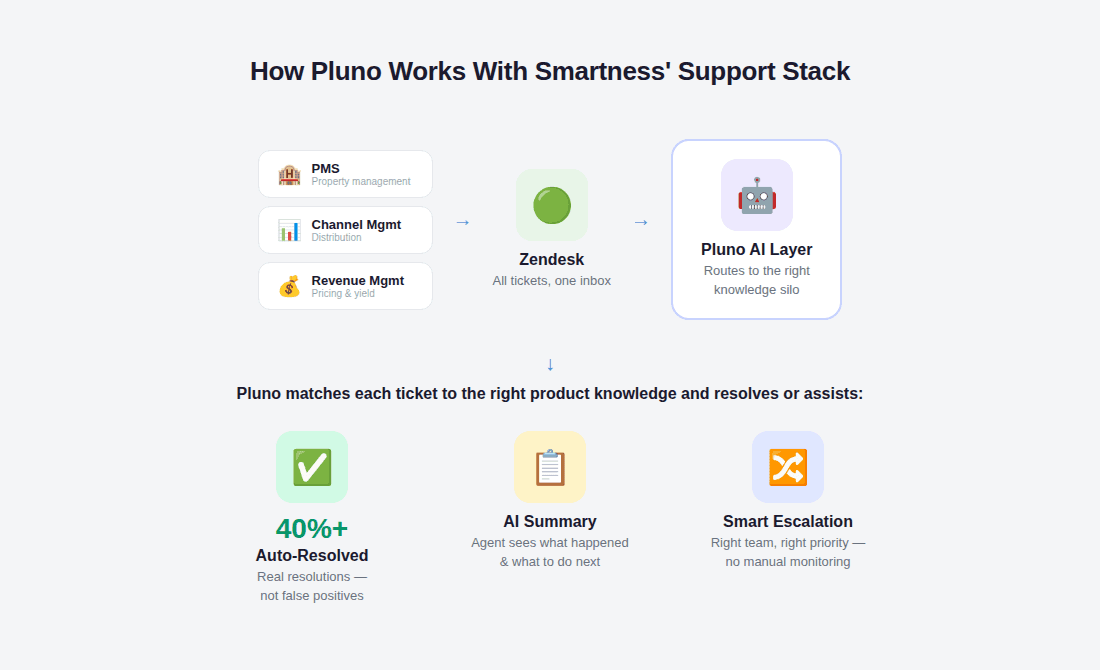
The transition was smooth — almost plug and play. Because Smartness had already structured content for the previous AI tool, they recycled that setup for Pluno. Here's what changed:
Native Zendesk Integration: Goodbye Maintenance Hell
Unlike the competitor solution, Pluno integrates directly into Zendesk. It pulls from Zendesk's own knowledge base, tickets, and context — all in one system. No parallel platform to maintain, no scattered reporting. As Joseph puts it: maintenance is now "super light."
Knowledge Base Segmentation: The Right Answers for the Right Product
Smartness needed Pluno to split content into knowledge silos per product, ensuring the AI pulled answers from the correct product's documentation. This was a crucial feature — Pluno shipped it fast, and it unlocked the ability to roll out product by product.
AI Ticket Summaries: Skip the Thread, Go Straight to Resolution
Pluno summarizes the entire conversation, identifies what's missing, and suggests the next action. Joseph now jumps into tickets without reading the thread — he reads the Pluno summary, takes the suggested action, and closes the ticket in minutes.
Meet Marco: An AI Agent Customers Think Is Real
The biggest tone shift from the previous tool: Pluno's responses are conversational, not robotic. The experience was so natural that the team named the AI agent Marco — a real Italian name, because he talks to customers day and night. Some customers sent him kisses. Others messaged "You never sleep!" Teammates tagged him in tickets as if he were a colleague. Joseph had to remind his team: Marco isn't real.
THE RESULTS
From Hours to 22 Minutes — With Numbers You Can Trust
Pluno didn't just feel better — it transformed key metrics. And this time, the numbers are real.
⚡ First Response Time: Hours → 22 Minutes
Pluno handles a large proportion of simple tickets instantly. For the rest, AI summaries let agents respond in minutes instead of spending time re-reading threads. The combination collapsed first response time from hours to 22 minutes.
🚀 40%+ Real Ticket Deflection
Unlike the previous tool's inflated numbers, Joseph trusts Pluno's deflection rate. When Pluno marks a ticket resolved, it's actually resolved. The target is 100% of how-to questions and light errors handled automatically.
📈 Accurate Escalation & Routing
No more agents babysitting views to catch misrouted tickets. Pluno knows when something needs a human, when it's urgent, and routes it to the right team. If a ticket hasn't been escalated, Joseph knows it doesn't need one.
💬 Zero Robotic Interactions
Customers went from complaining about the AI to sending it messages of gratitude. The conversational tone — embodied by "Marco" — transformed the support experience from a wall between customers and help into a bridge.
Joseph's goal is clear: Pluno should eventually handle 100% of how-to questions and light errors,
freeing human agents to focus entirely on complex issues.
To get there, Smartness is planning a complete overhaul of their knowledge base structure and internal workflows — knowing Pluno adapts well to everything they do.
THE TAKEAWAYS
"There's No Reason Not to Give It a Try."
Joseph's advice to any support leader skeptical about AI in a crowded market is practical: give Pluno your 50 hardest questions. They'll come back with a matrix of answers you can analyze and decide. That's what convinced him.
He's clear on the philosophy too: support starts with real talent. AI isn't there to replace people — it's there to make a team's work dramatically more efficient. Pluno doesn't block customers from getting answers; it works with them to get there.
The partnership matters as much as the product. Joseph and the Pluno team chat daily. Features that matter get shipped fast. The knowledge base segmentation feature — crucial for Smartness' multi-product setup — appeared shortly after Joseph requested it. That kind of responsiveness shaped the product to fit their exact workflows.