

How Kojo Achieved from 0% to 50% Ticket Deflection & Same-Day Escalations Using Pluno's AI Support Agent
A conversation with

Sarala Conlan

About
Kojo is the leading materials procurement platform for contractors. By connecting office teams, field crews, warehouses, and vendors on one platform, contractors control procurement from takeoff to closeout, reducing waste and increasing productivity. Learn More
Industry
Procurement Software / SaaS
Company Size
51-200
Support Tool
Zendesk
Key Features
Deflection AI
AI Copilot
Escalation Copilot
AI Tagging & Field Filling
Quality Assurance
🚧 Core Challenges
5-person team overwhelmed by 1,000+ monthly tickets with no redundancy
Engineering escalations piling up due to slow, manual Jira ticket creation
No deflection — every ticket hit the queue, including repeat questions
International agents struggling to write rich English responses at speed
Sudden loss of an agent pushed an already stretched team to the edge
✅ Solutions
Deflection Agent catches repeat tickets before they reach agents
Escalation Copilot auto-fills Jira tickets and syncs updates back to Zendesk
AI Copilot suggests context-rich responses, helping agents stay on top of queues
Language support accelerates new hires, cutting weeks off the onboarding curve
AI capacity absorbed the missing agent's workload immediately, no hiring delay
Kojo is a 6-year-old construction procurement platform serving contractors and commercial builders across materials management and supply chain operations. With around 200 employees, the company has grown from a startup to a significant player in construction tech, helping teams streamline procurement workflows in an industry known for complexity and tight deadlines.
At the heart of their customer experience is a 5-person support team led by Sarala Conlan, managing well over 1,000 tickets per month for a complex, multi-feature product. Before Pluno, they were stretched to the breaking point.
THE CHALLENGE
High Volume, High Complexity, Zero Buffer
Kojo's support team faces a unique combination of pressures. Their product spans multiple features and product areas, which means the team encounters a wide range of questions — some repetitive, many never seen before. They even use an internal AI tool connected to their GitHub codebase just to help agents navigate product knowledge.
But product complexity was something they could manage. What they couldn't manage were these compounding bottlenecks:
Escalations stuck in backlog: Kojo holds a high bar for Jira tickets — each one must include detailed, relevant data so developers can solve issues quickly. The time required to manually create these tickets was so significant that escalations would sit in agents' backlogs for days. For a small team already handling response metrics, the choice was stark: keep up with the queue or properly escalate. Often, escalations lost.
No deflection at all: Every ticket landed in the queue, including repeat questions with answers already in their Help Center. Agents were manually sending article links over and over. They tried the basic Zendesk AI agent included in their plan, but it wasn't a fit for their needs.
International team, English-only customers: With English not being the first language for some agents — but all customers based in the U.S. — new hires faced a steep ramp: learn a complex product and write clear, context-rich responses in English while keeping up with response time metrics.
No room for loss: When Kojo unexpectedly lost an agent right before implementing Pluno, the pressure intensified. Down to just 4 people with no buffer, they didn't just need a replacement — they needed help now.
THE SOLUTION
An AI Layer That Sits on Top of Zendesk and Actually Works
Kojo needed help on multiple fronts: deflecting simple tickets, streamlining escalations to engineering, and supporting agents through complex troubleshooting and language barriers. They found that in Pluno — not as a replacement for their existing stack, but as an intelligent layer that integrates directly with it.
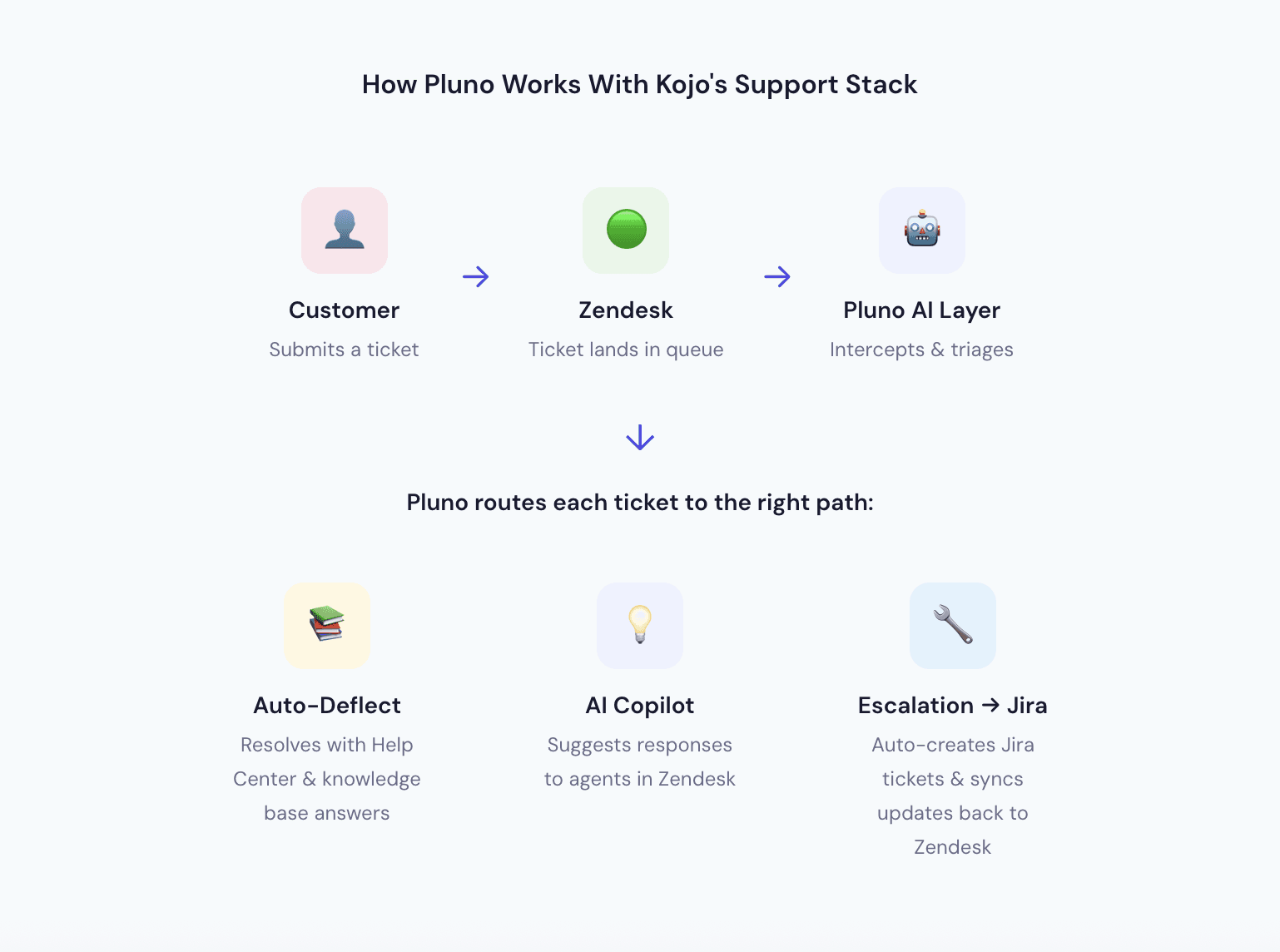
Here's how each piece of the solution works from the support team's perspective:
Deflection Agent: Catching Tickets Before They Hit the Queue
Since implementing Pluno's Deflection AI in October 2024, hundreds of tickets each month never reach an agent's queue. The deflection agent sits on top of Zendesk and intercepts incoming tickets, resolving those that have documented answers in Kojo's Help Center — before they become the support team's problem. The team still gets plenty of novel questions, but the predictable, repetitive load is handled automatically.
Escalation Copilot: Automating the Jira Bottleneck
This targets Kojo's most painful workflow. Instead of agents manually filling out multiple fields to meet their high bar for developer handoffs, Pluno does it automatically. The key differentiator is the two-way integration between Zendesk and Jira: when Pluno creates a Jira ticket, it's automatically linked to the Zendesk ticket. When customers ask for updates, Pluno pulls the latest from Jira and posts it in Zendesk. When engineering updates the Jira ticket, Pluno adds an internal comment to keep the support agent in the loop — without anyone having to manually check between systems.
This targets Kojo's most painful workflow. Instead of agents manually filling out multiple fields to meet their high bar for developer handoffs, Pluno does it automatically. The key differentiator is the two-way integration between Zendesk and Jira: when Pluno creates a Jira ticket, it's automatically linked to the Zendesk ticket. When customers ask for updates, Pluno pulls the latest from Jira and posts it in Zendesk. When engineering updates the Jira ticket, Pluno adds an internal comment to keep the support agent in the loop — without anyone having to manually check between systems.
AI Copilot: Bridging Language & Experience Gaps
For Kojo's international team, the AI Copilot serves as both a training tool and a writing assistant within Zendesk. New agents see suggested responses that are rich in context and properly formatted in English, helping them maintain response time standards within their first few weeks — something that would have taken much longer to develop on their own. Beyond language support, the Copilot also helps experienced agents explore new troubleshooting paths before escalating to the technical team.
Emergency Capacity When It Mattered Most
When Kojo lost an agent right before implementing Pluno, the timing couldn't have been better — or more necessary. For a team with no redundancy, AI deflection wasn't a nice-to-have optimization; it was emergency capacity. The deflection agent essentially became the replacement they needed while operating with just 4 people. The team wasn't worried about AI taking their jobs — they were relieved to have help.
THE RESULTS
A Team That Can't Imagine Going Back
The impact has been immediate and measurable. Here are the same four key results, broken down:
⚡ 0% → 50% Ticket Deflection Rate
Before Pluno, there was zero deflection — every ticket hit the queue, including repeat questions. Sarala now reviews Pluno analytics weekly and sees the deflection agent consistently handling 30–50% of tickets, with peaks above 50%. For a 5-person team handling over 1,000 tickets monthly, that translates to hundreds of tickets that never reach an agent. The impact goes beyond operations: reduced workload helps prevent agent burnout on a busy, lean team.
🚀 Days-Long Backlog → Same-Day Escalations
Escalations that used to sit in backlogs for days — waiting for an agent to find time to manually fill out all the fields — are now created the same day. The engineering team notices the difference too: the Jira tickets Pluno creates are detailed, complete, and ready for developers to act on immediately.
📈 40% Faster Onboarding for New Hires
The AI Copilot has compressed the learning curve, particularly for agents where English isn't their first language. New team members can maintain response time standards within their first few weeks, supported by context-rich suggested responses — something that previously took much longer to develop.
💬 No More Language Barriers
With all customers based in the U.S. but an international support team, language was a persistent hurdle. The AI Copilot's suggested responses in fluent, context-rich English removed this barrier entirely, letting agents focus on solving problems rather than struggling with phrasing.
THE TAKEAWAYS
"Test It, You'll See the Difference."
When asked what she'd tell another support leader considering AI, Sarala's advice is practical. There are options everywhere — some let you write your own LLMs, some offer basic chatbot functionality. But what sets Pluno apart, in her view, is the depth of integration with existing tools like Zendesk and Jira: automatic ticket updates, precise follow-ups, and smoother collaboration between support and engineering.
Her recommendation: take advantage of demos and trial periods. For Kojo, the proof was in the product. Once the team saw what Pluno could do, the decision was easy.